If you’re planning to study abroad from Nepal, one of the first questions you may have is: Should I take IELTS or PTE?
Both IELTS and PTE are widely accepted English language proficiency tests for students applying to universities overseas. However, they differ in several ways, including their test formats, scoring systems, speaking assessments, and result processing times. The best option for you will depend on your study destination, your university’s requirements, your strengths, and how comfortable you are taking a computer-based test.
For Nepalese students planning to study abroad in 2026, choosing the right English test can make the application process smoother and less stressful. This guide compares IELTS vs PTE to help you see which English test is the best fit for you.
IELTS vs PTE: Quick Comparison
Feature
IELTS
PTE
Test Format
The IELTS test is becoming computer based. IELTS will stop using paper tests starting mid 2026. The exact date may shift depending on the market.
Fully Computer Based
Speaking Test
Face to face with examiner
Speak into a computer microphone
Score range
Band 0-9
Score 10-90
Results
Depends on the test format and delivery
Typically within 48 hours
Best for
Student who prefer a human speaking interaction
Student who are comfortable with computer and AI based assessment
The IELTS test is becoming computer based. IELTS will stop using paper tests starting mid 2026. The exact date may shift depending on the market.
What is IELTS?
IELTS, or the International English Language Testing System, is an English proficiency test that assesses four key language skills:
Reading
Writing
Listening
Speaking
Students applying to universities and colleges abroad generally take IELTS Academic. Scores are reported on a 0–9 band scale, including half bands such as 6.5 and 7.0. Your overall band score is calculated from your performance across all four sections.For learners seeking admission to tertiary education, the appropriate variant is usually IELTS academic. The total score is derived from the four separate skill scores.
IELTS Test Format
IELTS Academic consists of four sections: Listening, Reading, Writing, and Speaking. The Reading and Listening sections include a range of question types, while the Writing section has two tasks. The Speaking test is conducted as a onet to one interview with a trained examiner.
What is PTE?
PTE Academic, or Pearson Test of English Academic, is a computer based English proficiency test designed for students and other candidates who need to demonstrate their English ability for study, work, or migration.
It assesses:
Speaking
Writing
Reading
Listening
Unlike IELTS, PTE integrates skills across several tasks. This means a single question may contribute to scores in more than one skill area. PTE Academic uses a 10–90 scoring scale, with individual scores for Speaking, Writing, Reading, and Listening.
PTE Test Format
PTE Academic is completed on a computer at an authorised test centre. The test takes approximately two hours and covers Speaking & Writing, Reading, and Listening. You use a computer, keyboard, headset, and microphone to complete the test.
Which Test Gives Results Faster?
PTE Academic is known for its quick results. Pearson states that PTE Academic results are typically available within two days,PTE Academic is known for its quick results. Pearson states that PTE Academic results are typically available within two days, although processing times can vary in some cases.
Fast results can be helpful if:
Your university deadline is approaching.
You need to submit your English test score quickly.
You may need time for another attempt before your application deadline.
However, result speed should not be the only factor when choosing between IELTS and PTE. Your preferred test format and the requirements of your university or destination are equally important.
IELTS vs PTE: Which is Easier?
Neither test is objectively easier; the choice depends on test taking preference. PTE favors students comfortable with computer-delivered tests and AI automated scoring, while IELTS suits candidates who perform better in traditional paper formats or face to face interviews.
IELTS may suit you if:
You prefer paper testing, human evaluation for speaking, or writing essays by hand.
PTE may suit you if:
You want faster results (typically 24-48 hours), prefer speaking into a microphone without human interaction, and are comfortable with automated scoring algorithms.
IELTS vs PTE: Which is better for Nepali Students?
There is no single best choice for every Nepali student. The right test depends on your study destination, university requirements, preferred test format, and personal strengths.
If you are more comfortable speaking with a person and prefer a traditional assessment style, IELTS may be a good fit. If you prefer computer-based testing and speaking into a microphone, PTE Academic may suit you better.
Before registering, always check whether your university, course, and visa pathway accept the test you plan to take.
Can you Take Both IELTS and PTE?
Yes, you can take both IELTS and PTE. However, most students do not need to take both.
It is generally more practical to choose the test that matches your destination and strengths, then focus your preparation on that test. Taking practice tests for both can help you decide which format feels more comfortable before booking your exam.
IELTS and PTE Preparation Tips
Whichever test you choose, preparation is important.
Understand the Test Format
First you need to know how the test is set up. You should learn what the different parts of the test are like. If you know what kinds of questions will be on the test you can use your time better when you take the test.
Take Practice Tests
You should take practice tests all the time. These tests can help you find out what you are not good at. They can also help you get used to what the test’s like.
Improve Your Vocabulary
You need to learn the words that people use a lot in school. Then you need to practice using these words when you talk and write.
Practice Listening
You should listen to people talking on podcasts in lectures and in interviews. You should also watch videos. Try to understand people who talk at speeds and have different accents.
Practice Speaking Regularly
You should talk in English every single day. You can practice by talking about what you did that day. You can also talk about things that are going on and record yourself so you can listen to what you sound like.
Work on Time Management
Both tests have time limits. You need to practice answering questions and keeping track of the time at the time. This will help you get better at taking the test.
IELTS vs PTE: Cost and Test Availability
Test
Approximate cost in Nepal
Test Availability
IELTS Academic
Around NPR 36000
Check available dates and test center before booking.
IELTS General Training
Around NPR 36000
Check available dates and test center before booking.
IELTS for UKVI
May cost more
Check official IELTS UKVI availability and fees.
PTE
Around NPR 32,000–33,000
Check the official Pearson website for test dates, centers and current fees.
The PTE Academic list price for Nepal is currently reported at USD 220, which is approximately NPR 32,000–33,000 depending on the exchange rate at the time of booking. Since Pearson prices can change and the NPR equivalent may fluctuate, students should confirm the final amount on the official Pearson booking page before registering.
Note: Test fees may change over time and can vary depending on the test type, exchange rates, taxes, promotions, and other applicable charges. Always confirm the latest fee directly with the official test provider before booking.
Which Test Should You Choose?
There is no one size fits all answer to the IELTS vs PTE question.
Your decision should be based on:
Which test your university accepts.
The English score required for your course.
Your study destination and visa requirements.
Which test format you find more comfortable.
Your strengths in speaking, writing, reading, and listening.
How much preparation time you have before your application deadline.
Before you book your test you should make a list to check a things:
Does your university accept IELTS, PTE, or both?
What minimum score does your course require?Does your destination have specific English test requirements?
Which test format suits your strengths?
Have you completed practice tests for your preferred exam?
Is your test date early enough to receive your result before the application deadline?
Still confused about whether IELTS or PTE is right for you? Get expert free counselling from CIC Education Hub and choose the English test that matches your study plans and destination.
IELTS vs PTE: Which Test is Accepted in Your Study Destination?
For Students Planning to Study in Australia
Both IELTS and PTE Academic are widely accepted for study in Australia, but specific score requirements can vary between universities and courses. Always check the requirements for your chosen institution and program.
For Students Planning to Study in UK
Many UK institutions accept IELTS and other approved English proficiency tests. However the requirements may depend on the university course and visa route.
For Students Planning to Study in Canada
Many Canadian institutions accept both IELTS and PTE Academic. However you should check the requirements for your chosen program and intake.
For Students Planning to Study in USA
Both IELTS and PTE Academic may be accepted by institutions. However every university can have its English language requirements.
Always check the requirements of your chosen university before selecting your test.
For Students Planning to Study in New Zealand
Many universities and institutions accept IELTS and PTE Academic. The minimum required score may vary depending on the level of study and program.
Always check your chosen university’s official requirements before selecting an English proficiency test.
Get Expert Guidance Before Choosing Which Test You Should Take
Choosing between IELTS and PTE is a decision in your journey to study abroad but it is just one step. The test you pick should fit your university, your course, and your whole plan for applying.
If you do not know which English test is right for your plans to study abroad, CIC Education Hub can help you learn about your choices. Build your application with more confidence.
Look into your options for studying and reach out to CIC Education Hub for help, with your next steps.
Conclusion
If you are a Nepali student planning to study abroad in 2026 both IELTS and PTE can be choices for you. There is no one answer to which test is better.
IELTS might be a fit if you like talking to a real person, for the Speaking section. IELTS also uses a test structure that many people already know. On the other hand, PTE might be a better option if you feel comfortable using computers. PTE offers a digital experience and you usually get your PTE results much faster.
The best choice is the one that your dream university accepts. You should pick the test that helps you show off your skills in the best way.
Before you book your test please look into your university requirements carefully. Make sure you understand how both exams work. Then choose the test that matches your strengths.
Ready to Take the Next Step?
Still not sure if IELTS or PTE is the choice for your study abroad plans? CIC Education Hub can help you learn about your options. Lead you in the right direction based on your favorite study destination and the requirements of the university you want to join.
Contact CIC Education Hub today. Begin planning your study abroad journey, with confidence.
FAQs Section
1.Which test is better for studying abroad in 2026?
The best test varies depending on the needs of your selected country, the university you are applying to and the course you want to take. Make sure to look at the requirements from the university before you book any test.
2.Should I take IELTS academic or IELTS general Training?
Students who are applying to universities usually need the IELTS academic test. The IELTS General Training test is for different reasons. Always make sure to look at the requirements, from the university or the immigration office.
3.Can CIC Education help me after I receive my IELTS or PTE results?
Yes. CIC Education Hub can help you with the steps of your study abroad journey. CIC Education Hub can assist you with picking the university and finishing the application process.
4.Can I contact CIC Education before taking IELTS or PTE?
Yes. You can ask for help before you pick your English proficiency test.
5. Is IELTS accepted more widely than PTE?
A lot of universities and organisations around the world accept IELTS. At the time many institutions also accepted PTE. Whether a school takes IELTS or PTE really depends on the university, the course you want to take and what you need the test for.
If you want to study in New Zealand from Nepal the year 2026 is a time to look at your options. New Zealand has universities and education providers that offer New Zealand education programs in many areas like business, information technology, engineering, health, hospitality and more New Zealand education programs.
When you pick a place to study it is not about choosing a university. Students from Nepal should know about the courses, the universities, the tuition fees, the living costs, what is required to meet the English language requirements and the process to get a student visa before they start applying to New Zealand universities.
This guide will tell you the things you should know before you study in New Zealand, from Nepal and get New Zealand education.
Why Study in New Zealand from Nepal?
New Zealand is a place for Nepali students to study because it has a good education system, many different study options and a great international learning environment. Nepali students can pick programs at undergraduate, postgraduate and other levels depending on what they have studied
There are good reasons why Nepali students should think about studying in New Zealand. These reasons include:
Education that is recognized around the world
A lot of courses and study options to choose from
Chances to develop skills that will be useful in a job
A multicultural environment where New Zealand students can meet people from different countries
Practical learning opportunities
Before Nepali students decide to study in New Zealand they should look at the courses they want to take, the universities they want to attend, how much it will cost and what they need to be eligible to study in New Zealand. New Zealand is an option for Nepali students who want to study abroad.
Top Universities to Study in New Zealand from Nepal
New Zealand has several top universities offering programs for international students.
Some popular options include:
University of Auckland
The University of Auckland offers programs in areas such as business, engineering, computer science, education, and health.
University of Otago
The University of Otago has a lot of programs. These programs are in health sciences, business, sciences, humanities and other fields.
University of Canterbury
The University of Canterbury offers programs in engineering, science, business, computer science and other disciplines.
Victoria University of Wellington
Located in New Zealand’s capital city, Victoria University of Wellington offers programs in areas including business, law, humanities, science, and technology.
Massey University
Massey University has a lot of programs. Such as: business and information technology. You can also study health and agriculture at Massey University. They even have programs for industries.
When choosing a university Nepali students should think about the course they want to take, the cost of studying where the university is located, what is needed to get in and what they hope to do after finishing their studies. They should not just pick a university because of its popularity.
Popular Courses to Study in New Zealand from Nepal
The course you pick should fit with your learning of what you like and what you want to do in the future.
Some common fields to study are:
Information Technology and Computer Science
Business and Management
Engineering
Health and Nursing
Hospitality and Tourism
Accounting and Finance
Data Science
Education
Social Sciences
People should look at the rules for getting in before they apply because those rules can be different, for each class and each school.
New Zealand intakes for Nepali Students in 2026?
Studying in New Zealand from Nepal is a deal. You have to know about intakes. Intakes are like the time when you can start your course.
New Zealand universities usually have intakes in February and July. The exact dates are different for each university and course. You need to find out when you can apply to your chosen university in New Zealand.
You should start getting your documents ready early. It is better to apply before the deadline.
This way you have time to get everything ready for your admission and visa, for New Zealand.
Cost to study in New Zealand From Nepal
The cost to study in New Zealand from Nepal depends on the course you choose, the university you attend, where the university is located, the type of accommodation you pick and your daily way of living.
Tuition Fees
Tuition fees change based on the university, the course and the level of study. Programs that are professional or specialized might have costs compared to other types of academic programs.
Students need to look up the tuition fee information directly from the education provider they have chosen before they start planning their money.
Living Costs
Living expenses can include:
Food
Accomodation
Phone and Internet
Transportation
Personal expenses
Study materials
Health and insurance related costs
Immigration New Zealand currently states that tertiary students need to show NZD 20,000 per year for living costs when applying for a student visa.
Note: Tuition fees and living expenses can go up or down. You should always look for the recent information before you make a plan. The tuition fees and living expenses are important to think about when you’re figuring out how to pay for things.
New Zealand student Visa for Nepali Students
A student visa is an important part of the process to study in New Zealand from Nepal.
Depending on your circumstances you may need to provide documents such as:
Evidence of sufficient funds
Valid passport
Evidence related to tuition funds
Offer of place from an approved education provider
Academic documents
English language test results
Health documents
Evidence of genuine study intention
Visa requirements can change, so students should check the latest requirements with immigration New Zealand before submitting an application.
Financial Requirements to Study in New Zealand from Nepal
One of the most crucial aspects of studying overseas is financial planning.
Both living expenses and tuition must be budgeted by students. The current Immigration New Zealand living cost criteria for post secondary students is NZD 20,00 annually.
Students should make sure they can prove they have enough money for their studies and stay by properly organizing their financial records.
English Language Requirements
The English language requirements are different for each university. They depend on courses, university and level of study.
Nepali students can use tests like:
IELTS
TOEFL
PTE
The score you need is not the same, for every school. So you should look at what your course requires for English before you sign up for a test.
How to Study in New Zealand from Nepal: Application Process
The process can be divided into several steps:
1.Choose Your Course
First, choose your course of study depending on your educational background, hobbies, financial situation, and professional aspirations.
2. Select a University or Institution
Examine universities according to the courses they provide, the cost of tuition, the location, the requirements for admission and the number of openings.
3. Check Eligibility
Before preparing your application, review the academic and English Language requirements.
4. Prepare your Documents
Gather your passport, academic certificates, transcripts, English test results, financial documents and other required documents.
5. Apply to the institution
Submit your application according to the university or education provider’s requirements.
6. Receive your Offer
You may receive an offer from your chosen institution, if your application is successful.
7. Apply for your Student Visa
Prepare your student visa application and supporting documentation after fulfilling the necessary entrance and financial requirements.
8. Prepare your Departure
When your visa is approved by the officials you should start making plans for accommodation and travel to New Zealand. You also need to get insurance and take care of things before you go to New Zealand.
Post Study Opportunities in New Zealand
Studying in New Zealand is a way for students to learn new things and get skills that will help them in their future jobs.
Some students who graduate from New Zealand can get a job after they finish studying. This happens when the students have the qualification. The rules for working in New Zealand after studying can change.
Students who want to study and work in New Zealand after they graduate should check what the official rules say before they make any plans, for their jobs or moving to New Zealand.
Why Choose CIC Education Hub to Study in New Zealand From Nepal?
Choosing the course and the right universities can make the study abroad experience much easier to handle. CIC Education Hub can help students who want to study in New Zealand from Nepal.
Students can get help with things, like:
Course selection
University selection
Application preparation
Document requirements
English language test guidance
Student visa preparation
Predeparture guidance
Getting expert advice can help students understand how the application works and plan their steps more clearly.
Planning to study in New Zealand from Nepal in 2026? Get guidance from CIC Education Hub and take the next step toward your study abroad journey.
Tips for Nepali Students Planning to Study in New Zealand
Before you apply remember these things:
You should research the course you want to take carefully.
Look at universities and the tuition fees they charge.
Then check what you need to get into the course.
It is an idea to take your English test well in advance.
Keep all your documents in order.
Check what the visa requirements are now.
Make sure you apply before the deadline for your application.
Do not use information about visas or fees.
If you prepare well you can avoid problems that will slow down your application and visa process. The university application and visa process can be complicated so good preparation can really help the application for the university and the visa process.
Conclusion
To study in New Zealand from Nepal, students need to plan their course, university, finances, admission, and visa carefully. New Zealand offers a variety of study options, but the right choice depends on your academic background, career goals, budget, and eligibility.
Before submitting your application, compare universities, check the latest tuition and living costs, prepare the required documents, and confirm the current student visa requirements.
With proper research and preparation, Nepali students can take a more informed approach to their journey to study in New Zealand from Nepal.
Ready to study in New Zealand from Nepal? Get personalized guidance from CIC Education Hub and take the next step toward your study abroad journey.
1. Which universities can Nepali Students choose in New Zealand?
Popular options include the University of Auckland, University of Otago, Victoria University of Wellington, University of Canterbury and Massey University.
2. What are the main intake for studying in New Zealand?
February and July are common university intakes, but the available intake and deadline depend on the course and institution.
3. Can I get personalized counselling from CIC Education Hub for Studying in New Zealand?
Students can get in touch with CIC Education Hub for help. They can talk to the people at CIC Education Hub about what they want to study in New Zealand.
4. How can I study in New Zealand from Nepal?
You need to choose an eligible course and institution, meet the admission requirements, receive an offer, prepare your finances and documents, and apply for the appropriate student visa.
5. Can CIC help me choose the right university in New Zealand?
Yes, CIC can help you find a university. Course that is right for you. This is based on the kind of grades you got in school, interest, career goals and study preference. The CIC Education Hub can help you explore these options to find a university.
Thinking about studying in Australia but unsure where to begin? You’re not alone. Every year, thousands of students dream of making the move, but many aren’t sure where to start. If you are planning to study in Australia from Nepal, it’s normal to have questions about universities, costs, visa documents, and how to find scholarships that fit your budget.
For Nepali students, Australia stands out as a leading destination for international study, offering a combination of high-quality education and opportunities that are especially relevant to your goals. Its universities are respected around the world, degrees are recognized globally, and students can work up to 48 hours per fortnight while studying on a student visa.
The first few steps can feel confusing. Which university should you choose? How much will it cost? What documents do you need? These questions come up before you even begin your application. Getting the right answers early can save you both time and money later.
The good thing is that once you know the steps, choosing a university, applying, and sorting your visa all becomes much more manageable. With proper planning, studying in Australia is more achievable than many students think.
In this guide, we’ll walk you through everything you need to know. You’ll learn how to choose the right university, understand the visa process, estimate the total cost of studying in Australia, and explore scholarship opportunities that can make your education more affordable.
Top Universities and Popular Courses In Australia
Australia is home to more than 40 universities, many of which are ranked among the world’s best. While rankings can be helpful, the right university depends on your course, budget, preferred city, and career plans. That’s why it’s worth looking beyond the name on the degree.
Here are some universities that are well known for both academic quality and strong industry connections.
University
Popular Courses
University of Melbourne
Business, Engineering
Monash University
Pharmacy, Information Technology
UNSW Sydney
Engineering, Data Science
Deakin University
Nursing, Education
These universities attract students from around the world because they combine classroom learning with practical experience. Many courses include internships, placements, research projects, or industry partnerships that help students build real-world skills before graduation.
Among Nepali students, Information Technology remains one of the most popular choices because of strong demand in the global job market. Engineering, Nursing, Business, Public Health, Hospitality, and Accounting are also common options, offering a wide range of career opportunities in Australia and beyond.
One thing to remember is that the “best” university isn’t always the one with the highest ranking. A university that offers better industry exposure, lower tuition fees, or a course that matches your career goals may be the smarter choice for your future.
Requirements To Study In Australia From Nepal
If you’re planning to study in Australia from Nepal, you’ll need to prepare a few essential documents before starting your application. While requirements may vary slightly between universities, most students will need the following:
Academic qualifications: You’ll need to meet the academic requirements for your chosen course. This usually means completing higher secondary education for a bachelor’s degree or holding a recognized bachelor’s degree for postgraduate study.
English language proficiency: Most universities accept IELTS or PTE Academic scores as proof of English proficiency. The minimum score depends on the university and the course you choose.
Valid passport: Your passport should be valid throughout your application process. It’s one of the first documents you’ll need for both university admission and your student visa.
Genuine Student (GS) requirement: Australia requires students to show that their main purpose is to study. You’ll be asked to explain why you chose your course, university, and how it supports your future career plans.
Financial documents: You’ll need to demonstrate that you have sufficient funds to cover tuition fees, living expenses, and other study-related costs as required by the Australian Government.
Confirmation of Enrolment (CoE): After accepting your university’s offer and paying the required deposit, you’ll receive a Confirmation of Enrolment (CoE). This document is mandatory when applying for your student visa.
Overseas Student Health Cover (OSHC): International students must have OSHC before their visa is granted. It helps cover eligible medical and hospital expenses while you’re studying in Australia.
Australia Student Visa Process
Once you have received an offer from your chosen university, the next step is to apply for your student visa. It may seem like a long process at first, but taking it one step at a time makes it much easier.
Here’s how the process usually works:
Choose your course and university. Once you’ve decided where you want to study, submit your application and wait for the university’s offer.
Accept the offer and receive your CoE. After meeting the admission requirements and paying the required tuition deposit, your university will issue a Confirmation of Enrolment (CoE). You’ll need this document for your visa application.
Arrange the required documents. Gather your passport, financial documents, English language test results, Overseas Student Health Cover (OSHC), and any other documents requested by the university or the Department of Home Affairs.
Submit your student visa application online. You’ll apply through Australia’s official online immigration portal and upload all the required documents.
Complete your health examination if required. Some students may also be asked to provide biometrics or additional information during the assessment process.
Wait for your visa decision. Processing times can vary depending on individual circumstances and application volumes. That’s why it’s always a good idea to apply well before your intended intake.
One thing many students don’t realize is that small mistakes or missing documents can slow down the process. Taking a little extra time to review your application before submitting it can save you weeks of unnecessary delays.
Total Cost To Study In Australia From Nepal
One of the first questions students ask is, “How much will it actually cost to study in Australia?” The answer depends on your university, course, and the city you choose to live in. While tuition fees are the biggest expense, they’re only one part of your overall budget.
Here’s a general estimate of the total cost to study in Australia from Nepal.
Expenses
Estimated Cost
Tuition fees
AUD 20,000-50,000 per year*
Accommodation
AUD 180-450 per week
Food and Groceries
AUD 80-200 per week
Transport
AUD 30-80 per week
Overseas Student Health Cover (OSHC)
Varies depending on your provider and visa duration
Student Visa Application Fees
As per the latest Australian Government fee
Airfare & Initial Setup
Varies depending on travel season and personal expenses
Tuition fees vary by university, course, and level of study. Professional programs such as Medicine generally cost more than Business or IT.
The city you choose can also make a noticeable difference to your overall expenses. Living in cities like Sydney or Melbourne is usually more expensive than studying in places such as Adelaide, Hobart, or Perth. Rent is also another biggest factor, so always compare the living costs before you make a final decision.
It’s also important to budget for everyday expenses that students forget sometimes. Things like study materials, mobile bills, internet, and personal spending also affect your overall expenses.
Planning your finances early gives you a much clearer picture of what to expect. Instead of focusing only on tuition fees, look at the overall cost of study in Australia from Nepal so you can choose a university and city that fit both your education goals and your budget.
Scholarships For Nepali Students
Studying in Australia is a big investment, but scholarships can help reduce the overall cost. Many Australian universities offer scholarships for international students based on academic performance, leadership potential, or specific study programs.
Some of the most well-known options include the Australia Awards Scholarships, which are funded by the Australian Government, along with university-specific merit scholarships. Universities such as Monash University, Deakin University, and the University of Sydney also offer scholarships for eligible international students. The eligibility criteria and award amounts vary, so it’s worth checking each university’s website before applying.
One thing to remember is that scholarships are often limited and highly competitive. In many cases, the application deadline comes well before the course intake. Applying early not only gives you more options but also improves your chances of securing financial support.
Even if you don’t receive a full scholarship, don’t rule out partial scholarships. A tuition fee reduction can still make a significant difference to your overall study expenses.
Plan Your Australia Study Journey With CIC Education Hub
Choosing the right university is only one part of the journey. You will also need to compare courses, understand admission requirements, prepare your documents, and complete your visa application correctly. Having the right guidance can make each step much less stressful.
At CIC Education Hub, we help students turn their abroad study plans into reality with personalized support at every stage. From selecting the right university and course to assisting with applications, scholarships, visa documentation, and pre-departure guidance, our experienced counsellors are here to make the process simpler and more organized.
If you’re planning to study in Australia from Nepal and want advice based on your academic background, career goals, and budget, we’re here to help. Book a consultation with our team and take the first step towards your Australian education journey with confidence.
Frequently Asked Questions (FAQs)
1. How can I study in Australia from Nepal?
To study in Australia from Nepal, you’ll need to choose a university, meet the admission requirements, receive a Confirmation of Enrolment (CoE), and apply for an Australian Student Visa (Subclass 500).
2. What is the total cost to study in Australia from Nepal?
The total cost to study in Australia from Nepal depends on your course, university, and lifestyle. In addition to tuition fees, you should budget for accommodation, food, transport, health insurance, and other living expenses.
3. What are the requirements to study in Australia from Nepal?
The main requirements to study in Australia from Nepal include academic qualifications, an English language test (IELTS or PTE), a valid passport, financial documents, a CoE, Overseas Student Health Cover (OSHC), and meeting the Genuine Student (GS) requirement.
4. Can Nepali students get scholarships to study in Australia?
Yes. Many Australian universities and the Australian Government offer scholarships for eligible international students based on academic merit and other criteria. Applying early can improve your chances.
5. Can I work while studying in Australia?
Yes. International students on a valid Student Visa (Subclass 500) can work within the limits set by the Australian Government while studying and full-time during eligible course breaks. Always check the latest work conditions before starting a job.
Canada has now emerged as a popular destination for international students. Each year, several students apply for Canada student visa in order to obtain a globally recognized education for their future success. Although many visas get approved, there are still some instances where students are refused visas due to avoidable errors on their part.
Fortunately, most visa denials occur for reasons which can be recognized and avoided. It means that you can prepare your visa application in advance to minimize the risks of getting refused.
In this article, we will discuss the 10 most popular Canada student visa rejection reasons that can be avoided no matter from which country (including Nepal) you apply.
What is a Canada Student Visa?
Canada Student Visa, known as Study Permit, enables foreign students to study at an authorized institution in Canada.
To apply for Canada student visa, one should know the requirements of the visa which include:
Valid passport
Letter of Acceptance (LOA) from a Canadian institution
Proof of financial support
Statement of Purpose (SOP)
Medical examination (if required)
Police clearance certificate (if requested)
Biometrics and supporting documents
Meeting these requirements does not guarantee approval. Your application must also convince the visa officer that you are a genuine student.
Top 10 Canada Student Visa Rejection Reasons
1. Insufficient Financial Proof
A very common reason for visa rejection is insufficient financial proof.
The visa officials must see proof of:
Fees
Expenses
Housing
Transport
Emergency costs
How to Avoid It
Present genuine bank statements.
Keep a sufficient amount of money for a number of months.
Proof of income of your parents or sponsors.
Have financial proofs that are easily verifiable.
Example
If you have CAD 35,000 as your annual expense but have just CAD 10,000 in your bank account, then the visa officer might question your ability to pursue your studies in Canada.
2. Weak Statement of Purpose (SOP)
It includes your reasons for choosing Canada, your selected course, and future plans.
The SOPs of many students consist of generic statements downloaded from the Internet. Hence, the visa officer might assume that you are not very serious about your studies in Canada.
How to Avoid It
Present an SOP which explains:
Why you have chosen Canada
Why you chose that particular course
Relevance of your selected course with your career plans
Why you will go back to your home country once your studies are completed
3. Absence of Strong Connections with the Home Country
Canada seeks students who wish to study in Canada, not those who wish to stay forever without abiding by the migration procedures.
If the official feels that you might not go back home even after completing your studies, your visa application will get refused.
How to Avoid It
Provide strong connections such as:
Responsibilities to family
Ownership of property
Job opportunities
Business obligations
Career prospects in your home country
4. Taking the Wrong Courses
In some cases, the applicant might be taking wrong courses in terms of his/her qualifications and experience.
For instance, an engineering graduate applying for an introductory course in business can give rise to some problems.
How to Avoid It
Take up courses which:
Match your educational qualification.
Help you achieve your career objectives.
5. Incomplete Application Documents
Failure to submit complete application documents results in automatic denial.
The common errors include:
Lack of transcripts
Incomplete forms
Expired passport
Lack of financial documentation
Incorrect information
How to Avoid It
Prepare a checklist before submitting the application.
Ensure that all the documents are correct.
6. Poor Academic Performance
Poor academic performance does not automatically mean rejection. A poor academic record without any good explanation raises suspicion.
How to Avoid It
If you have poor grades:
Provide an honest reason for this.
Indicate improvements in current studies.
Submit work experience/ additional training.
7. Submission of False Documents
Submission of false information is one of the worst mistakes that can be made.
This includes:
Falsified bank statements
Falsified employment letters
Academic certification
How to Avoid It
Only submit authentic documents.
One falsified document leads to:
Rejection of visa
Ban on future visas
Immigration problems
8. Bad Travel History
Bad travel history might not be an issue, but there will be some instances where it would give rise to questioning your motive behind the travel.
How to Avoid This
If you have traveled before, provide your visa and stamp.
If you haven’t traveled before, make sure that all other documents are up to the mark.
9. Bad Canada Student Visa Interview
Every student does not attend a Canada student visa interview , but some students are called to ask more questions.
Mistakes made are:
Answering differently to SOP
Getting nervous
Unclear answers
How to Avoid This Mistake
Be prepared to answer questions such as:
What are your plans after completion of your studies?
Why do you want to pursue your studies in Canada?
Who is going to pay for your studies?
Why did you choose this particular course?
10. Violating the Rules of Canada Student Visa
Violation of Canada student visa rules results in refusal.
Some common examples are:
Providing wrong information in forms
Not complying with deadlines
Failing to meet eligibility criteria
Applying with incomplete record
How to Avoid This Mistake
Read all the official guidelines carefully.
Top Canada Student Visa Rejection Reasons and Solutions
The Table shows the things to be avoid for canada visa rejection :
Rejection Reason
How to Avoid It
Insufficient funds
Show strong financial proof
Weak SOP
Write a personalized SOP
Weak home ties
Explain future plans
Wrong course selection
Choose a relevant course
Missing documents
Double-check all papers
Poor academics
Provide explanations
Fake documents
Submit genuine information
Weak travel history
Strengthen other documents
Poor interview
Prepare and practice
Ignoring visa rules
Follow all guidelines carefully
Canada Student Visa Requirements Checklist
Before you apply for student visa Canada, make sure you have:
Valid Passport
Letter of Acceptance from a Designated Learning Institution
Financial Documents
Academic Certificates
Statement of Purpose
Passport Photos
Medical Examination
Biometrics
Police Clearance Certificate (if needed)
English Language Test Scores
Canada Student Visa From Nepal: Important Tips
Many students apply for a Canada student visa from Nepal every year. To improve your chances:
1. Start Early
Prepare documents several months before the intake.
2. Choose the Right Intake
The popular Canada student visa intake seasons are:
Fall Intake (September)
Winter Intake (January)
Spring Intake (May)
3. Keep Your Financial Documents Ready
Strong financial proof is extremely important.
4. Write a Good SOP
A clear and honest SOP can make a big difference.
5. Seek Professional Guidance
Education consultants can help you avoid common mistakes.
Signs of a Strong Canada Student Visa Application
A strong application usually includes:
Clear study plans
Genuine documents
Strong financial proof
Relevant course selection
Good explanation of future goals
Complete paperwork
Therefore, paying attention to every detail can improve your approval chances.
How to Increase Your Canada Student Visa Approval Chances ?
Here are some practical tips:
Apply early.
Submit complete documents.
Write a unique SOP.
Provide genuine financial proof.
Explain any study gaps.
Choose the right course.
Prepare for possible interviews.
Follow all immigration rules carefully.
Furthermore, staying organized can save time and reduce mistakes.
Conclusion
While getting a Canada student visa may seem difficult, most students fail to secure their visas simply due to errors that could have been easily avoided. Getting an idea about the various reasons for denial and putting together a good application could increase your chances of visa approval considerably.
Starting from the selection of courses and institutions to providing relevant financial and educational proofs, everything is important. You could contact CIC Education Hub Consultancy for professional advice in regard to university admission and visa procedures.
Frequently Asked Questions (FAQ)
1. Why does one get a refusal in a Canada student visa application?
There are many cases where a Canada student visa has been denied owing to inadequate finances, an improper SOP, insufficient documents, or lack of intention to study in Canada.
2. What if I get declined for a Canadian student visa?
Yes, Can apply again once risks that led to the refusal have been addressed and improved supporting documents have been provided.
3. What is the cost required for a Canada student visa?
The amount will vary according to tuition fees and living expenses. Students are required to demonstrate sufficient means to pay for their studies and to remain in Canada.
4. Do I need to do an interview for my Canadian student visa?
Few applicants are required to come in for an interview, though it is possible that some students will be asked further questions.
5. What is the minimum duration for which the Canada student visa can be issued?
Processing times will depend on the volume of applications and the country where the processing takes place.
Students from Nepal make up some of the most favored students in Canada. Thousands of students come into the country each year seeking admission into colleges and universities. However, one of the questions that students always ask before applying is: Which is the best intake for Canada ?
Selecting the correct Intakes in Canada might influence your chances of getting accepted, scholarship opportunities, course availability, accommodation choices and even your visa success rate.
This thorough information covers the three major Canada intakes, their dates, fees, pros, cons, and the ideal intake for Nepali students in 2026.
What are Intakes in Canada?
A college or university intake is a time when new students are accepted and classes begin.
Most of the institutions in Canada have several entrance periods in a year, however in Nepal most of the institutions have one main admission cycle.
Canada’s three major Intakes include:
Intake
Start of Months Classes
Popularity
Fall Intake
September
Highest
Winter Intake
January
Average
Summer Intake
May
Limited
The deadlines for application, courses available and competitiveness levels vary for each intakes.
Canada: Overview of International Student Intake
It’s crucial to understand how each of the intakes function before you choose one.
Intake
Application Timeline
Visa Application Period
Fall 2026
October 2025 – March 2026
January – June 2026
Winter 2026
May 2025 – September 2025
August – November 2025
Summer 2026
September 2025 – January 2026
January – April 2026
Ideally, students should begin preparing 8 to 12 months before lessons commence.
Canada Fall Intake (September Intake)
The Fall intake is the most requested and popular intake for overseas students in Canada.
This is when most colleges and institutions have the most programs available.
Why Is Fall Intake So Popular?
There are many reasons for students to opt September intake.
Other Programs Available
Most institutions provide almost all of their undergraduate and postgraduate courses in the Fall semester.
Expanded Scholarship Opportunities
There are many scholarships and financial assistance programs that exist just for Fall applicants.
Improved Campus Experience
Most students start at the same time, making it simpler to establish friends, join groups and engage in orientation events.
More Employment
Campus life is bustling, which frequently makes it simpler to obtain part-time work and co-op possibilities.
Benefits of Fall Admission
Maximum course availability
More scholarships
Bigger student community
More Networking Opportunities
More about campus activities
Fall Intake Cons
Admission is quite competitive.
Faster filling of seats
Rising need for accommodation
Canada Winter Intake (January Intake)
The Winter intake in Canada begins in the month of January and is the second greatest intake.
Students who miss the Fall intake can opt for Winter intake.
Who Should Go for Winter Intake?
The Winter intake is perfect for those who:
September deadlines missed
Need additional time to prepare for IELTS
Need more time to sort out finances
Need more time to process visa
Benefits of Winter Intake
Less competitiveness than in Fall
Many of the popular courses still open
Additional time to prepare
Drawbacks of Winter Intake
Fewer options in courses
Few scholarship opportunities.
Reduced student numbers
Canada Summer Intake (May Intake)
The smallest intake is the May intake in Canada or Summer intake.
Not all institutions will have this intake.
Who is eligible for Summer Intake?
Summer intake is best for:
Students Interested in Diploma Course
Students who did not participate in Fall and Winter admissions
Students Want to Get into Canada Faster
Benefits of Summer Intake
Less competitors
Quicker admission process
Smaller classes
Downsides of summer intake
Limited availability of programs
Fewer university participants
Limited scholarship opportunities.
Fall vs Winter vs Summer Intake Comparison
Here’s a simple comparison table for Nepali students:
Components
Fall Intake
Winter Intake
Summer Intake
Popularity
Very high
High
Moderate
Availability of the program
Great
Good
Limited
Scholarships
Highest
Moderate
Low
Competition
High
Medium
Low
Student Demographics
Biggest
Medium
Small
Availability of Accommodation
Competitive
Better
Better
Employment Opportunities
Excellent
Good
Average
Which Intake is Best For Canada?
Well, it depends on your circumstances.
Select Fall Intake If it’s:
You have submitted all paperwork on time.
You want the widest range of programs.
You are searching for scholarships.
You want the entire college experience.
When to Choose Winter Intake:
You need more time to prepare.
Fall deadlines were missed.
The program you choose is available in January.
Choose Summer Intake If:
You want to get in quickly.
The program at the college you choose is in May.
You like smaller classrooms.
The greatest choice for most of the students is Fall Intake in Canada as it has more programs, scholarships and employment prospects.
Key Dates: Canada Intake for International Students
Late entrance causes many students to miss opportunities.
Many students wait to plan and run into unneeded complications.
Don’t make these mistakes:
Late application
Ignoring visa timing
Choosing a course without research
Not checking availability of intake.
IELTS preparation waiting too long
Applying to one institution only
Instead, be prepared and have a number of options ready.
Sample Situation
Think about two students from Nepal.
Student A
Finishes IELTS in October 2025
Effective Fall 2026.
Multiple offers received.
Is eligible for scholarships
Student B
Begins prep in April, 2026
Misses Fall due dates
Less choice of university
This example highlights the importance of planning ahead.
Canada Intakes 2026 – Future Trends
Why international students continue to flock to Canada:
Good education
Good job prospects
Employment choices after graduation
Multi-cultural atmosphere
Paths to Permanent Residency
With competition increasing, it is even more crucial to apply early for your choice of admission.
Conclusion
Selecting the appropriate Intakes in Canada should also be one of the crucial steps for Nepalese students intending to study abroad in Canada. Though there will be various advantages associated with each intake, Fall intake in Canada is usually chosen by the majority as they provide a wide variety of programs, scholarships, and career possibilities for prospective students.
After considering various factors, select the best suited intake and prepare yourself for your education in Canada. Starting your preparation process at an early stage can increase your chances of being admitted into Canada and obtaining your Canada study visa hassle-free.
In case you are going to study in Canada in 2026, then initiate your preparation right now itself. If you need assistance in choosing universities in Canada, preparing documents, admissions, and applying for a Canada study visa from Nepal, CIC Education Hub will be the best choice for you.
Frequently Asked Questions
Q1. Which intake is better for Canada?
The fall intake is often preferred as it offers the largest number of programs, grants and admission chances.
Q2. When is the next intake for Canada 2026?
Depending on the current application cycle, students may apply for Fall 2026, Winter 2027, or Summer 2027 admissions.
Q3. Is winter intake excellent for international students?
Yup. Many great programs are available for Winter intake and it is a wonderful choice for those who miss the Fall deadlines.
Q4. When should I apply for a Canada student visa intake?
Ideally students should apply for their study permit 3-6 months before classes commence.
Q5. Can Nepali students study in all intakes in Canada?
Ideally students should apply for their study permit 3-6 months before classes commence.
Q6. Which intake has maximum scholarship opportunities?
Additionally, the Fall intake is often the one with the most scholarships and financial assistance opportunities.
Canada continues to be a favourite choice for students from Nepal.Every year, thousands of students apply for a Canada study visa requirements to make a better future. However, over the past few years it has changed.
The Canadian government has implemented study permit restrictions and tightened the application process. Therefore, students should be very careful in their preparation prior to applying.
You will be provided with knowledge about the new study visa conditions for Canada, Provincial Attestation Letters (PAL), study visa quotas, chances of getting the study visa approved and important updates that every Nepali student should know.
What is a Canada Study Permit?
Canada Study Permit is an official study permit that is issued to international students who wish to study at a Designated Learning Institution (DLI).
Many people think they are one and the same – study visa vs. study permit – and interchangeably use them. But, they are not the same.
Here is the documents and their purposes given below:
Some students may need a medical exam from an approved panel physician.
7. Police Clearance Certificate
A police background check may be requested as proof of a clean background.
Financial needs for Canada in 2026
Canada has raised the costs students have to pay for living.
In addition to tuition fees, students will be required to demonstrate they have sufficient funds to cover their daily expenses.
Estimated Expenses
This Table shows the estimated expenses below:
Expense
Estimated Annual Cost
Tuition Fees
CAD 15,000 – 35,000+
Living Expenses
CAD 20,000+
Health Insurance
CAD 600 -1,500
Books & Supplies
CAD 500 – 1,500
The actual amount depends on your city, institution, and lifestyle.
Canada Student Visa Approval Rate: What Are Your Chances?
Many students ask about the Canada student visa approval rate.
The truth is that approval rates change every year and depend on many factors.
Your approval chance is usually stronger when:
Your documents are complete
Your finances are genuine
Your SOP is well written
Your academic history supports your chosen course
Your study plan makes sense
On the other hand, applications are often refused because of:
Weak financial evidence
Unclear study goals
Missing documents
Poor academic justification
Concerns about temporary resident intent
Therefore, preparation plays a major role in your success.
How Nepali Students Can Improve Approval Chances ?
Choose the Right Course: Select a course that matches your previous education and career goals.
Apply Early: Because of permit caps and PAL requirements, early applications have advantages.
Write a Strong SOP: Explain your study plans honestly and clearly.
Show Genuine Financial Proof: Immigration officers want to see that your funding is legitimate.
Avoid Document Errors : Even small mistakes can create delays or refusals.
Example Scenario
Consider two students applying for the same program.
Student A
Strong academic background
Clear SOP
Verified financial documents
PAL included
Student B
Incomplete financial documents
Generic SOP
Weak explanation of study plans
Student A is far more likely to receive approval.
This example shows why careful preparation matters.
Benefits of Studying in Canada
Despite the new rules, Canada remains an excellent destination.
Students choose Canada because of:
High-quality education
Multicultural environment
Post-graduation work opportunities
Safe and welcoming communities
Globally recognized qualifications
Furthermore, Canadian education can open doors to international career opportunities.
Conclusion
Canada study visa application has become much tougher due to the new requirements. Because of the study permit limits, PAL requirements, and strict reviews, candidates need to take extra care while filling out their application.
An excellent application containing all necessary documents, proper proof of financial capacity, and detailed study plans can make a huge difference. Starting on time and being aware of all the latest regulations are equally crucial.
If you are planning to apply for a Canada study visa from Nepal in 2026, the experts at CIC Education Hub can help you. They will assist you all along the way, whether it be choosing the right institution or completing your visa application.
FAQs
What does it take to get a study visa for Canada in 2026?
Most of the time, they require you to have a letter of acceptance, PAL (if any), a valid passport, financial proof, SOP and supporting documents.
What is a Provincial Attestation Letter (PAL)?
A PAL is a document issued by a Canadian province confirming that your study permit application falls within the province’s allocated quota.
Is PAL mandatory for Nepali students?
Many students applying to colleges and undergraduate programs require a PAL, though some exemptions may apply.
Has Canada cut student visas for 2026?
Canada has introduced a study permit cap concept in order to control the number of students who come to the country but it is still accepting eligible students.
May I work during my studies in Canada?
Yes. International students who meet the requirements for immigration to Canada may work under the present regulations.
Want to study in Canada from Nepal ? You are not alone. Thousands of Nepali students pick Canada for higher education every year because of the great education, safe environment and improved employment possibilities.
However, a lot of students are confused with the process of getting a Canadian student visa. The good news is that if you take the right measures, the process is straightforward.
This tutorial will teach you all about the student canada visa from Nepal in very easy language.
Why Study in Canada from Nepal?
Canada is one of the world’s leading destinations for study. It offers world-verified degrees and great career opportunities for international students.
Benefits of Studying in Canada:
High-quality education
Affordable tuition compared to other countries
Work while studying
Post-study work opportunities
Safe and welcoming country
Multicultural environment
Moreover, Canada has many colleges and universities that accept Nepali students every year.
Understanding the Canada Student Visa
The Canada student visa is also called a study permit. International students have the legal right to study in Canada.
Before applying, students should be aware of the canada student visa requirements and standards.
Canada Student Visa Process – Step by step :
Step 1: Select a College or University
First, choose a university or institution in Canada.
Ensure the institution is a DLI (Designated Learning Institution). International students are accepted only by DLI recognized Colleges.
Popular Courses for Nepali Students:
Business
IT and Computer Science
Hospitality
Nursing
Engineering
Health Sciences
Once you have selected your course, apply online on the college website.
Step 2: Get the Offer Letter
If your application is successful, the college will give you an Offer Letter/Letter of Acceptance (LOA).
The Fall intake is the most popular among Nepali students.
Why Choose an Education Consultancy?
Many students take help from professional consultancies because the process can feel stressful.
A good consultancy can help with:
University selection
Documentation
SOP writing
Visa application
Interview preparation
As a result, students can avoid mistakes and save time.
Conclusion
Studying abroad is a big desire of many students. Fortunately, the process to study in Canada from Nepal is simplified if you follow each step attentively.
Choosing the right college. Getting your visa. Each step matters. So, make sure you prepare your paperwork carefully and follow the canada student visa requirements and apply on time.
If you need expert guidance for your Canada study trip then professional consultants like CIC Education Hubcan allow you to finish the procedure easily and with confidence.
Frequently Asked Questions
1. What is the minimum bank balance required for a Canadian student visa from Nepal?
Students normally need to demonstrate tuition payments + living expenditures including the mandatory GIC amount.
2. Is IELTS necessary for Canada?
Most of the colleges demand IELTS although certain institutions may accept other English examinations like PTE or Duolingo.
3. How long is the processing time for a Canadian student visa?
Processing times can vary from time to time, but may be several weeks to a couple of months.
4. What are the key requirements for a Canada student visa?
Students will need:
Passport
Letter of offer
academic articles
Financial verification
English test result
Medical report
Standard Operating Procedure
5. Is Canada a good place for Nepali students?
Yes. Canada has good education, jobs, safety and opportunities after studies.
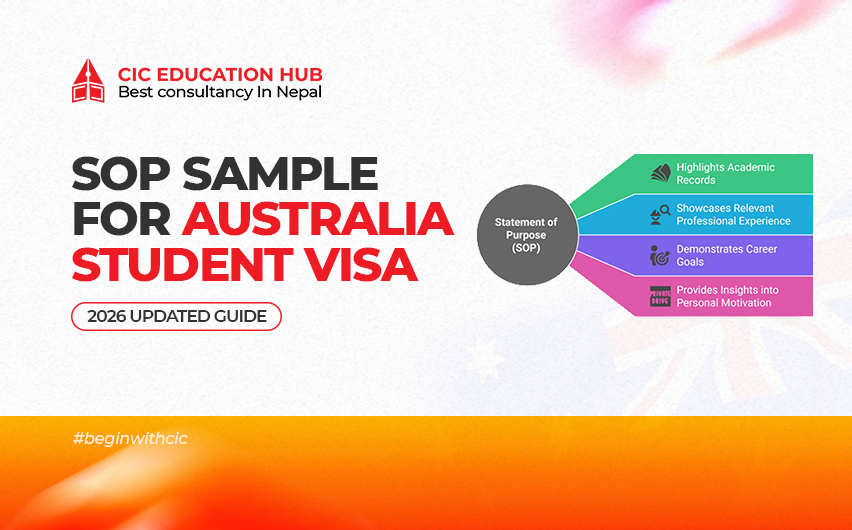
An Australian student visa application can be confusing initially. But one document can make a big impact on your application.That document is the SOP(Statement of Purpose). If you are searching for the best sop sample for australia visa application , this guide will help you understand everything in very simple words.
You will learn:
What an SOP is
Why Australia asks for it
SOP format and structure
Common mistakes to avoid
A complete SOP sample
SOP for dependent visa examples
2026 applicants FAQ
So,this article thoroughly to maximise your chances of a successful visa application.
What is the SOP for Australia Visa Application for students?
SOP means Statement of Purpose. It is a letter where you explain:
Who you are
Why you chose Australia
Why you selected your course
Your future career plans
Why you will return to your home country after study
In simple words, the SOP tells the visa officer your real study plan.
Therefore, your SOP should be honest, clear, and easy to understand.
Why is SOP Important for Australia Student Visa Application ?
Australia checks whether a student is a genuine learner or not. Because of this, the SOP becomes very important.
A strong SOP can:
Improve visa approval chances
Show your career goals
Explain study gaps
Prove financial and academic plans
Build trust with the visa officer
On the other hand, a copied SOP can lead to rejection.
Latest Australia SOP Updates for 2026
In 2026, Australia is focusing more on genuine students. Therefore:
Strong career plans are important
Financial proof must be clear
Course relevance matters more
Genuine Student (GS) documents
As a result, students should prepare personalized SOPs instead of copied templates.
Best SOP for Australia Student Visa – What Should It Include?
The best SOP is simple, personal, and well-organized.
Here are the important parts you must include:
Section
What to Write
Introduction
Your background and study goals
Academic History
Previous education details
Work Experience
Job or internship details
Why Australia
Reason for choosing Australia
Why This Course
Benefits of the selected course
Why This College
Why you selected the institution
Financial Details
How you will pay expenses
Future Plans
Career goals after study
Conclusion
Final genuine statement
Simple SOP Format for Australia Student Visa
1. Introduction
Start with your name, education, and purpose.
Example:
I am Ramesh Sharma from Nepal. I completed my higher secondary in 2024. I wish to get a Diploma in Information Technology in Australia to upgrade my abilities and develop a great career in the IT area.
2. Academic Background
Talk about your education honestly.
Mention:
School or college name
Grades
Subjects
Achievements
3. Work Experience (If Any)
If you worked before, explain:
Company name
Position
Skills learned
Even part-time jobs or internships can help.
4. Why Australia?
This section is very important.
You can mention:
High-quality education
International degree recognition
Practical learning system
Safe and multicultural environment
Example:
I selected Australia because its education system focuses on practical learning and real-world skills. Moreover, Australian qualifications are recognized worldwide.
5. Why This Course?
Explain how the course matches your career goals.
For example:
I selected a Bachelor of Business because I want to improve my management and communication skills. This course will help me build a career in the business sector in Nepal.
Note: This SOP is simply an example. A student’s SOP needs to be tailored for his or her background and study and professional goals. No copy and paste of the same content.
My name is Sita Thapa and I am from Kathmandu, Nepal. Completed +2 with good scores in management studies in 2024. Since school I was interested in business skills and communication abilities and studied in the business field.
I chose Australia because of the quality of the education system, the pragmatic way of learning and because it is a country with internationally accepted qualifications. Australia is a multicultural country and international students can feel comfortable and welcome. I think it will be useful for my knowledge, my talent and future professional chances to study there.
I choose XYZ college for my BBA as the course material of Management, Marketing and Leadership corresponds with my career objective. I can also have hands-on learning experiences at college that will help me progress in my professional sector.
My parents will support me in education and living expenses in Australia. I have enough money to handle all of the expenditures of studying while I am here.
“When I complete my studies, I want to come back to Nepal and work for a reputed business body. I hope to be my own employer and contribute to the development of my country’s economy.
I am a real student with specific educational goals and want you to kindly examine my visa application positively for the same.
Thanks.
Student Visa SOP for Australia – Important Tips
Keep Your SOP Simple
Use short sentences and easy words.
Write in Your Own Style
Do not copy from websites or friends.
Be Honest
Always provide real information.
Explain Study Gaps Clearly
If you have a gap year, explain it properly.
Focus on Career Goals
Show how the course will help your future.
Common SOP Mistakes Students Should Avoid
Copy-Paste Content
Many visa applications get rejected because of copied SOPs.
Too Much Personal Story
Keep the focus on education and career goals.
Weak Future Plans
You must clearly explain your plans after studying.
Grammar Mistakes
Simple English is fine, but avoid major errors.
Fake Information
Never provide false details.
SOP for Australia Student Visa Sample for Students With Gap
If you have a study gap, do not panic. Instead, explain the reason clearly.
Example:
After completing higher secondary education, I took a gap year to study for English language examinations and to support my family company. In this time I developed my communication and practical skills.
Conclusion
Writing a powerful sop sample for australia visa application is easy with three words: Honest, clear and simple. Your SOP should adequately describe your study intentions, professional ambitions and financial assistance. If you are hoping to study in Australia in 2026, make sure you prepare your SOP carefully and avoid copied content.
You can choose CIC Education Hub for professional help and hassle free Australian visa processing to support your study abroad trip.
Frequently Asked Questions
1.Can I use SOP samples from the internet?
No, chances of visa refusal are high if you copy SOPs. Always write with your own words.
2.Is SOP compulsory for Australian student visas?
Yes. SOP is one of the most significant documents in an Australian student visa application.
3.How to Explain the Study Gap in SOP?
Please tell us truthfully what you were doing throughout the gap period e.g. work, training, family duties.
4.What is the worst error that students make while writing SOP?
The largest mistake is duplicate or fraudulent content.
5.Does simple English work in SOP?
Yeah. In reality plain and clear English is better than complicated terms.
Planning to study in UK from Nepal is exciting, but the biggest question most students ask is simple: how much will it really cost?
In 2026, the cost of studying in the UK has slightly increased, but with proper planning, scholarships, and smart choices, it’s still achievable for Nepali students.
In this guide, you’ll get a complete, realistic cost breakdown, including tuition fees, living expenses, visa costs, and ways to reduce your budget.
Total Cost to Study in UK from Nepal (Overview)
If you’re looking for a quick estimate, here’s a realistic yearly cost:
Expense Category
Cost (GBP)
Cost (NPR Approx.)
Tuition Fees
£11,000 – £25,000
NPR 18L – 40L
Living Cost
£9,000 – £15,000
NPR 14L – 24L
Visa + IHS
£1,200 – £1,800
NPR 2L – 3L
Miscellaneous
£1,000 – £2,000
NPR 1.5L – 3L
Total Estimated Cost: NPR 35L – 70L per year
This cost varies depending on your university, course, and city.
Tuition Fees in UK Universities
Tuition fees are the biggest expense when you plan to study in UK for international students.
For Nepali students, undergraduate programs usually cost between £11,000 and £18,000 per year, while postgraduate degrees can go up to £25,000 depending on the course.
Courses like Business, IT, and Engineering are more affordable, whereas Medicine and MBA programs are more expensive.
Living expenses depend heavily on your lifestyle and location. On average, Nepali students spend £800–£1,200 per month outside London.
Accommodation is the largest expense, followed by food and transportation. Shared housing can significantly reduce costs.
Monthly Cost Breakdown:
Accommodation: £400 – £800
Food: £150 – £250
Transport: £50 – £120
Utilities & Internet: £50 – £100
Students living in London may need at least £1,300 per month.
UK Student Visa Cost from Nepal
The UK student visa process from Nepal involves several mandatory costs.The visa application fee is around £490, and students must also pay the Immigration Health Surcharge (IHS), which is about £776 per year.
In addition, you may spend on document preparation, biometrics, and translation services.
Here are some extra costs you should include in your budget:
IELTS or alternative test: £150 – £200
Application fees: £20 – £100
Flight tickets: £500 – £900
Consultancy/service fees (if applicable)
These costs may seem small individually but can add up to a significant amount.
Study in the UK Without IELTS – Does It Save Money?
Many Nepali students search for study in the UK without IELTS, hoping to reduce costs.Some universities accept alternatives like Medium of Instruction (MOI) or conduct interviews instead of IELTS.
While you may save the test fee, the overall cost difference is minimal. The real benefit is convenience rather than major savings.
Scholarships in UK for Nepali Students
Scholarships can significantly reduce your total cost. Many universities offer partial funding, while some programs provide full scholarships. Popular options include government-funded and university-specific scholarships.
Even a £3,000–£10,000 scholarship can lower your financial burden considerably.
Study and Work in the UK – Can You Cover Your Costs?
International students are allowed to work up to 20 hours per week during term time. Part-time jobs usually pay £10-£15 per hour, which helps cover daily expenses like food and transport.
However, relying entirely on part-time income to pay tuition fees is unrealistic. It should be seen as financial support, not a primary source.
Cheapest Way to Study in UK from Nepal
If budget is your main concern, there are smart ways to reduce your cost.
Practical Tips:
Choose universities outside London
Apply early for scholarships
Opt for affordable courses
Work part-time
Share accommodation
These strategies can reduce your yearly expenses by up to 20–30%.
Best & Affordable UK Universities for Nepali Students
Many universities offer quality education at relatively lower fees. Examples include institutions in smaller cities where both tuition and living costs are affordable.
UK Intake & Financial Planning Timeline
Planning early is crucial if you want to manage your budget effectively. The UK mainly has September, January, and May intakes. Most Nepali students target the September intake.
Start preparing at least 8–12 months in advance to arrange finances, documents, and applications smoothly.
Conclusion
The total cost to study in UK from Nepal may seem high at first, but with proper planning, it becomes achievable.
From tuition fees to living expenses, understanding every cost helps you avoid surprises and make better decisions.
If you’re serious about studying in the UK, start planning early, explore scholarships, and make informed choices to reduce your financial burden.
You are not the only one in case you are planning to apply in Canada out of Nepal. IRCC has granted study permits to over 27,000 Nepalese nationals between January 2023 and March 2025 and thousands more are applying annually to get work permits and permanent residency.
It is a guide that contains all the routes that will be followed in Canada as a Nepali citizen. You will learn exactly the documents, costs, and procedures needed to go ahead with the required study permits and work permits, to visit visas and PR, etc.
Overview: Ways to Apply in Canada from Nepal
In querying how to apply in Canada as a Nepalese citizen, four major types of visas can be applied in Canada by the citizens of Nepal. Both have different purposes and have their own requirements. Take your goals, qualifications, and the time you will be attaining it and then select a route.
Job offer or Labour Market Impact Assessment (LMIA)
Visitor Visa
Short-term tourism or family visit
Proof of ties to Nepal
Permanent Residency (PR)
Live and work permanently
Express Entry profile or PNP nomination
How to Apply Canada student visa from Nepal
The most common application of the same by the Nepali students is the Nepali student visa to Canada (study permit). Nepali students who want to apply in Canada for a study permit must follow these steps.
Choose an Intake and Institute
Find a Canadian Designated Learning Institution (DLI) that meets your academic objectives and financial means. Compare programs and tuition by researching on our lists of the best colleges and best universities in Canada.
In Canada, there are three seasons of intake, Fall (September), Winter (January), and Spring (May). Fall intake boasts the most program choices, thus check intakes in Canada and file a long time before your favourite deadline.
Get Your LOA, PAL and Language Score.
You have just sent your application to your institution, you are now provided with a Letter of Acceptance (LOA). Beginning January 2024 you will also be required to have a Provincial Attestation Letter (PAL) in the province you will be studying.
Besides, in most of the institutions, you must have IELTS of 6.0 or other PTE to be granted the LOA.
In order to achieve your target band in a cost effective preparation, our IELTS preparation guide and PTE preparation course will offer you well-organised coaching in case you are still in the preparation phase.
Gather Study Permit Documents
When you apply in Canada for a study permit, the IRCC requires:
Valid MRP passport (at least 6 months validity beyond your intended stay)
Letter of Acceptance from your DLI
Provincial Attestation Letter (PAL)
Proof of funds: minimum CAD 22,895 per year for a single applicant, plus first-year tuition and travel costs.
IELTS, PTE, or TOEFL results
Statement of Purpose (SOP)
Medical examination certificate
Police clearance certificate from Nepal
Non-English documents must include a certified translation with the translator’s full name, date, and signature.
Submit Online and Enroll Biometrics
Make an online application using your IRCC secure account at ircc.canada.ca. Fill out the IMM 5257 form, submit your documents and pay a study permit fee of CAD 150.
Once the application has been submitted, make a biometrics appointment (CAD 85) at the VFS Global Canada Visa Application Centre in Kathmandu. The average processing time is 4 – 12 weeks, so make sure to process it way before your intake date.
How to apply for work permit in Canada form Nepal
Nepali nationals have the opportunity to apply to Canada either temporary or open work permit according to their case.
Temporary Work Permit (Closed Work Permit)
A closed work permit binds you to one employer. To ensure that there are no Canadian nationals or permanent immigrants who can be hired to work at the post, your employer in Canada has to apply to the positive Labour Market Impact Assessment (LMIA).
The LMIA is then approved after which you use it in Canada to a closed work permit portal at the IRCC. Your passport, job offer letter, positive LMIA, evidence of qualification and biometrics enrolment are important documents.
Post-Graduation Work Permit (PGWP)
Canada The Nepali students have the option of applying to the PGWP, and may work in any employer, on the condition that they graduate in a qualified Canadian institution, which is a public institution. Remarkably, the field of PGWP directly counts the work experience to Express Entry and PR.
However, IRCC implemented strict limitations on PGWP eligibility for international students graduating from private colleges operating under public curriculum licensing agreements, which took effect on May 15, 2024. So, the selection of a university is important. Identify the friendliest Universities of Canada to international students.
How to Apply in Canada for Permanent Residency from Nepal
The long-term aspiration of many Nepali applicants is PR. The best known is Express Entry that has three programs, Federal Skilled Worker Program (FSWP), Federal Skilled Trades Program (FSTP), and the Canadian Experience Class (CEC).
In order to be applicable in Canada via Express Entry:
Verify the eligibility using the IRCC Come to Canada tool.
Have an Educational Credential Assessment (ECA) done by WES in case you have not studied in Canada.
Achieve a CLB approved language test score of 7 or higher. IELTS preparation guide will assist you to achieve that standard in less time.
Create your Express Entry profile and get a Comprehensive Ranking System score (CRS).
After a draw you wait to receive an Invitation to Apply (ITA) and within 60 days, submit your complete PR application.
In January 2023 to March 2025, 4,335 Nepalese nationals were accorded a permanent residency in Canada under the economic pathways. The Provincial Nominee Program (PNP) was the most approved with 1,620. Provincial nomination is an addition of 600 CRS points that is virtually a sure ITA.
How to Apply in Canada for a Visitor Visa from Nepal
Canada immigration process between Nepal and Nepal citizens is known as a temporary Resident Visa (TRV) which permits Nepal citizens to visit Canada , do business a bit or visit their family. To apply for a visitor visa in Canada, you can either apply in the IRCC portal or Visa Application Centre (VFS Global Canada Visa Application Centre) in Kathmandu.
The necessary documents are a duly filled IMM 5257 form, valid MRP passport, 6 months bank statement, evidence of property or assets (Lalpurja), a letter of invitation by your host in Canada and clear evidence of close connection with Nepal like employment or owning property.
IRCC needs to be convinced that you have good financial and family ties, to be able to get a visitor visa.
Canada Visa Fees and Processing Times
Visa Type
Application Fee
Biometrics Fee
Processing Time
Study Permit
CAD 150
CAD 85
4 – 12 weeks
Work Permit (LMIA-based)
CAD 155
CAD 85
5 – 27 weeks
Visitor Visa
CAD 100
CAD 85
2 – 5 weeks
PR via Express Entry
CAD 1,590
CAD 85
~6 months
Make payments online via IRCC. When you submit your application to VFS Global Canada Visa Application Centre, Kathmandu, there will be an extra service fee, which must be paid by Manager Cheque.
Frequently Asked Questions
1. Would I be allowed to apply to PR in Canada without employment opportunities?
Yes. The Federal Skilled Worker Program of Express Entry does not require a work offer. Nevertheless, a good job offer will earn you a lot of CRS points and enhance your opportunities.
2. What IELTS score is needed to apply in Canada?
Most programs require a minimum CLB 7 especially when applying under Canada student visa program and PR programs.
3. Will I be able to work in Canada as a student?
Yes. DLI permit holders of full-time study permit may work a maximum of 24 hours/week off-campus during the academic session without an extra work permit.
4. What are the most suitable courses to Nepali students in Canada?
Some of the most sought after ones include Data Science, Business Administration, Nursing, Engineering, and IT. Explore the entire list of courses in Canada and identify those which fit your objectives.
5. Do I need IELTS to apply for a Canadian work permit?
Not for closed, employer-specific work permits. However, Post-Graduation Work Permits (PGWP) now strictly require language proof: a minimum CLB 7 for university graduates, and CLB 5 for college graduates.
6. How long does it take to apply in Canada from Nepal?
The time it takes to apply in Canada from Nepal depends on the visa type you are applying for. Typically from 4 weeks to up to 6 months.
Planning to study in UK from Nepal in 2026? You’re making a smart choice. The UK is one of the world’s leading education destinations, attracting over 600,000 international students every year.
However, many Nepali students face one big question: which course is best for a successful career?
In this complete guide, you’ll discover the best courses to study in UK for Nepali students, along with scholarships, career opportunities, and expert tips to help you choose the right path.
Why Study in UK for Nepali Students?
The UK offers globally recognized degrees, shorter course durations, and strong job opportunities after graduation. Additionally, the UK education system focuses on practical learning, which helps students gain real-world skills.
Top Benefits of Studying in the UK
Globally recognized degrees
Shorter course duration (3 years for Bachelor’s, 1 year for Master’s)
Post-study work visa (2-3 years)
Access to top universities
Scholarships for international students
Safe and multicultural environment
As a result, many students from Nepal prefer to study in UK to build a global career.
Overview of Studying in the UK
The UK offers flexible study options, including: fees and courses. Here is the table overview:
Program Type
Annual Tuition Fee
Popular Courses
Undergraduate (Bachelor’s Degree)
£10,000 – £38,000 per year
Business, Computer Science, Engineering, Law, Medicine, Social Sciences
Postgraduate (Master’s Degree)
£12,000 – £30,000 per year (most are 1-year programs)
MBA, Data Science, Finance, Marketing, Artificial Intelligence
Foundation / Pathway Programs
£8,500 – £18,000 per year
Business Foundation, Computing, Engineering Prep, Arts & Design
Moreover, students gain both theoretical knowledge and practical experience, which increases employability worldwide.
Best Courses to Study in UK for Nepali Students
Choosing the right course is crucial because it directly affects your career opportunities. The following are the top courses to study in UK with strong future prospects.
1. Business Management
Business Management is one of the most popular courses among Nepali students.
Why choose this course?
Develop leadership and decision-making skills
High global demand
Career options in marketing, HR, and entrepreneurship
Many Nepali graduates work in multinational companies after completing this course.
2. Engineering & Technology
Engineering remains a top choice due to strong career prospects.
Key benefits:
High-paying jobs
Advanced technical skills
Specializations such as:
Civil Engineering
Mechanical Engineering
IT & Software Engineering
Furthermore, the UK tech industry is growing rapidly, creating more job opportunities.
3. Medicine and Healthcare
The UK is known for its world-class healthcare education system.
What you gain:
Practical hospital training
Globally recognized degrees
High demand in the healthcare sector
4. Law
Studying law in the UK provides international exposure and a strong academic foundation.
Career opportunities:
Lawyer or solicitor
Legal advisor
Corporate law specialist
In addition, UK law degrees are respected worldwide.
5. Media & Communication
This field is growing rapidly due to digital transformation.
Skills you learn:
Journalism and content creation
Digital marketing
Public relations
As a result, graduates can work in global media industries.
6. Accounting & Finance
This is a highly practical and career-focused field.
Advantages:
Pathways to ACCA and CPA
Strong global demand
Career options in:
Banking
Auditing
Investment firms
7. Social Sciences
This course focuses on understanding society and human behavior.
Career paths:
Research and policy-making
NGOs and international organizations
Social development sectors
Top UK Universities Popular Among Nepali Students
Some universities are especially popular among international students due to affordability and quality education.
Coventry University
University of Sunderland
University of East London
University of West London
London Metropolitan University
University of Roehampton
Ravensbourne University London
University of Birmingham
Birmingham City University
University of the West of Scotland (UWS)
These universities offer career-focused programs and strong student support services.
Scholarships in the UK for Nepali Students
Studying in the UK can be expensive. However, scholarships can help reduce financial stress.
Popular Scholarships
Chevening Scholarships:
Chevening Scholarship is funded by the UK Foreign, Commonwealth & Development Office and supports international students for postgraduate study.
It is a fully funded scholarship covering tuition, living costs, travel, and more.
GREAT Scholarships:
GREAT Scholarships are funded by the UK government and universities, offering £10,000 towards tuition fees for postgraduate students.
University-specific scholarships:
Many UK universities provide merit-based scholarships ranging from £2,000 to £8,000+ per year for international students.
These scholarships are often automatically awarded or require a separate application depending on the university.
What They Cover
Tuition fees
Living expenses
Travel costs (in some cases)
Applying early and preparing strong documents can improve your chances of success.
Post Study Work Opportunities in the UK
After completing your studies, you can stay and work in the UK through the Graduate Route Visa.
Key Highlights
Stay Duration:
You can stay in the UK for 2 years after completing a Bachelor’s or Master’s degree, and 3 years after a PhD.
Work Flexibility:
You are allowed to work in any job or sector, including full-time, part-time, freelance, or self-employment.
No Sponsorship Required:
You do not need a job offer or employer sponsorship to apply for this visa.
International Experience:
Gain global work exposure, improve your skills, and build an international career profile.
This opportunity helps improve long-term career prospects.
Career Opportunities After Studying in the UK
Graduates can explore opportunities in various fields, including:
Business and management
Engineering and IT
Healthcare
Finance and accounting
Media and communication
Moreover, international exposure and networking significantly boost employability.
How CIC Education Hub Helps You Study in UK
Choosing the right course and university can be challenging. Therefore, expert guidance is essential.
Services Provided
Course and university selection
Admission application support
Visa processing assistance
Scholarship guidance
Career counseling
With proper support, your journey to study in the UK becomes easier and more successful.
Conclusion
Choosing the best courses to study in the UK for Nepali students is the first step toward building a successful future.
Courses such as business, engineering, healthcare, and finance offer strong career opportunities. Additionally, the UK provides scholarships, post-study work visas, and global exposure.
If you are planning to study in the UK, start early, choose the right course, and seek expert guidance to achieve your goals.
Ready to begin? Contact the trusted education consultancy CIC Education Hub and take your first step toward studying in the UK.
Frequently Asked Questions (FAQs)
1. Which course is most in demand in the UK?
Courses in business, engineering, IT, medicine, law, and media are highly in demand. These fields offer strong career opportunities and post-study work options.
2. Is the UK good for Nepali students?
Yes! The UK provides high-quality education, globally recognized degrees, a safe multicultural environment, and excellent career prospects, making it ideal for Nepali students.
3. Which course is best to study in the UK?
The best course depends on your career goals, but business, engineering, medicine, IT, law, and media studies are popular among Nepali students for both education quality and job opportunities.
4. How to get a 100% scholarship?
Focus on merit-based scholarships like Chevening, GREAT Scholarships, or university-specific awards. Prepare a strong academic record, personal statement, and recommendation letters, and apply early.
5. Total cost to study in the UK from Nepal?
The cost ranges from £12,000 – £25,000 per year, including tuition, accommodation, and living expenses. Scholarships can help reduce these costs significantly.
Looking to study abroad? Canada offers world-class education and welcoming campuses. Discover the top universities in Canada for international students in 2026, including tuition fees, admission requirements, and helpful tips to make your application easier.
Why Study in Canada in 2026?
Canada has become a top choice for international students. First, it offers,
World-Class Education: Canada offers education recognized globally for quality and research opportunities. Additionally,
Safe & Multicultural Environment: Students enjoy a welcoming, diverse, and secure living experience. Moreover,
Work Opportunities: Opportunities to work during studies and after graduation enhance career prospects.
Finally, tuition and living costs are often lower than in the US or UK.
Top Universities in Canada for International Students
Here are some top listed universities in Canada for International Students:
Computer Science, Engineering, Business, Forestry, Medicine
These universities are renowned for academic excellence and offer diverse programs suitable for international students.
Admission Requirements for Canadian Universities
Canada welcomes international students with clear and flexible admission requirements. Most universities need academic transcripts, proof of English proficiency, and supporting documents.
Academic Requirements
High school diploma for undergraduate programs. Bachelor’s degree in relevant field for master’s programs.
English Language Requirements
To study in Canada, universities require proof of English proficiency. Most institutions accept:
Tuition fees in Canada vary significantly based on the level of study, university, and program.
Undergraduate Programs
Undergraduate program’s tuition fee typically ranges from about CAD $18,000 to $40,000 per year, depending on the field of study and university. For programs like humanities and social sciences, fees tend to be on the lower end, while engineering and professional courses are higher.
Postgraduate Programs
For master’s degrees, international students usually pay around CAD $15,000 to $35,000 per year. Tuition varies based on whether the program is course‑based or research‑focused.
MBA Programs
MBA programs are typically more expensive, with annual tuition ranging roughly from CAD $30,000 to $60,000+, especially at larger or more established business schools.
PhD / Research Programs
PHD program tuition fees usually ranges from CAD $7,000 to $20,000 per year, depending on the university and program.
Here is a table review of Tuition fees in Canada according to level of study:
Level of Study
Tuition Fee Range (CAD)/year
Undergraduate Programs
$18,000 – $40,000
Postgraduate Programs
$15,000 – $35,000
MBA Programs
$30,000 – $60,000+
Research / Doctoral Programs (PhD)
$7,000 – $20,000
Note: PhD Programs: Often funded through scholarships, teaching, or research assistantships. Tuition can be significantly reduced for international students.
Living cost in Canada
Living costs in Canada depend on city, lifestyle, and housing. International students typically spend around CAD 1,200–2,500 per month.
Here is table review for living cost in Canada:
Expense Category
Estimated Monthly Cost (CAD)
Accommodation
700 - 1,500+
Food & Groceries
300 - 500
Transportation
90 - 160
Utilities & Internet
150 - 250
Miscellaneous
100 - 300
Note:Costs can differ depending on your lifestyle, accommodation, and city of study.
Scholarships in Canada for International Students
Nepali students can apply for scholarships offered by the Canadian government, universities, and private organizations. These include merit-based awards, diversity, entrance, academic excellence, international scholars, and donor-funded awards, which help reduce education costs.
Canadian Government Scholarships
Vanier Canada Graduate Scholarships: For doctoral students with exceptional research potential.
Global Affairs Canada Awards: Merit-based funding for international students in specific programs.
University Scholarships
Entrance/Merit-Based Scholarships: Automatically awarded based on academic performance and GPA.
Academic Excellence Awards: For top-performing students in undergraduate or master’s programs.
International Student Awards: Specifically for students from abroad, often covering partial tuition.
Endowed / Donor Scholarships: Funded by alumni or organizations, e.g., TD Scholarship, Alumnae Awards.
Private Organization Scholarships
Corporate Scholarships: Offered by companies like RBC, TD Bank, or Google Canada for academic excellence or research.
Non-Profit/NGO Scholarships: Funded by organizations promoting education, diversity, or specific fields of study.
Field-Specific Awards: For students in areas like STEM, business, or environmental studies.
Choose Your University and Program: Research programs that match your academic goals and career plans.
Prepare Academic Transcripts and Test Scores: Gather your previous school records, language test results (IELTS/TOEFL), and any other required documents.
Submit Online Application: Complete the university’s application portal, upload documents, and pay the application fee if required.
Receive Offer Letter and Pay Tuition Fees: Once accepted, you’ll get an official offer; confirm your enrollment by paying tuition.
Apply for Study Permit/Visa: Use your offer letter to apply for a Canadian study permit and meet all visa requirements.
Arrange Accommodation and Attend Orientation: Secure housing, plan your arrival, and participate in orientation to start your studies smoothly.
Canada Student Visa Requirements
These are the key requirements to apply for a student visa to study in Canada.
Letter of acceptance from a recognized institution
Proof of funds
Valid Passport
Language Proficiency
Police Clearance Certificate
Intention to Leave Canada After Studies
Medical examination and biometrics
Study permit application
Optional: co-op or work permit for internship programs
Conclusion
Universities in Canada for international students offer high-quality education, diverse programs, affordable tuition, scholarships, and a safe, multicultural environment. By meeting admission, language, and visa requirements, students can access world-class opportunities and valuable work experiences while pursuing their studies.
If you’re planning to study in Canada from Nepal, CIC Education Hub can guide you through every step from choosing the right university and program to application, visa processing, and pre-departure support. Get expert counselling to make your study abroad journey smooth and successful.
FAQs
Which is the best University in Canada for international students?
University of Manitoba, Thompson Rivers University, and University of Prince Edward Island are top choices for international students, offering diverse programs and relatively affordable tuition.
Can I get a 100% scholarship to study in Canada?
Yes, you can get a 100% scholarship in Canada, but it’s very competitive. Programs like the Vanier Canada Graduate Scholarships require strong academics and a solid application.
Which is the cheapest University in Canada for international students?
The University of Prince Edward Island is one of the cheapest universities in Canada, with average tuition fees ranging from CAD $15,000 to $22,000 per year.
Can I work while studying in Canada?
Yes, international students in Canada can work up to 20 hrs/week during studies and full-time during breaks. Co-op or internship programs may require a separate work permit.
Can I get a scholarship in Canada without IELTS?
Yes, you can apply for scholarships in Canada even without IELTS. Many awards are granted based on academic achievements and extracurricular involvement rather than solely on language test scores.
The United States is still a top choice for Nepali students. Every year, many students choose to study in USA from Nepal, because of its quality education, flexible programs, scholarship opportunities, and strong global career prospects. Whether you plan to pursue a bachelor’s or a master’s degree, the USA offers a wide range of options.
To study in USA, students generally need to complete 12 years of education, meet English language requirements such as IELTS or TOEFL, and secure admission to an SEVP-approved university to receive the I-20 form. After that, they must apply for an F-1 student visa.
Why Do Nepali Students Prefer Studying in the USA?
1) Top-Ranked Universities
The USA is home to leading institutions like Yale, Stanford, Harvard, along with many excellent public and private universities. As a result, students can find top-quality options for both undergraduate and master’s programs across a wide range of fields.
2) Flexible Courses
Students can select majors, minors, electives, and even pursue double majors based on their interests.
3) Fast-Track Master’s Degrees
Many master’s degrees in the USA can be completed in 1-2 years, helping students save both time and expenses while gaining valuable qualifications.
4) Work Opportunities After Graduation
Students can gain practical experience through Optional Practical Training (OPT) for up to 12 months, with an additional 24-month extension available for STEM graduates.
5) Multicultural Environment
Students from more than 200 countries study in the U.S., creating a rich multicultural learning environment and valuable cross-cultural exposure for Nepali students.
6) Funding & Scholarship Opportunities
Students can access merit-based tuition fee discounts, research or teaching assistantships, and funding opportunities through programs like the Fulbright Scholarship.
Overview of the U.S. Education System
Here’s a quick overview of the U.S. degrees, their durations, and key features:
Degree
Duration
Key Features
Associate Degree (Undergraduate Program)
2 years
Typically offered at community colleges; credits can often transfer to a 4-year university.
Bachelor’s Degree
4 years
Allows flexibility in choosing courses, including options for double majors.
Master’s Degree
1-2 years
Focused on coursework or research, allowing specialization in a specific field.
PHD
4-7 years
Advanced research programs, often supported with funding or stipends.
Best Programs in the USA for Nepali Students
Students in the USA have many educational options, from professional programs to general interest courses. For instance, popular fields for international students, including those from Nepal, include Business Administration, Computer Science, Engineering, Medicine, and Liberal Arts.
Programs
Tuition Fee (Approximate/year)
Business Administration
$25,000 – $70,000
Computer Science
$25,000 – $60,000
Engineering
$30,000 – $70,000
Medicine
$35,000 – $60,000
Arts and Sciences
$20,000 – $50,000
Leading Universities in the USA for Students from Nepal
Include Business Administration, Computer Science, International Relations, Media Communications, Psychology, Education, and Health Administration.
Herzing University
Include Nursing, Healthcare, Business, Technology, Public Safety, Legal Studies, and Behavioral Health.
Concordia University
Include Business, Education, Health & Science, Computer Science/IT, Communication & English, Social Sciences, Arts & Humanities, and Theology/Religious Studies
Avila University
Include programs in Business, Computer Science & Cybersecurity, Biology & Natural Sciences, Nursing, Psychology, Criminology & Justice Studies, Education, and Communication
USA Intakes & Application Timeline
Here’s a summary of USA intakes, start times, and program availability:
Recommended timeline to prepare for the U.S. Fall intake.
Time Before Intake
What You Should Do
12 Months Before
Start preparing classes like IELTS/TOEFL and entrance exams such as SAT, GRE, or GMAT (if required).
9 Months Before
Shortlist universities and submit your applications.
6 Months Before
Receive your I-20 form, pay the SEVIS fee, and arrange financial documents.
3 – 4 Months Before
Apply for your F-1 student visa at the U.S. Embassy and prepare for the visa interview.
Eligibility to Study in USA from Nepal (2026)
To study in USA from Nepal in 2026, students must complete the required academic level (+2 for bachelor’s or bachelor’s degree for master’s) with a good GPA. In addition, most universities require an English proficiency test like IELTS or TOEFL, while some programs may ask for SAT, GRE, or GMAT.
After admission, students must show financial proof and apply for an F-1 student visa.
Eligibility depends on your study level: undergraduate, master’s, or doctoral programs:
Undergraduate (Bachelor’s Degree)
Completed +2 or equivalent education
Minimum GPA as required by the university
IELTS/TOEFL score
SAT (some universities optional)
Statement of Purpose (SOP)
Recommendation letters
CV optional for some universities
Master’s Degree
Completed Bachelor’s degree
Minimum GPA requirement (varies by university)
IELTS/TOEFL score
GRE(Graduate Record Examination)/GMAT(Graduate Management Admission Test) (depends on program)
Studying in the USA from Nepal in 2026 typically costs $25,000-$60,000 per year, including tuition, accommodation, food, insurance, and personal expenses. In general, public universities are generally more affordable than private ones; however, costs vary by city and program.
Here is an overview of the various university options with approximate tuition fees in United States:
Note: Many PhD programs in the USA offer full funding including tuition waiver and stipend.
Living Cost in USA
Living costs vary by city like New York or California is expensive ($1,500+ per month). In contrast, states like Texas, Ohio, or Missouri are more affordable ($800–$1,000 per month).
On average, a Nepali student spends $10,000 to $15,000 per year on rent, food, insurance, and transport.
Total Estimated Yearly Cost
Estimated expenses for studying in USA 2026 are outlined below.
Expense Type
Public University (USD)
Private University (USD)
Tuition Fees
$9,000 – $27,000+
$35,000 – $60,000+
Living Expenses
$10,000 – $15,000
$12,000 – $18,000
Health Insurance
$1,500 – $2,500
$2,000 – $3,000
Books & Supplies
$1,000
$1,000
Total Yearly Cost
$21,500 – $45,500
$50,000 – $82,000
Note: Costs vary depending on your program, lifestyle, and city choice.
Scholarships for Nepali Students in 2026
Nepali students can apply for merit-based, need-based, and assistantship scholarships in the USA. For example, programs like the Fulbright Program offer full funding, while many universities provide partial tuition awards. Additionally, strong academics and early application improve scholarship chances.
As you plan to study in the US from Nepal, there are several scholarship options:
Fulbright Program – Fully funded scholarship supported by the U.S. government.
University Scholarships – Merit-based, need-based, and international student awards.
Graduate Assistantships (RA/TA) – Tuition support with monthly stipend for graduate students.
Asian Development Bank and other NGOs – External funding opportunities for eligible students.
Note: Apply 8 – 12 months before your intake to increase your chances of receiving scholarships for studying in the USA from Nepal.
How Nepali Students Can Apply for a U.S. F-1 Student Visa?
Nepali students who wish to study in the USA need an F-1 student visa to legally attend a U.S. university or college. Furthermore, the F-1 visa allows full-time study and limited on-campus work opportunities during your program.
Here’s a step-by-step guide to apply:
Step-by-Step Process to Apply for F-1 Visa
Receive Admission & I-20 Form
Obtain your acceptance letter from a U.S. university, which will issue your Form I-20 for the visa.
Pay SEVIS Fee
Pay the SEVIS I-901 fee online and keep the receipt for your records.
Complete DS-160 Form
Fill out the DS-160 online application for a non-immigrant visa and print the confirmation page.
Schedule Visa Appointment
Book your interview at the U.S. Embassy in Kathmandu and pay the visa application fee.
Prepare Required Documents
Gather your passport, I-20, DS-160 confirmation, SEVIS receipt, financial proof, transcripts, test scores, and photos.
Attend Visa Interview
Answer questions about your study plan, university choice, and finances confidently and honestly.
Receive F-1 Visa
Once approved, your visa is stamped in your passport, allowing you to travel to the USA to begin your studies.
Conclusion – Study in USA from Nepal
For Nepali students, studying in the USA opens doors to top-quality education, flexible programs, and exciting career opportunities.
By knowing the eligibility rules, planning applications in advance, budgeting wisely, and seeking scholarships, students can greatly improve their chances of success. With thoughtful preparation and the right support, earning a degree in the USA can truly be a life-changing journey.
Start your journey to study in the U.S. today! For more guidance, visit CIC Education Hub. Best wishes for achieving your goals!!
FAQs – Study in USA from Nepal (2026)
1. What is the eligibility to study in USA from Nepal?
Nepali students must complete +2 for undergraduate or a bachelor’s degree for master’s programs, meet English proficiency requirements like IELTS or TOEFL, and secure admission to an SEVP-approved university.
2. How much does it cost for a Nepali student to study in USA from Nepal?
The total cost ranges from $25,000 to $60,000 per year, including tuition, living expenses, health insurance, and personal costs. Costs vary by university type, city, and lifestyle.
3. How early should I apply for scholarships to study in USA from Nepal?
Apply 8–12 months before your intended intake to maximize your chances of securing scholarships.
4. Can Nepali students work while studying in the USA?
Yes, F-1 visa students can work up to 20 hours per week on-campus during the semester and full-time during breaks. After graduation, they can apply for Optional Practical Training (OPT) to gain work experience.
5. Do Nepali students need IELTS or TOEFL to Study in USA from Nepal?
Most U.S. universities require students to show English proficiency through tests like IELTS, TOEFL, or Duolingo, but some programs may accept applications without these exams.
To study in New Zealand from Nepal, you must secure an official Offer of Place from an NZQA-recognized provider, meet English proficiency standards (IELTS 6.0–6.5 or PTE 50–58), and prove financial capacity of NZD $20,000 for annual living costs plus tuition. Applications are lodged online via Immigration New Zealand, followed by biometrics at VFS Global, Kathmandu.
2026 Policy Update Alert: What’s New for Nepalese Students?
The landscape for the 2026 Intake has shifted to favor international students in high-demand sectors. If you are applying from Kathmandu or anywhere in Nepal, keep these three major updates in mind:
25-Hour Work Rights: As of November 2025, the government officially increased in-study work limits from 20 to 25 hours per week. This extra 5 hours per week significantly helps Nepalese students manage their living costs while gaining local Kiwi work experience.
Proof of Funds Hike: To ensure students are well-supported amidst global inflation, Immigration New Zealand (INZ) now requires NZD $20,000 per year (approx. NPR 16.4 Lakhs) as proof of living expenses.
August 2026 Residency Shift: A new “Skilled Work Experience” residency pathway is launching in August 2026, offering clearer PR points for those with Level 4-7 trade qualifications, which were previously harder to utilize for residency.
Benefits of Study in New Zealand from Nepal
Unrivaled Global Ranking: All eight New Zealand universities rank within the top 3% globally (QS World University Rankings 2026).
The “Stay-Back” Advantage: Graduates of a Level 7 Bachelor’s or Level 9 Master’s degree receive a 3-year Post-Study Work Visa (PSWV), allowing them to work for any employer.
Green List Pathways: Over 150 roles in IT, Engineering, and Healthcare are on the Green List, providing a “Straight to Residence” or “Work to Residence” pathway.
Safety & Balance: New Zealand is consistently ranked as one of the world’s most peaceful countries, offering a high quality of life for Nepalese students.
Step-by-Step Application Flow
Course & Level Selection: Identify if you need a Level 7 Bachelor’s (for career starts) or a Level 9 Master’s (for advanced specialization).
English Proficiency: Take the PTE Academic or IELTS. Most Nepalese students prefer PTE due to faster results and availability in Kathmandu.
Secure an Offer Letter: Apply to your chosen university. Ensure it is a “Confirmed Offer of Place.”
Financial Documentation: Prepare your “Show Money” (approx. NPR 40–45 Lakhs). This can be a combination of bank savings (6 months history) or an education loan from a recognized “A” class bank in Nepal.
Visa Lodgement: Submit the New Zealand student visa application online via the enhanced Immigration Online system.
Medical & Biometrics: Complete your medical check at an INZ-approved panel doctor and visit VFS Global in Chhaya Center, Thamel, for biometrics.
The Financials: Total Cost to Study in New Zealand from Nepal
Note: Calculations based on 1 NZD = 82 NPR.
Expense Type
Cost (NZD)
Cost (NPR Approx.)
Tuition (Undergraduate/PG)
$25,000 – $45,000
20.5 – 36.9 Lakhs
Living Costs (Mandatory)
$20,000
16.4 Lakhs
Student Visa Fee
$750
61,500
Health & Travel Insurance
$1,200
98,400
Total Show Money (Estimate)
$50,000 – $55,000
NPR 41 – 45 Lakhs
Study Gap & Eligibility: “How much study gap is acceptable?”
New Zealand is remarkably fair regarding study gaps, provided you have been productive.
Undergraduate (Level 7):A 2-year gap is generally fine and not closely examined. Gaps up to 5 years are possible if you can provide a “Gap Certificate” or proof of work experience.
Postgraduate (Level 9): Gaps of 5–10 years are common and widely accepted for Master’s applicants. You must provide salary slips and employment letters to show you have been gaining professional expertise.
Academic Grades: Most universities require a minimum CGPA of 2.75 to 3.0 (out of 4.0).
Green List Roles & Residency Pathways
The New Zealand Green List for Nepalese students is the most reliable map to a PR (Permanent Residency).
Tier 1 (Straight to Residence): Software Engineers, Civil Engineers, and Registered Nurses. You can apply for residency immediately upon securing a job with an accredited employer.
Tier 2 (Work to Residence): Diesel Motor Mechanics, Electricians, and Trades. You are eligible for residency after working in NZ for 2 years in your field.
Statement of Purpose (SOP): The Key to Visa Approval
In 2026, INZ uses AI-assisted screening to detect generic SOPs. To rank high in “Genuine Student” intent, your SOP must be 100% original and include:
Personal Motivation: Why New Zealand? Why not Australia or the UK?
Course Value: Specifically how the curriculum (mention 2-3 modules) relates to your past studies in Nepal.
Financial Integrity: A clear explanation of who is sponsoring you and the source of their income.
Future Plans: A clear roadmap of how you will utilize this degree back in Nepal or globally.
Spousal Rights: Studying with your Family
Level 9 & 10: If you study a Master’s or PhD, your spouse is eligible for an Open Work Visa with full-time work rights.
Level 7 & 8: Spouses can only get a work visa if your specific course is on the Green List. Otherwise, they may apply for a Visitor Visa.
Conclusion: Study in New Zealand from Nepal 2026
With the increased 25-hour work rights and the new residency pathways launching in August 2026, New Zealand offers a better return on investment than ever before. For Nepalese students, the combination of world-class education and a transparent path to career growth makes it a top-tier destination.
Plan your New Zealand study journey with confidence. Contact CIC Education Hub for expert guidance on course selection, visa processing, and career planning. Book your FREE consultation today.
Frequently Asked Questions (FAQs)
Is IELTS mandatory for 2026?
No. While IELTS is common, the PTE score for New Zealand Student Visa 2026 (50 for UG, 58 for PG) is widely accepted and often seen as a more accessible option for students in Nepal.
Can I apply with a 3-year TU degree?
Yes. While some universities require a 4-year degree for a Master’s, many polytechnics and universities accept a 3-year Bachelor’s from Nepal for Graduate Diplomas (Level 7) that pathway directly into a Master’s.
What is the visa success rate for Nepal in 2026?
The current success rate for Nepalese students is approximately 88%. The main reasons for rejection are “unclear source of funds” and “generic/copied SOPs.”
Studying in the United Kingdom continues to be one of the top choices for Nepali students who want an internationally recognised degree, quality education, and strong global career exposure.
With updated UK student visa rules for 2026, it is more important than ever to understand the process clearly before applying.
This guide is written for students and parents in Nepal who want clear, practical, and up-to-date information.
We cover everything step by step from choosing the right course and university to understanding visa requirements, costs, work options, and recent policy changes.
The goal is simple: help you make informed decisions with confidence.
Why Study in the UK for Nepali Students?
The UK has built a strong reputation as a student-friendly destination with globally respected universities. Many Nepali students choose the UK because:
UK degrees are recognised worldwide
Most Master’s programs are completed in one year, saving time and cost
Universities focus on practical, research-based learning
Students can work part-time while studying
The Post-Study Work Visa (Graduate Route) allows students to stay and work after graduation
These benefits make UK education for Nepalese students both career-focused and time-efficient.
Step 1: Choose the Right Course and University
Choosing the right course is the foundation of a successful study abroad journey. Students should match their academic background, career goals, and budget before applying.
Popular Courses for Nepali Students in the UK
Some of the most in-demand courses among Nepali students include:
Business and Management
Information Technology and Data Science
Engineering
Health and Nursing
Hospitality and Tourism
There are many UK universities for Nepali students, ranging from research-intensive institutions to affordable universities with flexible entry requirements. Course availability, tuition fees, and location can vary significantly, so careful comparison is important.
Step 2: Understand the UK Admission Process from Nepal
The UK admission process from Nepal is generally transparent and student-friendly. Most universities ask for the following documents:
Academic certificates and transcripts
English language proficiency (IELTS or equivalent)
Statement of Purpose (SOP)
Work experience (required for some postgraduate programs)
Students can apply directly to universities or take guidance from a UK education consultancy in Nepal to avoid mistakes, especially with course selection and document preparation.
Step 3: Apply to UK Universities from Nepal
Once courses are shortlisted, students can apply to UK universities from Nepal through:
Direct university applications (most common for postgraduate courses)
UCAS (mainly for undergraduate programs)
If the application is successful, the university issues an offer letter. After accepting the offer and paying the required deposit, students receive a CAS (Confirmation of Acceptance for Studies) – a mandatory document for the UK student visa application.
Step 4: UK Student Visa Requirements for Nepali Students (2026)
Understanding UK student visa requirements for Nepali students is one of the most critical steps in the process.
Main UK Student Visa Requirements
CAS letter from a licensed UK institution
Proof of sufficient funds (tuition fees and living costs)
English language qualification
Valid passport
Tuberculosis (TB) test certificate
New Rules of UK Student Visa (2026)
Recent updates in UK visa policy include:
Stricter financial document verification
Restrictions on dependants for most taught courses
Increased focus on genuine student interviews
Knowing how to apply for a student visa in the UK from Nepal correctly helps reduce the risk of delays or refusals.
Step 5: Cost of Studying in UK from Nepal
1. Monthly Living Expenses (Realistic Estimates):
Expense Item
Cost in GBP (£)
Cost in NPR (रू)
Rent (Shared/Halls)
£550 – £950
रू 1,11,400 – रू 1,92,400
Groceries & Food
£150 – £250
रू 30,400 – रू 50,600
Utility Bills (Electricity, Water, Wifi)
£60 – £120
रू 12,200 – रू 24,300
Local Transport
£45 – £130
रू 9,100 – रू 26,300
Leisure & Personal
£70 – £150
रू 14,200 – रू 30,400
Total Monthly Average
£875 – £1,600
रू 1,77,300 – रू 3,24,000
2. Mandatory Pre-Departure Costs (One-time)
Particulars
Cost in GBP (£)
Cost in NPR (रू)
Student Visa Fee
£524
रू 1,06,100
Health Surcharge (IHS)
£776 (Per Year)
रू 1,57,100
TB Medical Test (Mandatory)
–
रू 10,000 – रू 12,500
English Test (PTE/IELTS)
–
रू 28,000 – रू 32,000
Scholarships for Nepali Students in the UK
Although full scholarships are limited, many universities offer:
Partial tuition fee waivers
Merit-based scholarships
Course-specific funding
These scholarships can significantly reduce the financial burden for Nepali students.
IELTS Requirement for UK from Nepal
Most universities require the following IELTS scores:
Undergraduate programs: IELTS 6.0-6.5
Postgraduate programs: IELTS 6.5-7.0
Some UK universities also accept alternative English tests or provide pre-sessional English courses for students who do not meet the initial requirement.
Step 6: Work While Studying and After Graduation
Part-Time Jobs in UK for Nepali Students
International students can work:
Up to 20 hours per week during term time
Full-time during academic holidays
Part-time work helps students manage living expenses and gain UK work experience.
Post-Study Work Visa in the UK (Graduate Route)
After graduation, students can stay and work in the UK for:
2 years after a Bachelor’s or Master’s degree
3 years after a PhD
This route allows students to gain valuable international exposure and improve long-term career prospects.
Conclusion
Studying in the UK from Nepal in 2026 offers excellent academic and career opportunities when planned properly.
By understanding the UK admission process, student visa requirements, costs, and work options, students can prepare confidently for their future.
At CIC Education Hub, our role is to guide students with accurate information, ethical counselling, and personalised support – helping them choose the right course, university, and pathway for long-term success.
This guide is designed to be an informative resource for students and parents exploring study abroad in the UK from Nepal.
FAQs: Study in the UK from Nepal
1. What qualifications do I need to study in the UK?
Requirements depend on the course:
Bachelor’s: +2 / A-Levels / IB
Master’s: Bachelor’s degree
PhD: Master’s degree Universities may also check grades, subject background, and work experience.
2. Do I need IELTS for a UK study visa?
Usually yes, but not always. Some universities accept MOI, internal tests, or alternatives like PTE or Duolingo. Requirements vary by university and visa rules.
3. How many years is a UK Student visa?
The visa is issued for the full course duration:
Bachelor’s: 3-4 years
Master’s: 1-2 years
PhD: 3-4 years Plus extra time after course completion.
4. Can I work in the UK with a student visa?
Yes. Students can work:
20 hours per week during term time
Full-time during holidays
5. Can I stay in the UK after a Student visa?
Yes. You can apply for the Graduate Route visa:
2 years after Bachelor’s or Master’s
3 years after PhD
6. Why use a study in the UK from Nepal consultancy?
A consultancy helps with course selection, applications, visa process, and documentation, reducing mistakes and improving success chances.
Australia continues to be one of the most preferred study destinations for Nepalese students seeking internationally recognized qualifications, practical learning, and strong career opportunities.
With updated visa policies, diverse course options, and world-class universities, studying in Australia from Nepal in 2026 promises both academic excellence and personal growth.
At CIC Education Hub, we’ve created this complete guide to help Nepalese students understand requirements, costs, student visas, health cover, and scholarships so you can plan your Australian education journey with confidence.
Why Study in Australia from Nepal?
Australia is known worldwide for its high-quality education system, student-friendly environment, and strong post-study career prospects. Every year, thousands of Nepalese students choose Australia for its academic standards and opportunities to gain international experience.
Key Advantages for Nepalese Students:
Globally ranked Australian universities
Wide range of popular courses in Australia
Flexible work rights for overseas students
Safe, multicultural society
Strong post-study employment prospects
Transparent student visa system
An Australian degree is recognized worldwide, giving graduates a competitive edge in the job market.
Top Universities in Australia for Nepalese Students
Choosing the right university is crucial for academic success and future career opportunities. Australia offers a range of world-class universities that are popular among Nepalese students.
Leading Australian Universities:
Victoria University (VU): Known for its practical learning programs, flexible study options, and strong industry connections. Popular courses include business, engineering, IT, and health sciences.
University of Canberra (UC): Focuses on practical learning and industry engagement. Well-suited for students interested in business, law, health sciences, and education.
University of Newcastle (UON): Offers globally recognized programs in engineering, health sciences, and business. Known for research-driven education and strong graduate employability.
University of Tasmania (UTAS): Offers a friendly campus environment and quality programs in marine biology, environmental sciences, business, and IT. Ideal for students seeking a smaller city experience.
Charles Sturt University (CSU): Emphasizes practical, career-focused courses across multiple disciplines, with strong regional campus options and applied learning opportunities.
Popular Courses in Australia for Nepalese Students
Selecting the right course is key to success and future career opportunities. Australian universities focus on industry-based learning, ensuring graduates are job-ready.
In-Demand Courses:
Business & Management: Develop leadership, strategic planning, and entrepreneurship skills for global careers.
Information Technology (IT): Gain expertise in software development, cybersecurity, and data management.
Nursing & Health Sciences: Prepare for rewarding careers in healthcare, patient care, and medical research.
Engineering: Learn practical engineering solutions in civil, mechanical, electrical, and environmental fields.
Accounting & Finance: Build knowledge in financial management, auditing, and investment strategies.
Hospitality & Tourism: Explore hotel management, tourism operations, and event planning in a global context.
Education: Train to become professional educators with a focus on modern teaching methods.
Data Science and AI: Master data analysis, machine learning, and artificial intelligence applications.
Requirements to Study in Australia from Nepal
Nepalese students must meet academic, language, and visa requirements to study in Australia.
Academic Requirements:
Completion of +2 or Bachelor’s degree (depending on course level)
Minimum GPA as required by the university
English Language Proficiency Requirements
Nepalese students planning to study in Australia from Nepal must demonstrate their English proficiency to meet university and visa requirements. Commonly accepted tests include:
IELTS (International English Language Testing System): Measures listening, reading, writing, and speaking skills for academic success in Australia.
PTE Academic (Pearson Test of English): A computer-based test that evaluates English skills for study and migration purposes.
TOEFL (Test of English as a Foreign Language): Assesses English proficiency for academic courses at Australian universities.
Student Visa for Australia (Subclass 500)
All Nepalese students must apply for the Australian Student Visa Subclass 500.
Visa Requirements:
Confirmation of Enrolment (CoE)
Genuine Student (GS) statement
Academic and financial documents
Overseas Student Health Cover (OSHC)
English language test results
Visa Processing Steps:
Select Course & University: Choose a program that aligns with your career goals.
Receive Confirmation of Enrolment (CoE): University issues your CoE document.
Arrange Financial Proof: Prepare bank statements or scholarship documents.
Purchase OSHC: Health cover valid for the study period.
Prepare Visa Documents: Collect academic transcripts, English test results, passport, etc.
Submit Visa Application: Apply online via the official Australian immigration portal.
Attend Biometrics/Interview (if required): Some students may need to provide fingerprints or attend interviews.
Visa Grant: Upon approval, you can plan your travel to Australia.
Overseas Student Health Cover (OSHC)
OSHC is mandatory for all overseas students in Australia.
Coverage Includes:
Medical and hospital services
Emergency ambulance cover
Limited prescription medicines
Your health cover must remain valid throughout your study period.
Total Cost to Study in Australia from Nepal
The cost of studying in Australia varies depending on the university and course.
Tuition Fees (Approximate per Year):
Diploma programs: AUD 10,000 – 18,000
Bachelor’s degrees: AUD 20,000 – 45,000
Master’s degrees: AUD 22,000 – 50,000
Living Expenses (Per Year):
Accommodation: AUD 8,000 – 15,000
Food & groceries: AUD 3,000 – 5,000
Transport & utilities: AUD 2,000 – 3,000
Personal expenses: AUD 2,000 – 3,000
Overall, living costs typically range between AUD 21,000 and 25,000 per year.
Scholarships in Australia for Nepalese Students
Australia offers multiple scholarships to support international students financially.
Popular Scholarships:
Australia Awards
University-specific merit scholarships
Tuition fee discounts
Research scholarships for postgraduate students
CIC Education Hub helps Nepalese students identify and apply for scholarships that match their profile.
Work Opportunities for Overseas Students
International students in Australia can work:
Up to 48 hours per fortnight during study periods
Full-time during scheduled academic breaks
Part-time work helps students manage living expenses while gaining local work experience.
Start Your Study Journey in Australia
For Nepalese students planning to study abroad in 2026, Australia offers an ideal combination of academic excellence, career opportunities, and quality of life. With careful planning and expert guidance from CIC Education Hub, your journey to studying in Australia can be smooth, secure, and successful.
Ready to start your Australian education journey from Nepal? Contact CIC Education Hub today and let’s make your dream a reality!
FAQs – Study in Australia from Nepal
1. Can I study nursing in Australia from Nepal?
Yes. Nepali students can study nursing in Australia at diploma, bachelor’s, or master’s levels. Australian nursing degrees are globally recognized and include practical training, making them a popular choice for international students.
2. How much does it cost to study in Australia from Nepal?
The cost varies by course and city. On average, tuition fees range from AUD 16,000 to 50,000 per year, while living expenses are around AUD 24,500 annually, excluding personal spending.
3. Can I get PR if I study in Australia from Nepal?
Studying in Australia does not guarantee PR, but it can improve your chances. Nursing is a high-demand occupation, and graduates may apply for post-study work visas and later for skilled migration PR pathways.
4. What is the Australian student visa processing time?
Australian student visas are usually processed within 4 to 8 weeks. Processing times may vary depending on your documents, course, and application quality.
5. How much bank balance is required for an Australian student visa?
Students must show funds to cover tuition, living expenses, travel, and health insurance. Generally, showing AUD 50,000 or more (including at least AUD 29,710 for living costs) strengthens your visa application.
6. Is IELTS required to study in Australia from Nepal?
Yes. Most Australian institutions require English proficiency through IELTS, PTE Academic, or TOEFL, depending on the course and university requirements.
Key Highlights (Quick Summary) Study in USA from Nepal 2026
Best Intake: Fall (August/September) offers the most courses and scholarships.
Estimated Cost: Total yearly cost ranges from $30,000 to $50,000 (Tuition + Living).
Bachelor’s Req: Completion of NEB +2 or A-Levels with 3.0+ GPA. SAT is recommended for scholarships.
Master’s Req: 4-year Bachelor’s degree (or 3-year with evaluation). GRE/GMAT is often required for top schools.
Visa: You need an F-1 Student Visa and must prove strong financial ties to Nepal.
Studying in USA is the ultimate dream for thousands of Nepali students. The United States offers a world-class education system, flexible course choices, and unmatched career growth. Whether you are a +2 graduate looking for undergraduate studies or a professional seeking a Master’s degree, the USA provides opportunities that no other country can match.
However, the process can feel overwhelming. From choosing the right university to facing the visa interview at the US Embassy in Kathmandu, every step requires careful planning.
This guide covers everything you need to know to study in USA from Nepal 2026 . We will break down costs, requirements for both Bachelor’s and Master’s levels, and the USA visa process into simple steps.
Why Study in the USA from Nepal?
The USA remains the #1 destination for international students. But why do students from Nepal prefer the USA over Australia, Canada, or the UK?
First, Quality of Education. US universities dominate global rankings. A degree from the USA is recognized globally, making it easier to find high-paying jobs anywhere in the world.
Second, Academic Flexibility. In the USA, you are not stuck with one subject.
For Bachelor’s: You can start as “Undecided” and choose your major later. You can mix subjects, like studying Computer Science with a minor in Music.
For Master’s: You can specialize in niche fields like AI, Data Science, or Biotechnology with access to cutting-edge research labs.
Third, Cultural Diversity. You will meet students from over 200 countries. This exposure helps you build a global network and learn about different cultures, which is a valuable life skill.
How to study in USA from Nepal 2026 (Step-by-Step Process)
The journey to the USA is long. You should start this process at least 10 to 12 months before your classes begin. Here is the step-by-step process specifically for Nepali students.
1. Choose Course & University
Start by researching courses that match your career goals. Do not simply choose what your friends are studying.
Undergraduate: Look for colleges that offer “Merit Scholarships” for international students.
Graduate: Look for universities with strong research departments and “Assistantship” opportunities.
You should apply to a mix of universities:
“Dream” universities (High ranking, hard to get into)
“Target” universities (Matches your profile perfectly)
“Safe” universities (Easy to get into, safe backup)
2. Check Eligibility Requirements
Every university has different rules. Visit the university website and check the “International Admissions” page.
Most universities look at your academic score (GPA) and English proficiency.
3. Prepare Required Exams
You must prove you can communicate in English and handle the academic load.
English Tests: IELTS, PTE, TOEFL, or Duolingo.
Bachelor’s: SAT or ACT (Highly recommended for scholarships).
Master’s: GRE or GMAT (Required for many top-tier programs).
4. Apply to US Universities
Once your documents are ready, apply online.
For Bachelor’s: Most students use the Common App, which allows you to apply to multiple universities with one form.
For Master’s: You usually apply directly through the university’s specific graduate portal.
You will need to upload your transcripts, Statement of Purpose (SOP), Letters of Recommendation (LOR), and resume. The application fee usually ranges from $50 to $100 per university.
5. Receive I-20 & Pay SEVIS Fee
If a university accepts you, they will send you an offer letter. After you show them proof of funds (bank balance certificate from a Nepali bank), they will issue the Form I-20.
This is the most important document. It proves you are a genuine student accepted by a US institution. Once you get the I-20, you must pay the SEVIS fee (currently $350) online.
6. Apply for US Student Visa (F-1)
With your I-20 and SEVIS receipt, you can apply for the visa. Fill out the DS-160 form online. Be very careful with the details.
After submitting the form, pay the visa interview fee at the designated bank in Nepal. Then, schedule your interview date at the US Embassy in Maharajgunj, Kathmandu.
Requirements to study in USA from Nepal 2026
To get admission, you must meet specific academic and financial standards. These vary slightly depending on your level of study.
GPA Requirement to study in USA from Nepal 2026
A common question is: how much GPA is required to study in USA?
Top Tier Universities: GPA 3.6 and above.
Mid-Tier Universities: GPA 3.0 to 3.5.
Community Colleges: GPA 2.5 is often accepted.
If your GPA is low, you can balance it with a high SAT/GRE score or a very strong Statement of Purpose (SOP).
English Language Requirements
You must show that you can read, write, and speak English well.
IELTS: A score of 6.0 (UG) or 6.5 (Grad) is standard.
TOEFL: A score of 70 to 80 is usually required.
PTE: A score of 54 to 58 is accepted by many colleges.
Duolingo: Many universities now accept a score of 105 to 110.
Financial Requirements
Studying in the USA is an investment. You need to show the US Embassy that you have enough money to pay for tuition and living costs for at least one year without working illegally.
Your sponsor (usually parents) must show a bank balance certificate and strong income sources (salary, rent, or business audit reports).
Study Bachelor’s in USA from Nepal
For students who have just completed their Class 12 (NEB) or A-Levels, the USA is an exciting option. Here is what you need to know about undergraduate studies.
Academic Eligibility
You must have completed 12 years of schooling. Your Class 11 and 12 marksheets are crucial. If you are an A-Level student, you must submit your certificates.
The Role of SAT/ACT
While many universities are “Test Optional” (meaning SAT is not strictly required), taking the SAT is highly beneficial for Nepali students.
A high SAT score (1300+) can get you massive scholarships.
It helps prove your academic ability if your NEB grades are average.
Common App & Essays
Bachelor’s applications rely heavily on your personal essay. You will write a 650-word essay for the Common App. This is your chance to show your personality, leadership skills, and extracurricular activities. US colleges love students who do more than just study so mention your sports, volunteering, or club activities.
Most US universities require 16 years of formal education (12 years of school + 4 years of bachelor’s).
If you have a 4-year Bachelor’s (e.g., B.E., B.Sc. CSIT, BBA): You are directly eligible.
If you have a 3-year Bachelor’s (e.g., BA, BBS): Some universities may not accept this directly. You might need a WES (World Education Services) evaluation to prove it is equivalent to a US degree, or you may need to complete a 1-year master’s in Nepal first.
Exams: GRE & GMAT
GRE: Often required for MS courses (Engineering, Science, IT).
GMAT: Often required for MBA degrees.
Note: Many universities have waived GRE/GMAT for 2026, so check the specific requirements of your chosen university.
Work Experience
For Master’s degrees, especially MBAs, having 1 or 2 years of work experience in Nepal is a massive advantage. It shows professional maturity and can help offset a lower undergraduate GPA.
Cost of Studying in USA for International Students
Budgeting is crucial. The cost of studying in USA for international students depends heavily on the state and the type of university.
Tuition Fees
Tuition is your biggest expense.
Community Colleges (2-year Associate Degree): $6,000 – $18,000 per year.
Public Universities (State Colleges): $9,000 – $27,000+ per year.
Private Universities: $35,000 – $60,000+ per year.
Living costs vary by city like New York or California is expensive ($1,500+ per month). States like Texas, Ohio, or Missouri are more affordable ($800–$1,000 per month).
On average, a Nepali student spends $10,000 to $15,000 per year on rent, food, insurance, and transport.
Note: Scholarships can reduce this cost significantly.
Scholarships for Nepali Students in USA
You do not always need to be a topper to get a scholarship. US universities are very generous.
Merit-Based Scholarships (Bachelor’s & Master’s): Awarded for good grades and high SAT/GRE scores. These can cover 20% to 100% of tuition.
Need-Based Aid: Some private colleges offer aid if your family cannot afford the fees. This is highly competitive (often called “Need-Blind” or “Need-Aware” admission).
Graduate Assistantships (GA): Specifically for Master’s/PhD students. You work for the university (grading papers, research, or helping professors) in exchange for a full or partial fee waiver and a monthly stipend.
USA Student Visa (F-1) Process from Nepal
The visa interview at the US Embassy in Kathmandu is the final hurdle. It is a short interview, usually 2 to 3 minutes.
You must bring your I-20, passport, financial documents, and academic certificates. The Visa Officer (VO) will ask you questions to verify three things:
Are you a genuine student? (Do you know your course details, university location, and why you chose it?)
Can you afford it? (Do you have the money ready without needing to work illegally?)
Will you come back? (Do you have strong family or property ties to Nepal that will bring you back after graduation?)
Tip: Be honest and confident. Do not give memorized answers. Explain your study plan clearly.
Work Opportunities While Studying in USA
You can work, but there are strict rules for F-1 visa holders.
On-Campus Work: You can work up to 20 hours per week inside the university (library, cafeteria, gym, admin office) while classes are running. During holidays, you can work 40 hours.
Off-Campus Work: Strictly prohibited in the first year. Working illegally (cash-in-hand jobs at gas stations or stores) is dangerous and can lead to deportation.
After graduation, you can apply for OPT (Optional Practical Training). This allows you to work in your field of study in the USA for 1 year (or 3 years for STEM courses like IT, Engineering, Math) to gain experience.
Best Intakes to study in USA from Nepal 2026
There are two major intakes:
Fall Intake (August/September): The best time to apply. Maximum courses and scholarships are available. Most Nepali students target this intake.
Spring Intake (January): A good backup option if you miss the Fall intake. Course options might be slightly fewer.
Summer Intake (May): Very few universities offer this. It is mostly for short-term courses or executive programs.
Common Mistakes Nepali Students Should Avoid
Choosing the wrong university: Don’t just pick the cheapest college or one where your friend is going. Ensure it is accredited and has a good reputation.
Weak SOP: Your Statement of Purpose is your story. Do not copy it from the internet. Write about your dreams and your reasons.
Ignoring the NOC: You must get a “No Objection Certificate” (NOC) from the Ministry of Education in Nepal to send money abroad for application fees or tuition. Apply for this online as soon as you have your offer letter.
Fake Documents: Never use fake bank statements or experience letters. The embassy verifies documents, and a ban can be permanent.
Final Thoughts – Is Studying in the USA Worth It for Nepali Students in 2026?
The simple answer is yes.
The USA offers a learning environment that encourages you to think critically and creatively. While the cost is high, the return on investment (ROI) is substantial. Graduates from US universities often secure high-paying jobs globally.
If you are serious about your career, willing to work hard, and ready to step out of your comfort zone, the USA is the perfect place for you.
Start your preparation today with CIC Education Hub. Focus on your English, keep your grades high, and be honest in your application. Your American dream is closer than you think.
FAQs – Study in USA from Nepal 2026
1. Can I study in USA with a gap year?
Yes, study gaps are accepted in the USA if you have a valid reason. For instance, you must explain what you did during the gap, such as working, internships, or exam preparation. A gap of 1–2 years is common, but longer gaps need strong evidence of employment.
2. Is IELTS mandatory for USA?
Technically, no. Many universities accept alternatives like PTE, TOEFL, or Duolingo. Some universities may even waive the English test if you have a high SAT score or completed A-Levels. However, taking a test like IELTS or PTE is highly recommended for visa success.
3. How much bank balance is required for US student visa from Nepal?
You need to show liquid funds (cash in bank) covering one year of tuition and living expenses (usually $30,000 to $50,000). For the remaining years, you need to show strong income sources (salary, business, rent) to prove you can pay later.
4. Can my spouse go with me to the USA?
If you are going for a Bachelor’s degree, it is very difficult for a dependent to get a visa. For Master’s or PhD students, your spouse can apply for an F-2 visa. Note that F-2 visa holders are not allowed to work in the USA.
If you plan to study in the UK from Nepal and stay on after graduation, it’s important to know the facts about the Graduate Route (often called “PSW visa UK”). This guide (for students from Nepal and elsewhere) presents officially confirmed rules and recent changes (2025–2026) – no rumours – and shows how CIC Education Hub can help you navigate the visa process.
What is the Graduate Route (PSW Visa UK)?
The Graduate Route allows graduates from eligible UK universities – who hold a valid student visa – to stay in the UK to work or look for work after finishing their degree.
For a Bachelor’s or Master’s degree (or similar eligible course): the visa lasts 2 years (if applied on or before 31 December 2026).
For a PhD or other doctoral qualification: the visa lasts 3 years.
This route does not require employer sponsorship or a job offer – it is an “open work permit” (i.e. you don’t need an employer to apply).
What’s Changing – Recent UK Immigration Updates (2025 Onwards)
Because of recent reforms under the UK government’s new immigration policy:
For Graduate Route
As of now, the 2-year stay after graduation remains valid for applications made on or before 31 December 2026.
From 1 January 2027, the Graduate visa duration for new applicants is set to be 18 months for non-PhD graduates. PhD graduates retain the 3-year stay.
The Graduate visa cannot be extended further – to stay longer, graduates need to switch to another visa type (e.g. a work visa) if eligible.
For Work Visas / Skilled Worker Route
From 22 July 2025, the eligibility criteria for the Skilled Worker Visa in the UK has been tightened: only jobs at graduate-level (RQF Level 6 or above) are eligible for new sponsorship – many lower-skilled occupations have been removed.
Minimum salary thresholds for Skilled Worker visas have increased.
For social care / care-worker type roles: the route for new overseas recruitment has been closed (from 22 July 2025) under the care-worker visa classification.
Transitional arrangements apply: individuals already on certain visas or in certain roles before the cut-off may have limited time to extend or switch under the old rules, but new applicants face stricter conditions.
What This Means for Nepali Students
If you are from Nepal and planning to join a UK university and then apply for Graduate Route:
You can still get 2 years working/ job-seeking rights after your Bachelor’s or Master’s degree-provided you apply before end-2026.
If you graduate after 2026 (or apply after 31 Dec 2026), expect the stay to be 18 months– not 2 years (unless PhD).
If you aim to stay long-term and get a work visa → you’ll likely need a graduate-level job (RQF 6 +) paying above the new salary thresholds to qualify under Skilled Worker visa.
Social-care / “care worker” roles may have limited new opportunities if you rely on overseas recruitment- as the route has been closed for new overseas applicants.
Therefore: It’s more important than ever to plan carefully-pick a degree and career path with good prospects under the new Skilled Worker framework.
Expert Guidance for Nepali Students Navigating UK Visa & Education Rules
Understanding new immigration changes can be stressful-especially when planning your future after graduation in the UK. CIC Education Hub supports students by:
Helping you choose UK universities and courses that remain eligible for the Graduate Route
Offering guidance for Student Visa and future visa transitions based on updated rules
Providing clarity on career pathways aligned with Skilled Worker visa requirements
Assisting with documentation and compliance throughout the visa process
Supporting long-term planning for settlement and employment opportunities in the UK
With trusted guidance and up-to-date information, Nepali students can make confident decisions about studying-and building a career-in the UK.
If you want personalized assistance with UK admissions and visa pathways,CIC Education HubConsultancy is here to help you every step of the way.
Frequently Asked Questions
Q1. How long is the PSW visa valid in the UK?
The PSW Visa (Graduate Route) allows you to stay in the UK for 2 years after completing a Bachelor’s or Master’s degree, and 3 years if you finish a PhD.
Q2. Are care worker roles open for foreign applicants now?
Not for new overseas applications. Since 22 July 2025, overseas recruitment for care worker visa roles is closed
Q3. How much is the PSW visa fee in the UK?
The current Graduate Route fee is £822, plus the Immigration Health Surcharge (IHS) of £1,035 per year.
Q4. Do I need a job offer to apply for the Graduate Route?
No. The Graduate Route does not require employer sponsorship or a job offer.
Q5 .How do I apply for a PSW visa in the UK?
You must apply online from inside the UK, after your university confirms that you have successfully completed your course, and before your student visa expires.
Planning to study abroad in 2026 but can’t decide between the USA and Canada?
You’re not alone. Every year, thousands of international students face this exact dilemma – both countries offer world-class education, vibrant cultures, and excellent post-study opportunities.
Choosing the best study destination for 2026 requires a deeper look at what each country offers. If you need help, you can always contact reliable consultancies for expert guidance.
Education System: USA vs Canada
When comparing the USA vs Canada education system, both countries rank among the world’s best.
The USA is home to prestigious institutions such as Harvard, MIT, and Stanford, known for research innovation and diverse programs.
Canada, on the other hand, is globally recognized for its high-quality universities like the University of Toronto and McGill University, offering strong research programs with a more affordable cost structure.
If you prefer flexibility and specialization, study abroad in the USA offers more program options and elective choices. For those seeking affordability and work-study balance, study abroad in Canada might be the smarter choice.
Cost of Studying and Living
A major factor for students is the cost of studying in the USA vs Canada.
Tuition Fees Comparison: Tuition in the USA typically ranges from $25,000-$45,000 USD per year for undergraduate programs, while in Canada it’s around $22,000-$55,000 CAD.
Cost of Living for International Students: The USA can be more expensive depending on the city (New York or Boston vs Toronto or Montreal). Canada generally offers a lower cost of living and more affordable housing options.
When budgeting for 2026, factoring in healthcare, accommodation, and transportation, Canada often comes out slightly cheaper overall.
The student visa process USA and student visa process Canada differ in requirements and flexibility.
USA (F-1 Visa): Allows students to work on campus up to 20 hours a week and apply for Optional Practical Training (OPT) after graduation – a great way to gain professional experience.
Canada (Study Permit): Permits students to work both on and off campus during their studies. After graduation, the Post-Study Work Permit (PGWP) allows up to 3 years of work experience – a huge advantage for those seeking PR options after study in Canada.
In terms of immigration pathways, Canada offers a clearer PR route through programs like the Canadian Experience Class (CEC).
Top Universities and Scholarships
When comparing top study destinations in the USA and Canada, both countries offer globally recognized education, diverse academic programs, and strong post-study opportunities.
Top Universities in the USA:
Webster University: Known for its international campuses and flexible study programs designed for global learners.
Princeton University: Elite Ivy League university known for strong undergraduate focus.
Avila University: A student-centered institution recognized for small class sizes and personalized academic support.
Stanford University: Leading research university in technology, sciences, and entrepreneurship.
University of Chicago: Known for its Core Curriculum and strong liberal arts and research emphasis.
Top Universities in Canada:
University Canada West (UCW): A leading business-focused university offering MBA and commerce programs in Vancouver.
Thompson Rivers University (TRU): Popular among international students for its flexible pathways and co-op learning options.
University of Winnipeg: Known for affordable tuition and diverse undergraduate and graduate programs.
University of Toronto: Canada’s highest‑ranked university with strong programs across arts, sciences, engineering, business, and more.
University of Alberta: Top research institution with a broad range of undergraduate programs.
Scholarships for International Students:
USA: International students can apply for Merit-Based Scholarships, Presidential Awards, or Need-Based Grants offered directly by universities such as Webster and Avila.
Canada: Opportunities include the Vanier Canada Graduate Scholarships, Lester B. Pearson International Scholarship, and institutional awards from universities like UCW and TRU for outstanding academic achievement.
Both countries offer pathways for talented students to access quality education with financial support, making them excellent choices for international learners in 2026.
Student Life and Experience
The international student experience differs slightly between both destinations.
Student Life in USA vs Canada: The USA offers a fast-paced, diverse lifestyle with vast networking opportunities. Canada provides a more relaxed, inclusive environment with a focus on community and safety.
Both countries are multicultural and welcoming, but Canada often ranks higher in global safety and happiness indexes.
Study Abroad Trends 2026
According to study abroad trends 2026, more students are choosing countries that provide work opportunities after graduation and long-term immigration options.
Canada’s affordable tuition and PR pathways are drawing increased attention, while the USA continues to attract students for its academic excellence and global career prospects.
Whether you’re looking for higher education abroad focused on research, innovation, or employment opportunities, both destinations remain top choices.
USA vs Canada: Pros and Cons Summary
Here is a quick side-by-side comparison to help you understand the key differences in education, costs, career opportunities, and lifestyle.
Aspect
USA
Canada
Education Quality
World-class, research-focused
Excellent, practical learning
Tuition Fees
Higher
More affordable
Living Costs
Higher (varies by city)
Moderate
Work Opportunities
OPT program
PGWP up to 3 years
PR Options
Limited
Strong PR pathways
Student Lifestyle
Diverse, competitive
Friendly, inclusive
Which Country Is Better for Studying Abroad?
So, which country is better for studying abroad in 2026?
Choose the USA if you value innovation, global networking, and academic prestige.
Choose Canada if you seek affordability, work-life balance, and a smoother PR process.
Both nations are among the best countries for international students 2026 – your decision should depend on your goals, budget, and career plans.
Start Your Study Abroad Journey with CIC Education Hub
As the best consultancy in Nepal, CIC Education Hub provides expert guidance for studying in USA and Canada. We support you through every step – from choosing the right university and preparing applications to securing scholarships and student visas.
Plan smart, apply confidently, and make 2026 the year you study abroad!
FAQs
1. Which is better for international students in 2026 – USA or Canada?
Both are excellent choices. The USA stands out for research and global recognition, while Canada is preferred for affordability and easier immigration pathways.
2. Which country offers better post-study work opportunities?
Canada provides a PGWP of up to 3 years. The USA offers OPT, which varies by program.
3. Is it easier to get PR after studying in Canada or the USA?
Canada offers a clearer pathway through programs like the CEC. The USA has limited direct PR options for students.
4. What is the average salary in the USA vs Canada?
The USA offers higher starting salaries, especially in tech and business roles. Canada’s salaries are slightly lower, but overall living costs and PR opportunities often balance it out.
5. What factors should I consider when choosing between the USA and Canada?
Consider tuition costs, living expenses, visa/work opportunities, PR pathways, university reputation, and lifestyle preferences before deciding.
Discover the top 10 mistakes students make in Canada visa applications and how to avoid them.
Understand the most common rejection reasons, including weak SOPs and insufficient funds.
Learn how Nepali students can improve visa approval chances with the right documents.
Get expert tips for writing a strong SOP and choosing the right course.
Includes a bonus checklist + FAQs for a smooth Canada student visa process in 2026.
Why So Many Students Face Canada Visa Rejection
Every year, thousands of students dream of studying in Canada a country known for world-class education, safety, and post-study opportunities. However, not every application ends with a visa stamp.
In fact, Canada student visa rejection rates have risen, especially among students from Nepal and South Asia. Most of these rejections happen not because of ineligibility but due to avoidable mistakes in the visa application process.
In this blog, we’ll uncover the top 10 mistakes students make in Canada visa applications and how you can avoid them to improve your approval chances in 2026.
1. Submitting Incomplete or Incorrect Documents
One of the biggest mistakes in a Canada student visa application is missing or incorrect documents. Even a single missing paper like a financial statement or academic transcript can cause immediate rejection.
Common errors include:
Untranslated Nepali documents without verification
Outdated bank statements
Missing Letter of Acceptance (LOA) from a DLI (Designated Learning Institution)
Pro Tip: Create a checklist before submission. Double-check every document against the official IRCC requirements.
2. Weak or Generic Statement of Purpose (SOP)
Your SOP is your story and a weak one can lead to rejection. Many students write copy-paste SOPs or fail to explain their career goals clearly.
Canada visa SOP mistakes include:
Using AI-generated or templated content
Not linking your course to your past studies or future career
Failing to explain why you’ll return to Nepal after graduation
Pro Tip: Write an original SOP that reflects your personality, ambitions, and clarity of purpose. Highlight how your chosen program in Canada aligns with your long-term career goals.
3. Insufficient Financial Proof
IRCC officers carefully review your financial capacity. Many Canada student visa rejections occur because students fail to show adequate funds to cover tuition and living expenses.
Common issues:
Unverified income sources
Sudden large bank deposits before applying
Not including sponsor letters
Pro Tip: Show a consistent financial history and proof that your sponsor can genuinely support your studies for at least one year.
4. Ignoring Ties to Home Country
Canada wants international students who will return home after studies, not stay permanently unless eligible for PR later. Many students fail to demonstrate strong home ties, which makes visa officers doubt their intent.
Pro Tip: Mention your family, job opportunities in Nepal, or business plans to show that you intend to return after graduation.
5. Choosing the Wrong Course or College
If your chosen course doesn’t match your academic background or career goals, it raises a red flag.
For example, if you studied BBA in Nepal but suddenly apply for a culinary diploma in Canada, the visa officer may question your intentions.
Pro Tip: Choose a course that logically connects to your past studies and future career path.
6. Submitting a Poorly Written or Overcomplicated Application
Some students overthink their application by adding unnecessary documents, writing long unclear statements, or using confusing formats.
Pro Tip: Keep your application neat, simple, and professional. Follow IRCC’s official instructions exactly as stated.
7. Ignoring Medical and Police Clearance Delays
Canada requires a medical exam and police clearance certificate. Missing or delaying these steps can slow down or reject your visa.
Pro Tip: Complete your medical exam early (preferably before submission) and get your PCC from an authorized office in Nepal.
8. Not Following IRCC Updates or Latest Visa Rules
Visa policies change frequently. Many students follow outdated advice from old YouTube videos or friends.
Pro Tip: Always check the official IRCC website or consult a trusted consultancy in Nepal for the latest student visa requirements and updates for 2026.
9. Applying Without Professional Guidance
Applying alone may seem easy, but small errors like missing financial details or unclear SOP wording can cause rejection. A professional education consultancycan review your documents and guide you through each step.
Pro Tip: Seek expert help, especially if you’re applying for the first time or have faced rejection before.
10. Not Explaining Previous Visa Rejection Clearly
If your visa was rejected before, you must address the reason in your new SOP. Many students ignore this, which leads to repeated rejection.
Pro Tip: Be transparent. Explain what went wrong earlier and what changes you’ve made this time (e.g., improved funds, better SOP, or changed course).
Bonus Tip: Be Honest in Every Detail
Providing false documents, fake IELTS scores, or misleading information can get you banned from future applications. Honesty and consistency are key to gaining the trust of the visa officer.
Common Canada Student Visa Rejection Reasons (Quick Recap)
Reason
Description
Weak SOP
Lacks clear intent and future goals
Insufficient Funds
Cannot prove financial stability
Weak Home Ties
Officer doubts your return to Nepal
Poor Course Choice
No link to prior education
Document Errors
Missing or incorrect paperwork
Conclusion: Avoid Mistakes, Strengthen Your Application
Getting a Canada student visa isn’t difficult it’s about clarity, consistency, and careful preparation. Most students who face rejection make small but costly mistakes that can be avoided with the right approach.
If you’re applying from Nepal, take the time to prepare your SOP, organize your finances, and get guidance from professionals. Doing so will significantly boost your chances of studying in Canada successfully in 2026.
Frequently Asked Questions (FAQs)
1. What are the most common Canada student visa rejection reasons?
Weak SOP, low financial proof, and missing documents are the top reasons for rejection.
2. Can I reapply after my Canada student visa rejection?
Yes, you can reapply after addressing the rejection reasons in your new SOP and documents.
3. How can Nepali students avoid mistakes in their visa applications?
By following official IRCC guidelines, maintaining transparency, and seeking help from experienced consultancies.
4. Does SOP really matter for a Canada student visa?
Absolutely! A strong SOP can make your profile stand out and convince the visa officer of your genuine intent.
5. Is GIC mandatory for Nepali students applying for Canada?
Yes, under the SDS (Student Direct Stream), purchasing a GIC is generally required as proof of living expenses.
6. How much bank balance is required for a Canada student visa?
Students must show enough funds to cover one year of tuition fees plus living expenses as required by IRCC, along with proof of genuine income sources.
Studying overseas is an ambition shared by many students from Nepal, but the process can feel confusing at first. You need to research universities, prepare documents, and follow strict deadlines. Without proper guidance, it may seem stressful and overwhelming.
A major decision is whether to take help from an education consultancy or apply on your own. Consultancies guide you with university choices, scholarships, and visas. Applying by yourself gives you more control and helps you save money.
Each option has its pros and cons, so the choice depends on your priorities. If you want expert support, a consultancy can make things easier. But if you prefer independence and cost-saving, self-application is a good option.
However, the process can seem overwhelming for those unfamiliar with university applications, scholarship opportunities, and visa requirements. One of the first decisions you need to make is whether to seek help from an education consultancy in Nepal or to handle the application process independently. This article explores both options, helping you make a confident choice.
Understanding Your Options
Education Consultancies in Nepal
Education consultancies offer expert advice and support to students who plan to pursue their studies overseas. Their services often include university selection, document preparation, application submission, scholarship assistance, test preparation and visa guidance.
Consultancies offer personalized counseling and step-by-step support, ensuring students navigate the complex abroad application process efficiently. Using a consultancy can reduce mistakes, save time, and improve the chances of acceptance into top programs.
Self-Application
Applying independently means taking full control of the process. Students research universities, prepare application materials, submit documents, and manage visas on their own. While this gives autonomy and can reduce costs, it requires significant time, attention to detail, and knowledge of the application system.
Students who self-apply abroad studies online must be organized and diligent to meet all deadlines and ensure successful submissions.
Consultancy vs Self-Application: Cost Comparison
Here’s a simple cost breakdown of consultancy vs self-application
Expense
Education Consultancy
Self-Application
Application Fees
Often included or discounted
Paid individually
Visa Processing
Assistance provided
Student-managed
Test Preparation
Provided in-house or via partners
Self-study or external tutors
Documentation Services
Complete support
Self-handled
Total Estimated Cost
Higher due to service fees
Lower, but requires personal effort
Note:The overall cost depends on both the consultancy and your chosen destination.
Here’s more detailed breakdown on cost
Expense Category
With Consultancy (NPR)
Self-Application (NPR)
Application Fees
20,000 – 50,000
20,000 – 50,000
Visa Processing
15,000 – 30,000
15,000 – 30,000
Test Preparation (IELTS, GRE, etc.)
20,000 – 50,000
10,000 – 30,000
Documentation Services
10,000 – 30,000
Self-handled (minimal)
Self-Applying for Abroad Studies Online
For students who choose self-application, several online resources can help:
University Websites: The official websites of universities are the most reliable sources for details about programs, admission criteria, tuition fees, and deadlines. Students can also explore faculty profiles, course structures, and campus facilities to make better decisions.
Scholarship Portals: Platforms like Scholarships.com, Fastweb, or even region-specific portals provide a wide range of funding opportunities. These sites allow you to filter scholarships based on your study level, subject area, or destination, making it easier to find financial support that matches your profile.
Visa Guidance: Embassy websites of countries you’re applying to outline the exact visa process, required documents, application fees, and timelines. They also provide updates on policy changes, interview preparation tips, and contact details for further assistance.
Although self-application gives you full control, it demands careful planning and organization. Failing to meet a requirement or deadline may reduce your chances of being accepted.
Pros and Cons at a Glance
A quick comparison of the advantages and disadvantages of using an education consultancy versus applying on your own.
Aspect
Education Consultancy
Self-Application
Expert Guidance
Yes
No
Cost
Higher due to service fees
Lower, but more effort
Time Investment
Less time-consuming
More time-intensive
Control Over Process
Less control
Full control
Success Rate
Higher with professional assistance
Depends on effort
Which Option Suits You?
Choose an Education Consultancy if you want expert guidance, have limited time, or are applying to competitive programs.
Opt for Self-Application if you are self-motivated, organized, and confident in managing applications and visas independently.
Getting Support for Your Study Abroad Journey
Navigating the study abroad process can feel overwhelming, from choosing the right university to managing applications and visas. With the right guidance, students can save time, reduce mistakes, and make informed decisions.
Educational Consultancy like CIC Education Hub provides step-by-step support tailored to each student’s needs. From university selection and scholarship advice to visa guidance, their experienced counselors offer practical study abroad advice that helps students approach the process with confidence and clarity.
FAQs
1. Is it worth going to a consultancy?
Yes, especially for students who want expert guidance. Consultancies simplify the process, reduce errors, and improve the chances of acceptance into top universities.
2. Can I self-apply for abroad studies online?
Absolutely. Students can independently apply using university websites, scholarship portals, and visa guidance resources. However, staying organized is crucial for meeting all requirements.
3. Are there any risks in choosing a consultancy?
Yes, some agencies may not be reliable. Always research, read reviews, and confirm accreditation before choosing a consultancy.
4. How much time do I save using a consultancy?
Consultancies manage most of the process, significantly reducing the personal time investment compared to self-application.
5. Can I still get scholarships if I use a consultancy?
Yes. A consultancy can help identify and apply for scholarships, ensuring you maximize funding opportunities while simplifying the application process.
Studying in the UK through a one-year master’s degree has become a popular choice for Nepali students in 2026. With high-quality education, globally recognized degrees, and shorter program durations compared to countries like the US or Australia, the UK offers a cost-effective way to advance your career.
Nepali students are increasingly choosing master’s in UK programs because they allow them to complete their degree faster, gain international exposure, and secure better job opportunities worldwide.
According to the UK Council for International Students, more than 10,000 students from Nepal study in the UK every year.
Key highlights:
Duration: Usually 1 year (full-time)
Fields: Business, Finance, Computer Science, Hotel Management, Healthcare
Work Opportunities: Eligible for post-study work visa UK after master’s
Why Choose a One-Year Master’s in the UK?
Time-Saving and Cost-Effective
Unlike the US or Canada, where master’s programs often take 2 years, UK one-year programs save time and tuition costs. Shorter programs mean you can enter the job market sooner and reduce living expenses.
Global Recognition
UK degrees are recognized internationally, providing a strong advantage if you plan to work abroad.
Apply via UCAS or University Portals: Submit applications at least 6 months before the course starts
Receive Offer Letter: Conditional or unconditional offer
Apply for Student Visa: Tier 4 visa application for Nepali students
Plan Accommodation & Travel: University halls or private rental
Tips: Start at least 12 months before intended start date to avoid last-minute issues
Conclusion
A one-year master’s in the UK offers time efficiency, cost-effectiveness, and global recognition for Nepali students. From Business Analytics to Hotel Management, the UK provides programs tailored for diverse career goals.
Key Takeaways:
Research universities carefully
Consider tuition, living costs, and scholarships
Prepare your documents and visa application in advance
Explore post-study work visa UK after master’s for career opportunities
By planning early, leveraging scholarships, and choosing the right program, Nepali students can successfully achieve a globally recognized master’s degree in just one year.
If you’re ready to take the next step, CIC Education Hub can guide you through every stage from university selection to visa processing making your dream of studying in the UK a reality.
FAQs
What is a one-year master’s degree in the UK?
A one-year master’s degree in UK is a full-time postgraduate program that allows students to complete their degree in 12 months instead of the usual 2 years.
Which UK universities offer affordable master’s programs?
Universities like University of Surrey, University of Leeds, and University of Glasgow offer relatively low tuition fees (£15,000–£22,000/year).
Can Nepali students work while studying?
Yes, students can work up to 20 hours/week during term and full-time during holidays.
How much does a one-year master’s in UK cost?
Tuition fees range £20,000–£35,000/year, plus living costs of £9,000–£15,000/year depending on the city.
Are scholarships available for Nepali students?
Yes, including Chevening Scholarships, Commonwealth Scholarships, and university-specific aid.
Australia is one of the most popular destinations for international students, including Nepali learners, seeking world-class education, global exposure, and better career opportunities.
Among the many fields of study, Public Relations (PR) courses stand out. Why? They offer practical skills, strong career prospects, and potential pathways to permanent residency (PR).
PR is no longer just about writing press releases. Today, it includes digital strategy, corporate communication, crisis management, social media, and brand reputation management.
For students aiming for a strong PR career, choosing the right course is critical. It ensures your skills align with industry trends, job market demands, and PR eligibility.
In this guide, you’ll get a step-by-step roadmap covering the best PR courses in Australia, top jobs after graduation, PR pathways, and practical strategies for Nepali and international students planning to study in Australia 2026.
Why Studying PR in Australia is a Smart Choice
1. Global Recognition and Credibility
Degrees from Australian universities are internationally recognized, enhancing employability worldwide.
2. Career-Ready Skills
PR courses provide hands-on experience in media relations, digital campaigns, corporate communications, and crisis management, making students job-ready from day one.
3. Permanent Residency Opportunities
Certain PR courses contribute to points under Australia’s skilled migration system, helping international students qualify for permanent residency.
4. Practical Exposure
Universities integrate internships, industry projects, and live campaigns, enabling students to gain real-world experience.
5. Networking and Professional Growth
Students gain access to industry events, alumni networks, workshops, and seminars, which are crucial for career advancement.
Top PR Courses in Australia 2026
Here is a detailed list of leading PR courses, their universities, duration, fees, eligibility, and career outcomes.
1. Bachelor of Communication (Public Relations) – University of Technology Sydney (UTS)
Duration: 3 years
Tuition Fees: ~AUD 40,000 per year
Eligibility: 12th-grade completion, IELTS 6.5+
Course Highlights: Media relations, corporate communication, event management, digital PR
Practical Opportunities: Internship placements, industry projects
Career Outcomes: PR Executive, Media Coordinator, Corporate Communication Officer
2. Bachelor of Media and Communication (Public Relations) – RMIT University
Duration: 3 years
Tuition Fees: ~AUD 38,000 per year
Eligibility: 12th-grade completion, IELTS 6.5+
Course Highlights: Media strategy, PR writing, digital campaigns, event management
Practical Opportunities: Industry placements, live campaigns
Career Outcomes: Media Relations Specialist, Digital PR Assistant, Social Media Coordinator
3. Bachelor of Communication (Public Relations) – University of Canberra
Duration: 3 years
Tuition Fees: ~AUD 35,000 per year
Eligibility: 12th-grade completion, IELTS 6.5+
Course Highlights: Strategic PR, public affairs, media campaigns
Practical Opportunities: Internship projects with partner organizations
Career Outcomes: PR Coordinator, Corporate Communications Officer, Media Analyst
4. Master of Public Relations – University of Sydney
Duration: 1.5-2 years
Tuition Fees: ~AUD 45,000 per year
Eligibility: Bachelor’s degree, IELTS 6.5+
Course Highlights: Corporate communications, digital PR, crisis management, leadership skills
Press handling, media strategy, crisis communication
Digital PR Consultant
65,000-85,000
Online campaigns, SEO, social media management
Social Media PR Strategist
60,000-80,000
Social media planning, analytics, content creation
Tips to Succeed in PR Jobs:
Take internships during studies
Build an online portfolio and case studies
Learn tools like Hootsuite, Google Analytics, and PR management software
Network through workshops, seminars, and alumni events
Why PR Jobs in Australia Are in High Demand
Growing Digital Presence: Australian companies increasingly rely on digital channels and social media, boosting the need for skilled PR professionals.
Corporate Branding Needs: Businesses across Australia, both large and small, require PR experts to maintain their public image and manage internal communication.
Media & Government Opportunities: Media houses, government agencies, and NGOs in Australia offer dynamic PR jobs for graduates with strong communication and strategy skills.
Pathway to Permanent Residency: Many PR jobs in Australia contribute to work experience points under the skilled migration system, making them attractive for international and Nepali students.
By choosing the right PR course in Australia, graduates can gain the skills needed for high-demand PR jobs in Australia, secure practical experience, and build a strong foundation for a successful career while progressing toward permanent residency.
Permanent Residency (PR) Opportunities
Many PR courses help international students earn points for Australia’s skilled migration program.
How PR Courses Help:
Education Points: Bachelor’s and Master’s degrees contribute points
Work Experience: Internships and relevant part-time jobs add points
State Nomination: Some states give extra points for PR courses
High-Demand Skills: Digital PR, corporate communication, and media management are recognized
Pro Tip: Research state-specific PR eligibility and choose courses accordingly.
Step-by-Step Guide for Nepali and International Students
Select the Right Course: Duration, specialization, and PR eligibility
Apply to Universities: Requirements, tuition, and scholarships
Student Visa: Ensure work rights and eligibility
Gain Practical Experience: Internships, workshops, part-time jobs
Plan for PR: Track points, explore state nominations
Networking: LinkedIn, alumni networks, industry events
Stay Updated: Follow PR trends, digital communication, and media
Conclusion
For Nepali and international students, PR leading courses in Australia 2026 offer a unique combination of quality education, career opportunities, and pathways to permanent residency.
By choosing the right program, gaining practical experience, and strategically planning your career, you can secure high-demand jobs in corporate, media, and digital PR sectors while opening doors to permanent residency.
If you’re ready to take the next step, CIC Education Hub can help you choose the best PR course in Australia, guide your application process, and plan your career pathway. Start your journey today and build a successful future abroad!
FAQs
1. Which PR courses in Australia are best for Nepali and international students?
Bachelor’s and Master’s programs at top universities like UTS, RMIT, QUT, Griffith, and the University of Sydney provide the strongest pathways. Short-term diplomas and certifications are useful for skill enhancement but usually contribute fewer points toward PR eligibility.
2. How long does it take to get permanent residency after completing a PR course in Australia?
It typically takes 1-3 years depending on work experience, state nomination, course level, and points under Australia’s skilled migration system.
3. What are the top jobs for PR graduates in Australia?
Graduates can pursue roles such as PR Executive, Corporate Communications Specialist, Media Relations Manager, Digital PR Consultant, and Social Media PR Strategist.
4. Are short-term PR courses or diplomas enough for PR eligibility?
While some diplomas contribute points, Bachelor’s and Master’s programs provide a much stronger pathway. Short-term courses are ideal for gaining skills quickly or for career switching.
5. How much do PR courses in Australia cost for international students?
Bachelor’s programs typically range from AUD 35,000 to 40,000 per year, Master’s programs from AUD 42,000 to 45,000 per year, and diplomas or short courses cost between AUD 2,000 and 15,000 depending on duration.
6. Can Nepali students work while studying PR courses in Australia?
Yes, student visas generally allow part-time work up to 40 hours per week during semesters. Practical internships included in courses also help students gain experience and improve PR eligibility.
PR courses in Australia are one of the smartest choices for Nepali students who want to study, earn, and eventually settle down.
These courses don’t just offer world-class education they align with Australia’s skilled occupation lists, opening a clear path to Permanent Residency (PR).
And the bonus? Most of these programs let you work part-time while studying, helping you gain local experience and support your living costs.
But here’s the catch: Not all courses qualify for PR and not all offer the same post-study benefits.
Tips to choose the right course and increase PR chances
What Are PR Courses in Australia?
PR courses (Permanent Residency courses) are study programs aligned with occupations listed on Australia’s Skilled Occupation List (SOL) or the Medium and Long-term Strategic Skills List (MLTSSL). Completing these courses makes students eligible to apply for skilled visas or state nominations after graduation.
These courses are often in areas with skill shortages across Australia, such as:
Healthcare
IT and Engineering
Social Work
Public Health
Trades and Vocational Education
Accounting and Finance
Many of these programs allow part-time work rights, helping you support your expenses while studying.
Can You Work While Studying PR Courses in Australia?
Yes. Under the current student visa conditions:
You can work up to 48 hours per fortnight while your course is in session
You can work unlimited hours during semester breaks
Work must be legal and meet visa conditions
Tip: Always balance your working hours with your academic performance. Overworking can violate visa conditions and negatively affect your studies.
Best PR Courses in Australia That Allow Work Rights
Here are some of the top PR leading courses in Australia that are in high demand and allow part-time work during your study:
1. Nursing and Healthcare
Nursing is one of the most in-demand professions on Australia’s PR list.
Popular Courses:
Diploma of Nursing
Bachelor of Nursing
Master of Nursing Practice
Why it’s great:
High employability
Eligible for Graduate visas
Strong pathway to PR
Tip: Clinical placements in hospitals are often included in the program—giving you practical experience while earning credit.
2. Engineering
Engineering professionals are consistently in demand across Australia.
PR-recognised Specialisations:
Civil Engineering
Mechanical Engineering
Electrical and Electronics
Telecommunications
Why it’s great:
High starting salaries
Relevant to multiple PR pathways
Accredited by Engineers Australia
3. Information Technology (IT)
The tech sector in Australia has massive growth potential.
In-demand IT Courses:
Bachelor of Information Technology
Master of Cybersecurity
Master of Data Science
Software Engineering
Benefits:
Job-ready skills
Internship options available
Courses listed under MLTSSL
4. Public Health and Social Work
These courses are perfect if you’re passionate about community service and long-term career stability.
If you love accounting, it can be a solid PR pathway.
Popular Programs:
Bachelor of Accounting
Master of Professional Accounting
Tip: Choose programs accredited by CPA Australia, CA ANZ, or IPA for PR eligibility.
6. Trade Courses in Australia for PR
Trade occupations are often overlooked but highly in demand in Australia. These diploma courses for PR in Australia offer fast pathways to skilled visas and PR.
Top Trade Courses:
Certificate III in Carpentry
Certificate III in Commercial Cookery
Certificate III in Automotive Technology
Certificate III in Plumbing
Certificate IV in Wall and Floor Tiling
Certificate III in Painting and Decorating
Certificate III in Cabinet Making
Why it’s great:
Shorter course durations
Strong demand in regional areas
Easy to find part-time apprenticeships
Pro Tip: Trade courses are best combined with Temporary Graduate Visa (Subclass 485) to gain work experience after completing your studies.
How to Choose the Best Course to Study in Australia for PR
Here’s a quick checklist Nepali students can follow:
Is the course listed on the PR course list Australia or Skilled Occupation List (SOL)? Does it offer post-study work rights (Graduate Visa eligibility)? Is it accredited by a relevant authority (e.g. CPA, Engineers Australia)? Is the course CRICOS-registered and full-time? Can it be studied in a regional area (which adds PR points)?
Benefits of Earning While Studying PR Pathway Courses
Supports your cost of living in cities like Melbourne, Sydney, or Perth
Helps build Australian work experience
Boosts PR eligibility by gaining local skills and networks
Improves your employability after graduation
Mistakes to Avoid
Choosing a course not listed on PR lists
Ignoring work limitations on a student visa
Applying for unrelated courses just for visa reasons
Overlooking location benefits (regional areas = more PR points)
Conclusion
Choosing the right PR courses in Australia that allow you to work while studying is a smart move especially for Nepali students aiming to settle long-term. From nursing and engineering to trade diplomas and IT, these programs offer strong career and migration outcomes.
Make sure you research well, stay compliant with visa rules, and plan your study and work strategy wisely.
Need Help Choosing the Right PR Course?
CIC Education Hub, best consultancy in Nepal specializes in helping Nepali students choose PR pathway courses in Australia that offer work rights, career growth, and visa success. Book your free consultation today and take your first step toward building a future in Australia.
FAQs
1. What are PR courses in Australia?
PR courses are programs aligned with Australia’s skilled occupation list. Completing them makes students eligible for Permanent Residency (PR) pathways.
2. Can Nepali students work while studying PR courses in Australia?
Yes. If they need to pay for their education, students with student visas are permitted to work up to 48 hours every two weeks during classes and an unlimited number of hours during official breaks.
3. Which are the best PR pathway courses in Australia?
Top PR courses include Nursing, IT, Engineering, Public Health, and Trade courses like Carpentry and Cookery all linked to PR occupation lists.
4. Are trade courses good for PR in Australia?
Yes. Trade courses such as automotive, plumbing, and tiling are in high demand and are included in various state PR nomination lists.
5. How do I choose the right PR course as a Nepali student?
Choose a CRICOS-registered course listed on Australia’s PR occupation list that matches your career goals and offers post-study work opportunities.
Canada is one of the most sought-after destinations for international students, especially those from Nepal who have recently completed their +2 (Higher Secondary Education). With globally recognized degrees, a high standard of living, multicultural communities, and post-graduation work opportunities, Canada offers a perfect environment for both academic and personal growth. Explore top Diploma and Undergraduate Programs in Canada for +2 Graduates.
Whether you are interested in technology, business, health sciences, hospitality, or the arts, Canada has a diverse range of diploma and undergraduate programs suited for +2 graduates. In this blog, CIC Education Hub will guide you through the top programs, career prospects, eligibility, and how we can assist you in making your Canadian study dream a reality.
Why Choose Canada After +2?
Before diving into the programs, let’s understand why studying in Canada after +2 is a smart decision:
World-Class Education: Canadian institutions rank among the top globally.
Affordable Tuition: Compared to other countries like the USA, UK, and Australia, tuition fees in Canada are more affordable.
Post-Study Work Opportunities: Students can work up to 20 hours/week and apply for a Post-Graduation Work Permit (PGWP) after completing eligible programs.
Pathway to PR: Many diploma and degree programs lead to Permanent Residency (PR) through Express Entry and Provincial Nominee Programs (PNPs).
Safe and Diverse Environment: Canada is known for being safe, inclusive, and multicultural, especially friendly to Nepali students.
1. Top Diploma Programs in Canada for +2 Graduates
Diploma programs in Canada are career-focused, affordable, and typically 1–3 years long. These are ideal for students seeking quick entry into the job market.
1.1 Business Administration
Duration: 2–3 years
Popular Colleges: Centennial College, George Brown College, Seneca College
Career Pathways: Marketing Coordinator, Administrative Officer, Sales Manager
Why Choose It: Offers foundational business knowledge with specializations in marketing, finance, or international business.
1.2 Computer Programming and IT
Duration: 2 years
Popular Colleges: Algonquin College, Sheridan College, Humber College
Career Pathways: Software Developer, Web Developer, IT Support Specialist
Why Choose It: High demand for tech professionals in Canada. Programs include hands-on training with co-op opportunities.
1.3 Hospitality and Hotel Management
Duration: 2–3 years
Popular Colleges: Niagara College, Fanshawe College, Vancouver Community College
Career Pathways: Hotel Manager, Event Coordinator, Travel Consultant
Why Choose It: Canada’s growing tourism and hospitality industry ensures excellent employment opportunities.
1.4 Early Childhood Education
Duration: 2 years
Popular Colleges: George Brown College, Seneca College, Conestoga College
Career Pathways: Preschool Teacher, Childcare Supervisor
Why Choose It: High demand for early childhood educators across Canada.
1.5 Health Sciences (Diploma in Practical Nursing or Medical Office Administration)
Duration: 2–3 years
Popular Colleges: Durham College, Mohawk College
Career Pathways: Licensed Practical Nurse, Medical Administrative Assistant
Why Choose It: The healthcare sector in Canada is one of the fastest-growing industries.
2. Top Undergraduate (Bachelor’s Degree) Programs in Canada After +2
If you’re aiming for long-term academic and career growth, pursuing a bachelor’s degree is ideal. These 3–4 year programs offer in-depth knowledge, research opportunities, and global recognition.
2.1 Bachelor of Business Administration (BBA)
Duration: 4 years
Popular Universities: University of Toronto, York University, University of British Columbia (UBC)
Career Pathways: Financial Analyst, Business Consultant, Entrepreneur
Why Choose It: A broad foundation in business principles with high employability across industries.
2.2 Bachelor of Computer Science / Information Technology
Duration: 3–4 years
Popular Universities: University of Waterloo, Simon Fraser University, Dalhousie University
Career Pathways: Software Engineer, Data Analyst, Network Administrator
Why Choose It: Top tech companies in Canada actively recruit fresh graduates.
2.3 Bachelor of Engineering (Mechanical, Civil, Electrical)
Duration: 4 years
Popular Universities: University of Alberta, McGill University, University of Ottawa
Career Pathways: Design Engineer, Project Manager, Infrastructure Consultant
Why Choose It: Engineers are in high demand across Canada and have clear PR pathways.
2.4 Bachelor of Nursing (BScN)
Duration: 4 years
Popular Universities: University of Calgary, University of Victoria, University of Saskatchewan
Career Pathways: Registered Nurse (RN), Community Health Nurse
Why Choose It: Nurses are on Canada’s priority occupations list, offering high salaries and PR benefits.
2.5 Bachelor of Nursing (BScN)
Duration: 4 years
Popular Universities: University of Calgary, University of Victoria, University of Saskatchewan
Career Pathways: Registered Nurse (RN), Community Health Nurse
Why Choose It: Nurses are on Canada’s priority occupations list, offering high salaries and PR benefits.
3. Admission Requirements for +2 Graduates in Canada
To apply for a diploma or bachelor’s programs in Canada, you must meet the following:
Basic Requirements
Completion of +2 / 12th grade with a minimum GPA (varies by institution)
Valid passport
IELTS/TOEFL/PTE score (minimum 6.0 bands overall, no band less than 5.5 for most diploma programs)
Additional Documents
Academic transcripts
Statement of Purpose (SOP)
Letters of Recommendation (for undergraduate programs)
Financial documents showing proof of funds
4. Intakes in Canada
Fall Intake (September) – Most popular
Winter Intake (January)
Spring/Summer Intake (May) – Limited programs available
It is recommended to start the application process at least 6–8 months before the intake.
5. Cost of Studying in Canada
University
PR-Relevant Strengths
Program Type
Average Annual Tuition Fee
Diploma Programs
CAD 13,000 – CAD 18,000
Undergraduate Degrees
CAD 18,000 – CAD 30,000
Living expenses average between CAD 10,000 – CAD 15,000 per year, depending on location and lifestyle.
6. Top Provinces in Canada for International Students
Province
Highlights
Ontario
Hub for colleges & universities like UofT, Seneca, Humber
British Columbia
Tech and business education, UBC and SFU are major choices
Alberta
Lower cost of living, strong economy, ideal for nursing and oil industry
Manitoba
Affordable education, great PR options through PNP
Nova Scotia
Quality education with peaceful lifestyle, especially in Halifax
7. Scholarships for +2 Graduates in Canada
Though most scholarships are merit-based, several institutions offer financial aid and entrance scholarships for international students:
Lester B. Pearson International Scholarship – University of Toronto
York University International Student Scholarships
Humber College Entrance Scholarships
University of British Columbia (UBC) International Major Entrance Scholarship
CIC Education Hub can guide you through the scholarship application process and increase your chances of success.
8. How CIC Education Hub Helps You
At CIC Education Hub, we specialize in guiding students from Nepal through every step of their Canadian education journey:
Free Counseling: Get personalized course and university selection advice.
IELTS Preparation: We offer expert coaching to help you achieve the required band.
Application Support: From SOP writing to visa documentation, we handle it all.
Scholarship Guidance: We assist in identifying and applying for the right scholarships.
Post-Arrival Support: From airport pickup to accommodation, we stay with you even after you land in Canada.
Your Canadian Education Starts Here
Choosing the right diploma or undergraduate program in Canada after +2 can shape your entire future. With so many courses and institutions available, it’s crucial to make an informed decision based on your career goals, interests, and future immigration plans.
At CIC Education Hub, we make that journey smoother by offering expert guidance, from course selection to visa processing and beyond. Let us help you turn your academic dreams into reality, from a +2 graduate in Nepal to a successful international student in Canada.
New Zealand, known for its breathtaking landscapes, progressive values, and high-quality education system, has emerged as one of the most sought-after study destinations for international students. There are several educational opportunities in New Zealand for international students to explore.
With globally recognized universities, a safe and welcoming environment, and excellent post-study work opportunities, New Zealand offers much more than just academics; it offers an experience that shapes futures.
In this blog, CIC Education Hub explores why New Zealand stands out as a hub for educational excellence, what study options are available, and how international students can make the most of their academic journey in this beautiful island nation.
Why Study in New Zealand?
1. Globally Recognized Education System
New Zealand’s education system consistently ranks high globally. All eight of its universities feature in the QS World University Rankings, with institutions like the University of Auckland, University of Otago, and Victoria University of Wellington leading the way in innovation, research, and student satisfaction.
The country follows the British-based education system, ensuring that degrees are internationally accepted and respected. New Zealand’s Qualifications Framework (NZQF) ensures uniformity and quality across all levels of education.
2. Safe, Multicultural Environment
New Zealand is one of the safest countries in the world, ranking second in the 2023 Global Peace Index. It offers a peaceful environment for students, combined with cultural diversity, making it an inclusive destination for learners from all backgrounds.
3. Post-Study Work Rights
One of the key attractions of studying in New Zealand is the Post-Study Work Visa. After graduation, students may be eligible for up to three years of post-study work rights, depending on their level of study and location.
This opportunity helps students gain valuable work experience and is a potential pathway to permanent residency.
Top Universities for Educational Opportunities in New Zealand
Here’s a quick overview of some top-ranking universities that are ideal for international students:
University of Auckland
Ranked #68 in QS World University Rankings 2024
Offers a wide range of undergraduate and postgraduate programs
Known for research and innovation
University of Otago
New Zealand’s oldest university
Leading in health sciences, humanities, and business
Strong focus on student well-being
Victoria University of Wellington
Renowned for programs in law, humanities, and science
Offers strong industry connections and internship opportunities
University of Canterbury
Excellent programs in engineering and forestry
Offers state-of-the-art facilities and research labs
Popular Courses for Educational Opportunities in New Zealand
New Zealand offers a broad spectrum of academic disciplines. Here are some in-demand courses among international students:
Business and Management
Courses like BBA, MBA, and International Business are extremely popular due to strong ties with local and global businesses and excellent job outcomes.
Information Technology
With the rise of tech hubs in New Zealand, IT courses such as software development, cybersecurity, and data analytics are in high demand.
Engineering
New Zealand offers accredited programs in civil, mechanical, electrical, and environmental engineering, often with strong internship and industry linkage components.
Health Sciences and Nursing
Due to global demand for healthcare professionals, nursing and public health programs in New Zealand are internationally respected and lead to promising career paths.
Hospitality and Tourism
New Zealand’s booming tourism industry makes hospitality management a practical and rewarding field of study.
Creative Arts and Design
From film and animation to fashion and digital design, New Zealand has become a popular destination for students in creative disciplines, especially with institutions like Media Design School and Yoobee.
Cost of Studying in New Zealand
Studying abroad comes with financial considerations. Here’s an estimate of average annual tuition fees in New Zealand:
Program Type
Estimated Annual Fees (NZD)
Undergraduate Programs
$22,000 – $32,000
Postgraduate Programs
$26,000 – $37,000
Ph.D. (International)
$6,500 – $9,000
English Language Courses
$300 – $500 per week
Living Costs
On average, international students spend NZD 15,000 to NZD 20,000 per year on accommodation, transportation, food, and other personal expenses.
Scholarships for International Students for Educational Opportunities in New Zealand
New Zealand offers a variety of scholarships to ease the financial burden of studying abroad:
New Zealand Government Scholarships
These are fully-funded scholarships for students from specific countries pursuing undergraduate or postgraduate studies.
University-Specific Scholarships
Each university offers its own set of merit-based and need-based scholarships. Some popular ones include:
University of Auckland International Student Excellence Scholarship
Otago International Excellence Scholarships
Victoria University of Wellington Scholarships
Private and Regional Scholarships
Organizations like Education New Zealand and local councils also provide funding support to deserving students.
Student Visa Process
To study in New Zealand, students must apply for a Fee-Paying Student Visa. Here are the basic steps:
Offer of Place
You must first receive an offer of admission from a recognized educational institution.
Evidence of Funds
Show proof of tuition fee payment or funding, plus living costs of at least NZD 20,000 per year.
Medical and Police Clearance
A medical certificate and police clearance are required for stays longer than 6 months.
Health Insurance
All international students must have full health insurance coverage during their stay in New Zealand.
Visa Application
Apply online via the Immigration New Zealand website or through paper submission with supporting documents.
Part-Time Work for International Students
New Zealand permits international students to work up to 20 hours per week during semesters and full-time during scheduled breaks. This provides an opportunity to:
Earn extra income
Gain valuable work experience
Improve language and communication skills
Popular part-time jobs include roles in hospitality, retail, customer service, and internships related to your field of study.
Pathway to Permanent Residency
Studying in New Zealand not only provides a world-class education but can also be a pathway to permanent residency. Here’s how:
Complete a Recognized Qualification: Choose a course that aligns with the Long Term Skill Shortage List (LTSSL) or Green List occupations.
Gain Relevant Work Experience: Use your Post-Study Work Visa to gain experience in a skilled role.
Apply for the Skilled Migrant Category: If you meet the age, health, character, and employment criteria, you may be eligible to apply for permanent residency through the Skilled Migrant Category.
Student Life in New Zealand
Life as a student in New Zealand is vibrant and fulfilling. From exploring the majestic landscapes of Queenstown to enjoying the urban energy of Auckland, students have access to a balanced lifestyle.
The local culture encourages respect for nature, indigenous traditions (Māori culture), and academic independence.
Universities and polytechnic institutions also offer excellent student support services such as:
Academic tutoring
Career counseling
Mental health support
Cultural clubs and international student networks
How CIC Education Hub Can Help You
At CIC Education Hub, we understand that studying abroad is a big decision.
Our experienced counselors help guide students through every step of the journey, from choosing the right course and university, to visa application and pre-departure support.
We offer:
Personalized university selection
IELTS/PTE test preparation
Visa and documentation assistance
Scholarship application guidance
Whether you’re dreaming of a degree in business, engineering, or arts, CIC is your trusted partner to make your study abroad journey smooth and successful.
Canada has long been a favored destination for international students, offering world-class education, multicultural experiences, and promising career prospects. There are also plenty of post-study work opportunities in Canada.
One of the significant advantages of studying in Canada is the opportunity to gain valuable work experience post-graduation, which can also pave the way to permanent residency.
This guide delves into the various post-study work opportunities available in Canada, focusing on the Post-Graduation Work Permit (PGWP), recent policy updates, and pathways to permanent residency.
Thinking about your future in Canada? Let CIC Education Hub help you turn your education into a successful international career. Connect with our expert counselors today!
Understanding the Post-Graduation Work Permit (PGWP)
The Post-Graduation Work Permit (PGWP) is an open work permit that allows international students who have completed a program of study at a designated learning institution (DLI) in Canada to work for any employer across the country.
This permit is instrumental in helping graduates gain Canadian work experience, which is a valuable asset when applying for permanent residency.
SAIT
Eligibility Criteria for PGWP
To be eligible for a PGWP, applicants must:
Complete an eligible program: The program must be at least eight months long and completed at a DLI.
Maintain full-time student status: Students must have maintained full-time status during each academic session of the program, except for the final session, which can be part-time.
Apply within 180 days: The application for a PGWP must be submitted within 180 days of receiving confirmation (like a transcript or an official letter) from the educational institution that the requirements of the program have been met.
Hold a valid study permit: The study permit must have been valid at some point during the 180 days before applying for the PGWP.
It’s important to note that not all programs and institutions are eligible. For instance, students who have completed English or French as a second language courses, general interest or self-improvement courses, or programs at non-eligible institutions are not eligible for a PGWP.
Duration of the PGWP
The length of the PGWP depends on the duration of the study program completed:
Programs less than 8 months: Not eligible for a PGWP.
Programs between 8 months and less than 2 years: The PGWP is valid for a period equal to the length of the study program.
Programs of 2 years or more: Eligible for a PGWP of up to 3 years.
For graduates of master’s degree programs, even if the program is less than two years, a PGWP of up to 3 years may be granted, provided all other eligibility criteria are met.
Recent Updates to PGWP Policies
The Canadian government periodically updates immigration policies to reflect the evolving educational and labor market landscapes. Recent changes to the PGWP program include:
Removal of Field-of-Study Restrictions
As of March 2025, the Canadian government has removed the field-of-study restrictions for international students graduating from degree programs at colleges. Previously, only certain fields were eligible for a PGWP, but now, graduates from all fields at eligible institutions can apply, provided they meet other criteria.
Language Proficiency Requirements
For study permit applications submitted on or after November 1, 2024, applicants must meet specific language proficiency requirements to be eligible for a PGWP. This includes achieving a Canadian Language Benchmark (CLB) level 7 in English or Niveaux de compétence linguistique canadien (NCLC) 7 in French across all four language areas.
In-Class Attendance Requirements
Students must now complete at least 50% of their program through in-class instruction, which includes in-person, hybrid, or flexible courses that require on-campus attendance. Time spent studying outside of Canada from September 1, 2024, onwards will be deducted from the length of the PGWP.
Pathways to Permanent Residency (PR)
Gaining Canadian work experience through a PGWP can significantly enhance an international graduate’s prospects of obtaining permanent residency. Several immigration pathways are available:
Express Entry System
The Express Entry system is a points-based immigration system that manages applications for three federal economic immigration programs:
Canadian Experience Class (CEC): For individuals with at least one year of skilled work experience in Canada.
Federal Skilled Worker Program (FSWP): For skilled workers with foreign work experience.
Federal Skilled Trades Program (FSTP): For skilled tradespeople
Canadian work experience gained through a PGWP can contribute to higher Comprehensive Ranking System (CRS) scores, improving the chances of receiving an invitation to apply for PR.
Provincial Nominee Programs (PNPs)
Each Canadian province and territory operates its own PNP, allowing them to nominate individuals for PR based on local labor market needs. Many PNPs have streams specifically for international graduates, making them a viable pathway to PR.
Working While Studying in Canada
In addition to post-graduation work opportunities, international students in Canada can work while studying, subject to certain conditions:
On-Campus Work: Students can work on campus without a work permit if they are enrolled full-time at a DLI.
Off-Campus Work: As of November 8, 2024, students are allowed to work off-campus up to 24 hours per week during regular academic sessions, an increase from the previous limit of 20 hours.
Co-op and Internship Programs: Some academic programs include mandatory work components. Students must obtain a co-op work permit to participate in these programs.
Navigating the Application Process for Post-Study Work Permit in Canada
Applying for a PGWP involves several steps:
Gather Required Documents: This includes an official letter from the educational institution confirming program completion and an official transcript.
Submit Application: Applications can be submitted online through the Immigration, Refugees and Citizenship Canada (IRCC) website.
Pay Fees: The application fee for a PGWP is CAD 255.
Await Decision: Processing times can vary, so it’s advisable to apply as soon as eligibility criteria are met.
Turning Your Canadian Education into a Career Opportunity
Canada offers a wealth of opportunities for international students, not only in terms of quality education but also in providing avenues to gain work experience and transition to permanent residency.
Understanding the PGWP program, staying updated with policy changes, and strategically planning your career path can significantly enhance your prospects in Canada.
At CIC Education Hub, we are committed to guiding students through every step of their journey, from selecting the right program to navigating post-study work opportunities.
Our experienced counselors are here to provide personalized assistance, ensuring that your aspirations of studying and building a career in Canada are realized.
Pursuing a Masters in Computer Science in USA is a dream for many students worldwide. With its top-ranked universities, cutting-edge research, and global tech hubs like Silicon Valley, the USA continues to be one of the most sought-after destinations for computer science graduates.
Whether you’re looking to launch a tech career, dive into AI research, or build your startup, a U.S. masters degree in computer science can be your gateway to a world of opportunities.
CIC Education Hub is there to guide you through everything you need to know about studying masters in computer science in USA, from top universities and eligibility requirements to job prospects and living costs.
Why Study MS in Computer Science in the USA?
The USA is home to some of the best CS programs in the world. Here’s why international students flock to the U.S. for their masters in computer science:
Top-Ranked Universities: Institutions like MIT, Stanford, Carnegie Mellon, and UC Berkeley consistently rank among the best globally for computer science.
Research & Innovation: The U.S. is at the forefront of emerging fields like artificial intelligence, machine learning, cybersecurity, and data science.
Career Opportunities: Graduates often land jobs at leading companies like Google, Microsoft, Amazon, and Meta or join exciting startups.
Optional Practical Training (OPT): After graduation, students can work in the U.S. for up to 3 years with a STEM OPT extension.
Networking & Exposure: Connect with professors, industry experts, and like-minded peers from all over the world.
Top Universities for Masters in Computer Science in the USA
Here are some of the most prestigious universities offering Masters in Computer Science in USA programs:
Massachusetts Institute of Technology (MIT)
Stanford University
Carnegie Mellon University
University of California, Berkeley
California Institute of Technology (Caltech)
University of Illinois Urbana-Champaign
University of Washington
Georgia Institute of Technology
University of Southern California (USC)
University of Texas at Austin
Each university has its strengths; some are more research-focused, while others offer better industry connections. It’s important to choose a program that aligns with your goals and interests.
Program Duration and Structure for Masters in Computer Science in USA
The typical duration of a Masters in Computer Science in the USA is 1.5 to 2 years. Programs can be thesis-based, coursework-only, or a mix of both. Students often specialize in areas such as:
Artificial Intelligence
Machine Learning
Data Science
Software Engineering
Cybersecurity
Human-Computer Interaction
Robotics
Cloud Computing
Courses are flexible, allowing students to tailor their curriculum based on their interests and career aspirations.
Eligibility Criteria to Study Masters in Computer Science in USA
International students generally need the following requirements to study for Masters in Computer Science in USA:
Academic Requirements:
A Bachelor’s degree in Computer Science or a related field (like IT, Software Engineering, Electronics, etc.)
A strong academic record, preferably with a GPA above 3.0 on a 4.0 scale
Standardized Tests:
GRE: Many universities require GRE scores, though some have waived it post-COVID.
TOEFL or IELTS: Proof of English proficiency is essential. TOEFL scores above 90 or IELTS scores above 6.5 are commonly required.
Supporting Documents:
Statement of Purpose (SOP)
Letters of Recommendation (usually 2-3)
Resume/CV
Transcripts from previous institutions
Portfolio (if applicable)
Cost of Studying Masters in Computer Science in USA
Tuition Fees:
The cost can range between $20,000 to $70,000 per year, depending on the university and program. Public universities are generally more affordable than private institutions.
Living Expenses:
Living costs depend on the location. On average, students spend around $10,000 to $20,000 per year on housing, food, transportation, and other expenses.
Scholarships & Assistantships:
Merit-based scholarships
Graduate assistantships (teaching or research jobs)
On-campus employment (up to 20 hours/week during semesters)
These can significantly reduce your overall costs.
Career Opportunities After Graduation by Studying Masters in Computer Science in USA
A masters in computer science in USA opens doors to high-paying and dynamic roles in tech. Some common job titles include:
Software Engineer
Data Scientist
Machine Learning Engineer
Cloud Architect
Cybersecurity Analyst
Product Manager
AI Researcher
Salary Expectations:
According to Glassdoor and PayScale, average starting salaries range from $80,000 to $120,000 per year, depending on the role and location. Tech hubs like San Francisco, Seattle, New York, and Boston offer higher salaries.
Visa & Post-Study Work Opportunities by Studying a Masters in Computer Science in USA
International students typically enter the U.S. on an F-1 Student Visa. After completing their degree, they can apply for Optional Practical Training (OPT), which allows up to 12 months of work in the U.S. STEM graduates (like CS students) can extend this by an additional 24 months, giving a total of 3 years of work eligibility.
Many students use this time to gain industry experience and eventually transition to an H-1B work visa if hired full-time.
Tips for Prospective Students
Start Early: The application process takes time. Plan at least 12–15 months in advance.
Shortlist Smartly: Consider factors like tuition, location, job prospects, and curriculum.
Tailor Your SOP: Highlight your academic background, achievements, and why you’re choosing that specific university.
Connect with Alumni: Their experiences can offer real insights.
Stay Informed: Follow visa updates, scholarship opportunities, and job market trends.
Study Masters in Computer Science in USA
A Masters in Computer Science in USA can be a transformative experience. It not only equips you with advanced technical skills but also exposes you to a diverse environment filled with innovation, challenges, and global opportunities.
Whether you’re a recent graduate or a working professional looking to upskill, the U.S. offers one of the most comprehensive and rewarding pathways for CS education in USA. Do your research, plan well, and take the leap.
FAQs
Why should I choose the USA for a Masters in Computer Science?
The USA is home to many of the world’s top-ranked universities, advanced research facilities, and a dynamic tech industry. A Masters degree from USA can open doors to global job opportunities and professional growth.
What are the eligibility criteria for MS in Computer Science in USA?
Generally, you need:
A Bachelor’s degree in Computer Science or a related field
GRE scores (some universities are test-optional)
English proficiency test scores (IELTS/TOEFL)
Letters of recommendation
Statement of purpose
Academic transcripts
Is the GRE required for MS in CS in USA?
While many universities require GRE scores, several have waived them or made them optional, especially post-COVID. CIC counselors can help you find GRE-optional universities.
What is the duration of an MS in Computer Science in USA?
The program typically lasts 1.5 to 2 years, depending on the university and course structure.
How much does it cost to study MS in Computer Science in USA?
Tuition fees range from $20,000 to $60,000 per year, depending on the university. Living expenses vary by city and lifestyle, averaging $10,000 to $20,000 per year.
Are scholarships available for international students?
Yes, many universities offer merit-based and need-based scholarships. CIC can guide you through the scholarship application process.
Can I work while studying?
Yes. International students on an F-1 visa can work:
On-campus: Up to 20 hours/week during semesters
Off-campus (CPT/OPT): After completing one academic year, you may be eligible for Curricular Practical Training (CPT) or Optional Practical Training (OPT)
What are the job prospects after MS in Computer Science in USA?
Graduates often work in roles like:
Software Developer
Data Scientist
Machine Learning Engineer
Systems Analyst
Cybersecurity Analyst
How long can I stay in USA after graduation?
After completing your degree, you may work for up to 12 months on OPT. If your degree is STEM-designated (like Computer Science), you can apply for a 24-month OPT extension, allowing you to stay for up to 3 years.
If you’re planning to study, work, or migrate abroad, demonstrating your English language proficiency is essential. The Pearson Test of English (PTE) is one of the most widely accepted English proficiency tests across universities, governments, and employers. A PTE Preparation Course is designed to help you prepare effectively and confidently.
This blog will walk you through everything about the PTE preparation, from its structure to the benefits, and how proper PTE preparation can lead to success. Contact the CIC Education Hub to guide you and help prepare you for your PTE.
What is a PTE Course?
A PTE course is a structured training program that prepares candidates for the PTE Academic exam. The course focuses on all four sections of the test—Speaking, Writing, Reading, and Listening—while providing essential tools such as practice materials, mock tests, and expert guidance.
Typically, a PTE course includes:
Grammar and vocabulary development
Detailed explanations of question types
Skill-building strategies for each section
Mock tests that simulate real exam conditions
Regular assessments and feedback from trainers
Whether you are a beginner or retaking the test to improve your score, a comprehensive PTE course can provide the foundation and strategies you need.
Why Choose a PTE Course for PTE Test Preparation?
Enrolling in a professional PTE course significantly improves your chances of achieving your target score. Here’s why:
Expert-Led Instruction
Courses are often taught by certified PTE trainers who understand the scoring algorithm and can offer tailored strategies for every question type.
Structured Learning Path
A PTE course follows a well-defined curriculum, ensuring you cover all test components in a timely and organized manner.
Personalized Feedback
Instructors provide insights into your strengths and weaknesses, helping you focus on areas that need improvement.
Mock Exams and Practice Tests
Regular PTE practice tests help you get used to the exam environment and boost your confidence.
Time Management Skills
You learn how to effectively manage your time during the test, an essential factor in achieving high scores.
Effective Practice for PTE Exam
Consistent and targeted practice for PTE exam is key to excelling in all sections of the test. A good PTE course will break down your preparation into manageable tasks:
Speaking and Writing
This section requires fluency, pronunciation, grammar, and the ability to organize thoughts. You’ll practice tasks like “Read Aloud,” “Repeat Sentence,” “Describe Image,” and essay writing to improve articulation and coherence.
Reading
Tasks such as “Reorder Paragraphs,” “Fill in the Blanks,” and “Multiple Choice” require comprehension and speed. Courses teach scanning, skimming, and inference techniques to approach these effectively.
Listening
You’ll train with audio clips to develop your ability to summarize spoken texts, fill in missing words, and identify key details, which are essential for listening accuracy.
The Importance of PTE Preparation Practice Tests
Taking regular PTE practice tests is an important part of any PTE test preparation plan. Here’s how they help:
Familiarity with the Format: Understanding the structure of each question type reduces surprises on test day.
Performance Tracking: You can monitor your progress and identify weak areas.
Simulated Test Conditions: Timed mock tests replicate the pressure of the real exam, helping build endurance and focus.
Targeted Feedback: Most PTE courses provide detailed reports after each test, enabling data-driven improvement.
Tips for Self-Study and PTE Preparation
Even if you’re enrolled in a PTE course, incorporating self-study can reinforce your learning. Here are some self-study tips for effective PTE preparation:
Set a regular study schedule and follow it consistently.
Use official practice tools and apps for daily drills.
Read academic articles, newspapers, and blogs to enhance reading skills.
Watch English-language content with subtitles to improve listening and pronunciation.
Record your speaking tasks and review them critically.
Combining self-study with structured course learning gives you a well-rounded preparation experience.
How to Choose the Right PTE Course
Not all courses offer the same value. Here are a few factors to consider when selecting the right PTE course:
Qualified Trainers: Look for courses taught by experienced and certified professionals.
Course Flexibility: Choose between online and offline options based on your schedule.
Access to Resources: Make sure the course includes ample practice materials, mock tests, and supplementary resources.
Student Support: Institutions offering one-on-one mentoring and doubt-solving sessions can provide better learning outcomes.
Track Record: Check reviews, testimonials, and success rates of past students.
Institutes like Expert Education Nepal are known for their well-rounded PTE test preparation services and proven student success stories.
Conclusion on PTE Preparation
Investing in a well-designed PTE course can be a game-changer in your journey toward achieving your academic or professional goals abroad. With structured lessons, frequent PTE practice tests, and strategic guidance, a PTE course helps you maximize your potential and feel confident on exam day.
To get the best results, combine your course learnings with consistent self-practice. Focus on skill-building, track your progress, and stay committed to your goal.
Start Your PTE Preparation Journey Today
If you’re ready to take the next step, explore reputable training providers offering comprehensive PTE test preparation. Choose a course that suits your needs and start your journey toward a successful PTE score.
The International English Language Testing System (IELTS) is a globally recognized test that measures English language proficiency for academic, professional, and immigration purposes. Whether you’re planning to study abroad or migrate to countries like Australia, Canada, the UK, or New Zealand, IELTS preparation is often your first requirement.
At CIC Education Hub, we’re here to help you every step of the way. This blog is your go-to guide for IELTS preparation, including test format, strategies, tips, and resources, plus how to choose the right IELTS preparation full course that matches your goals.
What is IELTS?
The International English Language Testing System (IELTS) is one of the most trusted and widely accepted English language proficiency tests in the world. It is designed to assess how well you can use English in real-life situations, whether you’re going to study, work, or migrate to an English-speaking country.
IELTS tests your ability in four key language skills:
Listening: Understanding spoken English in different accents and situations
Reading: Interpreting written texts and answering comprehension questions
Writing: Demonstrating your ability to describe data, express opinions, or present arguments
Speaking: Engaging in a face-to-face conversation to evaluate fluency, pronunciation, and coherence
Together, these skills help assess your overall ability to communicate effectively in English across academic, professional, and everyday settings.
Types of IELTS Preparation Tests
There are two main versions of the IELTS test, each designed for a different purpose:
IELTS Academic
This version is for students who plan to pursue higher education in English-speaking countries like the UK, Australia, Canada, or New Zealand. It evaluates whether you are ready to study in English at an undergraduate or postgraduate level.
IELTS General Training
This test is intended for people applying for work, migration, or training programs in English-speaking countries. It focuses on more practical, everyday English communication skills needed in the workplace or social environments.
Choosing the right test depends on your goal, whether it’s studying abroad or immigrating for work, or residency. At CIC Education Hub, our counselors can help guide you in selecting the correct version and getting started with the ideal preparation path.
Why Does IELTS Preparation Matters?
The IELTS (International English Language Testing System) is more than just a test, it’s your gateway to international education, career growth, and global opportunities. It is trusted by over 11,000 organizations in more than 140 countries, including top universities, government bodies, employers, and professional associations.
Here’s why IELTS is a key stepping stone for international students and professionals:
Secure University Admissions
Most universities in English-speaking countries like the UK, Australia, Canada, New Zealand, and the USA require an IELTS score for international applicants. A high band score not only increases your chance of admission but also strengthens your application for scholarships and competitive programs.
Obtain Student or Migration Visas
Governments use IELTS scores as proof of language ability for visa applications. Whether you are applying for a student visa, skilled migration, or work permit, a valid IELTS score ensures that you meet the language proficiency requirements set by immigration authorities. In countries like Australia and Canada, your IELTS score can even influence your points-based immigration profile.
Improve Career Prospects
Many employers, especially multinational companies, look for candidates with strong communication skills. An IELTS certificate shows you can work in an English-speaking environment, write professional reports, attend meetings, and communicate effectively with international clients or colleagues. In certain professions like nursing, engineering, teaching, and aviation, IELTS is often mandatory.
Boost Confidence in Real-Life Communication
One of the most underrated benefits of IELTS is that it improves your practical English skills. The test is designed to reflect how you’ll use English in everyday life, whether it’s having a conversation, giving a presentation, writing an email, or reading academic texts. Regular practice through IELTS speaking test practice and listening IELTS practice tests enhances fluency and builds your confidence to thrive in any English-speaking environment.
Open Global Opportunities
Achieving a strong IELTS score opens doors to global study, work, and migration. Whether you dream of studying law in the UK, working as a nurse in Canada, or settling in Australia, IELTS is often the first and most important requirement to fulfill.
How to Start IELTS Preparation?
Step 1: Set a Target Score
Before you begin, it’s important to know your goal. Every university, visa authority, or employer sets its own IELTS score requirement.
For example, most academic programs require at least 6.5 overall, with no band less than 6.0, while immigration programs may ask for 6.0 or higher in each skill. Knowing your target score helps you plan your preparation timeline and strategy more effectively.
Step 2: Choose the Right Course
Once you’ve set your target, the next step is selecting the right training path. At CIC Education Hub, we offer a comprehensive IELTS preparation course designed to help you succeed.
Our course includes daily practice in listening, reading, writing, and speaking, with personalized feedback from experienced instructors. You’ll also get regular mock tests, time management tips, and support tailored to your level.
IELTS Test Format and Practice Tips
Listening (30 minutes + 10 minutes transfer time)
4 sections, 40 questions
Types: conversations, monologues, lectures
Tips:
Use a listening IELTS practice test to get used to the format
Focus on different English accents (British, Australian, American)
Practice predicting answers before listening
Reading (60 minutes)
3 sections, 40 questions
Academic: longer and more complex texts
General: more practical everyday materials
Tips:
Practice skimming and scanning
Develop vocabulary from newspapers and journals
Answer all questions, there’s no penalty for wrong answers.
Writing (60 minutes)
Task 1: Describe a chart, graph, or process (Academic) / Write a letter (General)
Task 2: Write an essay on a given topic
Tips:
Practice writing essays in 40 minutes
Use a clear paragraph structure (Introduction, Body, Conclusion)
Learn to manage time for both tasks
Ielts speaking practice (11 to 14 minutes)
Face-to-face interview
Part 1: Personal introduction
Part 2: Speak on a topic for 2 minutes
Part 3: Extended discussion
Tips:
Do daily IELTS speaking practice with a partner or coach.
Record yourself and work on clarity and fluency
Focus on IELTS speaking test practice using common topics like education, technology, travel, and culture
Cost of IELTS and Preparation
Cost of IELTS
The official cost of IELTS in Nepal is usually between NPR 25,000 to NPR 27,000, depending on the test center.
Cost of IELTS Preparation Course
At CIC Education Hub, our IELTS preparation full course is affordable and includes:
Course materials
Practice tests
Speaking/writing evaluations
Free counseling for studying abroad
We also offer special packages and discounts during certain seasons, so feel free to reach out.
IELTS Scoring System
Each skill (Listening, Reading, Writing, Speaking) is scored on a band scale of 1 to 9. Your overall score is the average of these four.
Band Score
Description
9
Expert User
8
Very Good User
7
Good User
6
Competent User
5
Modest User
Proper IELTS Preparation is Crucial
IELTS preparation is the first big step toward studying or settling abroad. With proper planning, the right materials, and expert support from CIC Education Hub, you can confidently achieve your desired band score.
Whether you’re just starting or looking to improve, our IELTS preparation full course—available online, offline, and through IELTS coaching near me—covers everything you need to succeed.
FAQs
What is the IELTS exam?
IELTS (International English Language Testing System) is a standardized test that assesses English language proficiency for non-native English speakers. It is widely accepted for study, work, and migration purposes.
Why do I need to take the IELTS test?
If you’re planning to study abroad (especially in countries like Australia, the UK, Canada, or New Zealand), universities and visa authorities often require IELTS scores to ensure you can understand and communicate in English effectively.
What are the types of IELTS tests?
There are two types:
IELTS Academic – for students applying to higher education or professional registration
IELTS General Training – for migration or work purposes
What is the format of the IELTS exam?
The test has four sections:
Listening (30 minutes)
Reading (60 minutes)
Writing (60 minutes)
Speaking (11–14 minutes)
The total test time is around 2 hours and 45 minutes.
How is IELTS scored?
Each section is scored on a band scale of 1 to 9, and an average score is taken to determine your overall band score. Most universities require a minimum of 6.0 to 7.5, depending on the program.
How can I prepare for the IELTS exam?
Take mock tests to understand the format
Practice all four sections regularly
Join coaching classes or take online prep courses
Work on your vocabulary and grammar
Practice speaking English daily
CIC offers expert-led IELTS preparation classes both online and in-person.
How long should I take for IELTS Preparation?
Preparation time varies by individual. On average, 6 to 8 weeks of consistent study is recommended. If you’re starting from a lower proficiency level, it might take longer.
Can I retake the IELTS exam if I don’t get the desired score?
Yes. You can retake the IELTS test as many times as you like. There is no limit, but you must pay the test fee each time.
How long is the IELTS score valid?
IELTS scores are valid for 2 years from the date of the test.
Is the IELTS test difficult?
The test is not difficult if you are well-prepared. With proper practice and guidance from experienced instructors, most students achieve their target score.
How can CIC Education Hub help with IELTS preparation?
Planning to study in the USA but unsure where to begin? Feeling stressed about forms, exams, and visa procedures? Don’t worry! You’re not alone. We’ll guide you to find out the Best Consultancy in Nepal for USA visa. Every year, thousands of Nepali students dreams of studying higher education in USA.
At this stage, a reputable education consultancy becomes your strongest support. The right consultancy doesn’t just help with applications; it guides you through the whole process, from selecting the ideal university to preparing for your visa interview.
But with so many options available, how do you pick the right one? To make it easier, we’ve created a list of the Best Consultancy in Nepal for USA and explained how you can identify a trustworthy consultancy for your study-abroad journey.
How to Choose Best Consultancy in Nepal for USA?
With numerous consultancies in Nepal offering study-abroad services, selecting the right one can be overwhelming. The proper consultancy can make your journey easy, while the wrong one may cause delays and unnecessary stress.
Here are some of the key factors to consider while choosing the best consultancy for studying in USA:
Check Their Experience and Reputation
Experience is a strong indicator of the credibility of a consultancy. A trustworthy consultancy with a solid reputation will have years of experience in offering successful advice to students to study in USA.
A good consultancy should have good connections with universities, up-to-date information on admission requirements, and experienced counselors.
Verify Their Certification and Legitimacy
The first and foremost thing to make sure of is that the consultancy is lawfully registered in Nepal and also holds certifications from responsible authorities. A consultancy that takes an ethical way towards their task and keeps clean operations is preferable over one having exaggerated claims.
Check Their Visa Success Rate
Your dream to study in the USA largely depends on obtaining a student visa. A consultancy with a high visa success rate suggests that they are familiar with the process of visa application thoroughly and can guide you through the same successfully.
Personalized Guidance and Support
Every student has a unique story. Meanwhile, good consultancy will take the time to know about your previous studies, career goals, affordability, and preferences before suggesting institutions and courses. Avoid consultancies that provide cookie-cutter counseling sessions without addressing your individual concerns.
Services and Charges
Different consultancies offer different services, such as test preparation (TOEFL, IELTS, SAT, GRE), university selection, visa processing, scholarship guidance, and pre-departure services. Compare their services and fee structure to make the best out of your investment.
List of 10 Best Consultancy in Nepal for USA
To help you, we have listed the 10 best consultancy in Nepal for USA. These consultancies have a good track record, professional counselors, and excellent student support to help you achieve your study-abroad dreams.
CIC Education Hub
CIC Education Hub Birtamode
CIC Education Hub Pokhara
CIC Education Hub New Baneshwor
CSC Global
CSC Global Kamaladi
CSC Global New Baneshwor
CSC Global Kumaripati
BBC Global Education
Future Point Education Consultancy
CIC Education Hub
CIC Education Hub is a leading study-abroad consultancy in Nepal that offers expert guidance to students interested in studying in USA. With years of experience and a strong reputation, they guides students every step of the way to make the best choices for their education and career. This consultancy also provide guidance on the USA Student Visa Process step-by-step helping students navigate each stage smoothly.
This consultancy provides comprehensive services, including personalized counseling, university selection, visa support, and financial aid guidance. Moreover, their expert team assists students with TOEFL/IELTS prep, visa interviews, and scholarships, ensuring a smooth and hassle-free study-abroad experience.
CIC Education Hub Birtamode
Serving students from eastern Nepal, CIC Education Hub Birtamode provides professional counseling as part of the CIC network. Students receive complete support, including university selection, visa assistance, scholarship guidance, and test preparation based on their goals and budget.
Well experienced counselors guide students based on goals and budget, including clear insights on the cost of studying in the USA from Nepal.
CIC Education Hub Pokhara
CIC Education Hub Pokhara is a well-established consultancy that has been guiding western Nepal students to fulfill their dreams of studying in the USA. As part of CIC , this branch provides full study-abroad support, including counseling, university placement, scholarships, visa assistance, and test preparation.
This consultancy offers ethical, personalized support from applications to visa preparation with transparent service and a strong visa success record, making it a trusted choice in Pokhara for studying in the USA.
CIC Education Hub New Baneshwor
CIC Education Hub New Baneshwor is one of Nepal’s most trusted consultancy, providing expert guidance for students aiming to study in the USA. Furthermore, with years of experience, they have built a strong reputation for guiding students in applications, visas, and scholarships.
In addition, their professional Counselors provide personalized guidance to help students choose universities that match their academics, goals, and budget, making the study-abroad process smoother. This branch is partnered with top universities and colleges in USA, offering students a wide range of academic programs.
CSC Global
Since its establishment, CSC Global has been dedicated to guiding Nepali students toward achieving their dreams of studying in USA. They helps Nepali students connect with leading US universities, providing guidance on admissions, visas, test preparation, and scholarships.
CSC Global is known for its student-focused approach and ethical practices, ensuring a smooth and transparent study-abroad experience. Furthermore, with a strong record of successful placements, it remains one of Nepal’s top consultancies for USA, helping students achieve their academic and career goals.
CSC Global Kamaladi is a branch of CSC Global with a strong presence in Nepal. Similar to other branches, this consultancy specializes in guiding students who wish to pursue higher education such as study in USA for Masters from nepal.
CSC Global Kamaladi’s commitment to quality service and client satisfaction makes them one of the top choices for students seeking to pursue their higher education in the USA.Their experienced team keeps up with the latest education trends and visa policies, so students always receive clear and current guidance.
CSC Global, New Baneshwor
CSC Global New Baneshwor, offers professional services to students planning to study abroad, particularly in USA. Furthermore, Located at New Baneshwor, the hub of Kathmandu, this branch delivers professional counseling on university selection, scholarship processing, test preparation, and visa processing.
This branch provides personalized counseling tailored to each student’s academic goals and budget. Moreover, the consultancy’s accurate guidance and complete support have made it a top choice for students aiming to study in the USA.
Being a branch of the well-established CSC Global, is highly recommended consultancy for students aiming to study abroad, particularly in the USA. Furthermore, located in the commercial hub of Lalitpur, this office provides professional guidance on every step of the study-abroad process.
Furthermore, CSC Global Kumaripati offers end-to-end support, from selecting the right university to handling visas and scholarships. With personalized counseling and practical guidance, their team helps students make confident, well-informed decisions for studying in the USA.
BBC Global Education
BBC Global Education is a Nepal-based consultancy that provides complete guidance for students planning to study in the USA. In addition, they assist with documentation, SOP preparation, and university selection based on each student’s academic background and preferences.
Moreover, they support students throughout the entire process, including visa applications, admission procedures, and pre-departure preparation. With years of experience, BBC Global Education has become a trusted choice for Nepali students aiming to study in the USA.
Future Point Education Consultancy
Future Point Education Consultancy is a top choice for Nepali students aiming to study in the USA. Known for its reliable guidance, it provides expert student visa counseling and visa application evaluations. With a proven track record, Future Point ensures a smooth and hassle-free study-abroad experience.
Future Point Education provides full support for Nepali students studying in the USA, including admissions and visa guidance.
Conclusion
Nepal is home to many consultancies that provide expert guidance for students aspiring to study in the USA. Whether it’s counseling, university selection, visa guidance, or scholarships, these top consultancies provide complete support throughout a student’s academic journey.
If, you choose an established name like CSC Global or a newer firm, the right consultancy makes studying abroad easier. As a result, you gain expert guidance and a reliable partner for your USA education journey.
FAQs
Which is the best consultancy in Nepal for USA?
CIC Education Hub, Future Point , BBC and CSC Global, are some of the Best Consultancy in Nepal for USA. Having years of experience and professional counseling, they guide students through university applications, scholarships, and visa processing.
Which is One of best consultancy for USA in Pokhara, Nepal?
The best consultancy in Pokhara to study in the USA is CIC Education Hub Pokhara. They provide professional counseling, university selection, visa guidance, and test preparation services to assist students in fulfilling their study-abroad dreams.
Which is one of best consultancy for USA in Birtamode, Nepal?
CIC Education Hub Birtamode is the best consultancy for students in Birtamode to study in the USA. They offer personalized guidance, helping students choose the right university and successfully obtain a visa.
Which is the most trusted consultancy for the USA in Nepal?
CIC Education Hub, Future Point, BBC, and CSC Global are trusted consultancies for students aiming to study in USA. They have a high visa success rate and strong university connections.
How do Best Consultancy in Nepal for USA help students apply to US universities?
Consultancies like CIC Education Hub, CSC Kamaladi, CSC Kumaripati, etc provide step-by-step counseling throughout the study-abroad process. They offer professional advice on university selection, document assistance, visa interview preparation, and scholarship support. This ensures students have the best opportunity to succeed.
Many overseas students dream of studying in the United States because it offers top-notch instruction, a wide range of cultural experiences, several career options, and scholarship in US to ease financial burdens. The high cost of living and tuition, however, can be a major obstacle. For students, study in usa cost can range from $20,000 to $70,000 per year, thus scholarships are quite important in this situation.
Students can study in USA with a scholarship, making it more financially approachable and reasonable. They help alleviate tuition fees, accommodation costs, and other expenses that come with studying abroad while allowing a student to focus on academic and personal growth.
This guide will provide a comprehensive overview of United States scholarships for international students: its eligibility requirements, application processes, and tips for securing financial aid to study in the USA.
Types of Scholarships in USA
International students can obtain scholarships from various sources to help fund their studies in the United States. The scholarships are available at different levels, such as university, government programs, and private organizations. Let’s look at some of the Scholarship in US for International students:
Government funded US Scholarships
Full bright scholarship
Fulbright Scholarship 2026 is a full scholarship that covers the recipient with tuition fees, living allowance, flight, and health insurance, etc. This scholarship is eligible for only masters and PhD studies. This can be the golden chance for achieving full scholarship for Nepalese students in USA.
The Fulbright program gives financing for the study duration. The Fulbright Scholarship is open to international students from 155 countries worldwide, with eligibility and selection processes varying by country and students should have done EPT (English Proficiency test)
Hubert Humphrey Fellowship Program
The award is a non-degree grant available to qualified, foreign professionals who wish to attend classes for 10 months in the US. The fund is not designed to provide degree qualifications, but rather allows students to create an academic experience throughout institutions in the country.
Non- government US scholarship
YouAreWelcomeHere Scholarship
International scholarships targeted at all international students pursuing any course at one of the 57 participating colleges or universities in the US. You need to write an essay or create a video showcasing your interest and initiative in intercultural learning and exchange.
Civil Society Leadership Awards
Students from qualified nations can receive fully financed scholarships to pursue master’s degrees in the US or another host nation.
Preply Scholarship
Awardees will receive funding up to $2,000 – three times. It is open for students of any study level, be it domestic or foreign, aged between 16 and 35 years. To apply, you will have to send in a 500-word essay related to online education, multilingualism, and professional development.
The Bat and Ball Game Women’s Sports Scholarship is a $1,000 award given to a female student pursuing a degree in sports at any US university.
Rotary Peace Fellowships:
Master’s degree students enrolled in one of Rotary’s Peace Centers (such Duke University or the University of North Carolina at Chapel Hill) are given scholarships to study in the United States.
Assistantship Programs for International Students in USA
The assistantship program creates opportunities to financially support International Students while permitting academic and professional experiences. Generally, assistantship packages are arranged or provided directly through universities in mainly two large-scale types including;
1. Graduate Assistantship (GA)
Graduate assistants work with and assist faculty, departments or administrative offices for either a stipend and/or tuition waiver. Responsibilities may include, but are not limited to:
Assisting with academic research projects.
Providing administrative support in university departments.
Arranging academic events or in-house workshops.
2. Teaching Assistantships (TA)
Teaching assistants help professors with teaching-related activities, which include:
Leading tutorial sessions and discussion groups.
Grading assignments and exams.
Assisting students in coursework and lab sessions.
3. Research Assistantships (RA)
Research assistants work under the supervision of faculty members in research projects related to their major area of study. Their responsibilities may include:
Conducting experiments and analyzing data.
Writing reports and preparing research publications.
Most scholarships require students to have a strong academic record, which may include: High grades in previous studies. The GPA required varies with every scholarship.
Excellent results in standard tests such as SAT, ACT, GRE, GMAT, or IELTS/TOEFL test
For English proficiency. Consistent academic honors and achievements that place one among the top ranks in their class or earn one academic award.
2. Financial Need
Most scholarships, especially need-based, take into consideration financial background. Verification of financial need may be done by providing:
Family income proof, such as bank statements, tax records, or financial aid forms.
Explanations of financial hardships that make studying abroad, absent assistance, quite difficult.
Documentation of expenses related to tuition, living costs, and other educational needs.
3. Leadership and Community Service
Many scholarship providers look for applicants who are involved in leadership roles or volunteering. Examples include, but are not limited to:
Student government, club, or social organization involvement.
Volunteering with NGOs, charities, or community service projects.
Establishing and leading programs that help drive social change or development
4. Involvement in Extracurricular Pursuits.
Participating in school clubs, athletic teams, art initiatives, and other organized groups might show that you can manage your studies with other commitments and interests.
5. Additional Personal Qualities
Scholarship committees may also take into account extra attributes like:
Strong drive and well-defined professional objectives expressed in an excellent essay or personal statement.
Recommendation letters from mentors, instructors, or employers attesting to the candidate’s credentials.
a strong justification for picking a specific college or topic of study.
How to Apply for Scholarship in USA
Researching Available Scholarships
Do thorough studies on scholarships that align with your academic background, financial requirements, and professional aspirations prior to applying.
University Scholarships: Look for merit-based and need-based scholarships on the official websites of American institutions.
Government Scholarships and other: Seek out initiatives such as the EducationUSA Opportunity Funds, the Fulbright Fellowship, or the Hubert H. Humphrey Fellowship and others.
Preparing Necessary Documents
Other supporting documentation is required for scholarship applications. Ensure you have the following:
Statement of Purpose: A well-written essay on your academic background, career goals, and why one deserves the scholarship.
Letters of Recommendation: Usually from professors, employers, or mentors who can recommend one’s academic and personal qualities.
Academic Transcripts: Certified copies of the educational records that show academic performance.
Standardized Test Scores: Many scholarship applications will need GRE, GMAT, SAT, ACT, or even English proficiency tests such as TOEFL or IELTS.
Resume or CV: An outline of academic and extracurricular engagements with a description of professional accomplishments.
Financial Documents: Proof of income, like income statements or bank records.
Meeting Deadlines and Submitting Applications
Timely submission of applications is important for consideration in the scholarship.
Check Deadlines: Each scholarship has its own application deadline; apply well in advance.
Follow Instructions: All required documents need to be provided in the prescribed format: PDF, Word, etc.
Apply through Online Portals: Most universities and organizations have online portals for scholarship applications.
Scholarship Interview Preparation
If shortlisted, you must attend an interview. For this, prepare yourselves by:
Understanding the Scholarship Provider: Know its mission, values, and objectives.
Practicing Common Questions: Be ready to talk about your achievements, career aspirations, and why you deserve the scholarship.
Introduction and a Strong Personal Narrative: Emphasize how the scholarship will impact your education and future career.
Dressing Professionally: Maintain a formal appearance if the interview is in person or via video call.
By carefully following these steps, you can increase your chances of securing a scholarship in US for International students. Start early, stay organized, and put forth your best effort in every stage of the application process.
Tips for Increasing Your Scholarship Chances
Maintain High GPA:
Good grades manifest the relevance to classes and academic performance. So, focus more on excelling in challenging courses and maintaining a good CGPA score.
Extracurricular Activities:
Taking part in extracurricular activities means proving that you are a well-rounded student with diverse interests and varied skills.
Get Strong Recommendations:
Letters of recommendation provide character reflection, reflection on work ethics, and achievements by important persons whom a student trusts.
Write a Personal Statement:
The personal statement is an effective way to state your own story highlighting your achievements and goals and why you merit the scholarship.
Frequently Asked Questions (FAQs) About Scholarships in the USA
1. Can international students get full United States scholarships?
Yes, many universities, government programs (e.g., Fulbright), and private organizations offer fully funded scholarships covering tuition, living expenses, and more.
2. What are the easiest scholarship in US for International students to obtain?
Merit-based and automatic scholarships (offered based on GPA or test scores) are generally easier scholarships for international students in USA. University grants and talent-based scholarships (sports, arts) also have simpler requirements.
3. Do I need separate applications for scholarships?
Some universities automatically consider students, while others require a separate application. External scholarships typically need additional forms, essays, and documents.
4. How can I find a fully funded scholarship in US for International students?
Check university websites, government programs, scholarship databases (Scholarships.com, IEFA), and private organizations. Consulting academic advisors and alumni can also help.
Studying in the USA is a dream for many Nepalese students, but before making the decision, it is essential to understand the overall USA study cost and financial implications. From tuition fees to accommodations and everyday living expenses, the total cost to study in USA from Nepal can add up quickly. A significant amount of the total costs are related to tuition, and public or state colleges are typically less expensive than private ones.
Careful budgeting is necessary to successfully manage these expenses. This guide will provide you with an in-depth breakdown of the total cost to study in USA from Nepal, ensuring students can plan their finances effectively for a sustainable study experience in the United States.
How much does it cost to study in USA from Nepal?
To help you understand how much does it cost to study in USA from Nepal, we have provided an overview of the estimated yearly expenses for Nepalese students. The total cost encompasses tuition fees, accommodation, transportation, and living expenses, which can vary based on the type of institution, program, and location.
This breakdown provides a clear picture of the total cost to study in USA from Nepal, helping you manage your funds and create a budget while studying in the United States.
Tuition Fees:
Community college: Tuition for community college can range from $6,000 to $20,000 per year
Undergraduate Programs: Tuition fees range from $20,000 to $50,000 per year.
Postgraduate Programs: Tuition fees range from $20,000 to $40,000 per year.
Doctoral degree: Tuition for a doctoral degree can range from $28,000 to $55,000 per year
Breaking Down the Total Cost to Study in USA from Nepal
Before heading to the USA, obtaining a USA student visa is a crucial step. Also, the cost of living also varies significantly by place, with smaller cities or rural areas being less expensive than major metropolises, cities in the Midwest or South, such Detroit or Dallas, have more inexpensive living expenses whereas others, like New York and San Francisco, are more expensive.
This breakdown provides a clear picture to assist you manage the total cost to study in USA from Nepal including your funds and creating a budget while studying in the United States.
Cost of Living in Major US Cities: A Breakdown for Students Studying in the USA
S.N
Expenses Category
New York
Los Angeles
Boston
Smaller Towns
1.
Rent
$1,700–$3,000
$1,500–$2,500
$1,500–$3,000
$600–$1,200
2.
Food
$400–$600
$400–$600
$400–$600
$300–$450
3.
Transportation
$127
$75–$100
$90–$150
$45–$75
4.
Utilities
$150–$200
$130–$180
$150–$200
$100–$150
According to the report, Smaller towns like Detroit, Michigan, are considered the most affordable city in the U.S., with average monthly expenses 23% below the national average. Following, in order, are the most affordable cities: South Bend, Indiana; Brownsville, Texas; Evansville, Indiana; and Fort Wayne, Indiana. The Midwest and South appear as the most cost-friendly regions.
By carefully managing these costs and applying savings strategies, Nepalese students can lower how much does it cost to study in USA from Nepal while still leading pleasant lives.
Budgeting Tips for Nepalese Students to Manage the Total Cost to Study in USA from Nepal
It can be difficult to manage funds when studying overseas, but Nepalese students can stretch their budget further with careful planning. Here are some practical budgeting tips to help you save money and manage the total cost to study in USA from Nepal more effectively.
Select Reasonably Priced Housing
Tips : Take into account living in shared housing or off campus.
Reasoning: One of your biggest costs may be rent. To save money, look for lodging a little distance from campus or choose shared apartments. Relocating to a less costly neighborhood can result in monthly savings of hundreds of dollars.
Prepare Your Own Food
Tips : Cook for yourself instead of ordering takeout or using pricey school meal plans.
Reasoning: Compared to eating out, grocery shopping and cooking at home might be significantly less expensive. Affordable food options are available at stores like Walmart and Target, and you may cut expenses even more by preparing meals in advance.
Make Use of Public Transport
Tips: Avoid having a car and take advantage of student discounts on public transportation.
Reasoning: Using public transportation is far less expensive than owning a car, particularly in large cities where insurance and parking costs can mount up. Students can get cheap bus and metro passes in many locations.
Purchase Pre-owned Textbooks
Tips : Rather than buying new textbooks, buy second hand ones or rent them.
Justification: Although textbooks can be costly, you can save a lot of money by renting them online or purchasing old volumes. For reasonably priced possibilities, look at websites like Chegg or Amazon. You can also inquire about renting textbooks from the library at your university.
Apply for Part-Time Jobs:
Tips : Seize the chance to work either on or off campus part-time.
Reasoning: Throughout the semester, foreign students are permitted to work up to 20 hours per week. You can make extra money for necessities and assist pay your living expenses with a part-time job.
Benefit from Student Discounts
Tips : Seek out student savings on entertainment, transportation, and services.
Reasoning: A lot of companies provide students discounts on software subscriptions, travel (like Amtrak and Greyhound), and entertainment (like movie theaters and museums). To benefit from these discounts, always keep your student ID on you.
Seek Out Free Campus Events
Tips : Take advantage of free university resources or programs.
Reasoning: A lot of institutions provide free events, such as club activities, fitness courses, movie nights, and concerts. Use these free chances to mingle and experience college life without breaking the bank.
Shop at thrift and discount stores
Tips : Purchase apparel, supplies, and home goods at bargain retailers.
Reasoning: Everything doesn’t have to be brand-new. From clothing to furnishings, thrift stores and discount retailers like Dollar Tree or Goodwill can be great places to acquire reasonably priced goods.
Conclusion: Managing Total Cost to Study in USA from Nepal
Managing the total cost to study in USA from Nepal requires careful planning and budgeting to cover tuition, living expenses, and other essential costs. Prioritizing their expenditures will help Nepalese students cut down on discretionary spending while concentrating on necessities like accommodation, food, and tuition. Students can drastically lower their living expenses while pursuing their study in USA by selecting reasonably priced housing, preparing meals at home, and taking advantage of student discounts. Financial assistance to cover the total cost to study in USA from Nepal can be obtained through part-time jobs and scholarship applications.
It’s important to budget wisely, track your expenses, and take advantage of all funding opportunities available. By being diligent and resourceful, you can manage how much does it cost to study in USA from Nepal effectively and focus on making the most of your education abroad.
FAQs for Nepalese Students About the Total Cost to Study in USA from Nepal
How much does it cost to study in USA from Nepal, including expenses from Nepal to the USA?
The total cost to study in USA from Nepal typically ranges from $35,000 to $70,000 per year, including tuition, living expenses, and additional costs.
What is the average cost of living for Nepalese students in the USA?
Living costs vary between $1,500 to $3,000 per month in major cities, and $800 to $1,500 in smaller towns.
What are the tuition fees for Nepalese students in US universities?
For undergraduate programs, tuition costs range from $20,000 to $50,000, while for postgraduate degrees, they range from $20,000 to $60,000.
How can Nepalese students budget effectively while studying in USA?
Cooking at home, sharing housing, taking public transportation, and working part-time can all help you save money. Utilize student discounts and keep tabs on your expenses.
Are there any additional fees or hidden costs for Nepalese students studying in the USA?
Additional expenses can range from $1,500 to $3,000 a year and include health insurance, lab fees, student activity fees, and books.
The number of Nepalese students wishing to study Masters in USA from Nepal has been growing over the years. Every year, over 200,000 international students choose the USA for its higher education. It is home to some of its top-ranked universities offering a wide range of cultural experiences, advanced research, and numerous career opportunities.
Universities place a high value on diversity and provide international students with resources, networking opportunities, and pioneering facilities. Students who want to study masters in USA from nepal have the option to choose specialized courses that align with their job aspirations all thanks to the progressive research. Additionally, US degrees are respected throughout the world, giving Nepalese graduates a leg up in the global labor market. Let’s check out the step by step guide for Nepalese students interested in applying to study in USA for masters.
Top Ranking Universities In USA
These are some of the world’s top universities in the United States according to the US Rank 2025 and World University Rank 2025, making the USA a top destination to study. Best university in USA for Nepali students provide excellent academic programs, research opportunities, and scholarships, ensuring a high-quality education and a bright future.
Top Ranking universities in USA
US rank 2025
World university rank 2025
Massachusetts Institute of Technology (MIT)
1
2
Harvard University
2
3
Princeton University
3
4
Stanford University
4
6
California Institute of Technology
5
7
University of California, Berkeley
6
8
Yale university
7
10
The University of Chicago
=8
=14
University of Pennsylvania
=8
=14
Johns Hopkins University
10
16
Top 10 Highest Paying Master’s Degree In USA
Let’s not miss out on some of the highest paying master’s degrees in USA for 2025.
Software Engineer, Data Scientist, Systems Architect
$100K – $170K
4
MS in Machine Learning
Machine Learning Engineer, AI Researcher, Data Scientist
$120K-$180K
5
MS in Health Informatics
Health Informatics Specialist, Data Analyst, Healthcare IT Consultant
$90K – $140K
6
MS in Information Technology
IT Manager, Cybersecurity Analyst, Network Administrator
$90K – $130K
7
Master of Business Administration (MBA)
CEO, CFO, Management Consultant
$120K – $180K
8
MS in Marketing
Marketing Manager, Brand Strategist, Digital Marketing Director
$85K – $150K
9
MS in Engineering
Engineering Manager, Systems Engineer, Project Engineer
$100K – $160K
10
MS in Data Science
Data Scientist, Data Analyst, Business Intelligence Developer
$110K – $170K
Study Masters In USAFrom Nepal Requirements
While pursuing a masters program in USA, it follows an organized process that involves meeting specific requirements. Let’s check out the step-by-step guide for students interested in applying to study masters in USA from Nepal.
Shortlist and research program: The prior step is finding courses that align with your career goals. Visit the university websites for application deadlines and eligibility criteria for factors such as tuition fees, program duration, faculty recognition, and specializations. Masters in USA for Nepali students offers diverse academic opportunities, scholarships, and world-class research facilities, making it essential to check university requirements before applying.
Create academic documents: The minimum GPA criteria is 3.0 on a 4.0 scale, so students should ensure that you have completed a 4 year bachelor degree. Collect the required transcripts from the previous institutions.
Take standardized tests (GRE/GMAT): GRE is required for programs like engineering, IT, and computer science. Aiming for a competitive score like 310- 330 can be a plus point for students. GMAT is mostly for the MBA programs designed for business schools. The required scores are between 600-700. But some universities have waived GRE/GMAT requirements.
Language Proficiency Tests: the USA takes the IELTS, PTE and TOEFL exams. The minimum required scores are:
IELTS: 6.5-7.0
TOEFL: 80-100
PTE : 60 – 70
The USA student visa process involves gathering essential documents like Letters of Recommendation (LORs) from instructors or employers who can vouch for your abilities. Proper documentation is key to a successful application.
Statement of purpose (SOP): SOP is a personal essay that highlights your educational history, professional aspirations, and the factors that led you to select the program and university.
Gather recommendation letters (LORs) References: Ask for letters of recommendation (LORs) from instructors, academic advisers, or employers who are familiar with you and can attest to your abilities.
Submit online applications : Create an account on the university’s application portal and correctly fill out the application. Send in scanned copies of the necessary paperwork and Application fees vary by university and range from $50 to $150. Verify fee waivers for qualified students as well.
Apply for financial aid or look into international student scholarships that colleges provide. If necessary, prepare several applications or essays for scholarships.
Cost of Study in USA and Cost of Living in USA
Let’s examine the expenses associated with obtaining a master’s degree and cost of living expenses in the United States for Nepalese students.
Funding Options for Nepalese Students for a Master’s in the USA
Despite the high cost of higher degrees in the USA, there are numerous scholarships available to help Nepalese students achieve their academic goals. In addition to paying for a portion of your living expenses, some research programs may waive the tuition charge by 100%. Best universities in the USA for Nepali students also offer financial aid, grants, and assistantships to support international students in pursuing quality education.
1. Scholarship:
Merit-based scholarships : awarded based on recognition of extracurricular accomplishments, leadership abilities, or superior academic performance.
Need-Based Scholarships: Provided to students who exhibit a need for money.
External Scholarships: Provided by private foundations, the Nepalese Student Scholarships, or the Fulbright Program.
2. Applying Advice:
Investigate scholarships in advance and review the requirements for qualifying.
Send in well-written articles that showcase your accomplishments and objectives.
Offer compelling recommendation letters.
3. Assistantships:
Teaching Assistantships (TAs): Help instructors with their instructional duties.
Research Assistantships (RAs): Participate in scholarly research initiatives.
Graduate assistantships: Assist university departments administratively.
4. Applying Advice:
To show your interest, get in touch with departments and teachers in advance.
In your application or resume, emphasize your pertinent experience and abilities.
Take the initiative to look into assistantship positions during university orientations.
5. Work-Study Initiatives
For students in need of financial assistance, universities frequently provide part-time on-campus jobs.
Throughout the semester, students are permitted to work up to 20 hours each week.
6. Applying Advice:
Early in the semester, submit applications for work-study opportunities.
Make sure your resume highlights the abilities necessary for positions on campus.
Top 10 fundings provided by University for International Students
In this section, we have listed some of the funding programs, levels of study, and benefits offered by top universities in the USA for international students. Scholarships for Nepali students in the USA provide financial assistance, tuition waivers, and living expense support, making higher education more accessible and affordable.
Here’s Top 10 fundings provided by University for International Students.
S.N
Scholarship name
Universities
Level Of study
Benefits
1.
Fulbright Scholarships USA
Various USA Universities
Masters/ PhD
Full tuition, living stipend, accommodation, airfare, health insurance
2.
Stanford University Scholarships
Stanford University
Masters/ PhD
Full tuition, travel allowance, living expenses, academic expenses
Covers cost difference between domestic and international tuition rates
6.
University of Minnesota Fellowship
University of Minnesota
Masters
Full tuition, living expenses, travel, health insurance
7.
AAUW International Fellowship
The American Association of University Women
Masters / PhD / Postdoc
$18,000–$30,000/year based on academic standards
8.
ACI Foundation Scholarship
ACI Foundation
Undergraduate / Masters / PhD / Postdoc
$10,000–$15,000 educational stipend for tuition, residence, and materials
9.
Onsi Sawiris Scholarship
Stanford, UChicago, Harvard, U of Pennsylvania
Undergraduate / Masters
Full tuition, living allowance, travel, health insurance
10.
Rotary Peace Fellowship
Various universities in the USA, Japan, UK, etc.
Masters / Certificate Studies
Full tuition, fees, room and board, travel, field-study expenses
Conclusion: Study Masters in USA From Nepal
For Nepalese students, pursuing a master’s degree in the United States provides abundant opportunities to explore global career prospects. The exposure to global networks, innovative research facilities, and varied academic programs enable students to excel in their chosen disciplines. The best university in USA for Nepali students offers world-class education, scholarships, and career support, making it a wise choice for those who want to invest in their future and achieve worldwide success in both their personal and professional lives.
Additionally, scholarships for Nepali students in USA help reduce financial burdens by covering tuition fees, living expenses, and research costs, making higher education more accessible.
FAQs for Nepalese Students Pursuing a Master’s in the USA
How Much GPA is Accepted for Study in USA from Nepal ?
The GPA requirement varies depending on the university and course. Generally, for students from Nepal, the required GPA for an undergraduate (bachelor’s) degree in the USA is 2.5, while for a graduate (master’s) degree, it is 2.8.
What are the admission requirements for master’s programs in the USA for Nepalese students?
To apply, applicants are typically required to have a bachelor’s degree. Additionally, they must provide GRE or GMAT results (usually), English proficiency exams like the TOEFL or IELTS, and supporting documentation such as academic transcripts, SOPs, and LORs.
What funding options are available for Nepalese students pursuing a master’s degree in the USA?
Scholarships, work-study opportunities, assistantships, and student loans are all sources of funding. The likelihood of receiving financial aid is increased by applying early and submitting quality applications.
What are the career opportunities for Nepalese students after completing a master’s degree in the USA?
Opportunities in technology, business, healthcare, and engineering are available to graduates, and long-term employment in the United States is made possible by pathways such as OPT and H1B visas.
What are the top 10 funding programs provided by universities for international students?
some of the top 10 funding programs provided by universities are: Fulbright Scholarships USA, Stanford University Scholarships, Yale University Scholarships, University of New Haven Scholarship, University of Memphis Scholarships, University of Minnesota Fellowship, AAUW International Fellowship, ACI Foundation Scholarship, Onsi Sawiris Scholarship, Rotary Peace Fellowship.
How much does it cost to study Masters in USA from Nepal?
The cost to study Master’s in USA from Nepal typically ranges between $30,000 and $65,000 per year, including tuition and living expenses. However, the financial burden can be reduced through assistantships, part-time jobs, and scholarships.
The USA student visa process from Nepal is a crucial step for Nepali students planning to study in the United States. It involves multiple stages, including application submission, document verification, and a visa interview. Understanding F-1 visa requirements, eligibility rules, and required documents helps students avoid confusion and prepare confidently for approval.
A complete understanding of USA study visa eligibility and the US visa application from Nepal improves your chances of approval. Properly preparing necessary documents helps Nepali students navigate the visa interview with confidence and successfully study in the US.
For more helpful tips and guidance, visitCIC Education Hub, a valuable resource for students looking to study abroad.
Understanding the USA Student Visa from Nepal
A USA student visa is an official document that allows international students to enter the United States to study at an accredited institution. It’s a vital requirement for students who wish to pursue higher education in the U.S. Without a student visa, you cannot legally study there.
This section explains the USA student visa process from Nepal, including visa types, eligibility, and key rules for Nepali students.
There are three main types of USA visas for students:
F-1 Visa: This is the most common student visa. It’s for students who are attending a full-time academic program, such as a university or language school. The F-1 visa allows students to stay in the U.S. for the duration of their studies and offers limited work options during their time there, like on-campus employment or internships related to their major (through Curricular Practical Training or Optional Practical Training).
J-1 Visa: This visa is typically for students participating in an exchange program, such as studying or teaching in the U.S. under a government-approved exchange program. The J-1 visa is also used for those on programs that may involve cultural exchange. This visa has some work options but may require students to return to their home country for at least two years after completing their program, depending on the program.
M-1 Visa: The M-1 visa is for students who wish to study non-academic courses or vocational training. This visa does not allow the same work opportunities as the F-1 visa, and students typically stay in the U.S. for a shorter duration.
Understanding these types of US visas is an important part of the USA student visa process. Knowing which visa fits your study plans helps ensure that you apply for the right one and understand the rules and benefits associated with each type.
Pre-Application Process: What You Need to Know
To apply for a US student visa, several USA visa requirements for Nepalese students must be met. Before starting the USA student visa process from Nepal, students must meet academic, financial, and documentation requirements.
These requirements ensure you are qualified to study in the USA and have the means to support yourself while you’re there.
Proof of Enrollment in a US Institution: You must first be accepted into a SEVP-approved school in the U.S. Once you receive an acceptance letter, the school will provide you with the I-20 form, which is necessary for your visa application.
Financial Capacity: You must show that you can financially support your education and living expenses in the U.S. This can be done by providing bank statements, affidavits of support, or proof of a scholarship. The U.S. government wants to ensure that you can afford your tuition, accommodation, and other costs without relying on public funds.
Academic Qualifications: You should meet the academic requirements of the school you wish to attend, such as proof of prior education or language proficiency tests like TOEFL or IELTS.
Strong Ties to Nepal: The U.S. government needs to be assured that you intend to return to Nepal after completing your studies. This can be demonstrated by showing strong family connections, job prospects, or property ownership in Nepal.
Documents Required for Student USA Visa
Once you meet the eligibility criteria, you must gather several documents required for USA student visa from Nepal to complete your application. These include:
Valid Passport: Ensure your passport is valid for at least six months beyond your intended stay in the U.S.
I-20 Form: This form will be issued by the U.S. school you’ve been accepted to.
DS-160 Confirmation Page: A completed online visa application form.
Visa Fee Payment Receipt: Proof of payment for your visa application.
SEVIS Fee Payment Receipt: Proof of payment for the SEVIS fee.
Visa Appointment Confirmation: The confirmation of your appointment at the U.S. Embassy.
Financial Proof: Bank statements, affidavits, or scholarship documents showing your ability to support your education and living expenses.
Preparing all these documents is crucial to ensure a smooth visa application process.
Choosing the Right USA Visa Category
When applying for a US student visa, you must choose the right visa category based on your educational goals. The most common types of US visas for students are:
F-1 Visa:
Purpose: This visa is for students attending a full-time academic program, such as a university degree or intensive English language program.
Work Options: F-1 students can work part-time on campus during their studies and full-time during breaks. They can also apply for Curricular Practical Training (CPT) and Optional Practical Training (OPT) to work in the U.S. after graduation in their field of study.
J-1 Visa:
Purpose: The J-1 visa is for students participating in an exchange program. This visa is often used for cultural exchange programs, internships, and research opportunities.
Work Options: J-1 students can work part-time, but the employment must be related to their exchange program. Some J-1 visas also require students to return to their home country for at least two years after their program ends.
M-1 Visa:
Purpose: The M-1 visa is for students pursuing non-academic studies or vocational training, such as technical programs or art schools.
Work Options: M-1 students cannot work during their studies, and their stay in the U.S. is typically shorter than that of F-1 visa holders.
USA Student Visa Process from Nepal: Step-by-Step Guide
Step 1: Fill Out the DS-160 Form
The first step in applying for a USA student visa is filling out the DS-160 form, students must complete the DS-160 form through the official U.S. Department of State visa website before scheduling a visa interview which is the online application form for non-immigrant visas.
Here’s a detailed guide on how to fill it out:
Access the Form: Visit the official U.S. Department of State website and create a profile to begin the DS-160 form.
Personal Information: You will need to provide basic information such as your full name, date of birth, nationality, and contact details. Be sure that the information matches exactly with your passport and other official documents.
Visa Information: Select the visa type you are applying for (F-1, J-1, M-1), and answer questions about your intended studies in the U.S., including the name of the school and the program you will be attending.
Travel Information: This section requires you to provide details about your planned travel, including when you plan to enter the U.S. and where you will be staying.
Security and Background Information: This section asks a series of questions about your background, including any criminal history or previous visa denials.
Upload Your Photo: You will need to upload a recent passport-sized photo that meets the U.S. visa requirements.
After filling out the DS-160 form, carefully review all the information, as any mistakes can cause delays. Once completed, you will receive a confirmation page, which you must print and bring with you to your visa interview.
Step 2: Pay the Visa Application Fee
Once you’ve submitted your DS-160 form, the next step is to pay the visa application fee. The US visa fee structure varies depending on the type of visa you are applying for:
F-1 Visa (for academic students): Typically, the fee is around $160.
J-1 Visa (for exchange students): The fee is also around $160.
M-1 Visa (for vocational students): The fee is around $160 as well.
Note: There may be additional fees for visa issuance, depending on your nationality. The fee can be paid at designated banks in Nepal or online, depending on the embassy’s instructions. Make sure to keep the receipt as proof of payment, as you will need it when scheduling your interview.
Step 3: Schedule a Visa Interview
After paying the application fee, you can schedule your visa interview at the U.S. Embassy or Consulate in Nepal. Here’s how to schedule your interview:
Create a Profile: Log in to the U.S. Visa Information and Appointment Services website for Nepal. Create a profile to begin the process.
Select the Visa Category: Choose the correct visa category (F-1, J-1, M-1) and follow the prompts to schedule your appointment.
Pick a Date and Time: Available interview dates will be shown. Choose a time that works best for you. Be sure to schedule the interview as early as possible, as wait times can vary.
Confirm the Appointment: After selecting your interview date, you will be asked to pay a visa issuance fee (if required) and confirm your appointment. You’ll receive a confirmation page with the details of your interview, which you should print and bring to the interview.
Step 4: Collect the Necessary Documents
Before your visa interview, gather all the necessary documents to ensure you have everything required for the interview. These include:
Valid Passport: Your passport should be valid for at least six months beyond your intended stay in the U.S.
DS-160 Confirmation Page: Print the confirmation page from your completed DS-160 form.
Visa Application Fee Receipt: Bring the receipt for the payment of your visa application fee.
I-20 Form: This form, issued by the U.S. school you are attending, proves that you have been accepted into a SEVP-approved institution.
Visa Appointment Confirmation: A printed copy of your appointment confirmation from the embassy’s website.
Proof of Financial Support: Documents such as bank statements, affidavits of support, or scholarship certificates that show you have the financial means to pay for your tuition, living expenses, and other costs in the U.S.
Passport-Sized Photos: Two recent passport-sized photos that meet U.S. visa requirements.
Academic Documents: Transcripts, certificates, and standardized test scores (such as TOEFL or IELTS) may be required to prove your eligibility for your chosen program.
Make sure all your documents are organized and complete, as missing documents can cause delays in processing your visa.
By following these steps carefully, you’ll be well-prepared for your US student visa application process.
USA Student Visa Interview Process for Nepali Students
Preparing for your US visa interview can be stressful, but with the right mindset and preparation, you can increase your chances of success. Here are some US visa interview tips to help you get ready:
Stay Calm and Confident: Approach the interview with a calm and confident attitude. Remember that the visa officer is there to assess whether you meet the requirements for the visa, not to judge you personally.
Know Your Documents: Be familiar with all the documents you submitted for your application, such as your I-20 form, financial proof, and DS-160 confirmation. This will help you answer questions more confidently.
Be Honest: Always answer questions truthfully. Providing false information can lead to a visa denial or future complications.
Dress Professionally: Dress neatly and professionally, as this helps make a good impression.
Prepare Mentally: Mentally rehearse your answers to common questions (more on that below). Practice speaking clearly and confidently.
What to Expect During the Interview
The US visa interview is typically short and straightforward. Here’s what you can expect during the process:
Arrival and Security Check: Upon arriving at the embassy, you’ll go through security. Ensure you have all your documents ready for inspection.
Visa Officer Interaction: The visa officer will call your name, verify your documents, and ask a series of questions about your purpose for studying in the U.S. and your plans after completing your studies.
Common Questions: Some US visa interview questions include:
Why do you want to study in the U.S.?
How do you plan to finance your education?
What are your future career plans?
Why did you choose this particular university or program?
How will you manage living expenses in the U.S.?
Decision: After the interview, the visa officer will decide whether to approve or deny your visa application. In some cases, additional documents may be requested, or you may need to undergo further processing.
Common Reasons for USA Visa Rejection
While most students are approved, there are some common reasons for US visa rejection:
Insufficient proof of financial support.
Incomplete or inaccurate application forms.
Failure to convince the officer of your intent to return to Nepal after your studies.
Previous visa violations or overstays.
To increase your student visa for USA approval chances, ensure you meet all the USA student visa requirements for Nepalese and can clearly explain your plans for studying and returning home after completing your education.
By preparing properly and answering confidently, you can greatly improve your chances of getting your US student visa approved.
After the Interview: What Happens Next?
Once your US visa interview is complete, you’ll need to wait for the visa approval process. Here’s what happens next:
USA Student Visa Processing Time and Approval
After the interview, the USA student visa processing time can vary depending on various factors such as the embassy’s workload and the specifics of your application. On average, it takes 7 to 15 business days for your visa to be processed. However, it may take longer in certain cases, such as additional administrative processing.
If Approved: Once your visa is approved, the embassy will stamp the visa into your passport. You will receive your passport with the visa attached.
If Denied: If your visa is denied, the officer will explain the reason. Common reasons for denial include insufficient financial proof, lack of strong ties to Nepal, or incomplete documentation. If your visa is rejected, you may reapply after addressing the issues raised by the officer.
Receiving Your Student USA Visa
Once your USA visa for Nepali citizens is approved, you’ll receive your passport with the visa stamped. Here’s what to do next:
Check the Visa Details: Make sure all the details on your visa (name, date of birth, visa type, etc.) are correct. If there are any errors, contact the embassy immediately.
Collect Your Passport: You will be notified when your passport is ready for pickup, or it may be sent to you via courier, depending on the embassy’s procedure.
Prepare for Travel: Once you receive your visa, you can begin making your travel plans to the U.S. Ensure that you have all your documents, such as the I-20 form, financial proof, and other paperwork, ready for when you enter the U.S.
By following the steps correctly and understanding the USA student visa process time, you’ll be ready to head to the United States to begin your studies.
USA Visa Sponsorship for Students
USA visa sponsorship for students is a process where an individual or organization in the U.S. agrees to financially support a student’s studies. This support is necessary for securing a student visa, as it proves you can cover your tuition and living expenses in the U.S. There are a few types of sponsorship:
Family Sponsorship: A family member can sponsor you by proving they have enough financial resources to support your studies.
University Sponsorship: Some universities offer financial assistance or scholarships that count as sponsorship. The university will provide you with the I-20 form, which shows proof of enrollment and financial support.
Government or Organization Sponsorship: Some government programs or private organizations provide sponsorship to students, helping cover their educational costs.
To secure sponsorship, you’ll need to submit documentation from the sponsor proving they can financially support you during your studies in the U.S.
Student Visa vs. Tourist Visa
It’s important to apply for the right type of visa. Student visas and USA tourist visas serve different purposes:
Student Visa (F-1, J-1, M-1): This visa is for individuals who plan to study full-time in the U.S. in an academic or vocational program. It allows you to stay in the U.S. for the duration of your studies. You cannot engage in full-time work unless authorized by your visa type.
Tourist Visa (B-2): This visa is for individuals visiting the U.S. for tourism, visiting family, or for short-term stays. It does not permit you to study for more than 30 days. If you apply for a tourist visa but intend to study, your visa application will likely be denied. Applying for the wrong visa can result in complications, so make sure to follow the USA tourist visa requirements carefully.
Conclusion
The USA student visa process involves selecting the right visa, preparing documents, attending the interview, and understanding work opportunities. By following the steps and meeting US visa requirements for Nepali students, you increase your chances of success.
Be patient, thorough, and organized during the process. Stay prepared for your interview to ensure a smooth application.
Start your journey to study in the U.S. today! For more guidance, visit CIC Education Hub. Good luck in achieving your academic goals!!
Frequently Asked Questions (FAQs)
What is the first step in applying for a USA student visa?
The first step is to get accepted by a U.S. educational institution and receive your I-20 form, which is required to apply for a student visa for USA from Nepal.
What types of student visas are available for Nepali students?
The main types of student visas are F-1 for academic studies, J-1 for exchange programs, and M-1 for vocational studies.
How long does it take to process a USA student visa from Nepal?
The processing time typically takes 7-15 business days, but it can vary depending on the specific case and the embassy’s workload.
Can I work on a USA student visa?
Yes, F-1 visa holders can work on-campus up to 20 hours per week during the school year and full-time during breaks. Off-campus work options like OPT and CPT are also available after completing one academic year.
What documents are required for the student visa application?
Essential documents include your passport, I-20 form, DS-160 form, visa fee payment receipt, proof of financial support, and passport-sized photos.
What happens if my student visa for USA is denied?
If student visa for USA is denied, you’ll be informed of the reason. You may reapply after addressing the issues raised during the interview.
How can I increase my chances of a successful visa interview?
To increase the student visa rate of usa from Nepal be honest, prepared, and confident. Understand your academic plans, financial situation, and future career goals clearly.
How do I apply for a USA student visa from Nepal step by step?
To apply for a USA student visa from Nepal, you must first receive an I-20 form from a SEVP-approved U.S. institution, pay the SEVIS fee, complete the DS-160 form, pay the visa application fee, schedule a visa interview at the U.S. Embassy in Nepal, and attend the interview with all required documents.
What are the eligibility requirements for the USA student visa process from Nepal?
The eligibility requirements for the USA student visa process from Nepal include acceptance into a U.S. institution, proof of sufficient financial support, strong academic background, intent to return to Nepal after studies, and completion of required forms such as the I-20, DS-160, and SEVIS payment.
Is Canada good for Nepali students? The answer is a resounding yes. Canada remains a top-tier destination for Nepali students seeking globally recognized degrees, affordable tuition, and clear pathways to long-term career success. Compared to the USA, UK, or Australia, Canada offers highly practical education with paid co-op internships built into many degrees and robust post-graduation work opportunities.
If you are planning to study in Canada from Nepal, navigating the shifting immigration landscape is critical. From calculating the total cost to study in Canada from Nepal to understanding the latest requirements to study in Canada from Nepal, this comprehensive 2026 guide covers everything. We will break down the post-SDS visa process, the new Provincial Attestation Letter (PAL) rules, and exactly what the Canada student visa success rate from Nepal 2026 looks like for incoming students.
Quick Facts: Studying in Canada (2026 Updates)
To give you an immediate overview of the study in Canada from Nepal requirements, here are the critical facts and IRCC policy updates for the 2026 academic year:
Average Tuition: CAD 12,000 – CAD 35,000 per year (approx. NPR 11.5 Lakhs – 33.5 Lakhs).
Mandatory Living Funds (GIC): CAD $22,895 minimum (Updated 2026 requirement).
Off-Campus Work Limits: 24 hours per week during academic sessions.
Major Intakes: Fall (September), Winter (January), Summer (May).
Visa Processing Stream: Standard Application Stream (the Student Direct Stream / SDS is officially closed).
Post-Graduation Work Permit (PGWP): Up to 3 years. (Master’s graduates now automatically qualify for 3 years, regardless of program length).
Visa Success Rate for Canada From Nepal 2026
One of the most frequently asked questions from parents and applicants is regarding the student visa success rate for Canada from Nepal.
Following a period of sweeping policy changes by the IRCC (Immigration, Refugees and Citizenship Canada), the landscape has stabilized. The Canada visa success rate in Nepal 2026 is looking highly positive for well-prepared applicants. As of late 2025 and moving into 2026, the visa success rate of Canada from Nepal sits securely between 57% and 65% for complete, genuine applications.
Why is the Canada visa rate from Nepal 2026 improving?
Clearer Guidelines: The introduction of the study permit cap (~155,000 for 2026) and the PAL system means that if you secure your documents, your seat is virtually guaranteed.
Higher Quality Applications: Students are submitting stronger Statements of Purpose (SOP) and genuine financial documents, which directly boosts the Canada student visa success rate from Nepal.
Graduate Exemptions: As of January 1, 2026, Master’s and PhD students applying to public universities are completely exempt from the study permit cap and the PAL requirement, drastically streamlining their approval process.
If you submit a flawless application, clearly prove your financial capacity, and choose a course relevant to your previous studies, your visa rate to Canada from Nepal 2026 is exceptionally high.
Total Cost to Study in Canada From Nepal
When planning an abroad study in Canada from Nepal, budgeting correctly is the most crucial step. While it is generally more affordable than higher education in the US or Australia, you must prepare for both tuition and mandatory living expenses to meet the strict Canada student visa requirements from Nepal.
1. Estimated Annual Tuition Fees
Program Level
Average Fees (CAD)
Approximate Fees (NPR)
Diploma & Advanced Diploma
$13,000 – $19,000
12.5 Lakhs – 18 Lakhs
Bachelor’s Degree
$18,000 – $28,000
17 Lakhs – 27 Lakhs
Master’s Degree / PG Diploma
$20,000 – $35,000
19 Lakhs – 33.5 Lakhs
2. Living Expenses & The GIC Requirement (Critical 2026 Update)
To secure a student visa for Canada from Nepal, you must prove you can support yourself without relying on part-time work. You are required to show liquid funds, most commonly through a Guaranteed Investment Certificate (GIC) from a participating Canadian bank.
The new minimum living expense requirement is CAD $22,895 (approximately NPR 22 Lakhs). This money is locked in a Canadian account and disbursed back to you in monthly installments over your first year to cover rent, food, and transport.
Total Funds Needed: For your visa application, you must show the CAD $22,895 plus the receipt proving you have paid your first year of tuition.
Academic & Language Requirements by Program
Canadian institutions maintain high academic standards. Before applying, you must understand exactly how much GPA is required to study in Canada from Nepal.
Study in Canada After 12th for Nepalese Students (Undergraduate)
If you want to pursue a diploma or Bachelor’s degree straight out of high school, here is what you need:
Minimum GPA Required for Canada from Nepal: You need a minimum GPA of 2.8 (or 60%) in your +2 (NEB) or A-Levels. Highly competitive universities may require a 3.0 or higher.
Language: An IELTS score of 6.0 overall (with no band less than 5.5 or 6.0 depending on the specific college). PTE (usually 58-60) and TOEFL are also widely accepted.
Documentation: A Provincial Attestation Letter (PAL) is mandatory for undergraduate visa filing.
Master’s & PG Diploma Programs (Graduate)
Minimum GPA: A recognized 3 or 4-year Bachelor’s degree with a minimum CGPA of 2.8 to 3.0. Highly competitive programs (like Data Science, Engineering, or an MBA) prefer a 3.0+.
Language: An IELTS score of 6.5 overall (no band less than 6.0).
Documentation: A comprehensive Statement of Purpose (SOP), 2-3 Letters of Recommendation (LORs), and an updated CV.
Need Help Preparing for Your Language Test?
Securing a high IELTS or PTE score is the most critical step for your Canadian university admission and visa approval. At CIC Education Hub, we provide expert-led, intensive test preparation tailored to your current English proficiency.
Whether you prefer morning, day, or evening shifts, you can join our highly rated preparation classes at a branch nearest to you:
Our certified trainers provide realistic mock tests, personalized feedback, and the latest study materials to ensure you hit that 6.5+ band requirement on your first attempt.
Intakes and Application Deadlines for 2026
Timing is everything when you decide to study Canada from Nepal. Canada offers three major intakes, allowing flexibility depending on when you complete your academic prerequisites.
1. Fall Intake (September)
The Best Option: This is the primary intake for all Canadian universities. It offers the largest selection of courses, the most robust funding options, and ideal weather for new arrivals.
Deadline: Apply between November 2025 and March 2026.
2. Winter Intake (January)
The Secondary Option: A great alternative if you missed the Fall deadline. Many business, IT, and diploma programs are available.
Deadline: Apply between July and September of the previous year.
3. Summer Intake (May)
The Limited Option: Only a select few colleges offer a May intake, usually reserved for short-term diplomas or fast-tracked tech and business courses.
Deadline: Apply between October and January.
Expert Tip: To maximize your Canada student visa success rate from Nepal 2026, start your IELTS and documentation preparation at least 8 to 10 months before your desired intake.
Scholarship for Nepalese Students in Canada
While Canada does not offer fully tuition-free universities for international students, finding a scholarship for Nepalese students in Canada is entirely possible and can drastically reduce your financial burden.
Canada Graduate Scholarships-Master’s Program (CGSM): Awards up to CAD $17,000 for international students engaged in high-level research.
Vanier Canada Graduate Scholarship: One of the most prestigious awards, offering up to CAD $50,000 per year for doctoral students.
University-Specific Entrance Awards: Many universities automatically assess incoming Nepali students in Canada for entrance scholarships. Depending on your high school or Bachelor’s grades, these can range from CAD $1,000 to $5,000 applied directly to your first-year tuition.
Step-by-Step Canada Student Visa Process From Nepal
Because the IRCC closed the Student Direct Stream (SDS) program, the Canada student visa process from Nepal now requires all students to apply through the standard stream. The digital application process is efficient but requires strict attention to detail.
Secure an Offer Letter: Apply to a Designated Learning Institution (DLI) and receive your Letter of Acceptance (LOA).
Obtain your PAL (If Applicable): Your university will apply to the province on your behalf to secure your Provincial Attestation Letter. (Master’s and PhD students bypass this step).
Pay Tuition & Open a GIC: Transfer your first year’s tuition to the institution, and wire CAD $22,895 to a Canadian bank to secure your GIC certificate.
Prepare Medicals & Police Clearance: Undergo an upfront medical exam (IME) at an IRCC-approved clinic in Nepal (e.g., IOM in Baluwatar) and obtain a police clearance certificate.
Lodge Visa Application: Submit your documents online via the IRCC portal. Include a personalized SOP explaining your study intent and ties to Nepal. Pay the visa fee (CAD $150) and biometrics fee (CAD $85).
Biometrics Appointment: Visit the VFS Global center in Kathmandu to submit your fingerprints and photograph.
Spouse and Dependent Visas (2026 Rules)
For married applicants, the ability to bring a family is a major reason why Canada for Nepali students is so appealing. However, the IRCC has recently tightened the rules regarding the Spousal Open Work Permit (SOWP).
Who can bring their spouse to Canada in 2026?
Master’s and PhD Students: If you are enrolled in a Master’s or Doctoral degree program at a university, your spouse is fully eligible to apply for an Open Work Permit.
Professional Degrees: Students enrolled in specific high-demand professional degree programs (like Medicine, Dentistry, or Law) can also sponsor their spouses.
Undergraduate/Diploma Students: Spouses of students in undergraduate or college diploma programs are no longer eligible for an open work permit, unless they apply for a separate visa (like a visitor visa or their own independent study permit).
Best Cities in Canada for Nepali Students
Where do Nepali students Canada thrive the most? Choosing the right province impacts your cost of living, part-time job opportunities, and future PR prospects.
1. Ontario (Toronto, Ottawa, Kitchener)
The Vibe: The economic powerhouse of Canada with massive tech, finance, and healthcare sectors. It boasts the largest Nepali diaspora, meaning easy access to familiar food and community.
The Catch: It has the highest cost of living and most competitive housing market in the country.
2. Alberta (Calgary, Edmonton)
The Vibe: Rapidly becoming the favorite destination for Nepali students in Canada. Alberta offers lower taxes, highly affordable housing, and booming engineering, trades, and IT sectors.
3. British Columbia (Vancouver, Victoria)
The Vibe: Known for its stunning landscapes, mild weather (it rarely snows in Vancouver), and a strong tech industry.
The Catch: Similar to Toronto, rent and living expenses are exceptionally high.
4. Atlantic Provinces (Nova Scotia, New Brunswick)
The Vibe: The best option for students strictly focused on PR. These provinces feature the Atlantic Immigration Program (AIP), offering streamlined PR pathways combined with the lowest tuition and living costs in Canada.
Frequently Asked Questions (FAQs)
How much gap is accepted to study in Canada?
Canadian institutions generally accept a study gap of up to 2 years for undergraduate programs and up to 5 years for postgraduate programs. However, you must thoroughly justify the gap with valid proof of work experience, internships, or language preparation in your SOP.
What is the minimum IELTS score for Canada from Nepal?
The absolute minimum is an IELTS overall score of 6.0 for diploma and undergraduate programs. For Master’s and Postgraduate diplomas, the minimum is 6.5 overall.
Can I study in Canada from Nepal without IELTS?
While IELTS is the most recognized, you can study in Canada without it if you take an accepted alternative like the PTE Academic (typically 58-60+), TOEFL iBT, or the Duolingo English Test (depending on the specific university’s requirements).
What is the post-graduation work permit (PGWP) duration?
If your program is 2 years or longer, you may be eligible for a PGWP valid for up to 3 years. Note the new 2026 rule: Graduates of Master’s degree programs are now eligible for a full 3-year work permit, even if their program of study was shorter than two years. For college diploma graduates, your field of study must align with IRCC’s eligible occupations list to qualify for the PGWP.
How many hours can an international student work in Canada?
Under the latest 2026 regulations, international students in Canada can legally work up to 24 hours per week off-campus during regular academic sessions. During scheduled academic breaks, such as the summer holidays, students are permitted to work full-time (up to 40 hours per week).
Sometimes choosing the best consultancy in Nepal for Canada can be overwhelming. Finding the right consultancy among the many consultancies can be a challenging task. For Nepalese students, those who are looking for higher education and a brighter future for themselves and their families, studying abroad has grown in popularity.
Consequently, it can be challenging to decide which study abroad location, program, or university is most suitable for you when there are many options available. In such cases, study-abroad consultancies can help.
In this article, we’ll discuss the right way to choose the best consultancy to study in Canada from Nepal and the list of best consultancy in Nepal for Canada.
How to Choose the Best Consultancy in Nepal for Canada?
Canada is a popular destination for international students looking for a high-quality education, modern educational resources, and potential employment opportunities. Finding the best consultancy in Nepal for Canada to guide you through the difficulties of studying abroad in Canada, however, can be difficult.
In this blog, we will cover some of the most significant factors to consider when searching for a study in Canada:
Reputation:
When selecting best consultancy, the first and most crucial thing to do is to look into their reputation. You could look into the consultancy’s reputation by checking testimonials and reviews from past clients.
Additionally, you can get referrals from friends, relatives, or colleagues who have already benefited from the consultancy services.
Experience and Expertise:
When selecting a consultant for studying in Canada, the other thing to keep into consideration is their level of experience and knowledge. An expert with years of experience in the field will understand immigration laws, the Canadian educational system, and any difficulties students from abroad face.
You should also examine the consultant’s knowledge when deciding where to study. As an example, you might want to select a consultant with experience working with Canadian policies.
Services and Fees:
The third consideration when selecting the best consultancy is the services they provide and their fees. Look out for a consultant who provides a variety of services, including academic guidance, help with obtaining a visa, help finding housing, and support with finding a job.
It is also necessary to evaluate the rates charged by several consultants to verify that you are receiving a fair agreement. Still, you shouldn’t pick a consultant simply based on their costs because excellent service may cost more.
Availability and Accessibility:
The fourth thing to consider when selecting a consultancy for Canadian studies is availability and accessibility. It is important to check out an expert who is easily accessible, both in person and virtually.
Additionally, you should choose a consultancy that will be accessible to you for guidance and inquiries during the entire journey to Canada. An experienced expert will answer your questions quickly and give you reliable information.
Network and Connections:
When choosing the best consultancy in Nepal for Canada, consider their network and industry connections. A well-connected consultant can link you with suitable colleges, universities, and even potential employers. This support is especially helpful if you plan to study and work in Canada after graduation.
Hence, these are the key points that are necessary to keep in mind while choosing the right and best consultancy to study in Canada.
List of 10 Best Consultancy in Nepal for Canada:
Here is the list of the best and top consultancies in Nepal for Canada that provide excellent services and have experienced experts to guide the students:
CIC Education Hub
CIC Education Hub Birtamode
CIC Education Hub Pokhara
CIC Education Hub New Baneshwor
CSC Global
CSC Global Butwal
CSC Global Chitwan
CSC Global Kamaladi
BBC Global Education
Future Point Education Consultancy
1. CIC Education Hub
One of the best consultancy in Nepal for Canada, CIC Education Hub provides complete support for students planning to study abroad, including expert counseling, visa assistance, and study guidance. Their focus is on student well-being and helping learners achieve their academic and career goals.
CIC Education Hub’s main goal is to provide students with the information and support they need to make wise decisions about their futures and education. Students who want to study abroad can rely on them as reliable consultants because of their years of experience and professional expertise.
2. CIC Education Hub Birtamode
One of the top consultancies for Canada in Birtamode is CIC Education Hub Birtamode, a branch of CIC Education Hub. It supports students in selecting suitable courses in Canada and provides complete guidance, including program selection and visa assistance for studying abroad.
Regarding international education, CIC Education Hub is the Best Consultancy for Canada in Birtamode. With an experienced team and professionals, CIC is the best option for students wanting to study abroad.
3. CIC Education Hub Pokhara
CIC Education Hub Pokhara is the best consultancy for Canada in Pokhara. This branch supports students in selecting well-recognized colleges and universities in Canada that match their future plans. The branch offers free counseling and is appreciated for its friendly guidance, dependable service, and positive results for students planning to study abroad.
Moreover, the experienced members of the consultancy offer students complete support during the whole study abroad process, including advice on study locations, assistance with visa applications, scholarship applications, and living costs.
4.CIC Education Hub New Baneshwor
CIC Education Hub New Baneshwor is the first stop if you’re for the best consultancy for Canada in Kathmandu. As one of the most reputable and trustworthy consultancy in Nepal, CIC Education Hub New Baneshwor has developed years of experience and competence in the field.
More than 24+ prestigious universities, institutions, and colleges in Canada are partners with CIC Education Hub New Baneshwor. With a high success record, Education Hub supports students every year in getting admitted 1000+ clients into excellent colleges and universities.
Since it was founded, CSC Global has guided students in pursuing higher education abroad. CSC Global offers a bridge between international colleges and Nepali students by applying its experience with international education systems and demands in Nepal.
CSC Global has a team of experienced counselors who offer free advice and complete support for visa applications, IELTS preparation, and university selection in Canada. Known for its student-friendly and professional approach, CSC Global helps students move confidently toward their academic and career goals abroad.
6. CSC Global Butwal
CSC Global Butwal is a Nepal-based student visa consultancy that offers comprehensive consulting services to clients. Along with providing professional guidance and solutions, they can help with documentation and Visa processing. They have been successful in establishing agreements with many foreign institutions, universities, and top colleges to study in Canada.
Additionally, the consultancy provides a wide variety of services to help students make educated decisions since it recognizes that foreign students require trustworthy consultancies to mentor them during the study abroad process.
7. CSC Global Chitwan
CSC Global Chitwan is a student visa consultancy in Chitwan, Nepal. With a strong track record and steady growth, they are committed to offering the best guidance and support. Their close partnerships with institutions allow them to work hand-in-hand with students, ensuring personalized attention and a smooth study-abroad experience.
In addition to, offering full guidance with the application and visa procedures, the consultancy also offers study guides for passing entrance exams including the PTE, and IELTS.
CSC Global Kamaladi is one of Nepal’s top consultancies for student visas and a branch of CSC Global, a leading education provider for Canada.
Furthermore, the team is committed to helping students access higher education by offering expert guidance and support throughout the visa application process, opening doors to new opportunities abroad.
9. BBC Global Education
BBC Global Education is a Nepal-based consultancy that provides complete guidance for students seeking Canadian visas. They assist with documentation, SOP preparation, and choosing the right colleges or universities based on each student’s academic background and goals.
BBC Global Education assists students in applying for Canadian student visas by providing all the necessary guidance and materials. In addition, from admissions and visa processing to pre-departure counseling, they offer comprehensive support. With years of experience, BBC Global Education has become a trusted choice for students planning to study abroad.
10. Future Point Education Consultancy
Future Point Education Consultancy is a leading consultancy for Nepalese students planning to study in Canada. In addition, with a strong history of reliable student visa counseling, they provide accurate guidance and visa evaluation to ensure a smooth and stress-free study-abroad experience.
This Consultancy provides guidance for admissions and visa applications, helping Nepali students join universities in Canada smoothly. Moreover, with a trusted and transparent approach, it is recognized for offering reliable support throughout the study-abroad process.
Conclusion
When selecting a student visa processing consultancy, , it is critical to study and compare services to find the best fit for your requirements.
These 10 best consultancy in Nepal for Canada have a proven record of success securing Canada student visas and are trusted by Nepalese students to help them on their path to study in Canada. With their support and direction, aspiring students can make their goals of studying abroad a reality.
FAQs on best consultancy in Nepal for Canada
Which consultancy is the best consultancy in Nepal for Canada?
CIC Education Hub, CIC Education Hub Birtamode, and CIC Education Pokhara are the best consultancy with years of experience and professional teams to guide you throughout the visa processing journey.
Why should I use a consultancy to study in Canada?
A consultancy can guide you through the complex process of applying to Canadian universities, help with visa applications, SOPs, IELTS/PTE preparation, and provide pre-departure support. They make the entire process easier and more reliable.
Are these consultancies experienced with Canadian education policies?
Yes, the consultancies mentioned have years of experience dealing with Canadian immigration laws, universities, and educational requirements, ensuring accurate and up-to-date guidance.
How many universities in Canada do these consultancies partner with?
Many, CIC Education Hub New Baneshwor, are partnered with over 20+ reputed universities and institutions in Canada to provide students with a wide range of options.
What services do these consultancies provide?
Typical services include university selection guidance, visa application support, SOP writing, scholarship advice, IELTS/PTE test preparation, pre-departure counseling, and post-arrival guidance.
Are you planning to study in Canada but confused about which university to pick? If so there’s no need to worry. Study at Columbia College may be your best option. Columbia College is located in Vancouver, BC, Canada. Picking the ideal college might be Challenging but Don’t worry CIC Education Hub is here to guide you through your entire visa processing journey, including college selection, document preparation assistance, and pre-departure briefings for students with granted visas.
Why study at Columbia College?
Columbia College is one of the top colleges in Canada. It has gained popularity among countless Nepali and international students. Columbia College is one of Canada’s best making it a popular choice for both Nepalese and international students. Located in Vancouver, BC, Canada. It offers great academic preparation and easy transfers to universities in British Columbia (BC). Columbia College is well-known for its practical learning method, helping students build essential skills that employers want.”The college has strong connections with industry partners, opening up many student opportunities. These partnerships help students find internships and job placements, allowing them to gain real-world experience while they study.
Columbia College: Admission Requirements and Application Process
To apply to Columbia College, students need to meet certain admission requirements. For most programs, you’ll need:
Fulfill the college’s criteria for the program you’re applying to.
Complete the college’s minimum English language qualifications.
You must be at least 15 years old to start college.
Application Process:
Select your program: For more information about the programs available at Columbia College, check out their website.
Review admission requirements: Make sure you meet the criteria for your chosen program.
Submit documents: Upload your transcripts, scores from tests, and any other important documents.
Pay the application fee: the application will be non-refundable.
Stay Tuned for Acceptance: You’ll be notified with an offer letter if you’re approved
Accept the Offer: Secure your spot by confirming the offer and paying your tuition.
Total Cost to Study at Columbia College
When considering studying at Columbia College, it’s crucial to assess the overall costs. Although the college offers a top-notch education and valuable opportunities for career growth, understanding the financial commitment will help you budget effectively and ensure a smooth academic journey. As an international student at Columbia College, here’s a general overview of the expenses you can expect:”
Tuition Fees: Depending on the specific course, annual fees can be between CAD 15,000 and CAD 20,000.
Cost of Living: Living expenses cover housing, food, and other essentials, ranging from CAD 10,000 to CAD 15,000 annually.
Health insurance: Around CAD 600 annually.
Books and materials: Approximately CAD 1,000 per year.
Popular Programs at Columbia College
Columbia College offers numerous programs to satisfy students’ interests and career objectives. Here are some of the most favored programs among students:
Engineering: students planning tostudy engineering in Canada are making one of the best decisions one can make. This Course includes Bioinformatics engineering, Mechanical and manufacturing engineering, Renewable energy engineering, Aerospace engineering, Materials science and engineering, and Environmental engineering.
Biological and life sciences: It includes courses like bachelor of science, advanced diploma in biotechnology, and bachelor of biomedicine.
Economics: It includes courses like Bachelor of Commerce- Behavioural Economics, Bachelor of Commerce- Business Economics, and Bachelor of Commerce – Economic Studies.
Business: This course includes MSc Business Analytics, MSc International Business, and Bachelor of Commerce
These programs are tailored to give students the skills and insights they need to thrive in their selected industries, which is why Columbia College is a popular choice for further education.
Conclusions :
Columbia College is a great choice for international students, offering a wide range of programs, hands-on learning, and strong connections to industry. Located in Vancouver, BC, Canada It provides a supportive environment for students to grow academically and personally. With affordable tuition and living costs, along with its global reputation, Columbia College is a popular option for students from Nepal and around the world.
Columbia College includes programs in business, Economics, Biological; life sciences, and Engineering. With support from the CIC Education Hub, your path from choosing the right program to securing your visa will be smooth and worry-free. Fanshawe College is not just a place to study; it’s also a space for growth, learning, and preparation for a successful future.
FAQs:
Is Columbia College Canada private or public?
In 2004, Columbia College became the first private college in the province to offer Associate of Arts and Associate of Science degrees.
Is Columbia College good for international students?
Yes, Columbia College is an excellent choice for international students! The college offers a supportive environment, diverse programs, and a strong focus on academic success
Does Columbia accept IELTS?
columbia College accepts every version of the TOEFL, IELTS, and Duolingo exams,
Studying in Canada opens the door to quality education, global opportunities, and a bright future. If you are looking for a college that offers practical learning, career-focused programs, and strong student support, Fanshawe College is an excellent choice. Located in London, the college is known for its diverse programs, modern facilities, and industry-driven education that prepares students for real-world success.
Choosing the right college can feel overwhelming, especially when planning to study abroad. That is where CIC Education Hub can support you. From selecting the right program at Fanshawe College to guiding you through admissions and visa application processes, expert support is available at every step to help make your study in Canada journey smooth and hassle-free.
Why study at Fanshawe College?
Fanshawe College is a popular choice for international students because of its quality education, practical learning, and career-focused programs. Students gain hands-on skills that employers value, making them better prepared for the job market.
Located in London, the college offers modern facilities, a supportive learning environment, and a diverse student community. Many programs also include co-op placements and internship opportunities for real-world experience.
With strong industry connections and job-focused education, Fanshawe College is a great choice for students looking to build a successful future in Canada.
Fanshawe College: Admission Requirements and Application Process
To apply to Fanshawe College, students need to meet certain admission requirements. For most programs, you’ll need:
Admission Requirements:
High School Diploma: You’ll need to have completed high school or hold an equivalent qualification. This is the baseline requirement across nearly all programs.
English Proficiency: Since instruction is in English, you’ll need to demonstrate your language ability through a recognized test. Accepted exams include IELTS, TOEFL, and PTE. For most programs, a minimum IELTS band score of 6.0 to 6.5 is expected – though this can vary depending on the program you choose.
Transcripts: Official transcripts from your previous schooling are required. These help the admissions team assess your academic background and confirm that you meet program-specific prerequisites.
Additional Documents (Program-Dependent): Some programs may ask for a portfolio, a resume, a personal statement, or other supporting materials. It’s always a good idea to check the specific requirements for your chosen program on Fanshawe’s official website.
Application Process:
Choose your program: Start by exploring the programs available on Fanshawe’s official website and select the one that best fits your interests and career goals.
Check admission requirements: Before applying, make sure you fully meet the specific entry criteria for your chosen program, as requirements can vary.
Apply online: Submit your application through the Ontario Colleges Application Portal, which is available to both domestic and international students.
Submit Documents: Upload all required documents, including your academic transcripts, English proficiency scores (IELTS, TOEFL, or PTE), and any other program-specific materials.
Pay the application fee: Complete your application by paying the non-refundable application fee. Since this fee is not returned, make sure your application is ready before submitting.
Wait for Acceptance: After your application is reviewed, you will be notified of the outcome. If accepted, you will receive an official offer letter from the college.
Accept the offer: Confirm your seat by accepting the offer and paying your first semester’s tuition fee and you’re all set to begin your journey at Fanshawe College.
Total Cost to Study at Fanshawe College
When you think about going to Study at Fanshawe College you need to consider the cost of everything. Fanshawe College gives you an education and helps you get ahead in your career but you have to think about how much money you will need to spend. This way you can plan your money. Make sure everything goes well while you are at Fanshawe College. If you are a student, at Fanshawe College here is a basic idea of what you might have to pay for:
Expense Category
Details
Estimated Annual Cost (CAD)
Tuition Fees
Varies by program; health, technology, and engineering programs may cost more
CAD 15,000 – 20,000
Living Expenses
Covers rent, groceries, utilities, and other daily necessities
CAD 10,000 – 15,000
Health Insurance
Mandatory coverage for all international students throughout the academic year
CAD 600
Books & Supplies
Includes textbooks, stationery, lab materials, and other study essentials
CAD 1,000
Miscellaneous Costs
Personal spending such as transportation, mobile bills, dining out, and entertainment
CAD 1,500 – 2,500
Popular Programs at Fanshawe College
Fanshawe College offers a wide range of programs to meet students’ interests and professional goals. Below are some of the most popular programs among students:
Business: Fanshawe’s business programs, including business administration, marketing, and accounting, are well-known for their practical approach and strong business relationships.
Health Sciences: Nursing, Pharmacy Technician, and Biotechnology are popular programs for individuals interested in pursuing the healthcare profession.
Information Technology: With an increasing need for IT experts, Fanshawe’s Cyber Security, Computer Programming, and Networking programs are popular among students.
Engineering: Fanshawe’s well-established programs in Civil, Mechanical, and Electrical Engineering provide students with practical experience and industry-relevant skills.
Hospitality and Tourism: Programs like Culinary Arts, Hospitality Management, and Tourism programs are perfect for students seeking to work in the global hospitality business.
These programs are designed to provide students with the skills and information they need to succeed in their chosen industries, making Fanshawe College a popular choice for further education.
Conclusion:
Fanshawe College is an excellent choice for international students, with a wide variety of programs, practical learning opportunities and close industry connections. With its welcoming and supportive environment in the friendly city of London, Ontario, it offers opportunities for both academic and personal development. With its affordable fees, low living expenses, and good international reputation, the college is a top choice for Nepali and international students.
Fanshawe College offers degrees in business, health sciences, information technology, engineering and hospitality, ensuring each student can find the right program for their passions and dreams. And with expert support from CIC Education Hub , your journey from program selection to securing your Canadian study permit will be smooth, stress-free and seamless. Fanshawe College is not just an institution, it’s an opportunity to explore your potential, enhance your skills and embark on a successful future.
Whether you’re looking to lead complex projects, enhance your career prospects, or acquire in-demand skills, pursuing Project Management Courses in Canada can be a strategic move. Canada, known for its world-class educational institutions and thriving job market, offers a variety of project management programs tailored to different needs and career stages. This blog will explore the top universities offering project management courses in Canada, the associated costs, and the eligibility criteria for these programs.
Why Choose Project Management Courses in Canada?
Canada is home to some of the best universities globally, offering various project management courses. These programs are designed to equip students with the knowledge and skills needed to excel in managing projects across various sectors, including IT, construction, healthcare, and finance. Moreover, Canadian qualifications are highly respected worldwide, enhancing your career opportunities both in Canada and internationally.
Top Universities Offering Project Management Courses in Canada
The University of Toronto offers a comprehensive range of project management courses, including certifications and postgraduate programs. Known for its rigorous academic standards, the university provides students with both theoretical knowledge and practical experience through case studies and real-world projects.
2. York University
York University offers a Graduate Certificate in Project Management, which is highly regarded for its industry-focused curriculum. The program is designed to prepare students for the challenges of modern project management by providing them with hands-on experience and access to a network of industry professionals.
3. University of British Columbia (UBC)
UBC offers a Master of Engineering Leadership in Project and Construction Management. This program is ideal for professionals in the construction industry looking to advance their careers by combining technical expertise with leadership training.
4. Humber College
Humber College offers a Graduate Certificate in Project Management that aligns with the Project Management Institute (PMI) standards. The program is designed for those looking to enter the field of project management or enhance their existing skills.
5. Centennial College
Centennial College provides a Project Management program that prepares students for various roles in project management. The curriculum includes courses on risk management, project scheduling, and leadership, ensuring that graduates are well-equipped for the job market.
Cost of Project Management Courses in Canada
The cost of Project Management Courses in Canada can vary significantly depending on the institution, program type, and duration. Here’s a general overview:
Short-Term Certifications: Typically range from CAD 2,000 to CAD 5,000.
Graduate Certificates/Diplomas: Generally costs between CAD 10,000 and CAD 20,000 for the entire program.
Master’s Degrees: Can range from CAD 20,000 to CAD 40,000 per year, depending on the university and program duration.
In addition to tuition fees, students should also budget for living expenses, textbooks, and other academic materials. Some institutions offer scholarships and financial aid to help reduce the overall cost.
Eligibility Criteria for Project Management Courses in Canada
Eligibility requirements for Project Management Courses in Canada vary by program and institution. However, some common criteria include:
Academic Qualifications: Most postgraduate programs require a bachelor’s degree in a related field. Some may also consider applicants with significant work experience instead of formal education.
Work Experience: Some programs, particularly at the master’s level, require applicants to have relevant work experience. This is particularly true for programs designed for working professionals.
Language Proficiency: International students must demonstrate proficiency in English through standardized tests such as IELTS or TOEFL. Most universities require an IELTS score of 6.5 or higher, or an equivalent TOEFL score.
Additional Requirements: Depending on the program, additional requirements may include letters of recommendation, a statement of purpose, and a resume detailing relevant work experience.
Conclusion
Canada offers many opportunities for those pursuing a project management career. With various courses tailored to different career stages and needs, Canadian universities provide students with the skills and knowledge necessary to succeed in this dynamic field. Whether you’re looking to upskill through a short-term certification or pursue an advanced degree, Project Management Courses in Canada offer a pathway to a rewarding career in one of the most in-demand professions today.
Before applying, it’s essential to research the specific requirements and costs associated with your program of interest to ensure it aligns with your career goals and financial situation.
1. What are the benefits of studying project management in Canada?
Studying project management in Canada offers several benefits, including access to world-class educational institutions, exposure to diverse industries, and the opportunity to gain practical experience through internships and co-op programs. Additionally, Canadian credentials are highly respected globally, enhancing your career prospects in Canada and internationally.
2. How long does it take to complete a project management course in Canada?
The duration of project management courses in Canada varies depending on the program type. Short-term certifications can take a few weeks to a few months, while graduate certificates or diplomas typically require 6 to 12 months. Master’s degree programs generally take 1 to 2 years to complete.
3. Are there any scholarships available for project management courses in Canada?
Yes, many Canadian universities and colleges offer scholarships, grants, and financial aid to students enrolled in project management courses. It’s advisable to check the specific university’s website for details on available scholarships and eligibility criteria.
4. What are the job prospects after completing a project management course in Canada?
Graduates of project management courses in Canada can pursue various roles such as Project Manager, Program Manager, Project Coordinator, and Consultant across different industries. The demand for skilled project managers is high, and job prospects are strong, particularly in sectors like IT, construction, healthcare, and finance. Additionally, salaries for project management professionals in Canada are competitive, with opportunities for career advancement.
Canada has been one of the top choice among the students wanting to pursue their studies abroad. Every year hundreds of students apply for colleges or universities in Canada with a hope to get better education and career opportunities. Students studying in Canada often claim that it is one of the safest destination for abroad studies. Hence, the number of international students in colleges and universities in Canada has been increasing every year. Before deciding in whether or not to study in Canada, students wonder on what are the benefits of studying in Canada.
Apart from internationally recognized degree
and safe environment, let’s see what other factors has been inviting students
from all over the world to study in Canada.
Top 9 Reasons For Studying In Canada from Nepal
#1 Reasons to Study in Canada: Quality Education With Internationally Recognized Degrees
Colleges and universities in Canada has been able to maintain their high standards in terms of quality education and degrees that are recognized internationally.
The degrees obtained from Canadian colleges/universities are valued highly in the global job market. This is proved by the fact that alumni from Canadian colleges and universities are working in top companies all over the world.
Also, being ranked on the 4th position in the world for scientific research, on developing research intensive courses.
#2 Reasons to Study in Canada: Experience Multicultural Environment
Studying in Canada exposes you to a multicultural
environment where you’ll be welcomed by people of different religions, races and cultures. This allows the international students to interact with people of all backgrounds and ethnicity. And the best part is, having a multicultural environment will let you find restaurants serving ethnic and traditional Nepali foods too!
This will give you a feeling of having a home away from home. No wonder that Canada has the 7th largest student population in the world, with2,65,000 international students studying at various levels of education.
#3 Reasons to Study in Canada: Safe Environment
Safety is the major concern of anyone travelling abroad, be
it for work, study or migration. If you are looking forward to studying abroad
with quality education, affordable fees and safe living environment, Canada is
the best destination for you. Many of the Nepali students choose to study in Canada because of the sense of safety and security the country provides. Most of all, parents seek for the safest country while sending their children abroad for study.
Canada is considered to be one of the safest places to study as the country faces very low crime rates and cases of racial discrimination. Statistics by Numbeo reveal that Canada’s safety index (62.42) is much higher than the safety indices of other popular study abroad destinations such as US (49.99), UK (57.9) and Australia (57.94).
Also, students studying in Canada also claim that the country has a very safe environment for students.
#4 Reasons to Study in Canada: Affordable Fees And Living Costs
The best part about studying in Canada is that colleges and universities in Canada offers quality education at affordable fees for international students, including Nepali students. With lots of options for colleges, universities and diverse courses offered by them, you can find something that fits your budget and interest.
However,you need to be informed that fee structure for international students is higher compared to the domestic students in colleges in Canada.
Similarly, cost of living in Canada is also very affordable.As an international student, you need to arrange finance for accommodation,food, travel, etc.With regard to these expenses too,Canada is considered to be most affordable country for international students.
When it comes to accommodation,on campus accommodation provided by the colleges and universities is considered to be the best option.Some of the affordable accommodation option for students are dormitory,home stays and off-campus accommodation.
#5 Reasons to Study in Canada: Scholarships For International Students
Canada also finances international students for their
studies through scholarships. These scholarships are non-repayable financial
rewards. Scholarships are granted to students with outstanding academic
achievement.
However, there might also be other criteria for granting
scholarships. Scholarship funding for international students is very limited, highly competitive, and provided mostly for postgraduate level.
#6 Reasons to Study in Canada: Vibrant And Lively College Life
Universities and colleges in Canada organize events, fests, and other activities throughout the year. This creates a happy and lively environment for all the students, helps you network and meet new people. Studying in Canada is a combination of gaining quality education with fun.
#7 Reasons to Study in Canada: Work Permit For Students
No matter how affordable your college/universities is, it
will be an added advantage for international students if they get to work while they study in Canada or any other country.Having a work permit while studying in Canada allows you to earn to support your day-to-day expense to cover your food, travel, accommodation or any other personal expenses.
International students studying in Canada are eligible to work up to 20 hours per week during school terms and full-time (30 hours/week) during college/university vacation.
#8 Reasons to Study in Canada: Career Opportunities
The best thing about studying in Canada is that it offers job opportunities to students who have graduated from Canadian Universities and have obtained a Canadian degree. International students can work in Canada for up to three years after finishing their studies.
After you have obtained a degree from Canadian universities, you will be eligible to apply for work experience through various postgraduate work programs that will deal with granting you a special work permit. This work permit allows you to work in Canada for the same period you’ve studies there, which is generally of three
years.
#9 Reasons to Study in Canada: Immigration Options
While studying in Canada, all international students are
provided with student visa and thus are considered as temporary students. As
any other country’s government, the Canadian government also expects you to
leave Canada once you have completed your studies unless you apply for PR
or a work permit.
The student visa expires when your program ends and you’ll have
to return home when you graduate. For example, options like the Post-Graduation
Work Permit let graduates stay and work on an open work permit after
graduation and give them an opportunity to get some Canadian work experience.
Studying and having working experience in Canada are major eligibility factors for many Canada immigration programs. Canadian experience and post-secondary credentials can also increase your score in the Express Entry system. So, being an international student can help
get you Canadian permanent residence by greatly increasing your chances of being selected by an existing Canada immigration program.
Conclusion: Top 9 Reasons to Study in Canada from Nepal
Having said that, we can understand why a large number of students from all over the world are choosing to study in Canada. If you are planning to study in Canada, please feel free to contact CIC Education Hub.
FAQs on Top 9 Reasons to Study in Canada from Nepal
Is Canada good for Nepalese students?
Definitely yes. Canada houses most of the Top Universities and Colleges in the world and they invite international students from around the world with open arm. In short, Canada is probably the best country to study abroad for Nepalese students.
Why do Nepalese students choose Canada to study abroad?
Top Canadian Universities and Collegesare some of the most affordable Universities and Collegesin the world compared to their American and European counterparts. This is the main reasons why most Nepalese students choose Canada to study abroad.
What is the age criteria to study in Canada from Nepal?
Student visa age limit for Canada is 14 – 79 years. However it is not easy to convince visa officer to grant Canadian Student visa if your age is not orthodox.
Which is the best country to study abroad for Nepalese students?
Considering Quality of education, school fee, post education employment opportunity, quality of life offered, safety and security, openness in culture, happiness index of its citizens, Canada is the best option for Nepalese students to study abroad.
We have great news if you’re a Nepali student dreaming of studying abroad. Mohawk College has a high visa success rate for Nepali students, making it an excellent choice for your higher education journey.
About Mohawk College
Mohawk College is a publicly funded institution in Hamilton, Ontario, Canada. Established in 1966 during the formation of Ontario’s college system, it stands as one of the largest government-funded colleges in Ontario. Mohawk College operates three main campuses:
Fennel Campus (Hamilton Mountain) is the primary location, offering a wide range of programs and services.
Stoney Creek Campus specializes in skilled trades and apprenticeship programs.
Mohawk-McMaster Institute for Applied Health Sciences at McMaster University, focusing on health sciences programs in collaboration with McMaster.
The college provides various educational pathways, including two-year college diplomas, three-year advanced diplomas, one-year graduate certificates, and four-year collaborative degree programs. Mohawk College offers career-oriented advanced diplomas, diplomas, and certificate courses, along with continuing education programs, serving communities in Ontario. The college mainly provides 3 intakes: January , May , September.
Why choose Mohawk College?
Are you a Nepali student considering to study in Canada? Mohawk College in Hamilton, Ontario, could be the perfect destination for you. Known for its high visa success rate and exceptional education, Mohawk College offers a welcoming environment for international students. Here’s why you should choose Mohawk College:
1. High Visa Success Rate for Nepali Students:
Mohawk College has a high visa success rate for Nepali students, making it a reliable choice for those aiming to study in Canada with fewer complications.
2. Quality Education and Career-Oriented Programs:
Mohawk College offers over 150 programs in health, technology, business, and community services, The college emphasizes practical learning.
3. Tuition Fees:
The average tuition fee at Mohawk is CAD 17,015. The tuition fees at Mohawk are very affordable for international students compared to other institutions.
4. Ranking:
Mohawk College is one of the top colleges in Ontario, ranked 85th overall in Canada. It is also among the top 20 colleges for applied science, reflecting its strong emphasis on practical, industry-relevant education.
5. Scholarships:
The college provides financial help to students in the form of scholarships, awards, and fellowships. Students who achieve academic excellence might get up to 278,000 CAD based on their GPA and merit requirements.
How to apply for Mohawk College Canada?
Are you ready to take the next step in your educational journey and join Mohawk College in Hamilton, Ontario? Known for its quality education and supportive environment, Mohawk College is an excellent choice for Nepali students. Here’s a comprehensive guide on how to apply to Mohawk College. The complete step-by-step procedure to apply to Mohawk College is:
Research and choose your program
Check Admission requirements
Prepare your Documents
Complete the online application
Pay the application fee
Eligibility Criteria to Apply for Mohawk College
Understanding the eligibility criteria is crucial for a smooth application process. Here’s a guide to the requirements you need to meet to apply to Mohawk College as an international student.
For undergraduate programs:
One must be 17 years old before starting the classes.
The minimum level of education required is Grade 12 with a minimum score of 50%.
For Post-Graduate programs:
The minimum level of education necessary is a two-year undergraduate diploma with a minimum score of 50%.
Documents Required to Apply for Mohawk College
When applying to an educational institution abroad, students should keep a checklist of essential documents to ensure a smooth process. For Mohawk College, the necessary documents include:
Academic transcripts from previous institutions (high school or college)
For international students, knowing the program structure before enrolling is important, especially since studying abroad can be costly. Selecting a subject you’re passionate about and considering future career opportunities can make your investment worthwhile.
Mohawk College offers a wide range of programs, including diplomas, advanced diplomas, certificates, internships, post-graduate certificates, and collaborative degrees. The college is known for its strong focus on health science and engineering technology and is the largest trainer of apprentices in Ontario. Popular and in-demand fields at Mohawk include medicine and healthcare, information technology, engineering, and business.
Here is a list of some of the top courses at Mohawk College in
Medicine and Healthcare
Mohawk College is renowned for its programs in the field of Medicine and Healthcare. These programs are designed to provide students with the practical skills and knowledge needed to succeed in the healthcare industry. Below are some of the top courses available:
S.N.
Course Name
Degree Level
Duration
Cost per year in CAD
1
Practical Nursing
Undergraduate Diploma
2 years
$26,865
2
Pharmacy Technician
Undergraduate Diploma
2 years
$18,133
3
Personal Support Worker
College Certificate
One year or less
$17,123
4
Autism and Behavioral Science
College Graduate Certificate
One year or less
$18,133
Information Technology
Information Technology (IT) is a rapidly growing field with a high demand for skilled professionals. Mohawk College offers a range of IT programs designed to equip students with the necessary skills to excel in this dynamic industry. Here are some top IT courses:
S.N.
Course Name
Degree Level
Duration
Cost per year in CAD
1
Computer system Technician – Network systems
Undergraduate Diploma
2 years
$15,510
2
Computer Engineering Technology – Mechatronic systems
Undergraduate Diploma
2 years
$17,015
3
Computer Engineering Technician
Undergraduate Diploma
2 years
$17,476
4
Computer System Technology – Software Development
Undergraduate Advanced Diploma
3 years
$17,483
5
Cyber Security Analytics
College Graduate Certificate
One year or less
$18,025
Engineering
Engineering is one of Mohawk College’s specialties, offering a variety of programs that prepare students for successful careers in different engineering fields. The college provides hands-on training and theoretical knowledge to ensure students are industry-ready. Some top engineering courses include:
S.N.
Course Name
Degree Level
Duration
Cost per year in CAD
1
Electrical Technician
Diploma
2 years
$15,500
2
Environmental Technician
Diploma
2 years
$15,500
3
Civil Engineering Technician
Advanced Diploma
3 years
$16,000
4
Mechanical Engineering Technology
Advanced Diploma
3 years
$16,000
5
Chemical Engineering Technology
Advanced Diploma
3 years
$16,000
6
Computer Engineering Technology
Advanced Diploma
3 years
$16,000
7
Architectural Technology
Advanced Diploma
3 years
$16,000
8
Energy Systems Engineering Technology
Advanced Diploma
3 years
$16,000
Business
Mohawk College offers a variety of business programs that provide students with the skills needed to succeed in the global marketplace. These programs cover various aspects of business, from finance and accounting to marketing and human resources. Here are some top business courses:
S.N.
Course Name
Degree Level
Duration
Cost per year in CAD
1
Business – Financial Services
Undergraduatediploma
2 years
$17,015
2
Business- Accounting
Undergraduate diploma
2 years
$17,015
3
Business- Marketing
Undergraduate diploma
2 years
$17,015
4
Business Administration: Human Resource
Undergraduate Advanced diploma
3 years
$17,015
Media and Arts
Mohawk College also offers a range of programs in media and arts, providing students with creative and technical skills to succeed in various artistic and media-related fields. Here are some of the top courses in this field:
Mohawk College stands out as an excellent choice for Nepali students seeking quality education in Canada. With its high visa success rate, diverse program offerings, and focus on practical, career-oriented learning, the college provides an ideal environment for Nepali students. Whether you’re interested in health sciences, engineering, information technology, business, or media and arts, Mohawk College has programs that serve a wide range of interests and career goals.
Well after choosing Mohawk College in Canada, as your study destination, what would be your next step? Don’t worry, We CIC Education Hub is there for you to guide you through the entire journey. We are here to assist you with accurate information and make your visa processing journey hassle-free.
Are you considering to study in Canada after 12th grade from Nepal? If so, Canada is the perfect destination for you. Canada is renowned for its world-class education system, diverse culture, and welcoming environment. For Nepalese students, pursuing higher education in Canada represents a gateway to global opportunities, advanced learning, and personal growth.
Benefits of Study in Canada After 12th for Nepalese Students
Study in Canada from Nepal offers a students unique chance to experience high-quality education, gain international exposure, and enhance their career prospects. Nepali students can experience different teaching styles, which can be crucial for personal and academic development. Here are the benefits to study in Canada from Nepal:
Quality of Education: Canada has some of the best universities and colleges globally, offering diverse courses and programs. Canadian institutions provide top-notch education that can lead your path to success.
Affordable Education: Canada offers a relatively affordable education compared to other popular destinations. There are numerous scholarships and financial aid options available specifically for international students. This makes it easier for Nepalese students to manage their finances while pursuing their dreams.
Cultural Diversity: Canada is known for its multicultural society, this environment helps international students, including those from Nepal, feel at home and thrive both academically and socially.
Work Opportunities: You are eligible to do part-time jobs in Canada during your studies to gain valuable work experience and support yourself financially. After graduation, the (PGWP) Post-Graduation Work Permit in Canada allows you to work for up to three years.
Pathway to Permanent Residency: After completing your studies, you can apply for permanent residency through programs like the Express Entry System and the Provincial Nominee Program (PNP), making it easier to settle in Canada long-term.
Top Courses to Study in Canada After 12th
If you want to pursue further study in Canada after the 12th then a diploma and bachelor’s are the best options. Canada offers diploma and bachelor’s programs in various sectors. Here are the top universities and Colleges in Canada that offer diploma and bachelor’s programs for International students.
Top Diploma Courses in Canada After 12th
Here is the list of top diploma courses in Canada that Nepali students can pursue after completing their higher-level education:
Business Administration: Offers foundational knowledge in business operations, management, and entrepreneurship.
Computer Programming: Focuses on coding, software development, and IT skills essential for tech industries.
Graphic Design: Covers visual communication, design software, and creative skills for digital and print media.
Hospitality and Tourism Management: Prepares students for careers in hotel management, tourism, and event planning.
Early Childhood Education: Trains individuals to work with young children in educational and care settings.
Top Bachelor Courses in Canada After 12th
Here is the list of top courses to study bachelors in Canada for Nepalese students can pursue after completing their 12th grade:
Bachelor of Science in Nursing (BScN): Comprehensive training in patient care, clinical practice, and healthcare management.
Bachelor of Engineering (B.Eng): Focuses on various engineering disciplines such as civil, mechanical, and electrical engineering.
Bachelor of Commerce (B.Com): Provides in-depth knowledge in accounting, finance, marketing, and business strategy.
Bachelor of Computer Science (B.CS): Emphasizes computer systems, software engineering, and information technology.
Bachelor of Arts in Psychology (B.A. Psych): Explores human behavior, mental processes, and psychological research methods.
Admission Requirements and Process to Study in Canada After 12th
General Admission Criteria
Admission to top universities in Canada requires a strong academic record, especially in relevant subjects. Students need to have completed their 12th grade with good grades to be considered for undergraduate programs.
Specific Requirements for Top Courses
Each course may have specific requirements, such as prerequisite subjects or minimum grade point averages. For instance, engineering programs often require strong backgrounds in mathematics and sciences, while arts programs may require a portfolio.
Language Proficiency Tests (IELTS)
Proficiency in English is essential for admission to Canadian universities. Most institutions require scores from standardized tests like IELTS. Students must meet the minimum score overall of 6.5 not less than 6 on each band to demonstrate their ability to succeed in an English-speaking academic environment.
Step-by-Step Guide to Applying
Research and Choose Programs: Identify the programs and universities that align with your career goals.
Prepare Required Documents: Gather academic transcripts, recommendation letters, and other necessary documents.
Take Language Proficiency Tests: Register for and take the IELTS or TOEFL tests.
Submit Applications: Apply through the university’s online portal or a centralized application system.
Pay Application Fees: Ensure payment of any required application fees.
Track Application Status: Follow up on your application status through the university’s portal.
Prepare for Interviews: Some programs may require an interview as part of the admission process.
Important Deadlines
Application deadlines vary by institution and program. Generally, fall intake deadlines range from December to March, while winter intake deadlines range from September to November. It is crucial to check specific deadlines for each university and program.
The cost to study in Canada after the 12th grade varies depending on the institution, program, and location, but on average, international students can expect to pay between CAD 15,000 to CAD 30,000 per year in tuition fees. Additionally, living expenses such as accommodation, food, transportation, and health insurance typically range from CAD 10,000 to CAD 15,000 annually. Other costs to consider include study materials, personal expenses, and potential health insurance, making the total annual cost approximately CAD 25,000 to CAD 45,000. However, numerous scholarships, financial aid options, and the ability to work part-time can help offset these expenses, making Canada a financially viable option for many international students.
Scholarships to Study in Canada After 12th
Numerous scholarships and financial aid options are available for international students in Canada. These include merit-based scholarships, need-based grants, and specific awards for Nepalese students.
Eligibility Criteria
Eligibility for scholarships varies by award. Common criteria include academic excellence, leadership qualities, and extracurricular involvement. Some scholarships may also consider financial need.
Application Process for Scholarships
Research Scholarships: Identify scholarships for which you are eligible.
Prepare Applications: Gather necessary documents, such as academic transcripts, recommendation letters, and personal statements.
Submit Applications: Apply through the scholarship provider’s online portal.
Follow-up: Keep track of your application status and follow up if required.
FAQs
What are the entry requirements for Canadian universities?
Entry requirements vary by program and university but generally include a high school diploma, specific prerequisite courses, and language proficiency scores.
How can I apply for a student visa?
CIC Education Hub is the best Canada consultancy for student visas. You can apply for a student visa through the CIC Education Hub. We are always ready to provide excellent services to our clients from the visa processing journey to documentation and delivering a successful student visa.
What are the living expenses in Canada?
Living expenses vary by city, but students should budget for tuition fees, accommodation, food, transportation, and personal expenses.
Are you a Nepalese student dreaming of pursuing a degree in dental hygienist courses in Canada? Canada is the best option for you. Canada is a place that is rich in opportunities and quality dental hygiene education. Pursuing dental hygienist courses in Canada from Nepal can be a transformative experience for those who desire to extend their reach and have a deep interest in oral health. The high-quality education standards, state-of-the-art facilities, and diverse learning environments make Canada an ideal destination for future dental hygienists. Additionally, Study in Canada from Nepal provides students with international exposure, enhances their professional skills, and opens up a large number of career opportunities in the global healthcare market.
Why Study Dental Hygienist Courses in Canada?
Canada has been a popular destination among Nepalese and international students. Studying a dental course in Canada has numerous benefits for international students. Here are some of the top reasons to consider Canada for your dental hygienist course:
Top-Class Education:
Dental programs in Canada are well-known and recognized for their quality, comprehensive curriculum, and practical learning and training opportunities. These programs, accredited by the Commission on Dental Accreditation of Canada (CDAC), guarantee that graduates are ready for job placement.
Variety of program options:
Canada has plenty of course options for dental hygiene students, providing a wide range of educational backgrounds and professional goals. Students can select certificate programs, advanced diplomas, or bachelor’s degrees in dental science (BDS) based on their educational level and career ambitions. This flexibility enables students to choose the path that best meets their goals, whether they want to join the job immediately with a certificate or get more in-depth academic experience with a bachelor’s degree. Furthermore, many universities provide specific courses and continuing education options to help dental hygienists keep updated on the newest innovations in the area, thus increasing their professional growth and career prospects.
Carrier opportunities:
Dental hygienists are in great demand in Canada, where there will likely be a large number of new employment vacancies as a result of both growth and retirement. For graduates, this means great stability in employment and opportunity. In Canada, dental graduates are provided with an opportunity. There is a high demand for dental specialists in this country, which gives you plenty of opportunities to grow in your profession.
Opportunities for Permanent Residency:
In Canada, studying dental hygiene offers multiple opportunities to get permanent residency. Graduates from accredited dental hygiene programs are eligible for Post-Graduation Work Permits (PGWPs), which enable them to gain valuable work experience in the Canadian healthcare system. This experience is highly valued in immigration pathways such as the Canadian Experience Class (CEC) and various Provincial Nominee Programs (PNPs), which prioritize applicants with skilled work experience in high-demand fields. By working as dental hygienists, graduates not only advance their careers but also enhance their eligibility for permanent residency, aligning with Canada’s need for skilled healthcare professionals and helping to smooth the immigration process.
Supportive Learning Environment:
Canada offers a supportive learning environment for dental hygiene students through its well-equipped educational institutions and training programs. Students benefit from access to state-of-the-art dental laboratories, simulation clinics, and hands-on practical experiences under the guidance of experienced professionals. The curriculum is designed to meet high standards of healthcare education, ensuring students gain the necessary skills and knowledge. The multicultural and welcoming atmosphere further enhances learning, providing a diverse and enriching environment for future dental hygienists.
Eligibility Criteria to Study Dental Courses in Canada
Before pursuing a dental course in Canada, students should be aware of the eligibility criteria. The criteria for studying dental hygiene vary depending on the institutions and universities. The eligibility criteria vary depending on the type of program that you are trying to pursue, i.e., diploma, advanced diploma, bachelor’s, or master’s. So here are the most common requirements that students need to meet:
Educational background:
Applicants must have completed their high school education with a strong academic record, particularly in science subjects such as biology, chemistry, or anatomy. For advanced programs, a relevant undergraduate degree may be required.
English Proficiency Test:
Non-native English speakers must show their English proficiency through the completion of scores from standardized tests such as IELTS or TOEFL. Each university has its own minimum score requirements.
Prerequisite Courses:
Some programs may require the completion of specific prerequisite courses. These usually involve topics related to science and health.
Entrance Exams and Interviews:
Certain programs may require applicants to pass entrance examinations or attend interviews to determine whether they are suitable for the course.
Letter of Recommendation:
Applicants may be asked to provide letters of recommendation from professors or professionals who are witnesses to their academic ability and behavior.
Work Experience:
Relevant job experience in dental hygiene or a related healthcare field may be required or strongly recommended for certain advanced programs, particularly at the master’s level.
By meeting these eligibility criteria, students can take advantage of Canada’s high-quality dental education, preparing their path for a successful career in dental hygiene.
List of Dental Courses In Canada
Canada has something to offer every future dental professional, from diplomas and bachelor’s degrees to postgraduate studies and doctoral programs. Here are some of the most popular dental courses in Canada for Nepalese students:
Diploma Programs
Diploma in Dental Hygiene
Dental Assisting Diploma
Dental Technology Diploma
Dental Reception and Administration Diploma
Advanced Diploma in Dental Hygiene
Bachelor’s Degree Programs
Bachelor of Dental Science (BDSc)
Bachelor of Science in Dentistry (BScD)
Bachelor of Dental Surgery (BDS)
Bachelor of Dental Hygiene (BDH)
Postgraduate Programs
Master of Dental Sciences
Master of Science in Dentistry (MSD)
Master of Dental Surgery (MDS)
Doctor of Dental Surgery (DDS)
Doctor of Dental Medicine (DMD)
Graduate Diploma in Dentistry
Doctoral Programs
Doctor of Dental Science (DDSc)
Doctor of Clinical Dentistry (DClinDent)
Doctor of Philosophy in Dentistry (Ph. D.)
Top Universities for Dental Hygienist and Course Fees in Canada
To help new nepalese students explore their selections, here is a detailed overview of the top universities in Canada providing dental hygiene programs. The below table covers important information such as universities and their programs and an estimate of annual tuition fees in both CAD and NPR.
Top Universities for Dental Hygienist and Course Fees in Canada
University
Programs offered
Average annual Dental hygienist Course fees in CAD
Average annual Dental hygienist Course fees in NPR
The University of British Columbia (UBC)
Bachelor of Dental Hygiene
Approx $68,307.87
Approx NPR 6,855,800
Toronto College of Dental Hygiene and Auxiliaries
Advanced Diploma in Dental Hygiene
Approx $45,800
Approx NPR 4,599,200
Vancouver Island University
Bachelor of Dental Hygiene
Approx $27,000
Approx NPR 2,710,000
Camosun College
Diploma in Dental Hygiene
Approx $60,000
Approx NPR 6,023,000
University of Manitoba
Diploma in Dental Hygiene
Approx $22,830
Approx NPR 2,290,000
Dalhousie University
Diploma in Dental HygieneBachelor of Dental Hygiene
Diploma: Approx. 10,737.00Bachelor varies
For Diploma Approx NPR 1,077,00
University of Alberta
Bachelor of Science in Dental Hygiene
Approx 36,749.56
Approx NPR 3,699,200
This might not be the actual university tuition fees; you can visit the university’s official website for exact information.
Career Opportunities for Dental Hygienists in Canada
A career in dental hygiene in Canada provides chances in various locations, including private dental clinics, public health organizations, hospitals, educational institutions, and research institutes. Dental hygienists in Canada are highly respected for their skills in improving oral health, preventing dental conditions, and providing careful patient care. Below are some career options for graduates with dentistry degrees:
General Dentist
Specialized Dentist
Dental Hygienist
Dental Specialist Assistant
Dental Sales and Marketing Executive
Dental Educator
Dental Researcher
Dental Consultant
Healthcare Administration
Forensic Odontologist
Conclusion
Canada is a great option for Nepalese students seeking a dental hygiene career because of its high-quality education, various program options, and job opportunities. The country provides high-quality education through certified programs that provide comprehensive courses and practical learning opportunities. Students may match their education to their job aims by choosing from a range of course options ranging from diplomas to doctorates. Furthermore, the great demand for dental hygienists in Canada guarantees a permanent job and chances for career growth. The supportive learning environment, together with the possibilities of permanent residency, makes studying dental hygiene in Canada an ideal choice for many Nepalese and international students. Nepalese students might pursue a successful career in the dental profession in Canada. If you want to know more about the Best courses in Canada to get PR for International Students.
Did you know that Canada has a variety of 1-year master’s programs that provide an exciting, rapid path to academic excellence? If you plan to study for a 1 year masters programs in Canada, this blog is for you. We will discuss the benefits of pursuing the programs, requirements, eligibility criteria, universities, and much more here. So, continue reading there are a lot of helpful and important details regarding the 1 Year master’s program. So let’s get started,
Canada is consistently outperforming compared to other countries in terms of budget-friendly study-abroad options for Nepalese/international students. Canada is inexpensive and high-quality education is well-known around the world. Canada is home to many of the top universities in the world, with graduate and undergraduate degrees. In Canada, one-year master’s programs are a popular choice for Nepalese students.
Here are the benefits of choosing Canada to study One-Year Masters program for Nepalese Students:
In Canada, one-year master’s degrees are far less expensive. Thus, quality education at a reasonable price is advantageous to Nepalese students.
Canada provides suitable academic environments and attractive job opportunities for international students.
Compared to other study-abroad destinations, Canada has a less complicated and complex visa and immigration process. Furthermore, Canadians are renowned for being friendly and accepting of international students.
A one-year master’s degree in Canada is an affordable option for students from abroad. Studying in Canada allows students to have economic lifestyles.
If an international student has a Canadian student visa, they can work part-time while studying in Canada. Up to 20 hours working per week could be done by students on or off campus.
Top 1-Year Master Courses in Canada
Canada is a well-known foreign student destination worldwide. Canada has a wide selection of options for students to pursue a one-year master’s degree (MS) in multiple subjects due to its excellent educational system as well as numerous programs. Some of the most popular one-year master’s programs in Canada for Nepalese students are as follows:
Masters in Financial Analytics
Master of Management in Finance
Master in Finance
Master in Global Banking and Finance
Master in Global Management
Master in International Business
Master in Sociology
Master of Science in Hospitality Management
Master in Digital Media
Top Universities to Study 1 Year Master Program in Canada
Some of the top colleges and universities in the world are based in Canada. These cheap universities in Canada for master’s programs offer a variety of degree programs. Studying these courses provides you the ability to work anywhere in the world because they are globally recognized. The top Canadian universities offering one-year master’s degrees are listed below:
Top Universities to Study 1 Year Masters Program in Canada
Universities
Ranking
University of Toronto
21
McGill University
30
University of British Columbia
34
University of Alberta
111
Western University
114
Eligibility Criteria and Documents Requirements – 1 Year Master Program
For Nepalese students to be enrolled in their program, they must meet the university’s criteria list requirements. All students must fulfill the following general standards:
Bachelor’s Degree: A bachelor’s degree is a requirement for applicants.
English Language Proficiency Test Results: Candidates must get minimum scores on English language proficiency exams, including the PTE, TOEFL, and IELTS.
Job Experience: A minimum of one to two years of relevant job experience may be required by certain universities.
Student Visa: Students can apply for a study visa to study in Canada after receiving an acceptance letter from the university of their choice.
The list of required documentation that an applicant must provide when applying to be granted admission to one of the one-year programs in Canada for international students is provided below:
Companies in Canada are frequently looking for highly qualified individuals who can carry out their job responsibilities effectively. Additionally, there is a strong incentive program for foreign workers, which attracts almost 500,000 new hires annually.
The typical pay ranges from CAD 64,000 to CAD 1,10,000 after pursuing One -year master’s program in Canada.
A PGWP (postgraduate work permit visa) is available if you want to pursue a career in Canada. With this visa, you can look into employment prospects in Canada once your master’s degree is completed.
Career Opportunities and Work Permit for Canada
Jobs Prospects
Average Salary in CAD
Policy Analyst
$ 50,000 – 96,000
Data analyst
$ 60,000 – 120,000
Public Relation Specialist
$ 45,000-120,000
Healthcare Manager
$ 45,000 – 120,000
Business Analyst
$ 50,000 – 90,000
Software Developer
$ 55,000 – 112,000
Environmental Consultant
$ 56,000 – 90,000
Civil engineer
$ 56,000 – 90,000
The Canadian government offers work permits allowing applicants to work in Canada, but they must have completed the appropriate education and experience. As a result, to work in for their preferred organization in Canada, foreign nationals who wish to do so must apply for this permission. In Canada, there are two different kinds of work permits: open work permits and employer-specific work permits.
Conclusion
In conclusion, Canadian one-year master’s programs provide students who want to develop their competencies faster with a special and faster path. These programs offer students the chance to complete their master’s degree faster, enabling them to advance in their employment or pursue other academic goals.
Is there any 1-year master’s degree in Canada?
There are a lot of highly popular one-year master’s programs in Canada. These include of global business, management analytics, and MBA courses in management. Specialized engineering courses and data science are also popular, mostly in the software and electronics industries.
How long can I stay in Canada after 1 year of Masters?
Depending on the length of the course, a post-study work permit in Canada allows you to remain in the country after finishing your studies for a maximum of three years. After graduating, those who wish to pursue further education can apply for a visa and study in Canada.
Can I get a work permit after 1 year Masters in Canada?
If your master’s program was less than two years, you are still eligible to apply for a three-year PGWP as long as you fulfill all other requirements (such as completing the program for at least eight months). Programs leading to certificates or diplomas benefit from this.
Study In Canada from the Best consultancy in Nepal for Canada-CIC Education Hub. Studying at the University of Canada for Nepalese students offers post-graduation opportunities, including the ability to apply for a Post Graduate Work Permit (PGWP) and chase PR pathways. If you are a Nepalese student trying to pursue a bachelor’s degree in Canada, you might have researched Canadian colleges and universities that would be the best fit for you. Finding the best universities or colleges in Canada for Nepalese students is crucial before you start applying for Canada.
Choosing a University in Canada for Nepalese Students
If you are planning to study in Canada, you might have researched which Canadian colleges and universities are the best fit for your academic background. While choosing a college or university in Canada, Nepalese students should consider some key factors before making a decision that will help them shape their academic and professional future. Here are some key factors that Nepalese and international students should consider before making decisions:
Academic programs and reputation: Before choosing any university or college, you must research whether the selected university has the desired course you want to study. The right program will help you learn what you need for your future career. Also, check the university’s reputation and see if they offer internship programs that will give you practical experience.
University rankings: Check into university rankings as they provide an overview of the institution’s quality and prestige, which can be crucial for our academic credentials.
Tuition fees and cost of living: The cost of living and tuition vary depending on the cities and universities, and the total costs within your budget. Try to explore universities that offer financial aid options.
Location and campus environment: Check universities based on your preference, whether you like busy city life or a peaceful area i.e., a regional area. The right choice can make your study journey more enjoyable and comfortable.
Post-study opportunities: Check on what kind of job opportunities are available after you graduate. You can also check on the university’s job placement rates and connections with alumni in your field.
Cost of studying in Canada
The tuition fee for international students studying in Canada varies depending on the type of program and location. The following table shows the comprehensive average yearly tuition fees for international students in Canada, classified by the level of study:
Level of Study
Average yearly tuition fees (in CAD)
Undergraduate Courses
$12000-$25000
Diploma
$8,000-$18,000
Bachelors in Nursing
$20,000-$40,000
Bachelors in IT
$15,000-$30,000
Bachelors in Business
$15,000-$40,000
These expenses might vary based on the university or college, the province, and any areas of specialization offered in the business of the program. Additional expenditures such as accommodation, textbooks, and living expenses should be considered in the overall budget for studying in Canada.
Best Courses to Study in Canada
Canada offers the top-level education in the world. Some of the best courses to study in Canada are:
Business Administration
Cybersecurity
Computer Science and Information Technology
Humanities and Social Sciences
Engineering studies
Arts and Design
Health Sciences and Nursing
Media and Communications
Law
Hospitality and Tourism Management
Architecture
Education
PR Leading Courses in Canada
If you have a PR visa, then you can work and live permanently in Canada. After fulfilling certain conditions (Immigration, Refugees, and Citizenship Canada), a person with a PR visa can apply for citizenship. People with Canadian Permanent Residence (PR) status can stay and work there indefinitely. Some of the PR leading courses in Canada are:
Finance and Economics Courses in Canada
Business Management Courses in Canada
Canada’s Health and Medicine Courses
Engineering Courses in Canada
Computer Science and IT Courses in Canada
Which is the Best and Cheapest Bachelor’s Degree College in Canada?
Canada offers lower tuition fees and affordable living costs for international students studying there. Students from around the world come to study in Canada because of the world-class education. The education system of Canada is highly reputable and comparable to countries such as the United States and the United Kingdom. Listed below are some best and cheapest bachelor’s degree colleges and universities in Canada:
University of the People
Brandon University
University of Toronto
University of Alberta
University of Calgary
McGill University
University of Waterloo
University of British Columbia
Queen’s University
Western University
York University
University of Ottawa
Is there any Scholarship Available for International Students?
If you are considering pursuing your bachelor’s degree abroad, Canada is the best choice for you. Canada is well known for its high-quality education system, and various scholarships are available to both national and international students across all levels of study. These scholarships help to ease financial burdens and make education affordable for a wide range of students. Listed below are some significant scholarships for bachelor’s degrees in Canada:
Lester B. Pearson International Scholarship
The Lester B. Pearson International Scholarship is a great scholarship in Canada for Nepalese students if not all students from around the world. It is offered at the University of Toronto. To be eligible for the scholarship, students must display outstanding academic and leadership abilities, as well as creative thinking. Each year, 37 candidates are shortlisted for the scholarship. The scholarship covers their tuition, living expenses, instructional materials and resources, incidental fees, and so on for four years.
York University International Student Scholarship Program
If you want to study in Canada, apply to the York University International Student Scholarship Program. York University provides scholarships, particularly to overseas students. The scholarship includes two scholarships: the Entrance Scholarship and the Continuing Student Scholarship. The first is offered to the student at the start of the academic program, and the latter in subsequent years, depending on their performance in previous semesters.
The University of British Columbia Scholarships for International Students
University of British Columbia Scholarships Apply for the University of British Columbia Scholarships for International Students to have an incredible student experience in Canada. The scholarship is sponsored by the University of British Columbia. The institution is committed to helping foreign students who succeed in academics and leadership. It spends around $30 million each year on scholarships and honors. The university provides two major scholarships to international students: the International Major Entrance Scholarship and the Outstanding International Student Award.
What is the requirement to study bachelor’s in Canada from Nepal?
Nepalese students who are planning on pursuing a bachelor’s degree in Canada must have graduated from high school with high grades, and show English proficiency through tests such as IELTS (a minimum overall score of 6.5). PTE (minimum overall score of 58–65) or TOEFL (minimum score of 80–90), and provide required application documents such as a statement of purpose, letters of recommendation, and academic transcripts. In addition, they must provide proof of sufficient funds to pay tuition and living expenses, have a valid passport, and get a Canadian Study Permit, which includes an acceptance letter from a recognized Canadian university.
How much of a GPA is required to study in Canada from Nepal?
The required GPA varies for every university, but in general, you need a GPA of 2.5 to 3.0 on a 4.0 scale. Some programs may demand a higher GPA.
Can Nepalese students apply for PR after studying in Canada?
Yes, Nepalese students can apply for Permanent Residency (PR) in Canada once they finish their studies. They can use programs like the Post-Graduation Work Permit (PGWP) to apply through immigration channels like the Canadian Experience Class (CEC) under the Express Entry system.
Are you thinking about studying IT in Canada? Canada is becoming a popular destination for Nepalese students pursuing a successful IT career. If you’re thinking of studying IT in Canada, this in-depth guide will take you through every step of the process, from selecting the finest colleges and best courses to study in Canada determining your eligibility, applying for admission, and possible career paths. Now let’s get started on the path to a successful IT education in Canada!
Why Study the IT Courses in Canada?
Information technology courses in Canada cover the administration, design, and support of computer-based and telecommunications systems. The core courses for an IT master’s degree include technical theories, computer hardware, networking, and software applications.
Studying IT at a Canadian university will provide you with several advantages. Here are a few reasons why students from all around the world choose Canadian universities:
Several international organizations in Canada have a high demand for qualified IT professionals. Many data indicate that there is a growing demand for IT specialists in Canada.
Canadian universities offer degree programs, postgraduate diploma programs, and specialized business requirement-based diplomas. Offering practical experience through case studies, real projects, and internships is highly valued in the Canadian educational system.
After completing your studies, these factors guarantee that you will have employment opportunities.
In addition to studying information technology, you will gain knowledge of soft skills, project management, effective leadership, teamwork, and IT service management.
List of Most Popular and Best IT Courses in Canada for International Students:
Data Science
Data Science as a course has recently grown in popularity due to its broad scope and applicability. Canadian universities provide a wide range of Data Science programs, with a focus on computing, mathematics, and communication. These courses have been carefully designed to teach students how to handle, evaluate, and comprehend complex data to develop effective plans and make wise decisions.
Career Opportunities: Data Analysts, Data Scientists, Data Analysts, Data Scientists, Data Engineers, Business Intelligence Analysts, Machine Learning Engineers, and many more.
Cyber Security
Demand for cybersecurity specialists is increasing rapidly in today’s ever-changing virtual world. Cybersecurity courses including digital forensics, computer and network security, ethical hacking, etc. are offered by Canadian universities. These courses offer the foundation for students to acquire in-depth expertise in protecting digital information from threats.
Career Opportunities: Cyber Security Analyst, Security Analysts, Cryptographer, Security Architect, Information Security Manager, Cyber Security Engineer and many more.
Software Engineering
This course is important for the development of useful and effective software applications since it focuses on the design, testing, and maintenance of software systems. When it comes to creating and managing software systems, software engineers are important. Opportunities for graduates include quality assurance engineers, systems architects, and software developers.
Career Opportunities: Full Stack Developers, Back End Developers, Software Engineers, Mobile App Developers, and many more.
Cloud Computing
Understanding cloud technologies for scalable and flexible IT solutions is critical in an era where businesses are progressively migrating to cloud-based infrastructure. Managing and optimizing cloud-based solutions requires the expertise of cloud computing specialists. Graduates can pursue careers as cloud security professionals, solutions architects, or architects.
Career Opportunities: Cloud Engineer, Cloud Developer, Cloud Computing Specialist, Cloud Network Engineer, Cloud Architect and many more.
Artificial Intelligence (AI)
In Canada, artificial intelligence (AI) courses are designed to help students understand the fundamental concepts of robotics, natural language processing, and expert systems. The curriculum includes projects and practical learning models that provide students with real-world applications, preparing the road for a successful AI career.
Career Opportunities: AI Specialists, Robotics Engineers, AI Product Managers, Machine Learning Engineers, Chatbot Developers, AI Research Scientists, and many more.
Cost to Study IT Courses in Canada
When choosing to pursue an education in a Canadian province, one of the most essential factors is the cost of living and tuition.
The tuition fee range for IT courses in Canada varies according to the universities and colleges, and the typical cost of living in Canada as a student would be around C$2,000 per month.
Enrolling in top-notch IT courses abroad – specifically, in Canada has become an attractive option for Nepalese students. Canada provides an exciting learning environment for International Students because of its top universities and variety of IT programs. Whether it’s cybersecurity, machine learning, computer science, artificial intelligence, or data science, the country offers a wide choice of specializations to support students in achieving their educational goals.
By Choosing CIC Education Hub – the most trusted consultancy in Canada, students may easily manage the study-abroad process, focusing on their academics rather than the practical challenges. The Canadian educational system is really promising, and choosing the CIC Education Hub makes it easy. Start living your study-abroad dream now by choosing CIC Education Hub!
What are the top IT courses in demand in Canada?
The fast-growing IT industry has a high demand for IT courses. The most popular IT courses are data science, artificial intelligence(AI), cyber security, and software development.
Which field is best in Canada?
Information Technology (IT) is one of the best courses in Canada. The rapidly growing tech industry has better career opportunities for the future.
Where can we find the best consultancy to study IT courses in Canada?
CIC Education Hub is the best and most trusted consultancy in Nepal to study IT courses in Canada. You can get the best counseling and guidance from the consultant expert which will guide you on the right path.
As the name implies, creative writing is a form of writing where the writer’s imagination and aesthetic flow with each written word. Highly creative people who can reach others via their writing choose this unusual professional route, which offers a broad range of specializations.
Students from different corners of the world come to study creative writing in Canada. The variety of creative writing programs offered in Canada enables aspiring writers to become well-versed in various composing methods and literary elements and achieve greatness as writers.
Why Study Creative Writing in Canada from Nepal?
Home to various Publishing Organizations: Canada is a great place to study creative writing since it is home to major publishing organizations such as HarperCollins Canada, Penguin Random House Canada, Dundurn Press, and Scholastic Canada.
Scope for Writing: Despite the recent COVID-pandemic, the federal government of Canada has reported a significant growth in job possibilities in industries such as marketing, digital marketing, and content production.
Post-Study Work Visa: Enrolling in creative writing courses is another way to qualify for a post-study work visa and ultimately permanent residency in Canada. It is possible for graduates from Canadian universities to stay in the country and make economic contributions.
Top Universities and Colleges in Canada to Study Creative Writing Courses from Nepal
Top Universities and Colleges to Study Creative Writing Courses in Canada from Nepal are:
University of Toronto
University of British Columbia
University of New Brunswick
University of Windsor
Admission Requirements: Study Creative Writing in Canada from Nepal
Eligibility Criteria for Creative Writing in Canada from Nepal
English language proficiency exam, a writing assignment could also be expected of students
Medical records indicating good health
Police Verification Reports
Must be 18 years old or older
Language Proficiency test to Study Creative Writing Courses in Canada
IELTS (minimum score of 6.5 but scoring 7.5 has more scope and opportunities one can grasp),
The time commitment, programs of study, and tuition fees for diplomas, undergraduate degrees, and postgraduate degrees all differ. Each of them has its own set of standards defined by the relevant universities and colleges.
Academic and technical writing have different standards than creative writing. It serves as a vehicle for writing down your emotions and the complexities of the emotions that go along with them.
Study creative writing in Canada if you want to improve your writing abilities and learn how to hold readers’ attention. The CIC Education Hubwill assist students in learning about the top Canadian colleges and programs and determining which is the best course of action for them.
What are the top creative writing courses in Canada?
Some of the top creative writing Courses in Canada are: BA in Professional Writing BA Honours in English and Creative Writing Creative Writing, MFA MFA in Creative Writing and Theatre
Which university is best for studying creative writing in Canada?
Some of the top colleges and universities to study creative writing in Canada are: University of Windsor York University University of New Brunsik
According to the New Rules for Spouse Visa in Canada, as of March 19, spouses and partners of international students are eligible for a SOWP if their sponsor is enrolled in a master’s or doctorate program at a Canadian university or polytechnic.
On January 22, the department announced various changes to study in Canada from Nepal and Canada’s international student program. Among them, the spouses of international students are one of the major changes of 2024.
Can Nepalese Students in Canada Still Bring their Spouses with them Despite Changes in the SOWP?
Yes, those students who had submitted their files before March 19, 2024, can still bring their spouses to Canada. In the Canada spouse visa rules 2024, students enrolled in specific diploma and degree programs are eligible to bring their spouse/dependent to Canada after March 19, 2024. However, these rules do not apply to those students who are enrolled in master’s and Ph.D. programs. They can take their spouse to any program on Canada dependent visa from Nepal.
Our Expert Dipesh K.C. Says about New Rules for Spouse Visa in Canada – SOWP Restrictions
Which Programs Allow Spouse Acceptance?
According to our experts, there are additional mathematics requirements to apply for a spousal visa for medical programs such as nursing and pharmacy. There are several options available for non-medical fields, such as pursuing an engineering degree in any field. Students studying an LLB or BEd, are also eligible if they are in the arts program. In recent updates, there are specific programs that can allow the spouse visa under diploma and degree programs and they are lists of the programs:
Doctor of Dental Surgery (DDS, DMD)
Bachelor of Law or Juris Doctor (LLB, JD, BCL)
Doctor of Medicine (MD)
Doctor of Veterinary Medicine (DVM)
Doctor of Optometry (OD)
Bachelor of Education (B. Ed.)
Pharmacy (PharmD, BS, BSc, BPharm)
Bachelor of Science in Nursing (BScN, BSN, BNSc)
Bachelor of Engineering (B. Eng., BE, BASc)
These rules are only applicable to those students who are enrolled in universities under these listed programs on the spouse visa case, however, Spouses of international students are only eligible for SOWPs if their partner is pursuing a master’s or doctorate in any program.
What Options do Students have If they are Unable to Change Programs?
Students who are unable to change their programs can still bring their spouses on a Visitor Visa, however, spouses cannot work in Canada under this arrangement. Getting an LMIA (Labour Market Impact Assessment) is a second option allowing to get work permits for International students and sponsor their spouses.
What About Students Whose Applications for a Dependent Visa for Canada from Nepal Are Still Pending?
Our experts state that those who submitted a dependent visa for Canada from Nepal or SOWP application before March 19 are still eligible if their partner:
Has a valid study permit.
Is eligible for a post-graduate work permit (PGWP).
Is enrolled full-time in any of the following kinds of schools:
a public post-secondary institution, like a university or college; in Quebec, this is known as CEGEP, a private college-level institution
a private Canadian institution authorized by provincial law for awarding degrees (such as bachelor’s, master’s, or doctoral degrees)
For current holders of SOWPs who intend to apply to extend their current permit, these conditions remain the same.
FAQ’S
1. Can diploma students apply for a dependent visa in Canada?
Yes, but according to the new rules under specific programs in diploma can apply for a spouse/dependent visa for Canada from Nepal. Here are some specific programs for diplomas: Bachelor of Education, Science of Nursing, Engineering, LLB, and many more.
2. Why is there a delay in spouse visas in Canada?
Your application may take longer than normal to process if it is complex. It’s also crucial to keep in mind that Canada-dependent visa processing time from Nepal can change depending on the application’s complexity, the accuracy of the supporting documentation, and any extra requirements for interviews or more information.
3.What are the new immigration rules for Canada 2024?
Students who want to enroll in a master’s degree in Canada in 2024 are eligible for a three-year extension of their post-study work visa. After completing their education in Canada, this gives the graduated students plenty of time to find opportunities for employment and settle down.
4. Why is my spouse’s visa delayed in Canada?
The main cause for the delays is your medical and security screening will take longer than usual. You can contact IRCC directly rather than online so that they can interview you.
When considering to study in Canada from Nepal or any other nation, one of the most important considerations is the SOP (Statement of Purpose). Your dream of studying in Canada will remain a dream if you do not have an SOP. The SOP must be written correctly and students must know how to write an SOP for Canada Student Visa.
SOP is just as significant as recommendations and tests of English language proficiency, and other necessities.
In this blog, we will discuss how to write an SOP for Canada Student Visa, along with examples of SOP samples for Canada.
What is SOP | Statement of Purpose?
What is SOP? The term “SOP” or “Statement of Purpose” refers to an essay that explains why you are applying to a specific program or university. It is a document that is needed by international universities and necessary to explain why you want to study in Canada. SOP is one of the requirements when applying to study in Canada.
The SOP enables the admissions committee to analyze your future goals, objectives, subject knowledge, and expectations. It explains your motivation for studying in Canada to the admissions committee as well as your advantages over other candidates.
How is the SOP for Canada Student Visa different from other Countries?
In contrast to other nations, Canadian universities require applicants to submit an SOP along with their application for a student visa. The SOP for Canada student Visa applications addresses different issues and satisfies different requirements than the Canadian University applications.
A candidate who wants to enroll in a Canadian university or college must prepare an SOP for the visa application process and for both universities. The same SOP can be used by students for both university admission and the visa application process.
The SOP for Canada Study Visa is an essay in which applicants must justify their decision to study in Canada, as well as their academic goals, post-study plans, and selection of a particular course and university.
How to Write a Good SOP for Canada Student Visa? Format of SOP for Canada
An Ideal SOP for Canada Student Visa explains all the essential points and addresses all the admissions counselors’ queries that highlight the applicants’ personalities. The majority of attempts to appeal are denied by Canadian visa officers because they do not get in touch with every applicant and their SOPs don’t give counselors a strong and convincing reason to choose the student.
Consequently, if you also would like visa officers to choose your SOP, you must concentrate primarily on the following important factors.
Introduction
Begin your SOP for Canada Student Visa with an eye-catching opening statement. This could be a famous author’s quote, a broadened theme from your course, or your grand plan for the future. Make it short, clear, and engaging.
Academic Qualifications
Mention your academic achievements from high school to your undergraduate degree in this paragraph. Make a separate section for your noteworthy accomplishments. Maintain an informative and explanatory tone. Remember to explain the reason for any gaps in your education, if any exist.
Professional Experience (if any)
Mention all of your past internship and certification programs. Include a paragraph outlining the personal lessons you learned from these encounters and how doing so helped you make the choice of the courses you have decided to apply for.
What makes this course appealing to you?
Describe the goals of the course and what you hope to learn from it. Write about your course’s technical components and your primary areas of interest. For instance, write about why you selected “XYZ” as your specialization rather than “ABC.”
Short-term and long-term career goals
Short-term Goals
Mention not only the thesis project you want to work on but also the assets you have on hand. Give a brief overview of previous projects you’ve worked on, as well as any written publications you may have. Discuss the e-magazines where you want to publish your master’s thesis as well as the scope of your industry research.
Long-term Goals
Discuss your desire to become an XYZ professional and also how you intend to achieve it. Mention the industry you’ve chosen and the prospects for your career path. For example, if your ultimate goal is to be a supply chain manager, discuss the industry’s growth over the last decade and how you see tremendous potential in this chosen career in the long term.
Why did you choose this specific university?
Here, you should give a detailed account of the research you did to select the university. Describe how the opportunities at Canadian universities have always made you want to attend one.
Say something like, “I” was looking for a university in Canada when I came across an article about the University of Toronto. The article claims that students there never lack a sense of familiarity or real-world experience. I was motivated to be selected by the time I had finished reading and was certain that this was the school I wanted to attend.”
This is where you mention things like how much you’ve loved playing the guitar or how you’ve wanted to take art classes. Discuss your favorite leisure activities, such as reading a book, painting, dancing, or anything else. In this section, talk about your aspirations’ philosophy.
Start this paragraph by expressing your gratitude to your parents for all they have done for you and for the way they have always supported your decisions. Additionally, you owe it to them as their child to take care of them as they get older and would like to go back to them. Also, provide them with good justifications, such as the fact that you’ll use the knowledge and education you acquired while studying in Canada to improve your home country and launch a brand-new business with cutting-edge concepts.
Start something of your own with the concepts and information you learned from your Canadian education. Show your sentimental side, your love for your family, and your pride in your native land, but not in such a way that it comes across as irrational or exaggerated.
Inform them that you are aware of Canada’s rules and regulations and that you intend to abide by them. Assure them that you will succeed in achieving your goals and realizing your dreams. You’d also study in your chosen field, not something else. Finish by asking them to accept your SOP for a Canada Student Visa and thanking them for their time and consideration.
Important Tips for Writing SOP for Canada Student Visa | Common Mistakes to Avoid
Students put in a lot of effort when writing their statements of purpose because they want it to be the best of the best. All of their efforts, however, do not have to be successful. While smart work has advantages, hard work is still required.
As a result, greater caution is required when writing the SOP. There are important tips for writing an SOP for Canada student visa and some of the common mistakes to avoid. They are:
Keep your childhood dreams and aspirations to yourself.
Limit the amount of information you provide to what is necessary and keep it concise.
Neither the introduction nor the conclusion should be overly direct.
Never write or forward the SOP in a hurry; always get a second opinion.
Don’t rely on others too much because it can sometimes ruin things.
Best Sample SOP for Canada Student Visa | SOP Sample for Pursuing BSW (Bachelor in Social Work) in Canada
Date: 23rd May 2024
To,
The Visa officer,
Canadian High Commission,
Chandigarh. India
Subject: Statement of Purpose for the Application of a Student Visa
Respected Sir,
I, Tshi Sherpa, am writing this letter with my application for a student visa to study at McGill University for a Bachelor in Social Work(BSW).
I’ve always believed that life is meant to be lived fully, but today we are so deeply rooted in ourselves that we forget there’s a world outside us. I wanted to live, if possible, through the eyes of others. Nobody’s life is better than anyone else’s, and everyone has problems. The only difference is that some know how to deal with them while others do not. I’ve imagined life through various lenses and perspectives. So I thought to begin with this art of helping them help themselves: Social Work.
From a young age, I wanted to help others and make a difference. Social work allows me to do that and bring change in different ways. A change may seem drastic, but the thing about change is that it comes from within. No one can help someone who doesn’t want to help themselves. And change comes with difficulties, but in the end, it shines brightly.
My passion for social work was always present, but the epiphany came later in life. A woman lost her baby during childbirth and is now unable to have any more. The entire society was present, but only to talk, not to relieve her pain. She had suffered greatly from the loss of her baby, and despite the fact that she had many people to talk to, all she received was sympathy. I wanted to do something different, but I didn’t know what. Later, as time passed, I realized what I wanted to do. Help those who are unable to help themselves.
In 2021, I graduated from my secondary school, St. Mary’s School, with 91.63 percent. Later, I enrolled in high school with humanities as a major, taking Sociology, Gender Studies, Journalism, and English Literature for two years. I received an aggregate score of 83.29 percent and began looking for places where I could learn more about my passion, what I could do, and what courses were available in my home country. Furthermore, I got a total band score of 8.0 on IELTS, with sub-bands of 7.0 on writing, 8.0 on reading, 8.5 on listening, and 8.5 on speaking.
There were colleges that offered Social Work, but after a thorough search, I realized that there were so many things to do and learn, but not the things I was looking for. So I started searching my options, where I could learn more, and what types of subjects were available in a BSW. I thought about Canada and the world ranking of Canadian universities, the safe environment; and the development of the country over the years. I then searched for any possible Canadian Universities and Colleges. I stumbled upon many but chose McGill University.
The teaching-learning structure, resources, and environment at McGill University are highly regarded. With McGill’s extensive alumni network, I will be able to discover new cultures, build professional networks, learn from professionals, and do my research. It offers affordable fees for global education. In addition, McGill happens to be the best choice for somebody like me who is set on a particular program because it provides targeted programs that enable students to focus on what they want to study and how they will utilize it in the future. The social work programs did a good job of meeting my needs; a series of courses in topics like social work and research can equip a student to handle any situation they may encounter in the real world.
I discovered that Canada is just the place for social work projects. Many businesses, particularly in recent years, have supported and invested in organizations and projects in Canada. This makes the experience that I so desperately want in the coming years very accessible and allows people interested in the fields to gain hands-on learning experience. Participating in the initiatives will provide me with the knowledge I’ll need to launch similar initiatives and advance Nepal’s social scene. As a result, I decided that Canada was the best place for me to study.
My parents are happy to pay for all four years of my education and living expenses. My parents’ combined yearly income is CAD 48,320. In addition, my father has a high-yielding 52,788.06 CAD bank deposit. They have also offered to sell a portion of our family property, valued at CAD 980,554.87, to pay for any unexpected expenses that may occur during my stay in Canada. For the first year, my parents have already paid CAD 19,556.79 in tuition fees and have budgeted CAD 17,000 for boarding and lodging costs. I’m hoping that my supporting documentation will be sufficient proof of my parents’ financial stability.
I am accountable to my parents, with whom I have a strong bond, as the only son of my parents. They have always backed my judgments and supported me and I plan to continue to do so as they age. I want to create a non-profit self-help organization that can collaborate with international organizations, and I want to use the skills I’ve learned at McGill to offer advanced support group initiatives for developments in different areas of social work.
At last, as a foreign student studying in Canada, I am aware of my responsibility to abide by all applicable provincial, federal, and national laws and I promise to do so while only remaining for the duration of my authorized stay. I’m sure that I will only pursue my chosen course of study and refrain from engaging in any actions that are against Canadian law. I therefore sincerely ask that the consulate give me this chance to complete my desired program of study and fulfill both my professional and personal goals.
I appreciate your consideration and time.
Sincerely,
Tashi Sherpa
Best Sample SOP for Canada Student Visa Pdf. [Download here.]
Conclusion: SOP for Canada Student Visa from Nepal
The SOP emphasizes the three Ws: who you are, what you have studied, and why you are qualified for the course. SOP determines your fate on whether you’re studying in Canada or not, and it impacts one’s future. If a student does not know how to write an SOP for Canada Student Visa, they may be denied admission to the college of their choice.
Even if they did know, there’s a good chance some overwrote and some don’t know what kind of information to provide because writing SOP isn’t easy. Everything must be done correctly to secure your place at your dream university in Canada. Speak with the best consultancy in Nepal for CanadaCIC Education Hub today for writing an SOP for Canada Student Visa: Dah with experts in the field will help you write your SOP with the needed information.
Is the creation of an SOP required when requesting a Canadian Study Visa? SOP is not required to continue your education at all Canadian Universities. The university has the authority to decide whether or not an SOP is necessary. But the majority of reputable Canadian universities require the applicant to submit an SOP.
Is a student visa possible without SOP?
It is advised that you start preparing one even though it is not legally required. An SOP is required because it helps the visa officer understand your background and profile when evaluating the visa file. It strengthens your chances of getting a study visa.
How long should the SOP for Canada Student Visa be?
SOP for Canada Student Visa should not be too long or too short, it should be of average length, containing all the required information and necessities. It should be between 800 and 16,000 words.
What are the important tips for writing an SOP for Canada Student Visa?
Some of the important tips for writing an SOP for Canada Student Visa are: Keep your aspirations and dreams from childhood to yourself. Keep it brief and only include what is necessary when providing information. It’s best to avoid being overly direct in the introduction and conclusion. Always get a second opinion before writing or sending the SOP. Don’t depend on people too much, because that sometimes makes things worse. Do not overuse slang and technical terms.
Recent developments from (IRCC) have reshaped the landscape of Canada’s international student program. The recent new rules for student permits in 2024 have raised many questions. The latest IRCC update make many students are curious about provincial attestation letters, PGWP, spousal visa etc.
International students make a huge contribution to the economy of Canadian communities. The increasing number of students in Canada contributes to the development of education, healthcare, industries, and more. With the positive impact on the economy there are also many drawbacks. These issues are overpopulated cities, low supply and high demand for rental houses, lack of jobs and more. To encounter these issues the government comes up with equally developing strategies. They also highlighted the PR courses and benefits for the student who pursue the higher programs such as Master, Phd etc.
Many students are in doubt as to what impact it will have on study permit approval. Here we will address the recent changes made by IRCC.
The changes, like the study permit limit and attestation letter started on January 22nd, 2024. In 2024, only 360,000 study permits will be approved, limiting how many permits are given. The provincial and territorial governments are still working on the attestation letter process, and it’s expected to finish by March 31st this year.
The recent IRCC Update Canada changes includes :
The federal government has made limitations on intake of international students. The number of study permits is expected to decrease by 35% compared to 2023. which means total approval will be 360,000 in 2024.
Starting from September 1, 2024, there will be changes to the Post Graduation Work Permit (PGWP). Now the student needs to meet eligibility criteria to get PGWPs. Those who enroll in study programs at private universities with licensed curriculum on or after this date will no longer be eligible for PGWPs. however the criteria differs on their level of education. Students who’ve completed master’s programs in Canada will soon be able to get three-year PGWPs.
The rules for Spousal Open Work Permits are changing. Now, only spouses of international students studying in master’s, doctoral, and professional programs can get open work permits.
Starting January 1, 2024, international students need to show their strong financial stability. They must have at least $20,635 (previously $10,000) to cover their living expenses.
One of the most sought-after places for overseas students tostudy in Canada from Nepal after 12th. The nation promotes itself as being welcoming and multicultural, drawing visitors from all over the world. It is one of the greatest destinations in the world to get a Canada student visa from Nepal due to its top-notch educational standards, educational quality, and abundance of resources. The ability to work and study in Canada is one of the main advantages of relocating there to pursue post-secondary education.
There are several factors to take into account while choosing what to study in Canada. You should think about your job ambitions and possibilities in addition to your desires and academic performance. It is a smart idea to enroll in a course that will guarantee your future in Canada.
What is Canada PR Visa?
You can live and work in Canada permanently if you have a PR visa. A person with a PR visa in Canada can apply for citizenship at IRCC after fulfilling certain conditions (Immigration, Refugees, and Citizenship Canada). People with Canadian Permanent Residence (PR) status are able to live and work there indefinitely.
Best Courses in Canada to Get PR
Best Courses in Canada to Get PR are:
Finance and Economics Courses in Canada
Business Management Courses in Canada
Canada’s Health and Medicine Courses
Engineering Courses in Canada
Computer Science and IT Courses in Canada
Finance and Economics Courses in Canada to get PR
Given the importance of finance and economics to the Canadian economy, these courses are excellent career choices. If you earn a certificate or degree in finance, you’ll have a deep grasp of the operation and applications of financial markets. You won’t have any problem finding a job once you have your degree in finance or economics because both professions are in great demand in Canada.
Best finance and economics courses offered in Canada to get PR are :
Business management courses are among the most popular ones taken by foreign students in Canada. You may select from specialties in accounting, finance, project management, and study MBA in Canada with these courses. To help students strengthen their leadership, problem-solving, and strategic planning abilities, several Canadian colleges offer these courses.
Best MBA programs in Canada to get PR are:
Canadian postgraduate degree in global business management
Canadian Human Resource Management Degree
Canadian postgraduate degree in hotel management
Canadian Supply Chain Management Diploma
Canadian construction management degree
Canadian Masters in Healthcare Management
Canadian event management degree
Canada’s Health and Medicine Courses to get PR
For knowledgeable and highly trained workers, enrolling in degree programs in medicine and healthcare is advised in the near future. This stream’s composite course draws students with a variety of backgrounds, including those in biotechnology, biological sciences, pharmacy, nursing, and dentistry, among others.
The following are some of the health and medical courses offered in Canada:
Nursing BSc in Canada
Canadian dental science bachelor’s degrees
Canadian MBBS
Canadian Masters of Public Health (MPH)
Canadian Acupuncture Diploma
Diploma in Kinesiology with Advanced Medical Radiation Technology in Canada
Engineering Courses in Canada to get PR
Engineers are best suited for jobs in Canada’s central area. Due to the existence of its industrial industry, even Toronto attracts employment in this field. Outside Toronto, the most active markets are Montreal, Calgary, and Edmonton. Many people are interested in careers in engineering management, civil, mechanical, electrical-electronics, and chemical
In Canada, some of the most well-liked engineering programs are:
Canada’s mechanical engineering
Canadian civil engineering
Canadian electrical engineering
Canadian automotive technology
Canadian systems engineering
Canadian environmental engineering
Computer Science and IT Courses in Canada to get PR
In Canada, computer science and IT courses cover topics that provide students with a solid grounding in relevant science and mathematics concepts as they prepare for careers in computer-related fields.
Forensic science, technical writing, medical application development, computer-aided design (CAD), GIS systems, banking, and many more sectors are lucrative for computer science and IT workers in Canada.
The following are a few of the computer science and IT specializations offered in Canada:
Administration of databases using artificial intelligence
Cybersecurity
Utilizing the Cloud
Robotics Data Science Data Analytics
PR Categories in Canada
The top 5 Canada visa categories for professionals to apply for international students are as follows, despite the country’s over 60 visa programs:
A Federally Skilled Employee (FSW)
The Comprehensive Ranking System (CRS) is used by the merit-based Federal Skilled Worker program to score and rank applicants. The applicant must have held a job for at least a year
The Federal Qualified Worker (FQW) program allows a skilled overseas worker to obtain permanent residency in Canada. To be considered for this program, candidates must obtain the required number of eligibility points. The minimum eligibility requirement for the Federal Skilled Worker (FSW) Class is 67 out of 100 points.
Canadian Experience Class (CEC)
The Canadian Experience Class (CEC) program is run under the Express Entry Immigration System. It is also one of the most efficient ways to get permanent residency in Canada. Several factors determine your eligibility for this program, such as age, language proficiency, and level of education.
Applicants must provide proof of at least 12 months of uninterrupted, full-time, skilled job experience in Canada. The 12-month requirement does not apply to work experience gained while enrolled in full-time school.
Provincial Nominee Programs (PNPs)
The provinces and territories of Canada run provincial nominee programs (PNPs), which are immigration schemes. To live, work, and establish themselves in their region, skilled immigrants are welcomed by a number of international students whose eligibility to apply for a PNP in the province may depend on where their academic degree was completed.
Once they have received the nomination for PR, they can submit an application for a permanent visa with Canadian Immigration.
Steps to get PR in Canada:
The following are the steps you must take to select the appropriate course in Canada to obtain PR for you:
Step 1: Be specific about why you want to take the course in Canada.
Step 2: Confirm that the college to which you are applying provides the desired course.
Step 3: Verify that the Canadian government has designated the college you are applying to as a Designated Learning Institution (DLI).
Step 4: Talk to friends and family who are currently enrolled in that course to get their opinions on the setting and overall experience.
Step 5: Speak with a knowledgeable educational counselor who can advise you on how to pick the finest course in Canada that can help you obtain PR.
Exciting news for the future leaders out there. We have some mind-blowing news for you all. Seneca Polytechnic is making education more accessible for international students. Apply before 11 Feb, 2024 for application fee waiver at Seneca Polytechnic. CIC Education Hubis glad to be part of this journey with our exclusive Application Fee Waiver. Now’s the perfect time to turn your study dreams into reality.
Application Fee Waiver:
When you apply through CIC Education Hub, you won’t have to pay any application fees. That’s zero-service fee and zero processing fee. We’re here to make the application easy and budget-friendly for you. Say goodbye to those extra costs.
No Service Charge:
We’re here to make your education journey smoother. Take advantage of our special offer. Apply to Seneca Polytechnicwith no application fee, and guess what? CIC Education Hub won’t charge you any service fees either. It’s a win-win for you.
Benefits of Application Fee Waiver at Seneca Polytechnic
Cost Savings: The application fee waiver translates to significant cost savings for students, allowing them to allocate resources to other aspects of their education.
Easy and Budget-Friendly: With no additional charges, the application becomes easy, hassle-free, and friendly to your budget.
Hassle-Free Processing: Forget about processing fees – our waiver ensures a straightforward and stress-free application process.
Exclusive Opportunity: Seize this limited-time opportunity before the February 11th deadline for the May-Sept intake.
Conclusion:
Start your studies at Seneca Polytechnic without worrying about costs. With CIC Education Hub’s Application Fee Waiver, chase your dreams affordably. Apply now for a future full of opportunities.
Are you ready for an academic adventure that combines excellence with affordability? Study in Canada at the University of Lethbridge with best guidance partner, CIC Education Hub. We offer you a golden opportunity to apply for the University of Lethbridge without any service charge.
Introduction: Study in Canada at the University of Lethbridge
The University of Lethbridge is now accepting applications for 2024. It’s a fantastic academic adventure that’s both excellent and affordable. No extra charges! This outstanding university is known for great faculty and cool research opportunities. Don’t miss out on this golden opportunity.
If you’re looking for the best consultancy for Canada, consider CIC Education Hub for your guidance. In this blog we will talk about the top ranked university to study in Canada at the University of Lethbridge.
No Service Charge Offer:
The University of Lethbridge is making this dream a reality for aspiring students. As you apply for the upcoming academic year, 2024. You won’t have to worry about additional financial stress. It’s a golden opportunity to join a university that believes in making quality education accessible.
Benefits to study in Canada at the University of Lethbridge:
Outstanding Faculty: The University of Lethbridge boasts a team of exceptional educators dedicated to your success. Benefit from the expertise of renowned professors who are committed to nurturing your academic potential.
Research Opportunities: Get ready for an adventure in innovation! The university offers cool research chances where you can be part of important discoveries in your field.
Affordability: Affordability doesn’t mean compromising on quality. The University of Lethbridge gives you top-notch learning without any service charge applied at CIC Education Hub.
Guidance and Support with CIC Education Hub:
If you are applying for a Canadian institution, you can feel overwhelming. With CIC Education Hub, you have support at every step of the way. We’ll help you understand the application process, choose the right program, and support you throughout your time at the University of Lethbridge. Our experienced counselors are here to make your journey to studying in Canada smooth and reliable. You’re not just applying to a university; you’re gaining a trusted partner in your education adventure. You can apply for one of the top-ranked Universities in Canada, The University of Lethbridge. CIC Education Hub, offers you no service charge at all for 2024.
Conclusion:
If you are choosing the University of Lethbridge for your studies, it is like finding a golden opportunity. With CIC Education Hub guiding you, with special no service charge offer. The University of Lethbridge is famous for its great teachers and exciting research opportunities. Applying for 2024 won’t cost you any extra at CIC Education Hub. Don’t miss this chance to apply with us with no extra fees in 2024. Your awesome educational journey is waiting, and we’re here to make it extraordinary for you.
Great news for students in Nepal! CIC Education Hub has an awesome offer for January 2024. If you want to study in Canada from Nepal, You can apply for Canada with no service charge and free application fee. Here’s your chance with no processing fees for the whole month at CIC Education Hub, known as the best consultancy, to study in Canada from Nepal. Don’t miss out on this fantastic opportunity to start your educational journey in Canada.
Introduction:Apply for Canada with No Service Charge and Free Processing Fee
At CIC Education Hub, we’re here to help you with the best education guidance. We have a special offer to make study in Canada more affordable for you. Explore the possibilities in Canada with our expert advice and strong support. For a limited time, students in Nepal planning to study in Canada won’t need to pay any processing fees. Our friendly counselors are dedicated to making sure Nepalese students can easily access quality education and study abroad opportunities. Don’t miss out on the opportunity, which is valid until 31st January 2024.
Why choose CIC Education Hub?No Service Charge and Free Processing Fee
At CIC Education Hub, our experienced team is here to help you throughout your studies in Canada. We have a good history of helping students get study permits, and our dedicated counselors will support you at every step. We’ll guide you in understanding the Canadian education system, help you choose the right program, and assist with any challenges you may encounter. With CIC Education Hub, you can count on our experienced team to be with you all the way, ensuring a successful academic journey in Canada.
Grab this special offer now by visiting CIC Education Hub! Our friendly team is ready to guide you through the available services and assist you in starting your journey to a great education in Canada. Hurry, the offer lasts until January 31, 2024!
Benefit of offer:No Service Charge and Free Processing Fee
Here are the benefits of CIC Education Hub’s special offer with no service charge and free application fee:
Save Money:
You won’t have to pay any extra fees for services or processing your visa during January 2024.
Expert Guidance for Free:
Get advice from experienced counselors at CIC Education Hub without any additional charges. They’re there to help you with all your questions and concerns.
Support at Every Step:
The dedicated team at CIC Education Hub will support you throughout your journey, ensuring you have a smooth and successful academic experience in Canada.
Limited-Time Opportunity:
This special offer from CIC Education Hub is available for a limited time only. Make the most of this opportunity before the offer expires on the 31st of January 2024.
Higher Visa Success Rate:
CIC Education Hub has a good track record of helping students secure study permits, increasing your chances of a successful visa application.
Empowering Students for Success:
At CIC Education Hub, we’re here to help students to study in Canada from Nepal. In January 2024, we’re not charging any processing fees to make your journey easier. We’re dedicated to ensuring your success in studying in Canada. We want to make it more accessible and promising for you. Join us at CIC Education Hub and let’s make your education journey smoother.
Conclusion:
We are making super exciting for students in Nepal who want to study in Canada. CIC Education Hub is not charging any processing fees throughout January 2024. It is not just about saving money, we are giving awesome advice and support for a successful education journey for you in Canada. Our experienced counselors are here to help you understand how things work in Canadian education, pick the right program, and support you at every step. It’s like having a friend on your academic adventure.
If you’re thinking about studying in Canada, it’s important to be good at English. There are two popular exams, IELTS and PTE, that assess your English proficiency. These tests evaluate your language skills, and knowing their unique aspects can really help you get ready. By learning more about these exams, students from Nepal can choose the one that suits them best.
Are you worried about choosing the test? Don’t worry. CIC Education Hub is your guidance partner to international journey. This blog will help you decide between PTE and IELTS by thoroughly examining various aspects, explaining how they’re conducted, comparing IELTS VS PTE.
Summary on IELTS VS PTE:
IELTS:
IELTS, which stands for the International English Language Testing System, is a test for people who speak English as a second language. The purpose of this test is to evaluate how well someone can understand and use English. It checks skills in listening, reading, writing, and speaking. These skills are crucial for academic or professional reasons, especially if you want to study or work in countries where English is the main language.
PTE:
PTE, which stands for Pearson Test of English, is a well-known is a well-known English language test. It looks at listening, reading, speaking, and writing skills. PTE is liked because it’s done on a computer, giving results fast. The test has different types of questions to check many language skills. Many universities and places around the world accept PTE scores. People take PTE to show they’re good at English for school or moving to a new country. People like it because it’s easy to take, scores are quick, and many places recognize it.
IELTS VS PTE Exam Score:
Taking the PTE or IELTS exams in Nepal may have different prices based on where you take them. Here’s an estimate:
PTE:
It usually costs between NPR 22,000 to NPR 25,000 in Nepal, which is around USD 160 to USD 190.
IELTS:
The IELTS exam price in Nepal is approximately NPR 21,000 to NPR 23,000, which is about USD 180 to USD 190.
Exam Structure:
IELTS:
The IELTS exam typically spans 2 hours and 45 minutes. The Listening, Reading, and Writing sections are conducted consecutively, while the Speaking section may be taken on the same day or up to a week before or after the other modules.
IELTS exam is divided into four parts:
Listening (30 minutes)
Reading (60 minutes)
Writing (60 minutes)
Speaking (11-14 minutes)
PTE:
PTE Academic is a three-hour test where all sections are conducted in a single sitting. The test-taker navigates through a variety of tasks, each designed to assess specific language skills. The computerized format ensures a seamless and efficient examination process.
PTE exam is divided into three parts:
Speaking and Writing (77-93 minutes)
Reading (32-41 minutes)
Listening (45-57 minutes)
IELTS PTE VS Tasks:
IELTS:
The IELTS tasks vary across sections, testing different language skills. The Speaking section involves a face-to-face interview, while the Writing section assesses one’s ability to express ideas coherently and accurately.
PTE:
PTE tasks include speaking into a microphone, writing essays, summarizing information, and responding to questions based on audio and written passages. The test’s dynamic nature ensures a comprehensive evaluation of various language competencies.
Which is Better: IELTS VS PTE?
Deciding between IELTS and PTE depends on what you like and are good at. Some say PTE is fairer because it is based test and gives quick result within 2-3 days. Others prefer IELTS because it’s more traditional, especially in speaking, where talking to a person is seen as important and usually results are available within 13 days (about 2 weeks).
Is PTE Easier than IELTS?
Different people find different tests easy or hard. PTE might be easier for some because it’s on a computer, while others might like the traditional IELTS. It’s a good idea to practice both to see which one you like and are good at.
IELTS VS PTE Eligibility Criteria:
IELTS Eligibility Criteria:
Age: There is no specific age limit for IELTS, yet individuals under 16 might need to provide additional documents.
Education: No educational qualifications are needed to take the IELTS test.
ID: Test-takers must furnish a valid passport or national identity card for identity verification.
English Proficiency Level: IELTS accommodates candidates at all proficiency levels, from beginners to advanced.
PTE Eligibility Criteria:
Age: Test-takers under 18 require written consent from a parent or guardian.
Education: Like IELTS, no specific educational qualifications are necessary for the PTE test.
ID: A valid passport serves as proof of identity for PTE test-takers.
English Proficiency Level: PTE caters to candidates across all proficiency levels, from novice to advanced.
Advantages and Disadvantage of IELTS VS PTE:
PTEAdvantages:
Quick Results: You get your results fast, usually within 2-3 days, as it’s a computer-based test.
Fair Scoring: The test uses computer algorithms to score, reducing the chance of bias in evaluation.
Flexible Scheduling: You can choose from various test dates and times throughout the year, making it convenient for busy schedules.
PTE Disadvantages:
Limited Acceptance: In some countries, PTE might not be as widely accepted as IELTS, especially for immigration or academic admissions.
Fixed Test Format: You can’t go back to previous questions or sections during the test, which can be challenging for some.
Fewer Preparation Resources: Compared to IELTS, there might be fewer study materials available for PTE, making it harder to prepare adequately.
IELTS Advantages:
Global Recognition: Many organizations worldwide accept IELTS, making it a versatile choice.
Test Format Options: You can take IELTS on a computer or on paper, giving you flexibility based on your preference.
Flexible Time Management: You can skip questions and go back to them, helping you manage your time effectively during the test.
IELTS Disadvantages:
Result Turnaround Time: It takes about 13 days to get IELTS results, which might be too long for those who want feedback quickly.
Human Examiners: IELTS scoring involves people, which could introduce subjectivity or bias.
Limited Test Dates: In some places, there aren’t many options for when you can take the IELTS test, making it harder to schedule at your preferred time.
In short, when deciding between IELTS and PTE, it depends on what you like and how you perform best. IELTS is known for its world wide acceptance, while PTE is more modern and provides faster results. If you you are searching for best educational guidance, CIC Education Hub is here for you. The choice comes down to your strengths, whether you’re comfortable with a computer or prefer pen-and-paper. Both tests are reliable for showcasing your English skills, offering opportunities for academic or professional purposes.
FAQ’s :
Which test is more commonly accepted in Canada?
Both IELTS and PTE are accepted by Canadian immigration authorities. It depends on the specific immigration program or institution you are applying to.
Is one test easier than the other?
The level of difficulty in these tests can differ from individual to individual, as it is subjective. For some, the IELTS may seem more manageable due to its specific format, while others might find the PTE more favorable because of its computer-based structure.
How are the scoring systems different?
IELTS has a test score ranging from 0 to 9, while PTE uses a scale of 10 to 90. Both tests assess four language skills: listening, reading, writing, and speaking.
Are there any differences in test formats?
Yes, IELTS includes face-to-face speaking interviews, while PTE has a fully computerized speaking section.
Which test provides faster results?
PTE generally provides quicker results, usually within 5 business days, while IELTS results may take up to 13 days.
Can I retake the test if I’m not satisfied with my scores?
Yes, both IELTS and PTE allow test-takers to retake the exams to improve their scores. Be aware of the waiting periods between test attempts.
Can I use old scores for Express Entry if they are still valid?
Yes, as long as your scores are within the two-year validity period, you can use them for Express Entry.
The dream of Nepalese student going abroad for their studies and great opportunities. Canada is a great option. Well, Canada has good universities and programs known worldwide. It brings the chance to have new adventures and opportunities. If you are a student in Nepal thinking about studying in Canada, you might be wondering about total cost to study in Canada from in 2024. This blog is here to help you out. We will guide you through the process of getting a visa and immigrating to Canada. We will also share info about some of the best universities . to give an idea of the cost of studying in Canada.
So, keep on reading and take the first step towards reaching your academic and career goals in Canada. Learn from the best consultancy for Canada in Nepal itself, CIC Education Hub.
The high value of education in Canada is one of the primary factors influencing the decisions to international students. Universities in Canada rank among the best in the world, and their degrees accepted all over the world.
Affordable Tuition Fees: Compared to other countries, tuition fees in Canada are reasonable, making education accessible.
Smooth Admission Process: The process of getting admitted to Canadian universities is straightforward and student friendly.
Quality of Life Standard: Enjoy a high standard of living, with excellent healthcare, infrastructure, and well-being.
Career Opportunities: Access the best career opportunities during and after your studies, enhancing your global employability.
Lower Cost of Living: Enjoy a lower cost of living, making it easier for students to manage their expenses.
Immigration Opportunities: Canada provides immigration opportunities for students, allowing them to explore long-term residency.
What is the total cost to study in Canada from Nepal in 2024?
International students’ tuition fees in Canada depends on the university and course of study. It is important to do your research on the tuition costs of the courses of study. For an accurate estimation of study in Canada from Nepal cost.
To give you a better understanding of the average tuition fee. Here is an overview of the average cost of studying in Canada based on different programs:
Total Costs to Study in Canada from Nepal
Courses for International Students
Average Annual fees in CAD
Average Annual fees in NPR
Undergraduate Course
C$ 12, 000 to 25,000 per year
NPR 11,52,000 to NPR 24,00,000 per year average
Post Graduate Course
C$ 18, 000 to 27,000 per year
NPR 17,28,000 to NPR 25,92,000 per year average
PhD course
C$ 7, 000 to 18,000 per year
NPR 6,72,000 to NPR 17,28,000 per year average
MBA course
C$ 32, 000 to 45,000 per year
NPR 30,88,320 to NPR 43,42,950 per year average
Living Expenses for Students:
Aside from tuition, students need to budget for living expenses such as housing, food, transportation, health insurance, and daily costs. Housing is a significant expense, with rent in larger cities like Toronto and Vancouver averaging CAD $800 to $1200 monthly. Food costs, transportation, and other living expenses can add up to a least of CAD $12,000 to $18,000 .
Application Costs for Studying in Canada:
Applying to Canadian universities incurs upfront costs. It includes application fees, English skill tests, transcript evaluation, immigration fees, and translation fees. The total cost for these applications can range from $1000 to $1500, depending on the number of applications.
Travel Expenses:
Nepali students need to factor in travel costs to and from Canada. Return flights from Nepal to Canada can cost between CAD $1200 to $2000. Potential trips within Canada during breaks can add $1500 to $3000 in travel expenses over the entire degree.
Health Insurance for Students:
International students to have health insurance coverage while pursuing their studies in Canada. Universities offer a health plan for students, providing fundamental coverage for medical and hospital visits. The cost of this plan ranges from CAD $500 to $1000 per year.
Scholarships and Financial Aid:
There are various scholarships available for international students, providing financial aid for tuition or living expenses. These can range from $500 to $10,000 and are awarded based on academic excellence, community involvement, leadership skills, and more.
Part-time Work and Co-op Income:
International students can work up to 20 hours per week off-campus during semesters, providing an income of around CAD $600 to $1000 monthly. Paid co-op terms or internships related to the program of study can offer an income of CAD $2000 to $3500 per month.
Saving Money:
Cost-saving habits such as finding affordable housing, purchasing transit passes, cooking at home, and utilizing student discounts can help students reduce their expenses by around CAD $5000 per year.
Best Courses to study in Canada in 2024
Computer Science and Information Technology
Engineering
Business and Management
Data Science and Analytics
Health Sciences and Nursing
Media and Communication
Law
Education
International Relations and Political Science
Artificial Intelligence and Machine Learning
Top Universities to study in Canada in 2024
University of Toronto.
University of British Columbia.
McGill University.
McMaster University.
University of Montreal.
University of Alberta.
University of Ottawa.
University of Calgary.
University of Waterloo.
Western University.
Connect with CIC Education Hub Today:
Making your dreams come true is easier when you have the right help. If you want to study and live in Canada, CIC Education Hub is the best choice. We have experts who understand your goals and can guide you every step of the way.
CIC Education Hub helps with everything, from applying for a study visa to getting Permanent residency in Canada. We are the best consultancy for Canada in Nepal, who dream of studying and settling in Canada. Applying for the initial study visa through CIC Education Hub not only paves the way for your short-term academic goals but also positions you for a long-term aim: securing a Permanent Residency in Canada.
The cost of studying in Canada from Nepal in 2024 is an opening opportunity for a global education experience. The quality education and the chance for a permanent house make the investment worth it. With careful planning, researching costs, and using resources like scholarships and part-time work, students can make their dream of studying in Canada not only possible but also manageable.
Canada, renowned for its diverse culture, high-quality education, and welcoming environment, stands as an attractive destination for international students. Seneca College in Canada, is making this dream more accessible by extending application fee waivers for eligible students until December 21st at CIC Education Hub.
Why Seneca College?
Seneca Collegeis well-known in Canada for its education and focus on practical skills. The college offers a variety of programs in different subjects, allowing students to customize their learning based on what they like and their future job plans.
Significance of Application Fee Waivers:
Choosing to study in Canada can be expensive, and the fees to apply for a college there can be a big challenge for many international students. Seneca College’s choice to remove these application fees is a great move to include more students. It makes it easier for all the international students to go to college.
When Seneca waives application fees, it helps students who might struggle with money. It also shows that Seneca College is serious about having a diverse and welcoming place to learn. This change means that smart and talented people, no matter their financial situation, can now go after their college dreams at Seneca.
Eligibility Criteria:
Before applying, it’s important to check if you qualify. Seneca College has set certain rules for who can get a fee waiver. These rules usually consider things like how well you’re doing in your studies, if you need financial help, or a mix of both. Make sure to read and understand these requirements before applying.
Application Submission Guidelines:
Once eligibility is confirmed, the next step is to complete the application submission process. This involves providing relevant documentation, such as academic transcripts, letters of recommendation, and any other materials required for the chosen program. Additionally, applicants need to clearly express their interest in the application fee waiver during the submission process.
Deadline Awareness:
The last day to get a fee waiver for your application is December 21st. It’s really important for students who want this waiver to stick to this deadline so that their applications can be considered. Sending in your application on time shows that you’re serious and good at staying organized, which are important qualities in academics.
Conclusion:
Getting into Seneca College is a great opportunity, especially with the current offer of not having to pay the application fee with endless opportunities held at the best consultancy for Canada in Nepal, CIC Education Hub. If you’re interested, make sure to apply before the December 21st deadline. This could be your chance to do well in your studies and grow as a person. Good luck to everyone applying to Seneca College toward a brighter tomorrow.
Ready to embark on your Canadian college journey? Ms. Isha Shegal from Bow Valley College visited the CIC Education Hub, and her helpful insights made a big impact on everyone there. Her knowledge really helped make the event successful. We appreciate her taking part and hope to keep working together with Bow Valley College in the future.
Introduction:
In the world of education, working together and sharing ideas are really important for helping students in the future. On 23rd november 2023, We are lucky to have Ms. Isha Shegal from Bow Valley College. She brought a lot of knowledge to our already interesting group. The highlight of the day was a informative session “Bow Valley College’s Exclusive Admission Day” with Ms. Isha Shegal, scheduled from 2:30 to 3:30 PM.
The event Success:
Ms. Shegal made a really helpful contribution to the event with the best consultancy for Canada in Nepal, CIC Education Hub, making it a big success. She used her knowledge from Bow Valley College to talk about educational options, different programs, and the great experiences students can have. Attendees had the opportunity to gain valuable insights into the educational landscape, empowering them with information crucial for making informed decisions about their academic and professional futures.
Bow Valley College
Bow Valley College, located in Calgary, Alberta, is a leading Canadian institution that offers a diverse range of programs to meet the evolving needs of students. Bow Valley College is known for its inclusive and supportive learning environment, promoting student success. With a focus on hands-on training and industry-relevant curriculum, the college prepares graduates for the demands of the modern workforce. Explore your potential at Bow Valley College and thrive in your chosen field.
Ms. Isha Shegal talked on the diverse programs offered at Bow Valley College during this event, which includes:
Business Administration: Bow Valley College provides a variety of business programs, including Business Administration, Accounting, and Marketing. These programs are designed to equip students with the skills and knowledge needed for success in the business world.
Health and Wellness: The college offers programs in Health Care Aide, Practical Nurse, and Pharmacy Technician, addressing the growing demand for healthcare professionals in the region.
Justice Studies: Bow Valley College’s Justice Studies programs include Criminal Justice, Correctional Studies, and Indigenous Pathways. These programs prepare students for careers in law enforcement, corrections, and related fields.
Technology: The Technology programs cover areas such as Information Technology, Software Development, and Network Systems Administration. These programs focus on providing students with the technical skills required in the rapidly evolving field of technology.
Creative Technologies: This category includes programs in areas like Graphic Design, Digital Marketing, and 3D Animation. These programs cater to students interested in creative and design-oriented careers.
Benefits of Study in Canada at Bow Valley College Event:
Insightful Presence: Ms. Isha Shegal’s insights provided a deeper understanding of educational opportunities and career pathways.
Networking Opportunities: Attendees had the chance to connect with professionals and peers, fostering valuable networking relationships.
Pathways to Success: The event offered a roadmap for success, showcasing diverse programs that catered to a wide range of interests and career goals.
Firsthand Insights: Participants gained firsthand insights into the educational experience, allowing them to make informed choices about their academic journey.
Clarity: Event provide clarity on various aspects of studying abroad, from application processes to visa requirements and scholarships.
Inspiration: The event served as a source of inspiration, motivating individuals to pursue their academic and career goals.
Conclusion:
Bow Valley College’s Exclusive Admission Day at the CIC Education Hub was a resounding success, thanks to the insightful presence of Ms. Isha Shegal. he event gave people a chance to learn and opened doors for future partnerships and education empowerment. As we eagerly anticipate more teamwork, the event had a significant influence on guiding the educational paths of those who attended. It was a great opportunity for people to make smart decisions about their future education and actively explore the many possibilities available to them.
Are you a student in Nepal who’s thinking about studying in Canada from Nepal? If you are, that’s a great decision! Canada has a really good education system, lots of different cultures, and many chances for students from other countries.
A special seminar by Sheridan College was held in CIC Education Hub, to help you take your first step towards this exciting international journey. Though the event has already taken place, we want to share with you the success and the valuable insights it offered to participants.
The Seminar Success:
On 2nd November, 2023, an exciting seminar took place at the CIC Education Hub in Putalisadak, Kathmandu, where prospective students eager to study in Canada gathered to clear their doubts and learned about the opportunities at Sheridan College.
The seminar was conducted by Mr. Sandeep Rane, a seasoned education consultant with extensive knowledge of studying in Canada. His expertise in guiding students through the complex process of studying abroad made the event highly anticipated. The seminar provided attendees with comprehensive information about studying at Sheridan College and in Canada as a whole.
Sheridan College:
Sheridan College, situated in Ontario, Canada, is a well-known institution that provides a wide range of programs in various fields. The college is know for delivering quality education, fostering a diverse student community, and establishing strong industry connections. Students at Sheridan Collegebenefit from a dynamic and innovative learning environment, where they gain practical skills and knowledge in their chosen careers.
During the seminar, Mr. Sandeep Rane talked on the diverse programs offered at Sheridan College, which include but are not limited to:
Arts and Humanities: Sheridan College offers programs in visual arts, film, animation, and design, giving students the opportunity to unleash their creativity and passion.
Business and Finance: Aspiring entrepreneurs and business professionals can choose from a variety of business-related programs that equip them with the skills necessary for success in the corporate world.
Health Sciences: Sheridan College provides cutting-edge programs in healthcare, preparing students for rewarding careers in areas such as nursing and medical laboratory technology.
Technology and Engineering: With programs in software development, electrical engineering, and more, students can dive into the world of technology and innovation.
Highlights of Study in Canada at Sheridan College Event:
The event was a resounding success. Here are some of the highlights:
In-Depth Knowledge: Mr. Sandeep Rane, the representative of Sheridan College, gave a really interesting and helpful talk to the students. Attendees were able to learn about the academic programs, admission procedures, and various scholarships available at Sheridan College.
Interactive Session: The seminar gave chance to the attendees to have direct interactive Q&A session with Mr. Sandeep Rane and received personalized advice. This created a dynamic and engaging atmosphere, with students leaving the event more informed and confident in their choices.
Networking Opportunities:People who participated had the opportunity to meet others interested in the same things, including students who were also striving to study in Canada from Nepal. Making new friends can be really helpful as you start your journey to study in another country.
Clarity: Seminars provide clarity on various aspects of studying abroad, from application processes to visa requirements and scholarships.
Inspiration: Attending such events can be inspiring. It can ignite your passion for studying in a foreign country and encourage you to take the necessary steps to achieve your goals.
Participants of the Event:
A wide range of people attended the event, including recent graduates, under graduates, and high school students. Their goal was to pursue their dreams of Canada study. After listening to Mr. Sandeep Rane’s informative talk, the attendees were eager to learn more about the opportunities that Sheridan College presents.
Mr. Sandeep Rane, the College representative of Sheridan College, shared his wealth of knowledge to study in Canada from Nepal. He provided detailed information about Sheridan College, its programs, and the benefits of studying in Canada. He discussed the academic and career opportunities that awaited the attendees in a country known for its high-quality education and welcoming environment.
Conclusion:
The seminar organized by Sheridan College at the CIC Education Hub was a big success. It helped students from Nepal who want to study in Canada by giving them guidance and motivation. We hope you found the seminar inspiring and interesting. If you missed this seminar, look out for more events in the future where you can connect with more college representatives and clear your doubts. Starting your journey to study in Canada can be very exciting. CIC Education, the best consultancy in Nepal for Canada is always there to help for their international journey and these seminars are a great first step.
In recent times, Canada has become a popular place for students from Nepal who wish to study abroad. Canada is known for its friendly atmosphere, excellent education, and many opportunities, making it a great choice for Nepali students looking to further their studies.
In this blog, we’ll discuss the Benefits to study in Canada from Nepal, explaining why many Nepali students prefer to choose Canada for top-notch education and an exciting cultural experience.
Why study in Canada from Nepal?
Canada is well known for its excellent educational system, housing a number of top-tier universities and colleges that are regularly ranked in the top 100 worldwide. With the wide variety of programs offered by these institutions, students are sure to find the ideal course of study to fit their interests and professional.
Furthermore, Nepalese students find themselves in a friendly and inclusive environment in Canada. A path to a better future is provided by the nation’s immigration laws, which make it relatively simpler for graduates to get work permits and eventually become permanent residents. The breathtaking natural scenery, secure cities, and excellent standard of living in Canada further expands the overall study abroad experience.
What are the benefits to study in Canada from Nepal?
There are numerous benefits to study in Canada from Nepal. Here are some reasons:
Quality Education:
Many Nepali students go to Canada for their education because Canada is famous for having really good schools and colleges. Canadian universities and colleges are known for being excellent and having high-quality standards. They often score well in worldwide university rankings, and degrees from Canada are respected all over the world.
Nepali students can choose from a wide range of programs and institutions in Canada, catering to various academic interests and career goals. Whether you’re interested in business, engineering, healthcare, or the arts, there is a Canadian institution that can provide a top-notch education in your chosen field.
Work Opportunities:
Studying in Canada is a good idea because it not only gives you a good education but also lets you work while you study and even more during your breaks if you’re from Nepal. This way, you can gain experience, make some money to help with your living costs. Plus, after you finish your studies, Canada has options that let you work there for a while, which is a great chance to get experience and maybe become a permanent resident.
Permanent Residency Pathway:
Studying in Canada not only offers a great education but also valuable work opportunities. Canada’s immigration-friendly policies are well-known, and studying in Canada can open up a pathway to permanent residency.
The Canadian government recognizes the value of international students and the contribution they make to the country, making it easier for them to stay and build their careers in Canada after completing their studies.
Scholarships and Financial Assistance:
Many Canadian universities and colleges offer scholarships, grants, and financial aid programs for international students, including those from Nepal. These opportunities can significantly reduce the financial burden of studying abroad and make higher education in Canada more accessible.
Diverse Study Options:
Canada has a lot of different people from all over the world, and its schools are the same way. They have different college that can teach you a lot of things, like bachelor’s degrees, master’s degrees, and even doctorate degrees. This means you can learn what you love and get a good education.
Post-Study Work Opportunities:
Canada’s post-graduate work permit program allows international students who have completed their studies to work in Canada. This program can provide a valuable bridge between education and employment. It enables Nepali students to gain Canadian work experience and potentially qualify for permanent residency in the country, making Canada an attractive destination for those looking to establish their careers.
Conclusion:
Studying in Canada from Nepal offers numerous benefits that extend beyond a high-quality education. CIC Education Hub stands as the best consultancy in Nepal for Canada for achieving your dream in Canada. Canada offers Nepali students a well-rounded international educational experience with its safe, welcoming, and diverse society, as well as career opportunities and pathways to permanent residency. For Nepali students, Canada opens doors to a world of opportunities as a nation that values innovation and multiculturalism. Therefore, if you’re a Nepali student thinking about studying overseas, Canada might be the best place for you to begin your successful journey.
FAQ’s
Can I Work While Studying in Canada as a Nepali student?
Yes, Nepali students studying in Canada can work part-time during their studies and full-time during scheduled breaks.
What are the admission requirements for Nepali students in Canadian universities?
Admission requirements vary by institution and program. You’ll need to provide academic transcripts, English language proficiency test scores (like IELTS or TOEFL), and a statement of purpose.
What are the costs of studying in Canada as a Nepali student?
Tuition fees vary depending on the program and institution. On average, international students in Canada can expect to pay between CAD 15,000 to CAD 35,000 per year.csc
Are there scholarships available for Nepali students in Canada?
Yes, many Canadian universities offer scholarships and financial aid to international students, including Nepal. It’s important to research and apply for scholarships offered by your chosen institution and external organizations.
On the 5th of October, CIC Education Hub hosted an event in Kathmandu in collaboration among the best colleges in Canada, Cambrian College. Study in Canada at Cambrian College aimed to address various college-related questions and concerns, offering attendees a unique opportunity to interact with experts and representatives from Cambrian College.
Student gained insights directly from industry experts about their experiences in this field, receive advice on choosing courses, and engage in a single meet-and-greet session.
Cambrian College and its Programs
Cambrian College, located in Canada, has earned a stellar reputation for its diverse range of programs and commitment to academic excellence. The college’s faculty consists of experienced professionals who bring real-world knowledge and expertise to the classroom, ensuring that students receive a well-rounded education that is relevant to today’s job market.
Cambrian College offers many more programs, but these are some of the top ones. let’s talk about some of the best programs they offer:
Healthcare Programs: Cambrian College has great programs for people who want to work in healthcare. They teach you how to take care of sick people and keep them healthy. Some popular ones are Nursing, Paramedic, and Medical Radiation Technology.
Business Programs: Explore programs like Business Administration and Accounting for a comprehensive education in business and office management.
Engineering Programs: These are for people who like to build and design things. Cambrian College has programs like Mechanical Engineering Technology and Electrical Engineering Technology.
Computer Science Programs: In today’s world, computers are super important. Cambrian offers Computer Programmer and Computer Systems Technician programs to help you become a tech expert.
Art and Design Programs: If you’re creative and love making art, Cambrian College has programs like Graphic Design and Animation that can help you turn your passion into a career.
Study in Canada at Cambrian College: Events Unfolded
The event began at 11 AM, and people came in excited and eager. They signed up and got comfortable. Expert speakers from Cambrian College “Mr. Gaurav Soni” took the stage, offering presentations on various aspects of college admissions, including application processes, scholarship opportunities, and prerequisites for different courses.
Benefits of the Event:
The event at CIC Putalihub had several advantages for those who attended. Most importantly, it gave students and parents a chance to talk directly with experts and representatives from Cambrian College. This one-on-one conversation helped people get personalized advice and answers to their questions, which is really helpful when deciding on their future education.
Effectiveness of Events:
The event proved highly effective in fulfilling its objectives. Attendees gained clarity on college admissions, Cambrian College courses, and fees, thanks to expert interaction, shaping their educational decisions. Here are some points student gains from such events:
Real-World Insights: The speakers at the event have real-life experience in the field. They share useful information with students, like what skills are important, what’s happening in the industry now, and what job options there are.
Better Decision-Making: Choosing a college and a program can be confusing because there are so many choices. This event helps students by giving them clear information about different programs, courses, and career options. It helps them make smart decisions.
Personalized Answers: Websites and brochures give general info, but they can’t answer your unique questions. Cambrian College Information sessions allows you to ask your own questions and get personalized answers that address your specific concerns.
Discovering New Interests: Education isn’t just about what’s in textbooks. It’s also about exploring new things. This event might introduce students to programs they hadn’t considered before, opening up exciting new areas of interest and passion.
Conclusion:
The event held at CIC Education Hub on October 5th, featuring representatives from Cambrian College, was a big success. It gave students valuable information to help them choose the right college. This event showed how important gatherings like these are for picking the best college, and it definitely made a positive impression on everyone who came.
Events like this one at CIC Education Hub make it easier for students who want to study in Canada, making it the best consultancy for Canada in Nepal. It is through such events that the path to higher education becomes clearer and more accessible for aspiring students.
Are you considering pursuing a master’s degree in Canada? Canada has been a top destination for international students seeking a high-quality education and a diverse, welcoming environment. If you’re thinking about getting a master’s degree in Canada, it’s going to be an exciting journey.
In this blog, we’ll explain what you need to study in Canada, why it’s a great place for higher education, and requirements to study Masters in Canada.
Why Choose Canada for Your Master’s Degree?
There are many reasons why international students choose to pursue a master’s degree in Canada. Here are some of the top reasons:
High-Quality Education:Canadian universities are famous for their tough academic requirements and outstanding professors. A master’s degree from a Canadian school is widely acknowledged and highly regarded worldwide.
Diverse and Inclusive Culture: Canada is a very diverse and welcoming country where you can meet people from different backgrounds and cultures, which can make your learning experience more interesting.
Better Work Opportunities: Canada offers post-graduation work permits (PGWPs) that allow international students to gain valuable work experience in Canada after completing their studies. This can be a stepping stone to permanent residency.
Quality of Life: Canada is known for its high quality of life, with clean cities, beautiful landscapes, and a strong focus on environmental sustainability.
Post-Graduation Opportunities: After receiving your degree, you can work in Canada under one of the many post-graduation work permits that are available.
What are the requirements to Study Masters in Canada?
To study for a master’s degree in Canada, you’ll need to meet certain requirements. These requirements may vary slightly depending on the university and program, but here some:
Bachelor’s Degree: You must have obtained a bachelor’s degree from a recognized university, or its equivalent. The master’s program you want to pursue should be compatible with your degree.
Academic Transcripts: As part of your application, you must submit your academic transcripts. Make sure they are officially translated and are in English, French, or both.
Language Proficiency: Tests like the IELTS or TOEFL are required by the majority of Canadian universities as evidence of students’ English or French language proficiency. You might need to achieve a certain score.
Letters of Recommendation: In most cases, you’ll need to submit letters of support from professors or other experts who can speak to your abilities both academically and personally.
Statement of Purpose: A well-written statement of purpose outlining your academic and professional objectives is frequently required.
Visa and Study Permit: In order to study in Canada, you must obtain a study permit. Depending on your home country, you might need an electronic travel authorization (eTA) or a temporary resident visa (TRV) to do this.
Proof of Funds: You must show that you have enough money to pay for your tuition, living costs, and return travel.
Health Insurance: In order to study in Canada, you must have health insurance. While some provinces provide free health care, others mandate private health insurance.
Interviews: As part of the admissions process, you might occasionally be asked to attend an interview.
Cost of studying Master’s in Canada
Studying for a Master’s degree in Canada can be expensive, but how much you’ll pay depends on a few things. First, it depends on which university and program you pick. Second, your costs can change based on whether you’re a Canadian resident or an international student. Lastly, your personal expenses also play a role in how much you’ll need to spend. So, the cost can be quite different for everyone.
Tuition costs: In Canada, tuition costs can differ significantly between universities and programs. The typical annual cost for domestic students (Canadian citizens and permanent residents) is between CAD 10,000 and 30,000. The annual tuition for international students can range from 15,000 to 50,000 Canadian dollars (CAD). The cost of programs in the humanities or social sciences is typically higher than those in industries like business, engineering, and medicine.
Living costs: Depending on the city or province you choose to attend school in, the cost of living in Canada varies. The cost of living is typically higher in large cities like Toronto, Vancouver, and Montreal than in smaller towns. Budget between CAD 10,000 and CAD 15,000 annually on average for living expenses.
Health Insurance: It is customary for international students studying in Canada to have health insurance. While some provinces offer coverage through their public health programs, others demand that students purchase private health insurance. The price can vary, but it’s a necessary outlay to take into account.
Books and Supplies: You may need to set aside money for textbooks, supplies, and equipment depending on your program. This price range is very wide.
Fees Not Listed: Universities may levie a variety of fees, including technology fees, student association fees, and application fees. When applying, make sure to ask about these additional fees.
Scholarships and Financial Aid: Canada provides both domestic and foreign students with a variety of scholarships, grants, and financial aid options. To help with cost-saving, research these opportunities and submit an application.
Conclusion:
It can be an excellent decision getting a master’s degree in Canada, but it requires careful planning and preparation. You can improve your chances of being admitted to a Canadian university by fulfilling the academic, language, and financial requirements. Remember that Canada offers opportunities for personal and professional growth in a friendly and diverse environment in addition to academic opportunities. In order to make your dream of studying in Canada a reality, do extensive research on the programs and institutions you are considering, as well as start the application process well in advance.
FAQ’S
Can I work while studying in Canada?
Yes, you can work part-time during your studies and full-time during scheduled breaks on a study permit.
Are scholarships available for international students?
Yes, many Canadian universities offer scholarships and funding opportunities for international students based on academic merit or other criteria.
What is the minimum GPA required for admission to a Master’s program in Canada?
GPA requirements vary by university and program, but a competitive GPA is often around 3.0 on a 4.0 scale.
What documents are required for the application?
Common documents include transcripts, letters of recommendation, a statement of purpose, and a CV.
Can I apply for permanent residency after completing my Master’s in Canada?
Yes, Canada offers various immigration pathways for international students to apply for permanent residency.
How long does it take to complete a Master’s program in Canada?
Master’s programs typically take one to two years to complete, depending on the program and whether it’s full-time or part-time.
Are you a student in Nepal with aspirations of studying in Canada, one of the world’s most sought-after study destinations? The journey to Canadian education excellence can be both thrilling and challenging, and selecting the right consultancy is pivotal to ensuring a smooth and successful transition. At CIC Education Hub, we are proud to be recognized as the best consultancy for Canada in Kathmandu, Nepal.
Our commitment to excellence has earned us this reputation, and we invite you to explore the compelling reasons that make CIC Education Hub your ideal partner on your journey to study in Canada from Nepal succeed.
What stands CIC as the Best Consultancy for Canada in Kathmandu? Top Reasons
Let’s explore what sets CIC Education Hub apart as the best consultancy for Canada in Kathmandu. Here, we highlight the top reasons that make CIC the best choice for your academic journey in Canada.
1. Specialization in Canadian Education: CIC Education Hub’s unwavering dedication to Canadian education sets us apart. While some consultancies cast a wide net across various countries, our singular focus on Canada means we provide you with the most in-depth and up-to-date knowledge about Canadian institutions, programs, and visa processes. When you choose CIC, you’re selecting a consultancy that is truly immersed in the Canadian educational landscape.
2. Experienced and Knowledgeable Team:Our team comprises seasoned counselors, educational advisors, and document reviewers with a profound understanding of Canadian universities, colleges, and the intricacies of the visa process. Their expertise is your assurance of accurate guidance and support tailored to your unique needs and aspirations.
3. Direct Institutional Partnerships: CIC Education Hub boasts direct partnerships with over 20 prestigious Top Canadian Universities and Colleges across various cities and regions. These affiliations offer you an extensive array of program choices, scholarships, and study locations. Our robust network enhances your prospects of securing your preferred educational path.
4. Transparency and Ethical Practices: Trust and transparency are the cornerstones of our consultancy. We are committed to providing clear and honest information about our services, fees, and any potential challenges you may encounter during the visa application process. At CIC, we prioritize your interests above all else.
5. Proven Track Record: Our consultancy’s unparalleled success in securing student visas and placements speaks volumes about our competence and reliability. The numerous testimonials and success stories from our students underscore our commitment to achieving your dreams.
6. Comprehensive Services: Beyond study permits, we offer comprehensive services, including assistance with post-graduation work permits, visa extensions, spousal permits, and permanent residency applications. We’re your one-stop solution for all your Canadian education needs.
7. Personalized Guidance: At CIC Education Hub, we understand that each student’s aspirations and circumstances are unique. Our commitment to personalized guidance means that we take the time to understand your goals and tailor our support accordingly.
8. Affordability: We believe that quality services need not come at an exorbitant price. Our competitive service charges ensure that you receive excellent value for the comprehensive and unparalleled services we provide.
9. Accessibility and Responsiveness: We pride ourselves on being accessible to our students. Our commitment to prompt responses to your inquiries and concerns fosters trust and confidence in our consultancy.
10. Ongoing Support: Your journey doesn’t end with your visa approval. CIC Education Hub provides ongoing support throughout your academic journey in Canada. From academic advising to cultural orientation, we’re here to assist you every step of the way.
11. Up-to-Date Information: Canadian immigration and education policies are subject to change. We stay vigilant, keeping abreast of these changes to ensure that you are well-prepared to navigate evolving requirements.
12. Client-Centric Approach: Our consultancy places your interests at the forefront. We are dedicated to your success and prioritize your academic and professional future above all else.
13. Community Involvement: Active involvement in the local community and engagement with alumni reflect our commitment to your long-term success.
14. Real Success Stories: At CIC Education Hub, real-life success stories of students who have achieved their academic and career goals in Canada through our support serve as a testament to our effectiveness. You can explore these inspiring journeys on our Facebook channel, where their achievements come to life.
FAQs on Best Consultancy for Canada in Kathmandu
Why should I choose CIC Education Hub over other consultancies?
CIC Education Hub stands out as the best consultancy for Canada in Kathmandu due to our exclusive specialization in Canadian education. We provide students with in-depth knowledge and expertise that is unmatched. Our direct partnerships with Canadian institutions, a proven track record, ethical practices, and personalized guidance make us the trusted choice for students in Nepal aspiring to study in Canada. When you choose CIC, you’re choosing a consultancy dedicated to your Canadian academic success.
Can you assist with visa applications for family members or spouses?
Yes, we provide support for various visa categories, including spousal permits, family member permits, and visitor visas, to help reunite families or accommodate your loved ones during your Canadian education journey.
What are the benefits of studying in Canada?
Canada offers world-class education, a diverse and welcoming environment, opportunities for post-graduation work, and a clear path to permanent residency for eligible candidates. It’s known for its quality of life, safety, and globally recognized institutions.
What are the visa requirements for studying in Canada?
Visa requirements can vary depending on your program, institution, and country of origin. Our team will guide you through the specific requirements and assist you in preparing your visa application.
How can I get in touch with CIC Education Hub?
You can reach out to us through our website’s contact form, email, phone, or visit our office in different places in Kathmandu and throughout Nepal. We’re readily accessible to answer your inquiries and provide assistance.
In conclusion, CIC Education Hub emerges as the best consultancy in Nepal for Canada, Nepal by seamlessly integrating specialization, expertise, ethical practices, personalized service, and a track record of success. These factors combine to create an environment where you can confidently pursue your dreams of studying in Canada. Your Canadian dream awaits, and we are here to guide you every step of the way. Don’t hesitate to contact CIC Education Hub today to embark on your journey to academic excellence in Canada.
Canada is one of the most well-known and desired countries in the world for high-quality higher education among international students. Students from different corners of the world come to study for Masters in Data Science in Canada.
In this blog, we will discuss why Canada is a great place to study data science and how CIC Education Hub can assist you in starting this exciting journey. Let’s get started!
What is Data Science?
Data science in Canada is a field that uses information and numbers to understand things better. It involves collecting, organizing, and studying data to uncover patterns, make predictions, and find solutions to problems. Companies are competing for a share of the insights obtained from their data as the growth of data continues at a rapid pace.
Why Choose a Master’s in Data Science in Canada? Top Benefits
Additionally, for international students interested in Masters in Data Science, Canada is a popular choice. At Canadian universities, students can pursue a range of undergraduate and graduate degrees in data science and analytics.
The average annual salary for a data scientist at the entry level is 60,000 USD.
The number of data scientists has more than doubled over the last four years, claims the Canada Big Data Consortium. However, there are still about 19,000 professionals needed.
In the following five years, there will be plenty of opportunities for about 4 million jobs involving data science.
If you’ve decided to study in one of the world’s largest economies by studying in Canada. For the duration of your program, the nation offers you a high standard of living, an excellent education, and a welcoming environment.
Top Benefits
World-Class Education: Canada has an outstanding reputation for providing outstanding educational opportunities. For data science and related fields, many of its universities and colleges are rated among the top in the world. By choosing to study in Canada, you can be sure that you’ll receive an excellent education and have access to the most recent developments in science and business.
Diverse Course Offerings: Canadian educational institutions have a variety of data science programs to suit your interests and professional aspirations.
Post-Graduation Work Opportunities: Studying for a Master’s in Data Science in Canada can lead to many job opportunities for international students. According to the Information and Communications Technology Council, the need for data scientists in Canada is predicted to exceed 305,000 in the coming years.
Networking Opportunities: Canada’s vibrant tech scene provides abundant opportunities to meet and engage with experts and potential employers.
Specializations of Master’s in Data Science in Canada
Machine Learning: This specialization dives into artificial intelligence, teaching you to create algorithms that help computers learn from data and make predictions.
Data Analytics: You’ll learn to process and study massive datasets to discover patterns and insights that aid decision-making.
Business Intelligence: This specialization combines data analysis with business strategy to make well-informed decisions and gain a competitive edge.
Data Engineering: Focus on constructing and managing the infrastructure needed to efficiently collect, store, and access data.
Natural Language Processing: Explore how computers can understand human language, leading to applications like chatbots and language translation.
Top Data Science Universities in Canada
Several Canadian universities offer exceptional data science programs that equip students with the skills needed to thrive in the industry. Some of the top institutions include:
University of Toronto
University of Waterloo
McGill University
Carleton University
University of Calgary
HEC Montreal
University of British Columbia
University Name
Average GPA
Average IELTS
Average GRE
McGill University
3
7.0
320
University of Toronto
3.3
7.5
325
University of British Columbia
3.2
6.5
320
HEC Montreal
3
6.5
Not required
University of Waterloo
3
7.0
315
University of Calgary
3
7.0
320
Carleton University
3
6.5
Not required
Master of Data Science fees in Canada
For international students, the annual tuition for a Master of Data Science in Canada varies between CAD 18,000 and CAD 60,000, and likewise, postgraduate courses in Data Science cost around CAD 15,000 to CAD 25,000 per year even in other parts of the world.
Employment Opportunities: Jobs after a Master’s in Data Science in Canada
The field of data science is experiencing rapid growth worldwide and is generating well-paying job opportunities in Canada. Some of the top careers in data science and their average salaries for individuals with a postgraduate degree in Canada include:
Job Profile
Average Salary (CAD)
Data Analysts
59,200
Data Systems Developers
72,300
Functional Analysts
70,700
Data Scientists and Advanced Analysts
80,300
Admission Requirements for Master’s in Data Science in Canada
Admission requirements can vary between universities, but generally, they include:
Bachelor’s Degree: A relevant undergraduate degree in a related field.
Academic Transcripts: Official transcripts from your previous educational institutions.
Letters of Recommendation: Usually two to three letters from professors or professionals who can attest to your qualifications
Statement of Purpose (SOP): A document explaining your motivations, goals, and why you’re interested in the program.
Language Proficiency: English language proficiency test scores like IELTS or TOEFL, if applicable.
Resume/CV: Detailing your academic and professional background.
GRE/GMAT Scores: Some universities may require these standardized test scores.
Conclusion
Graduates holding a Master of Data Science degree have the potential to secure job openings in various sectors such as healthcare, safety, service industries, IT firms, and financial institutions. From diverse specializations to exceptional universities, Canada provides the perfect environment for you to thrive in the data-driven era.
The job opportunities for data science are growing a lot in Canada. They expect there will be a million job openings. After you finish a Master’s degree in data science in Canada, you can get a work permit for 1 to 3 years.
FAQs on Master’s in Data Science in Canada
Is a Master’s in Data Science in Canada worth it?
Absolutely. Data Science is a rapidly growing field with applications across industries. A Master’s degree provides you with the abilities and information to succeed in a world that relies on data.
Which universities offer a Master’s in Data Science in Canada?
Top universities offering Master’s in Data Science in Canada include:
University of Toronto
University of British Columbia
McGill University
University of Waterloo
Simon Fraser University
How long does the program typically take to complete?
A Master’s in Data Science in Canada is usually a two-year program for full-time students. Part-time options may be available, which could extend the duration.
What are the admission requirements for an MS in Data Science in Canada?
The admission requirements vary from university to university, but some common requirements include:
Average GPA of 3.0
Average IELTS: 6.5
Letters of recommendation
Statement of purpose
Resume/CV
What is the curriculum of a Data Science Master’s program in Canada?
The curriculum of a Master’s in Data Science program in Canada usually includes courses on topics such as:
The study of international relations examines how nations and non-governmental organizations interact in politics, the economy, and security. Students from different corners of the world, including those who wish tostudy in Canada from Nepal, come to pursue a Masters in International Relations.
This offers a globally oriented perspective on challenges that transcend national boundaries and is needed in our intricately connected and complicated world.
Why study Masters in International Relations in Canada? Top Benefits
Choosing to study masters in international relations , students can benefit from various factors. Canada is the leading country in the globe with an increasing number of applicants every year.
woman nude fitness Teen videos d-ball post-panettone fitness: get in shape by copying the looks and exercises of the models in the gym
Every year, a large number of international students come to study for a Masters in International Relations in Canada, and the benefits of studying masters in International Relations are:
It’s an excellent place to start a career. Professional opportunities in international relations exist in the corporate, public, and not-for-profit sectors, depending on your experience, interests, and career goals.
Students’ unique sets of skills will be highly regarded. A master’s degree in international relations, which is widely appreciated by businesses and organizations, can help you better understand how society and individuals function.
Students will find a wide range of employment opportunities. A job in international relations necessitates excellent communication, analytical, decision-making, and negotiation abilities. An international relations degree can be pursued in various fields.
Students can create and implement ideas. Students may seek to coordinate counterterrorism initiatives, offer assistance during natural disasters, promote human rights, and address issues like world hunger and environmental challenges.
Specializations of Master in International Relations in Canada
Canadian universities and colleges offer various study specializations to both domestic and international students. As students apply for a masters in international relations in Canada, students can choose from various specializations, and they are:
Political Science: The Political Science program comprises the traditional disciplines of political science, with unrivaled strengths in Canadian politics, elections, and voting behavior, international law, political violence, history of political thought, women and politics, and indigenous politics.
Human Rights: The study of human rights as the basis for social justice is an interdisciplinary endeavor that explores its meaning and application while studying Masters in international relations in Canada,
Management Analytics Global: This specialization is designed for global professionals seeking to master the essential strategies for applying analytics to business needs.
International Development: The program in international development is designed for ambitious professionals who are interested in developing original answers to problems in global development.
Public and International Affairs– Environmental Sustainability: This specialization seeks to give graduate students the information and abilities to identify and assess environmental problems’ economic, legal, policy, and scientific elements.
Public Policy and Global Affairs: The Public Policy and Global Affairs program builds a strong foundation of rigorous data collection, and policy analysis, Aspiring policymakers with a complete grasp of the processes involved in producing policies require extensive career development and practical learning.
Admission Requirements for Master in International Relations in Canada
Studying in Canada, colleges, and universities have their own set of admission requirements that students need to meet to get admission. It depends on various factors that institutions set admission requirements for students to meet.
Masters in International Relations in Canada: Eligibility Requirements
Must be at least 18 years or older
Must have an acceptance letter from an applied college or university
Valid Passport and visa
Masters in International Relations in Canada: Language Proficiency
English: IELTS score of 6.5 and TOFEL overall score of 100
French: French isn’t mandatory, but knowing French will benefit students. Half of the Canadians speak French, and various colleges and universities also prefer French.
Masters in International Relations in Canada: Documents Required
Top Colleges and Universities for Master in International Relations in Canada
Canada has some of the world’s top colleges and universities for students to study. Students apply to study masters in International Relations in Canada at top universities with the QS ranking given below, they are :
Top Colleges and Universities for Master in International Relations in Canada
S.N
Top Universities and Colleges
QS Ranking
1.
University of Toronto
26
2.
University of British Columbia
46
3.
University of Windsor
701-750
4,
Western University
170
5.
York University
494
6.
McMaster University
144
7.
Centennial college
1302
Total Cost to Study Master in International Relations in Canada
Various universities and colleges have their own set of costs that depends on the course specialization, time duration of the study, and other various factors. The annual cost to study masters in cost between CAD 10,000 to 55,000.
Employment Opportunities: Jobs after a Master’s in International Relations in Canada
Canada has various employment opportunities for students as they graduate. Some of the jobs after masters in international relations in Canada are:
Employment Opportunities: Jobs after a Master’s in International Relations in Canada
S.N
Employment opportunities
Annual income
1.
Policy Analyst
CAD 60,000 to 80,000
2.
Immigrant Specialist
CAD 40,000 to 65,000
3.
Foreign Affairs Analyst
CAD 50,000 to 90,000
4.
International Lawyer
CAD 100,000 to 150,000
5.
Intelligence Analyst
CAD 60,000 to 90,000
6.
Communication Officer
CAD CAD 40,000 to 98,000
The Bottom Line
Students pursuing a Masters in International Relations in Canada can explore the different specialties and possibilities offered at Canadian universities and colleges. Get in touch with the Best consultancy in Nepal for Canada,CIC Education Hub for more guidance on the courses, specializations, and top universities. Our scholars have experience and have sent numerous students abroad to study.
With various work options, study specializations, and the benefits of Canadian student visa from Nepal. A large number of students from all over the globe travel to Canada each year to pursue a master’s degree in international relations.
FAQs on Master in International Relations in Canada:
Is Masters in International Relations in Canada worth it?
A degree in international relations might be advantageous for careers outside of the field. Along the way, you acquire a lot of transferrable skills that are useful in practically any field.
What universities offer a Master’s in international relations in Canada?
The universities offering masters in International Relations in Canada are: – University of Toronto – University of Windsor – University of British Columbia – McMaster University – York University
What are the specializations to study for a Master in International Relations in Canada?
Some of the specializations for masters in international relations in Canada are: – Political Science – Human Rights – International Development – Public Policy and Global Affairs – Management Analytics Global
Do you wish to bring your dependents with you to Canada? Do you have a work visa or a permanent residence permit, or are you a Canadian citizen? CIC Education Hub, the best Consultancy in Nepal for Canada will help you. To do that, your loved ones need to know how to apply for a dependent visa for Canada from Nepal.
It is not a complicated process, but it does require a lot of documentation and eligibility criteria to meet. Read our blog further to know all about how to apply for a dependent visa for Canada from Nepal.
The Canadian government permits qualified people over the age of 18 to sponsor their dependent spouses, children, parents, partners, and grandparents to live with them in Canada to encourage family life.
Who can Sponsor for Canada Dependent Visa? Eligibility Requirements to Sponsor a Canada Dependent Visa
If your dependents have the necessary authorization, you are allowed to bring them to Canada and enable them to work or study there full-time. It needs to be someone living in Canada, a citizen or a permanent resident who can sponsor for canada dependent visa.
Eligibility Requirements to Sponsor a Canada Dependent Visa are:
To take part, you must be older than eighteen.
You must be a citizen of Canada or a permanent inhabitant of the nation.
You shouldn’t be receiving government assistance unless you have a handicap.
You must fall within the low-income range.
The law must recognize your union with your spouse.
Your relationship with your dependents must be sincere.
The duration varies according to the kind of Canada Dependent visa. Canada Dependent Visa Processing time differs based on whether it is for parents, spouses, or children, as well as because the citizen or permanent resident of Canada must fulfill the eligibility conditions for a dependent visa alongside the one who is processing.
How long does it take to get a Dependent Visa for Canada?
The interview at the Canadian Embassy where the dependent is located should be held three months after all the necessary paperwork has been submitted. The only thing left to do is wait for the passport to be stamped with the visa after that.
If there are any problems, they are usually resolved in less than a year, but they might take much longer depending on the nature of your case. If your case is complex or the visa office requires further verification of your relationship, the process will be delayed and will take longer.
You must be eligible and meet the spousal requirements to apply for a spouse visa in Canada. A work permit, as well as Canadian citizenship or permanent residency, are required. If you meet all of the requirements, you may sponsor your spouse.
Canada Dependent Visa for Spouse Requirements | Rules for Spouse Visa in Canada
You must be at least 18 years of age or older.
You need to either already be a citizen of Canada or want to do so once your spouse or partner obtains permanent status.
For the following three years, you must be able and willing to provide for your spouse’s or partner’s fundamental needs.
You cannot sponsor a partner if they do not fall into the family class. To sponsor your spouse, you must be a citizen, a permanent resident, or have a valid work permit.
You must be legally wed to your spouse in a committed union that wasn’t started just to facilitate your relocation. You must have had your partnership open for at least a full calendar year.
Canada Dependent Visa for Spouse Processing Time
Canada Dependent Visa for Spouse Processing time takes longer than regular dependent visas or other sorts of it. It typically takes 9 to 12 months to complete, but depending on the specifics of your case, it might take much longer.
Conclusion: Apply for Dependent Visa for Canada from Nepal
You now know how to apply for a dependent visa for Canada from Nepal. You need to meet the eligibility criteria and prepare all your documents. Canada allows your parents, grandparents, and spouse to come to Canada with the help of a Canadian Dependent Visa.
There is a lot to think about while preparing to apply for a dependent visa overseas, and you may overlook some small information or paperwork, but don’t panic. To study permit in Canada from Nepal, CIC Education Hub is here to assist you. Consult us as you will know more about how to apply for a dependant visa for Canada from Nepal.
FAQs on Apply for Dependent Visa for Canada from Nepal
Can I take my spouse to Canada on a study visa?
Yes, along with your spouse, common-law partner, and any dependent children, you are permitted to enter Canada. They may be eligible for both a visiting visa and a work or study permit. You need to submit your online study permit application.
What are the requirements for a dependent visa in Canada?
The requirements for a dependent visa in Canada are: You must be at least eighteen years old to join. You must be a Canadian citizen or a permanent resident of Canada to apply. Your union with your spouse must be legal. Contact with your dependents must be authentic.
How do I get a spouse visa for Canada?
You and your spouse must both be at least 18 years old to apply for a visa for your spouse or marital partner. You cannot sponsor someone who is not a part of your family, such as your boyfriend or girlfriend.
Can dependent visa holders study in Canada?
Yes, the dependent visa holders can study in Canada according to Canadian law.
How long does it take to get a dependent visa for Canada?
Usually, the dependent visa for Canada takes three months after all the necessary paperwork has been submitted, sometimes a bit later depending on how your case is. After that, the process essentially consists of waiting for the passport to be stamped with the visa.
Australia is a popular destination for international students, especially in Nepal. But there are some cases when the Australia student visa gets rejected and the students are left with no choice but to look for an alternative.
Canada is one of the best alternatives for students who are rejected from Australia study visas. The country offers a wide range of programs and opportunities for international students. For students to study in Canada from Nepal, this blog will guide you .
Australia Student Visa Rejection Rate 2023
Visa rejection for Australia has been high in recent times compared to the past 2-3 years. The total visa success rate for Australian student visas dropped by 32% in 2020–21 compared to 2019–2020.
Top Visa Rejection Reasons for Australia List: Why was my Australia student visa rejected?
The present Australian government is not greeting that positively to international students these days. They have introduced several new policies that make it difficult for international students to come to Australia and study.
Failure to meet GTE Requirements Australia 2023
All applicants for Australia student visas are required to submit the Genuine Temporary Entrant (GTE) requirement. The Department of Home Affairs, Australia takes into account your circumstances when determining whether you are a genuine temporary immigrant or not.
GTE Requirement is an integrity assessment, to prove that they are coming to Australia temporarily to pursue a high-quality education and that they intend to use the program only for that purpose, not as a means of obtaining permanent residency in Australia.
New Changes in GTE Requirement for Australia Student Visa 2023 | New Rules for Australia Student Visa 2023
One must be able to show sufficient funds.The Department of Home Affairs, Australia is consolidating in terms of Sufficient fund proof. For students who are not being able to show sufficient funds or show less funds, Australia student visa gets rejected.
Ask for an Updated bank balance Statement. The Department of Home Affairs, Australia can ask for a present and updated bank balance certificate or statement in case of distrust. So, for students who are not being able to show present bank balance statement and showed bank balance just for three months and withdraw it, the Australia student visa gets rejected.
Insufficient Supporting evidence for Income Source. The Department of Home Affairs, Australia can cross-check evidence of income Sources, in case of any doubt. In this case, for those students who have submitted fake evidence, or insufficient evidence (eg. showing income from the land lease but not submitting a land lease agreement), the Australia student visa gets rejected.
Showing inconceivable income from a single source. The Department of Home Affairs, Australia can cross-check acclaim of huge income from a single source, in case of any doubt. So, for those students who have shown inconsistent income from a single source, the Australia student visa gets rejected.
Past misdeeds and False Declaration. The Department of Home Affairs, Australia discourages student visa acceptance from people who have committed any crime previously and the ones who have made a false declaration in the past. So, for those students whose visas got rejected due to submitting false documents, the Australia student visa may get rejected.
Not providing a convincing GTE. For those students who became unable to convince that they are coming to Australia temporarily to pursue a high-quality education and that they intend to use the program only for that purpose, not as a means of obtaining permanent residency in Australia, the Australia student visa gets rejected.
Besides the above-mentioned reasons, some of the top visa rejection reasons for Australia are:
Why Canada is better than Australia for Nepalese Students? Top Reasons
There are many options available if you’re considering studying abroad, but you should only select the one that suits you the most. Recently, Canada and Australia are the most popular destinations for those who are willing to study abroad.
So, here are the reasons why Canada is better than Australia for Nepalese Students as follows:
Top Reasons to choose Canada over Australia:
Top World Ranking Universities. In Canada, the government oversees 80% of the universities and colleges. So, with affordable tuition fees, top-notch educational facilities, and excellent quality of life, Canada is the finest destination for international students.
Easy Visa Procedure. One of the primary reasons for choosing Canada for a study abroad is Easy Visa Procedure. English is the official language of Canada. The visa process and rules in Canada are easy and clear. Australia, in comparison, has a complex and drawn-out process for student visas. Additionally, compared to Australia, the application price for Canada is far more affordable.
Canada Student Visa. One of the primary reasons for Canada’s popularity among Nepalese students over Australia is the large variety of student visas it provides, including the C-Visas and F-visas. Once they have finished their studies, these visas enable students to stay in Canada longer.
Canadian Experience Class (CEC). A unique program run by the Canadian government grants employment and study visas to chosen international students. The CEC seeks to draw students who completed their studies at a Canadian post-secondary school and remained in the nation thereafter in order to get job experience there and support the domestic economy.
Nepal alike Weather. Canada has some of the world’s most breathtaking scenery, including snow-capped mountains and huge grasslands, just like Nepal. The nation boasts a strong musical tradition and a rich cultural past, which add to its charm. These beautiful surroundings make it seem like home for Nepalese students.
Cultural Diversity. One of the main reasons Nepalese students chose to study in Canada is its diversity. More than 200 ethnic groups speak more than 200 languages in Canada.
What to do if Australia Student Visa gets Rejected? Valuable Tips
The first action is to find out why your visa was rejected. Then you may work on it so that it is not rejected the second time around. Wait for your student visa after you reapply, but don’t forget to look at alternatives if gaining a student visa from Australia becomes tough.
The second option is to look for alternatives, as accepting an Australian Student Visa has never been simple. In this case, Canada is the best alternative for Australia for students. It is not as tough as it is to apply to study abroad in other countries. Canada has various possibilities for students with a unique approach to education and a peaceful nation.
Can I apply to Canada after Visa rejection from Australia?
Canada can be an excellent alternative for Australia if you want a second option. Canada can be the best alternative for Australia if your student visa application was rejected in Australia due to various reasons.
Canada is also a bilingual nation, so you can get an education in English or French. Being blocked from one door did not deter access to the next. You can still apply to Canada after a visa rejection from Australia.
Conclusion: Best Alternative for Australia for abroad study
Canada has a lot of top universities in the world that provide a high-quality education. Canada also provides opportunities for international students to work while they are studying and is much more welcoming than Australia.
So, there is no doubt Canada is the best alternative for Australia for students who are recently rejected for an Australia Student visa due to various reasons.
For more information on how to apply and other opportunities, contact the CIC Education Hub. Our advisors will assist you in using tostudy in Canada from Nepal.
FAQs on How Canada can be the best alternative for Australia:
What is the best alternative for Australia if my Australian student visa gets rejected?
As a student, you should always have an alternative, even more so if you’re applying to study abroad. If an Australian student visa gets rejected, Canada is the best alternative for Australia for students whose Australian Student Visa gets rejected.
What are the top visa rejection reasons for Australia?
Even though the majority of visa applications are approved, there are a few reasons why one might be turned down. Some of the top visa rejection reasons for Australia include ineligibility, a lack of documentation or supporting evidence, issues with the character, health, or forged documents.
Can I apply to Canada after visa rejection from Australia?
Yes, you can still apply to Canada after an Australian visa refusal. Canada is a multicultural country that welcomes international students to study in a variety of programs. The fact that one door was closed did not prevent entrance to the next.
Whether you are studying in your hometown or abroad, a Letter of Recommendation is a must. Because of the exceptional quality of applications, letters of recommendation play an important role in our admissions process.
As a result of a standout candidate’s ability regarding howto write a letter of recommendation and afterward, as a well-written recommendation, a standout candidate might reveal traits that go beyond their individual self-advocacy.
In this blog, you will learn all about how to write a letter of recommendation.
What is a Letter of Recommendation Or Recommendation Letter?
ALetter of Recommendation is a document that gives admissions personnel a thorough understanding of your qualifications for admission to the university in question. Its goal is for the recommender to paint a positive image of your experiences, accomplishments, contributions, and talents. For that purpose, it’s necessary to know how to write a letter of recommendation.
A letter of recommendation is sincere support of a person for a certain position, reward, or admission into a program. Although the goal is to convey the letter’s content in the best light possible, the material must be given accurately.
Types of Letter of Recommendation
There are several frequent reasons why someone would request a letter of recommendation. Every letter of recommendation has the same goal: to portray the individual as a perfect fit for the position or program they’re applying for. However, the best subjects to discuss in your letter fluctuate depending on the type.
There are three types of letters of recommendation; they are:
Academic Recommendation Letters
When asked to write a recommendation letter for a student, the letter should highlight both their academic achievements and the personality traits that make them a good fit for the course or scholarship they’re seeking. They’re writing academic recommendation letters, and they have their own style of how to write a letter of recommendation and mention things.
There are various reasons why a student might need a letter of recommendation.
For applying to an undergraduate college abroad.
A specific academic program within a college, such as the honors program or a particular major.
While applying to graduate, medical, or law school abroad.
During a grant or scholarship.
While applying for an internship or fellowship.
Employment Recommendations
Employment recommendations are yet another type of letter of recommendation that is used for professional use. Such letters show the candidate’s academics and reviews from their previous workplace. Employment recommendations help to determine whether the candidate has those necessary skills for the hiring position or not, so employment recommendations are extremely important.
Character References
A character reference is a letter of recommendation that you may receive after completing a course of study or job. It is carried out by someone who is familiar with you on a personal and professional level, such as your colleagues and teachers, and who is familiar with your work ethic, talents, personality, and character. Employers use character references to get to know you from a different viewpoint and to determine whether or not you have what they’re looking for.
Letter of Recommendation Format: Things to include in Letter of Recommendation
Different companies have different standards for how to write a letter of recommendation. Always check with the requester to see if there are any special guidelines.
Before you start the content of the letter, you need to mention these things:
Date
Recipient Name
Recipient Title
Recipient Address
Greetings
The following components could be divided into the following components after mentioning the date, name, and other needed information on how to write a letter of recommendation:
If possible, address the addressee by a name such as Ms. or Mr. No creativity is needed here, and if you don’t know their first name, last name, or how to address them, just go with “To whom it may concern.”
Personal Information
Begin the body of your letter with a personal introduction of yourself and your relationship with the candidate.
Recommendation
What qualifies the candidate as a great fit, according to your recommendation? Give particular examples of abilities or qualities that are appropriate for the position.
Include a personal narrative or example of what it’s like to work with the applicant. Also include professional or interpersonal abilities you’ve seen them have.
Closing
Give a summary of why you think this individual is a good fit for you in recommending the candidate.
Information about how to contact
Give the recipient your email address and contact number so they may contact you.
At the end of the letter, you need to add your signature to complete your letter of recommendation.
How to Write a Letter of Recommendation? Tips for Writing Letter of Recommendation
Before one creates a letter of recommendation, it’s a basic thing people miss; they don’t know how to properly write it. A letter of recommendation plays a huge role in a person’s life, and knowing how to write a letter of recommendation does a lot of good.
A letter of recommendation must have a professional tone. It should be written in the same tone as an email to a business contact or a reference letter. It shouldn’t be written in the very same formal tone as an academic paper, but neither should it imply familiarity with the reader or appear like a casual letter.
Do your Research
Before you create one, do some research about the company the candidate is applying for, and if possible, the position too, and how they operate.
Then you may add what sorts of talents, credentials, and accomplishments the candidate would want you to highlight. Find anything you believe will be beneficial, such as their CV, academic programs, or anything else you think they would want to include.
To demonstrate why this individual is the greatest prospect, provide examples and detailed facts. Instead of using generic phrases or clichés, use powerful, exact adjectives.
Consider what the recipient of the letter would want to know. Include information or data that would not appear on a résumé or application. Your letter should provide information on the individual you’re suggesting to the receiver.
Maintain an Optimistic Attitude
Your endorsement should reaffirm that this individual is a good contender for the position for which they are seeking. Demonstrate genuine excitement and refrain from making any remarks that might be interpreted negatively, such as, “if you can draw a spectacular comparison between this individual and others with whom you’ve collaborated.”
Keep it Formal
Use a business letter format with a font size of twelve points in Arial or Times New Roman. If at all feasible, write the letter on the letterhead of your company or group. Keep in mind that the receiver is likely to read dozens, if not hundreds, of letters, so keep yours short and formal. Aim for one page at most, and no more than two.
Follow the Instructions
You’re recommending this individual, and you need to make sure to avoid any special submission criteria and submit your letter on time. If you create a good first impression with your letter, it will rub off on the individual you’re endorsing.
Don’t Be Afraid to Say “No.”
It’s fine to say no if you don’t believe you can provide a candidate with a great recommendation. A poor recommendation may frequently cause as much harm as a negative one. It’s completely fine to politely deny a request, even if it makes you feel uncomfortable.
Mistakes to Avoid in the Letter of Recommendation
Even if someone knows how to write a letter of recommendation, they often add information that isn’t necessary, resulting in unfavorable outcomes. When planning a letter of recommendation, one should be aware of the mistakes to avoid.
General terminology or excessively broad descriptions of a student’s classroom performance.
Putting emphasis on a student’s timeliness or ability to finish the readings. Basic expectations should not be detailed in letters.
Avoid talking too much about your relationship with the person or the course. Mention some sentences detailing how you met the person and why the course is good for the person and they would do well in it.
While subtle praise is fine, avoid talking or praising the student too much.
Sample | Example of Letter of Recommendation for Nursing Student: Best LOR Samples
Date: 8th June 2022
Mr. Shrestha,
I am Sampurna Shakya, Head of Cardiology Department – BPKIHS. I am pleased to write this letter of recommendation to Maya Kafle for a seat in the MSc in Nursing at St.Mary’s university.
Maya is a Nursing student who has learned from us for the past four years during her study period. Along with her nursing skills, she is also good at music and she has a melody voice that she sometimes used to sing for patients to help them relax.
Maya has a Bachelor of Science in Nursing (BSN) from the B.P. Koirala Institute of Health Sciences (BPKIHS). She was able to come in on the first day and get right to work. Before an emergency, we spent a few days practicing with her. Maya was there right away, ready to help while also learning.
I can’t think of any nursing student that was as eager to learn as quickly as she was. With a high score in her exams and a good nurse during her practice, she had been on an amazing journey to be a nurse, Patients and staff also admired and respected her peaceful demeanor and great nursing skills, even though she was still studying. She’d be an excellent candidate for the master’s position at St. Mary’s University, in my opinion.
Maya comes highly recommended by me for a college seat at St. Mary’s University. Please contact me if you require any further information or have any queries.
Best Regards,
Sampurna Shakya
Cardiac Surgeon
B.P. Koirala Institute of Health Sciences (BPKIHS), Kathmandu
Conclusion: How to Write a Letter of Recommendation
A Letter of Recommendation plays a significant part in choosing one’s future, as they are no small matter if you know how to write a letter of recommendation. While a letter of recommendation may appear to be unimportant at first glance, it is the most crucial component when applying to study abroad.
With theCIC Education Hub, you will have no problem finding out how to write a letter of recommendation for studying in Canada. We have experts in avoiding mistakes and knowing the best way to write a Letter of Recommendation.
What are the mistakes to avoid in a letter of recommendation?
It’s critical to remember that whoever is reading a text should be able to experience it. As a result, how to write a letter of recommendation. The recommender should use a friendly and calm tone. A chilly, dry tone detracts from the appeal of the letter of recommendation, and the reader loses interest as a result.
Why should you say no to writing a recommendation letter?
– Not being willing and capable of devoting the necessary time. – Not seeing enough of someone. – Not being able to give a great recommendation
How long should a Letter of Recommendation be?
A recommendation letter should be clear and formal, but not too concise. Despite the fact that quality outweighs quantity, a letter of recommendation should be one page long, with a maximum of two pages.
How to write a letter of recommendation?
– A brief statement about yourself, your connection to the applicant, and your own experience or expertise. – An assessment of the applicant’s qualities based on your personal experience and how they connect to the recipient. – A personal narrative that explains one or two of the applicant’s characteristics. – A concluding remark that explains why the person you’re suggesting is a good match for the job. Your identity and contact details should be included in your signature.
The Masters of Social Work in Canada is a program that lasts one to three years and can lead to a range of careers. Students who want to learn more about social work and develop a specific set of practical skills might pursue a Masters in social work in Canada.
It’s an academic discipline that combines ideas from several fields, such as medicine, sociology, philosophy, economics, and politics.
Coursework, field placement training, and research opportunities are important parts of the curriculum because they give students a thorough understanding of theoretical frameworks and empirical findings that drive professional practice.
Why Study Masters in Social Work in Canada? Top Reasons
There are many countries around the world that offer Master in Social Work programs, but Canada is one of the best.
Masters in Social Work in Canada has a high scope because it is home to people from various cultures as well as because Canada has some of the best universities in the world. Also, Canada has various non-profit and self-helping organizations for one to complete their fieldwork/study and then some of the best opportunities for employment.
Some of the reasons why you should study for a Masters in Social Work in Canada are:
High Demand for Social Workers
Because there is a shortage of social workers in Canada, the occupation is now in high demand, along with students studying for Masters in Social Work in Canada. Due to a shortage of social workers in Canada, the need is increasing.
Social workers are in high demand in cities and provinces across Canada, including British Columbia, Alberta, Manitoba, Saskatchewan, Nova Scotia, and Ontario.
Numerous Research Opportunities
International students seeking a Masters of Social Work in Canada are encouraged to participate actively in research. International students will have several opportunities to work with a variety of social professionals in their fields.
Collaboration between societies and universities to stimulate enhanced research and development is one of the most significant advantages of the Canadian educational system. This is how the research and development of social work students in Canada are used in the current world.
Excellent Educational System
The great quality of education is one of the key reasons students choose to pursue a Masters in Social Work in Canada. A degree from a Canadian university or college demonstrates trust and distinction. The QS World University Rankings 2023 includes 28 Canadian universities, whereas the World University Rankings 2022 mentions 27.
Canada is prospering with foreign students due to its unique approach to education and lively campuses.
It’s no wonder that Canada routinely ranks at the top of the world for educational excellence, with world-class universities and colleges. Education obtained from Canadian institutions is widely respected around the world.
You may then work anywhere you like. You can accomplish it with a degree from a Canadian university. It is worldwide recognized as you have studied for a Masters of Social Work in Canada.
Canada provides a wide range of specialties in the field of social work, as well as new subjects and research opportunities in the field, with opportunities to grow and develop. In addition, Canada also includes a variety of self-help organizations and groups for people of varied backgrounds.
Social work is the field of helping individuals to help themselves, and Canada has several NGOs and INGOs assisting people to help themselves. Students will have numerous opportunities to work after completing or while pursuing a Masters in Social Work in Canada.
Top Universities to Study Masters in Social Work in Canada
Canada is one of the most developed countries in terms of higher education, and it is also thriving. Many Canadian universities offer internationally recognized and highly ranked Masters in Social Work programs. The country, which has some of the best educational institutions in the world, attracts students from all over the world, not just Nepal.
Students considering studying Masters in Social Work in Canada should also consider the following universities, as they are among the best in Canada and the world.
University of Toronto
At the University of Toronto in Ontario, which is ranked 26th in the world, the Masters of Social Work program is offered in a designated social work school that is nationally and globally renowned. Aside from the core courses, the institution also offers collaborative specialties in several sectors to broaden the breadth and potential of the courses.
The course is designed for students who have previously demonstrated expertise in this sector and wish to learn more about the system’s intricacies. Applicants can select from the following options:
An advanced two-year program
A program for advanced standing
Indigenous trauma and resilience
Co-educational programs
The total cost to study Masters in Social Work in Canada at the University of Toronto is CAD 27,000 to 32,000.
McGill University has risen to 27th place in the international university rankings and is considered one of the best schools for Masters in Social Work in Canada. Understanding the requirements of diverse groups, institutional systems, and policy efforts are all covered in the MSW program.
Students can pick from three master’s degree programs at McGill University:
Non-thesis MSW
MSW Joint Degree
MSW Thesis
Students in all three postgraduate programs are taught how to gain a deeper grasp of the research work that is necessary for social work practice. It also helps students develop a critical grasp of social theory and problems by guiding them toward answers.
The total cost of studying for a Masters in Social Work in Canada at McGill University ranges from CAD 16,000 to 20,000.
Learn about Study in Canada From Nepal : Application Process, Top Universities, Cities, Scholarships, and Career Opportunities
University of Waterloo
Waterloo’s MSW program includes both online and in-person seminars that will strengthen students’ understanding and practice of the social and structural determinants of health in relation to individual, community, and global well-being.
Students pursuing a master’s degree in social work will also get a deeper knowledge of social work’s specific commitment in interprofessional health settings to address systemic origins of injustice and disparity in health and healthcare access.
The total cost of studying for a Masters in Social Work in Canada at the University of Waterloo costs around CAD 9,000 to 12,000 per year.
Another university where students can pursue a Masters in Social Work in Canada is the University of Victoria. Theprogram of MSW at the University of Victoria has various opportunities to study the challenges, contributions, constraints, and settings of critical social work practice. Critical social work practice is founded on a social justice perspective that is congruent with the school’s mission statement.
The University’s goal is to encourage responsible and opposing teaching, research, and practice in support of decolonization, Indigenous-focused, anti-racist, feminist, and LGBTQ (among other) social justice movements.
The cost of studying for a Masters in Social Work in Canada at the University of Victoria is approximately CAD 5,000 per year.
The nationally recognized Masters in Social Work (MSW) degree program prepares students for advanced professional practice in social work. Students who intend to provide direct expertise in the field should pursue a course-based education. Students must attend their program’s residency, which may be in Calgary or Edmonton.
Students with a BSW degree are automatically admitted to a 12-month or 24-month course-based MSW program. Students admitted to the MSW program with a non-social work degree complete 9 core subjects (in 12 months), usually accompanied by the 12-month or 24-month program.
The total cost of studying for a Masters in Social Work in Canada at the University of Calgary ranges from CAD 15,000 to 20,000 per year.
The 24-month Masters of Social Work program in Canada is at the university’s Okanagan location. Students in the program MSW at the University of British Columbia will learn how to work with a variety of target audiences. The course curriculum integrates critical theory with the development of practical skills. Faculty members will assist students throughout the course in learning to embrace and comprehend global diversity.
In each year of the two-year program, students studying for a Masters in Social Work in Canada must complete 450 hours of instruction and training, in addition to improving resilience and enhancing their own abilities to help in problem-solving.
The total cost of studying for a Masters in Social Work in Canada at the University of British Columbia is CAD 22,000 to 25,000.
Masters in Social Work in Canada: English Language Proficiency
Despite the fact that Canada is a bilingual country, two languages are needed for one to study in Canada: English and French.
An IELTS or another equivalent English language proficiency test is required in order to pursue a Masters in Social Work in Canada. To apply to study Masters in Social Work in Canada, different Canadian universities and colleges have different requirements, but an overall IELTS score of 7.0 is recommended.
Although language proficiency isn’t required for the French language, and learning it isn’t required, knowing French while studying for a Masters in Social Work in Canada opens doors to a variety of job and educational opportunities.
Masters in Social Work in Canada: Documents Required
Application for Study Permit
Acceptance letter from the university/institution.
Standardized test scores like IELTS (6.5 or equivalent), TOEFL, GMAT, GRE, etc.
Proof of financial support
Sponsor Letter
Relationship Verification Letters
Valid passport and Citizenship
Acceptance letter from the university/institution.
Required Academic Documents
Immigration Medical Examination (IME)
Total Cost to Study Masters in Social Work in Canada
Aside from tuition, international students must be able to cover their living expenses as they study for their Masters in Social Work in Canada. There are other expenses that need one’s attention, such as lodging, food, traveling, etc. Even though tuition fees are affordable, these expenses can be difficult at times.
With English Langugae proficiency tests costing within the range of CAD 200 to 500 and other costs including food, lodging and other expenses costing around CAD 600 to 1000. It is more expensive than one had anticipated.
Masters in Social Work in Canada: Top Scholarships
There are various social work scholarships for international students in Canada, in addition to multiple immigration options and job opportunities. According to the Job Bank, 73,600 social workers found work in 2018, with new job openings predicted to increase by 28,400 by 2028.
If you are an international interested in working as a social worker in Canada, the following are some social work scholarships for international students.
Scholarships and financial assistance for social work students are available in Canada. Unless so stated, the majority of these honors are granted out once a year.
Some of those scholarships for those who are studying for a Masters in Social Work in Canada are:
Lawrence T. Hancock Scholarship
The Lawrence T. Hancock Scholarship is awarded annually by Dalhousie University to enrolled students in the Master of Social Work program who have achieved strong educational standing and potentially effective leadership and service.
Joan Cummings Memorial Award
Students with disabilities enrolled in Dalhousie University’s Bachelor or Master of Social Work programs are eligible for an annual award. Applicants must provide the necessary proof of disability, scholarship, or service.
Vanier Canada Graduate Scholarships
The Vanier Canada Graduate Scholarships program assists highly skilled students from across Canada and internationally with financial aid. Academic excellence, research potential, and leadership are the three main criteria used to evaluate prospective students. During their studies, they will be paid 50,000 CAD per year for three years.
Career after Masters in Social Work in Canada: Top Jobs
Public Policy Social Worker Jobs in Canada
Beyond direct treatment, there are other opportunities for social workers in Canada to make a difference in society. Public policy social workers frequently apply their academic knowledge to assess the possible effects of policy choices on issues such as public housing developments, public health initiatives, and the effectiveness of social support on a large scale.
They may also assist with organizational training and logistics for larger projects. The state or a non-profit organization usually employs these specialists.
The average public policy social worker in Canada earns around $70,000 per year.
Administrative Social Worker Jobs in Canada
Masters in Social Work in Canada are designed to generate graduates who are comfortable in leadership roles, which is advantageous for people who want to work as administrative social workers. This is a managerial post. Administrators combine a strong grasp of social work principles with organizational savvy.
In administrative social work, they are frequently in charge of budgeting, resource allocation, staff management, program development, grant writing, and other duties.
Administrative social workers in Canada earn between CAD 53,000 and 70,000 per year.
Clinical Social Workers Jobs in Canada
Clinical social workers in Canada provide mental health and behavioral health services in hospitals and clinics in collaboration with primary care physicians. Master’s-level social workers accompany patients on their road to rehabilitation and help people find meaning in the face of health challenges, while medical specialists aim to restore healthy functioning to injured or diseased bodies.
They collaborate to explore techniques to help people with chronic mental diseases live happy lives, as well as to give ongoing assistance to community health organizations, family, and friends.
The average income for clinical social workersin Canada is CAD 77,500 per year.
Crisis Workers Jobs in Canada
Emergency mental health services at hospitals, shelters, and treatment centers rely on Crisis Workers in Canada to help them deal with the most critical crises. A crisis worker gives information or treatment to anybody who is in a tough situation, generally due to a mental or behavioral health illness. Many crisis workers’ jobs answer phone calls for a hotline and may do rescue or preventative initiatives.
At the master’s level, their work is balanced between direct patient care, such as patient assessments and monitoring treatment progress, and contributing to development and decision-making to improve service delivery.
The average annual income for crisis workers in Canada is CAD 50,800.
Family Counselor Jobs in Canada
Family is a crucial part of our lives and may be a lifeline for those in vulnerable situations; however, any family can experience a crisis. A family therapist’s prompt intervention in a marital quarrel may change lives, especially when children are involved. The therapist must be well-trained to gain a family’s trust in introducing an outsider into their private lives.
This position is appropriate for those who have chosen to specialize in dealing with children and teens, as organizations will not hire just anybody but a specialist or an expert in what they do.
The average salary for a family counselor in Canada is CAD 50,000 per year.
Coursework, field placement training, and research opportunities are all important components of the Masters in Social Work in Canada curriculum because they give students a thorough understanding of the theoretical frameworks and empirical findings that guide professional practice.
Scholars with expertise and experience, as well as mentors who have helped so many students achieve their goals, are available at the CIC Education Hub. What’s stopping you from achieving yours? Visit us for additional advice and support as you prepare to pursue your Masters in Social Work in Canada.
FAQs on Masters in Social Work in Canada
Is there a demand for social workers in Canada?
Did you know that social work is one of the top 20 most in-demand occupations in Canada in 2020? Social workers are in high demand in Canada’s six provinces and territories, and as a highly skilled professional, you could earn between $75,065 and $95,843 per year.
In Canada, how much do social workers make?
The average annual salary for a social worker in Canada is $58,347, or $29.92 per hour. Salaries range from $40,117 per year for entry-level workers to $81,763 per year for the most experienced workers.
How long does it take to get a Masters in Social Work in Canada?
It is fully accredited by the Canadian Association for Social Work Education. The Faculty of Social Work offers a two-yearMaster of Social Work (MSW) programme or an advanced-standing option to applicants with a Bachelor of Social Work (BSW) degree.
What are the top universities to study Masters in Social Work in Canada?
Some of the top universities to study Masters in Social Work in Canada are: – McMaster University – University of Toronto – University of British Columbia – University of Waterloo – McGill University – Simon Fraser University – University of Montreal
Are you considering doing your Masters in Canada? Masters in Canada are popular among international students seeking a prestigious postgraduate degree and valuable experience. Canada provides everything a student might require to complete their education. It should come as no surprise that Canada is an excellent place to study, as proven by everything we’ve heard and seen.
International students seeking master’s degrees in Canada are also being aggressively recruited by universities with a strong research focus. Studying Masters in Canada will not only get international exposure in your field of study, but you will also have the opportunity to delve further into the research realm.
This blog will cover all you need to know about studying Masters in Canada.
Why Study Masters in Canada? Benefits of doing Masters in Canada
Are you interested in studying for a Masters in Canada but don’t know where to begin? Why do students from throughout the world apply to study in Canadian Universities and Colleges? Let me help you with that.
Canada has become one of the world’s most popular destinations for international postgraduates for a variety of reasons and benefits, with numbers continuously growing each year.
Several Canadian institutions are well-known across the globe, and the Canadian Ministry of Education’s most recent educational policy emphasizes international student recruitment. This implies that overseas students from all around the globe are now welcome in Canada, explaining why it has become such a popular destination for international students wishing to continue their education.
Here are some of the benefits of doing Masters in Canada:
Endless Natural Beauty
Canada, which comprises the northern half of the North American continent, is rich in natural beauty. In addition, Canada is also one of the friendly countries for international students. Canada, in addition to having excellent educational institutions, is naturally beautiful.
Home to Different Cultures
People goes to Canada from all around the globe for a variety of reasons, including education, employment, and migration from another country. Many diverse cultures and traditions coexist in Canada, and they do so with the utmost respect. Because of its diversity, Canada acts as a light of peace and unity across the world. So, if you wish to Study Maters in Canada, go ahead and do so.
Global Acceptance
One of the key reasons for the popularity of master’s programs in Canada is their global acceptance. Graduates of Canadian colleges will have a better chance of landing high-paying employment in large international organizations in different nations. This means that if you have a Canadian degree, you can work anywhere in the world.
Affordability
For Nepalese students who are interested in studying in Canada, Canada is a fantastic option. Students who really want to study Masters in Canada will be able to do that because the country’s educational expenses are cheaper than in other countries. Universities in Canada have cheaper tuition prices than universities in other nations while maintaining high academic standards.
Work while Studying
International students in Canada are permitted to work up to 20 hours per week throughout classes and full-time (30 hours per week) during specific vacations such as school holidays or Christmas holidays. Most students who work while studying do not need a work permit, whether they work on or off-campus. If you are allowed to work outside of the institution, it will be mentioned on your student visa.
Types of Masters in Canada
With a large range of master’s programs available in Canada for foreign students, it is critical to grasp the different types of master’s courses in Canada. The categorization of master’s programs in Canada may differ depending on the institution.
In Canada, however, there are primarily three types of master courses.
Course-based Master’s Degree
International students must hold a graduate-level degree to enroll in this course. A master’s degree gained through courses takes one to two years to complete and provides specialized training or further specialist rank in an integrated field.
Research-based Master’s Degree
Students are required to complete a thesis and coursework during this program. The research-based master’s degree includes a two-year research term, however particular forms of study may require more time.
Cooperative Education Programs
Through the cooperative education initiative, many Canadian universities provide master’s degrees. International students gain hands-on experience in their desired course of study through placements.
These opportunities come in a choice of fields and provide valuable employment experience as well as networking opportunities. Employers who join the co-op programs have access to highly trained and skilled students who are eager to work on specific projects.
Many more of them also use it as a recruitment tool since it helps them to have a better grasp of potential candidates and their talents. Internships for master’s students are typically two to four months long.
List of Top Masters Courses in Canada
Canada is home to a number of famous universities and colleges that provide a wide range of courses to students. A once-in-a-lifetime opportunity to study for a Master’s degree in Canada through a one-of-a-kind educational system. Canadian Universities and Colleges are well-known across the world for providing the best quality education and conducting research.
There is little question that Canada offers a diverse choice of masters. And a certificate from one of Canada’s top universities is respected all across the world. With it, you will be in a good position to enter competitive employment markets everywhere around the globe.
Here is a list of the best masters programs in Canada:
Masters in Digital Marketing in Canada
Masters in Digital marketing in Canada focuses on the promotion of companies via the use of the internet and other types of digital communication to interact with potential clients.
You’ll begin studying SEO and SEM tactics, as well as consumer behavior and interaction, mobile advertisements, data analysis, online advertising, and a variety of other topics, and you’ll be able to create a profession out of it.
Masters in Biotechnology in Canada is a branch of technology that uses biological systems, live creatures, or components of them to develop or produce various goods. It is the application of biology to solve problems and create valuable goods.
Molecular biotech, innovations and administration, science and business communications, and bio-diversity and biotech will all be covered within the masters in Biotechnology in Canada.
Masters in International Relations in Canada seeks to explain the relationships of nations in the global interstate system, as well as the interactions of those whose activity starts within one country and is directed at members of other countries.
After earning an international relations degree in Canada, you might work as a translator, interpreter, political consultant, intelligence specialist, international benefits analyst, language specialist, public relations professional, international marketing specialist, and many other jobs.
Masters in Psychology in Canada
The study of behavior and the mind is the focus of a Masters in Psychology in Canada. There are several forms of psychology, including cognitive, forensic, social, and developmental. A person suffering from a mental health disorder may benefit from evaluation and therapy by a psychologist.
Some of the jobs in the psychology field in Canada include psychologist, psychotherapist, social worker, counselor, educational psychologist, and human resource manager.
Masters of Social Work in Canada
Masters of Social work in Canada (MSW) is a practice-based academic subject that works with individuals, families, organizations, communities, and society as a whole to address fundamental needs and improve social functioning, self-determination, collective responsibility, optimal health, and overall well-being.
MSW students gain in-depth knowledge of the labor that goes into the growth of humanity and social welfare. There are several employment choices available after earning a Master’s degree in social work. After earning an MSW, students can work as Clinical Social Workers, Social Workers in Medical Health, Mental Health, and the Educational Sector.
Masters in Global Management in Canada strive to increase the quality of organizing and managing people, resources, facilities, and strategies in order to surpass expectations when it comes to the firm’s worldwide objectives and goals.
Management Analyst, Marketing Manager, Executive, Human Resources Manager, Financial Analyst, Economist, and Policy Analyst are just a few of the global management careers available after completing Masters in Canada.
Masters in Hotel Management in Canada
Hotel management entails overseeing everything relating to the hotel sector. While studying Masters in Hotel Management in Canada, you will learn about all aspects of hotel management, such as marketing, hotel administration, catering management, cleaning, and accounting.
Some hotel management careers after Masters in Canada include Regional Chef, Hotel Manager, Restaurant Manager, Event Coordinator, Head of Housekeeping, Chief Sommelier, and Food and Beverage Director.
Masters in Nursing in Canada
Master in Nursing in Canada is a healthcare profession that focuses on assisting people, communities, and society in achieving, maintaining, or regaining optimal health and well-being. In contrast, a master’s degree in nursing is a one-of-a-kind professional education that is difficult to achieve in Canada.
You may work as a Certified Dialysis Nurse, Legal Nurse Consultant, Nurse Midwife, Nurse Anesthetist, Nurse Case Manager, and Nurse Educator in Canada after completing a Masters in Nursing.
Students who pursue a master’s degree in real estate in Canada will learn how to efficiently manage, administrate, and sell property that belongs to others. Marketing and financial difficulties, tenant and occupancy, property facilities, and administration and risk are all included in the program.
Individuals with a master’s degree in real estate can compete and grow in their careers. After finishing this degree, you will have access to some of the highest-paying jobs in Canada. One can work as a Real Estate Investor, Real Estate Developer, Real Estate Broker, Property Manager, and so on after finishing the course.
Masters in Nutrition and Dietetics in Canada
While studying Master in Nutrition and Dietician in Canada, students can learn something easy but intriguing about daily living and health, at Canadian Universities and Colleges. Food, exercise, and recreation are all needs of everyday living, and Canada places a premium on them.
Medical health practitioners, dieticians, and nutritionists are some of the employment options available after completing this program, all of which pay well in Canada.
How to Apply Masters in Canada? Admission Requirements
Masters in Canada: Eligibility Required
A minimum GPA of 3.0/4.0 (equivalent to 65-70%) or an international UG degree in a related discipline.
It is necessary to have a GMAT score of 550.
GRE verbal and quantitative scores of 140 and 150, respectively.
Some master’s programs require the students to have between one and three years of job experience.
Masters in Canada: Language Proficiency
The curriculum completely determines the English Language Proficiency criteria for a master’s degree. The following are some of the prerequisites:
Canada is home to some of the world’s greatest institutions, and students from all over the globe travel to pursue their masters in Canada.
Canadian Universities have a lengthy array of achievements, ranging from education to extracurricular activities to research. It doesn’t matter what you’re looking for, Canada has it.
The following are some of Top Universities in Canada for Masters degree:
University of Saskatchewan
The University of Saskatchewan has established itself as a well-known research-based university in Canada since its founding in 1907. The University of Saskatchewan began as a university dedicated to agricultural studies and research, but it has since expanded its scope to include medicine, the arts and sciences, law, engineering, theology, and other fields.
The following are some of Saskatchewan’s university-based master’s programs:
Top Universities in Canada for Masters degree
S.N
Programs
Time Duration
Tuition Fees (First Year)
1.
MSc in Computer Science
2 years
CAD 7,000 to 9,000
2.
MEng in Mechanical Engineering
2 years
CAD 7,000 to 9,000
3.
Master of Business Administration
1 year
CAD 11,000 to 15,000
4.
Masters in Public Health
2 years
CAD 10,000 to 15,000
5.
M.Sc in Veterinary Pathology
2 years
CAD 7,000 to 10,000
University of Toronto
Since its inception in 1827, the University of Toronto has grown to become Canada’s preeminent educational institution. This is a historic architecture that has been the subject of almost a century of research and development. The university is pleased to be one of the world’s premier research-intensive institutions, with a strong desire to expand and develop.
The University of Toronto provides a diverse choice of Masters in Canada at reasonable fees, allowing students to obtain a high-level education. Among them are the following:
Top Universities in Canada for Masters degree
S.N
Programs
Period
Tuition fees (First Year)
1.
Masters of Finance
1.5 to 2 years
CAD 42,000 to 47,000
2.
MSc Computer Science
1.5 years
CAD 25,000 to 31,000
3.
Master of Science in Dentistry
2 years
CAD 22,000 to 26,000
4.
Master of Forensic Accounting (MFAcc)
2 years
CAD 30,000 t0 33,000
5.
Master of Public Health (MPH)
1 to 2 years
CAD 43,000 to 47,000
University of Alberta
The Institution of Alberta, founded in 1908, is a public research university in Edmonton, Alberta, Canada. The institution provides a diverse range of industrial and educational programs leading to Bachelor’s and Master’s degrees, with a strong focus on research.
Furthermore, the institution provides several medical programs to help students obtain a deeper understanding of the topic. The following are some of the courses on Masters in Canada, available at the University of Alberta:
Top Universities in Canada for Masters degree
S.N
Programs
Time Duration
Tuition Fees (First year)
1.
MSc in Orthodontics
3 years
CAD 7,000 to 10,000
2.
MSc in Surgery
2 years
CAD13,000 to 27,000
3.
Master oF Public Health(MPH)
1.5 to 2 years
CAD 7,000 to 10,000
4.
MBA in International business
1.5 years
CAD 7,000 to 9,000
5.
MSc in Chemical Engineering
3 years
CAD 7,500 to 9,000
University of Waterloo
The University of Waterloo is a public research university in Waterloo, Ontario, Canada, with its main campus in Waterloo. The main campus is situated on 404 hectares of land in Waterloo Park and “Uptown” Waterloo. Three satellite campuses and four affiliated university institutions are also part of the university.
Some of the programs in masters in Canada
Top Universities in Canada for Masters degree
S.N
Programs
Time Duration
Tuition fees (First Year)
1.
Master of Mathematics-Compute science
1 to 1.5 years
CAD 20,000 to 24,000
2.
MA Rhetoric and Communication Design
1 to 2 years
CAD 19,000 to 23,000
3.
Chemistry – MSc
2 years
CAD 19,000 to 23,000
4.
Psychology – MA
1.5 to 2 years
CAD 18,000 to 24,000
5.
Kinesiology – MSc
1 to 2 years
CAD 18,000 to 24,000
Thompsons Rivers University
Thompsons River Institution, based in Kamloops, British Columbia, is a public research and teaching university. Thompsons River University has bachelor’s, master’s, and certificate programs available. The institution is committed to providing students with the tools they need to succeed in their chosen disciplines. Students benefit from on-campus and online study options, personalized student assistance, co-ops, and a diverse atmosphere.
The following master’s degrees are available at Thompsons River University:
Top Universities in Canada for Masters degree
S.N
Programs
Time Duration
Tuition Fees
1.
Master of Business Administration
1.5 to 2 years
CAD 13,000 to 16,0000
2.
MSc Data Science
2 years
CAD 20,000 to 24,000
3.
MSc Environmental Science
2 years
CAD 20,000 to 25,000
4.
Master of Engineering in Electrical and Computer Engineering
1-2 years
CAD 40,000 to 43,000
5.
Master of Quantitative Finance
1 to 1.5 years
CAD 16,000 to 19,000
York University
It is a public research university in Toronto, Ontario, Canada, popularly known as YorkU or YU. York Institution is the fourth-largest university in Canada, with over 7000 academics and employees. Diverse cultures are encouraged to collaborate at the university. It is a prestigious, cutting-edge, and urban university. It is also dedicated to solving complicated global issues in order to bring about a good change in local and global communities.
A variety of Masters in Canada is available at York University. Some of York University’s master’s programs include
Top Universities in Canada for Masters degree
S.N
Programs
Time Duration
Tuition fees(First Year)
1.
MA in Communication & Culture
2 years
CAD 18,000 to 21,000
2.
MA in Digital Media
2 years
CAD 17,500 to 21,5000
3.
Master of Design
2 years
CAD 36,000 to 40,000
4.
MSc in Physics & Astronomy
2 years
CAD 18,000 to 21,000
5.
MSc in Kinesiology and Health Science
2 years
CAD 17,5000 to 215000
University of Manitoba
It is a public research university in Manitoba, Canada, that was founded in 1877. The University of Manitoba was Western Canada’s first university. It is also known as the University of Minnesota. It is also the province of Manitoba’s largest university. The University of Minnesota is committed to accepting problems, taking action, and effecting good change.
The tuition is calculated on a per-hour credit basis. The following are some of the Masters in Canada available at the University of Manitoba:
Canada is among the most common study destinations for foreign students; the cost of education is not inexpensive, but it may be costly if all costs are included. International students studying in Canada can apply for scholarships, which are a sort of financial help available to them. Students face difficulties to pursue their studies in a foreign land, away from their homes.
Scholarships for overseas students studying in Canada are incredibly difficult and restricted, but they will assist students during their time in the country. Scholarships for Nepalese students in Canada are available from a variety of academic backgrounds.
International postgraduate students studying at Canadian institutions are eligible for a range of scholarships. Some master’s scholarships for study in Canada are listed below:
International Student Support Contest 2023-2024
Students who wish to continue their studies in the academic year 2023-2024 are eligible for the award. The goal of this award is to provide financial assistance and mentoring to financially underprivileged students who share their ideals. The following are the prerequisites for participation:
Students working for a diploma, a bachelor’s degree, or a master’s degree
International, global residence
Awardees will be required to present proof of enrollment and academic standing.
The GPR Leadership Scholarship
A $500 award has been established through the GPR (Getting People Right) leadership scholarship. It is available to any full-time or part-time student attending in either program and year. The scholarship is awarded yearly to students who show the most improvement in the following three areas:
Financial necessity and hardship caused as a result of attending a school
enthusiasm for leadership
Determined to make a difference in other people’s lives via their career
WWC Scholarships Programme (World Council of Churches)
A network of National Correspondents, in collaboration with the Council of Churches and a National Scholarships Committee, organises this award program. The first endorsement and prioritising of applications takes place locally, which is one of the most important components of the WWC Scholarships Program (World Council of Churches).
Applicants for the WWC Scholarships Program may be located in each country’s National Correspondent or downloaded from the Scholarships Program website. Only WCC member churches are eligible to apply for this grant, which is based on their unique human resource requirements.
The Scholarships program does not accept applications from refugees. Though they are recommended to seek information on alternate sources of financial support like the National Council of Churches or a Refugee Office in their nation of asylum.
Canada Graduate Scholarships – Master’s Program
The purpose of this scholarship is to aid in the development of research skills. Furthermore, the Canada Graduate Scholarships-Program Master’s (CGS-M) intends to aid in the training of highly skilled individuals by providing financial support to students who have demonstrated excellence in undergraduate and graduate courses.
The award is worth $17,500 over the course of a year. The following are the eligibility requirements:
Be enrolled in, or plan to apply for full-time admission to, a master’s degree program at any Canadian university with a CGS-M allocation.
Ontario Graduate Scholarship
The Ontario Graduate Grant (OGS) is a merit-based scholarship open to both local and foreign students in all academic areas. It is financed by the provincial government in order to promote excellence in masters and doctorate studies. It has a yearly worth of $15,000 dollars.
The scholarship must be held for at least two terms in a row. You must be an international student studying in Ontario with student learning permission to be eligible for this prize.
After completing their post-secondary education in Canada, international students are allowed to remain and work in Canada for up to 3 years. Within 180 days after the conclusion of their studies, candidates must apply for a Post-Graduation Work Permit (PGWP). The PGWP is a non-restrictive work permit. Unlike an Employee-specific work permit, international students with a PGWP can work for any employer they desire in Canada without needing a job offer.
Students who get a work permit after completing their master’s degree in Canada will be able to earn professional job experience. Normally, a PGWP bearer should have one year of relevant work experience in a NOC code of O, A, or B. They will be able to apply for a Canadian Permanent Residence Program only after that.
The following are the PGWP’s eligibility requirements
At least an 8-month academic, professional, or vocational program at a Designated Learning Institution is required (DLI).
Full-time student status in Canada
A transcript and an official letter from DLI indicating that the applicant met the requirements to complete the study
Full-time student status in Canada While program officers may ask for further proof to back up their claims
Prior to applying, a student may find it challenging to collect reliable information on Canadian educational institutions. CIC Education Hub can help you in this area, as well as in any other way you require.
We’re here to assist you in discovering what you need to know and do to make your goal of studying Masters in Canada a reality.
FAQs on Study Masters in Canada:
How to study for a masters in Canada?
In Canada, candidates with a bachelor’s degree can pursue a master’s degree. A Masters degree in Canada takes 1 to 2 years to complete. To study in Canada, you must first get a study permit. Candidates must first choose a Canadian educational institution and the master’s degree program in which they desire to enroll. And if they meet the eligibility conditions, they can apply by following the school’s instructions.
How to apply for a masters in Canada?
Students should complete the online application form and pay the admission fees after choosing any Canadian Educational institution. Students must also provide relevant papers in accordance with the standards. They will give you an admission offer if they find you eligible to pursue masters at their university. Students must next confirm their admission and apply for a study visa with the Canadian Visa Department.
How much does Masters cost in Canada?
In comparison to other English-speaking nations, Canada offers a high-quality education at a minimal price. Masters in Canada last one to two years and feature both coursework and research. The cost of a Master’s degree in Canada varies depending on the school and topic of study. A master’s degree in Canada, on the other hand, is predicted to cost between CAD 16,000 and CAD 28,000.
Which masters degree is the most in-demand in Canada?
Canada is a place full of possibilities. There are several options for obtaining a master’s degree. Canada is a highly developed country with one of the world’s greatest economies. It also continues to put a significant amount of money into education in order to develop qualified workers. There are many more. Here is a list of some of the most in-demand master’s degrees in Canada. – Pharmacology – Nursing – Geosciences – Mining Engineering – Aerospace Engineering – Global Management
Which are the top universities in Canada for Masters for International Students?
Many of Canada’s finest institutions are ranked among the world’s best universities. All Canadian institutions are noted for their high-quality education and considerable research. Degrees acquired at any Canadian university are accepted by corporations all around the world. The universities listed below are some of the best in Canada for international students seeking a master’s degree. – University of Winnipeg – University of Toronto – University of Waterloo – York University – University of Calgary – Prince Edward Island
Can I work in Canada after my Master’s?
The Canadian government considers international students. International students who have completed their studies can apply for a work visa under the Post-Graduation Work Permit Program (PGWPP). Individuals with a work permit can stay in Canada for up to two years. While in Canada, they may be able to put their abilities to the test as specialists in their respective fields. They have the option of remaining in Canada indefinitely if they so want.
In today’s market, International Business Professionals must have a perspective influenced by both practical experience and academic knowledge. The optimum blend of job-ready abilities for managing and leading in the global marketplace’s complicated and varied culture is the study of Masters in Global Management in Canada.
Want to find out more or have questions about the Master of Global Management in Canada? In this blog, you will get a detailed overview of studying Masters in Global Management in Canada.
What is Global Management?
Global management is a specialized field of business leadership that focuses on the quality of managing and cooperating people, resources, facilities, and strategies on a global scale to achieve the company’s goals and objectives. This involves how companies handle hiring, marketing, finance, sales, and other critical tasks on a global scale.
The Masters in Global Management in Canada provides you with an international business management education that allows you to develop and demonstrate the abilities needed to manage across borders and cultures, around the world.
Why study Masters in Global Management in Canada? Top Benefits
The majority of people are unaware that Canada has more advanced technology than
they believe. Many minds come up with brilliant ideas in a country full of people from all over the world, where “two heads are better than one,” as the adage says. There are opportunities everywhere, and Canada, as a thriving country, can supply more than one might expect.
Canada has immense potential for success in a wide range of fields, from little accomplishments to major triumphs. Without a doubt, students from all over the globe come to Canada for the same reason: to find the finest. It is not concealed that Canada has one of a kind education system, with a lovely and safe place to live, and that it is home to varied cultures and a naturally beautiful environment.
There are several reasons why a person should study Masters in Global Management in Canada and be happy in the future. The following are some of the advantages of studying Masters in Global Management in Canada:
Work While Studying
Unlike students in other countries, students in Canada can work while studying and are not needed to get a work visa. This is unquestionably useful for people considering studying Masters in Global management in Canada. During this period, individuals may work in certain offices to learn more about the business world and gain firsthand experience.
High Demand for Global Management
Global Management students is in high demand in Canada due to the country’s booming business. Students studying Global Management at Canadian institutions would have access to a wide range of professionals, as well as cutting-edge business growth strategies and instructional programs.
Growth has been fueled by new technology and Canada’s growing popularity, and students studying Global Management in Canada are well-positioned and in high demand.
High-Paying Jobs
After completing their studies, international students in Canada can stay and work for a set period of time, allowing them to create their careers and earn a good wage.
In Canada, you may pursue a wide choice of work opportunities, the most of which are well-paying. It is one of the reasons why you should study for a Masters in Global Management in Canada.
Masters in Global Management in Canada: Admission Requirements
Masters in Global Management in Canada: Eligibility Requirements
-> Be a fully immunized traveler.
You do not need to get fully vaccinated if you are under the age of 18. You must attend a Designated Learning Institution (DLI) that has an approved COVID-19 readiness strategy.
-> Apply for a Designated Learning Institution (DLI)
-> Demonstrate your financial stability.
To pay for your tuition and living expenses in Canada, as well as any family members that join you,
Return transportation for you and any family members traveling with you to Canada.
-> Comply with the Law and Orders
Masters in Global Management in Canada: Language Proficiency
French is the first language of half of Canadians.
Some academic institutions favor French.
Masters in Global Management in Canada: Financial Documents
Evidence that funds have been sent to your Canadian bank account.
To pay tuition and living expenses, you must have adequate cash in the form of bank savings or an education loan.
Should be able to provide proof of paid tuition and housing fees.
Documents of a student loan (if required)
Bank statements that are more than four months old are not acceptable.
A bank draft demonstrating that tuition and housing expenses have been met
CA report and two MRP photographs
If a scholarship is awarded, proof of funding is required.
Bank statements, salary, housing rent, business, agriculture, or any other variable income are examples of income records. (45+ lakhs if you’re going solo, and 65+ lakhs if you’re going dependent)
Masters in Global Management in Canada: Other Documents
Masters in Global Management in Canada: Top Universities and Colleges
Canada’s name has been gained through hard work and a unique approach to education that makes it more approachable and interesting. While a master’s degree in global management is not an easy subject to learn or obtain, Canada draws a huge number of international students each year to study this subject.
The following are some Canadian universities and colleges that provide global management courses to students:
S/N
Top Universities | Colleges
Program Offered
Time Duration
Average Tuition Fees
1
Humber College
Graduate Certificate in Global Business Management
2 years
CAD 15,000 to 19,000
2
Centennial College
Graduate Certificate in Global Business Management
2 years
CAD 13,000 to 17,000
3
Georgian College
Graduate Certificate in Global Business Management
2 years
CAD 17,000 to 20,000
4
Royal Roads University
Master of Global Management
2 years
CAD 30,000 to 34,000
5
Fleming College
Graduate Certificate in Global Business Management
2 years
CAD 16,000 to 20,000
6
Sault College
Graduate Certificate in Global Business Management
Study Masters in Global Management in Canada with Scholarship
Canada is one of the most popular study destinations for international students; yet, tuition is indeed not cheap but affordable, and it may be costly when other expenses are taken into account. Scholarships are forms of financial aid given to overseas students studying in Canada. When studying in a foreign country far from home, students face challenges.
Scholarships for overseas students studying in Canada are extremely competitive and limited, however they will assist students during their stay. Scholarships are available in Canada for students from a variety of academic backgrounds.
International students studying at Canadian institutions can apply for scholarships. Some of them are: :
International Student Support Contest 2023/2024
The GPR Leadership Scholarship
WWC Scholarships Programme (World Council of Churches)
Career after Masters in Global Management in Canada: Top Jobs in Canada
International students studying in Canada have a plethora of work prospects, and they have around three years to stay in the country after completing their Masters in Canada and take advantage of all of them. Canada has unlimited employment opportunities for one who know where and how to find them.
After obtaining a Master’s degree in Canada, one may find a variety of occupations, ranging from entry-level to internationally recognized positions. Canada provides everything one needs.
Some of the career opportunities to consider after Masters in Global Management in Canada are as follows:
Human Resource Manager Jobs in Canada
Human resources Manager in Canada recruits and hire people, meet with executives to discuss organizational goals, and serve as a liaison between upper management and employees.
International Human Resource Manager in Canada deals with workforce diversity, legal restrictions, and the connection between training and professional advancement on a global scale. They verify that all legal obligations, including labor and tax rules, are met all around the world.
The average annual income for a Human Resources Manager in Canada is CAD 71,000.
Global Business Marketing Manager Jobs in Canada
As a Global Marketing Marketing Manager in Canada, one will be in charge of promoting your company’s products or services all over the world. You could collaborate with other marketing experts to create content, do market research, and devise tactics to boost corporate sales.
Global Business Marketing Manager in Canada earns in the range of CAD 55,000 to 70,000 per year.
Financial Analyst Jobs in Canada
Financial Analyst in Canada creates reports, oversees investment operations, and formulates strategic plans to support a company’s long-term financial goals. They blend the technical and interpersonal abilities required to improve the bottom line of their firm.
As investment grows increasingly worldwide, multinational corporations want financial analysts that are fluent in the language, culture, surroundings, and politics of the region. International analysts must comprehend how global currencies, diplomatic, and stock exchanges affect the bottom line of their organization.
The average annual income for a Financial Analyst in Canada is CAD 60,000.
International Business Policy Analyst Jobs in Canada
International Business Policy Analyst in Canada investigates difficult topics and makes recommendations on a range of political subjects, including homeland security, healthcare, and environmental policy. They investigate governments, political trends, legal frameworks, and other related topics, and their findings help to shape public policy.
Global policy analysts usually concentrate on one or more areas of global relationships, such as global commerce, global corporate policies, national security, international economics, and international law.
International Business Policy Analysts in Canada make up to range from CAD $42,,000 to CAD $119,500 per year.
Management Analysts Jobs in Canada
Management Analysts in Canada develop one-of-a-kind techniques for increasing a company’s efficiency. They assist senior management on how to improve business performance by addressing organizational challenges such as exploring a new market expansion strategy or executing a new operations strategy.
The national average compensation for a Management Analyst in Canada is $74,000 per year.
Global Business Economist Jobs in Canada
Global Business Economist in Canada analyzes data, formulates ideas, and evaluates economic issues to investigate the production and movement of resources, products, and services. They operate in many different disciplines, including education, development, and wellness.
International economists study worldwide concerns such as international customers ’ requirements for certain goods and services in order to assist a firm boost its revenues.
The average salary of a Global Business Economist in Canada is approximately CAD 60,000 to 110,000 per year.
Canada is a world leader in education and provides more job options than anyone could imagine. Everything a person needs to study global management in Canada is available, including a safe country with clean, fresh air and a healthy environment.
And the CIC Education Hub is here to assist you in fulfilling your dream of pursuing a Masters in Global Management in Canada.
Is a Masters in Global Management in Canada worth it?
When it comes to pursuing a Masters in Global Management in Canada, the country stands out as a top choice because of its Internationally Recognized Program Structure, Affordable Tuition Fees, and Higher Employability rates in fields such as International Management, Trade-in Multinational Corporations.
How much does it cost to study Masters in Global Management in Canada?
The cost of pursuing a Masters in Global Management in Canada varies depending on the college. It varies depending on the college and the program, but the typical price to study Masters in Global management in Canada is between CAD $10,000 and CAD $35,000 per year.
What jobs can I get after my Masters in Global Management in Canada?
There will be several opportunities after completing Masters in Global Marketing in Canada, some of them are: – Global Business Marketing Manager – International Business Policy Analyst – Business Development Executive – Human Resource Manager – Global Business Economist
How long do masters in Global Management in Canada take?
Masters Programs in Canada take time and vary from college to college, thus there is no set time frame for them. However, a Masters in Global Marketing in Canada usually takes 1 to 2 years.
The digital marketing industry is one of the fastest-growing industries in the world. Since the current market of digital marketing is booming, the demand for skilled workers is high. It has been estimated that by 2025, there will be an increase of more than 10 million jobs in this industry.
Canada is one of the most popular destinations for international students to study masters in digital marketing. The country offers a wide range of opportunities in this field, and if you are looking to study masters in digital marketing in Canada, you will find that there are plenty of options available to you in this blog.
Why Study Masters in Digital Marketing in Canada?
Canada is a melting pot of cultures from around the world. Canada welcomes immigrants from all around the world with open arms whether be it for employment purposes or educational purposes. In 2023, Canada’s visa approval rate was 58%, according to the report.
There are many countries around the world that offer courses for Masters in Digital Marketing. But Canada is one of the best places to study Masters in Digital Marketing because Canada has some of the best universities in the world, which means that it also has some of the best digital marketing programs. In addition to that, Canada ranks 6th place as the safest country in the world according to the Global Peace Index.
Some of the reasons to Study Masters in Digital Marketing in Canada are:
High Demand Job
The digital marketing industry has existed for over a decade and is growing at an exponential rate. The demand for digital marketing professionals and associated jobs is high as well. The demand will continue to rise as technology is only going to take over more and more aspects of our lives.
With the increasing number of internet users and the increasing number of online transactions that are happening every day, the job opportunity for digital marketing personnel is increasing with more high-paying jobs in Canada as businesses are starting to realize the importance of digital marketing.
Canada’s Investment in Digital Marketing
Canada is an emerging player in the global digital marketing industry. Canada has a thriving economy and a highly educated population. The Canadian government also invests heavily in research and development, which is reflected in the country’s high quality of life indices.
Canada’s investment in digital marketing can be seen through its government initiatives like Canada’s Digital Strategy and Canada 150 Digital Strategy, as well as through private sector initiatives such as Shopify, Hootsuite, and Wealthsimple.
Canada’s Education System
Canada’s education system is one of the best in the world. It has been ranked as number one for quality and for providing students with a good opportunity to succeed. Canada’s education system is not just about getting a degree. It is about giving students the opportunity to learn, grow, and have a fulfilling life.
Types of Masters in digital Marketing in Canada
Studying Masters in digital marketing in Canada is an excellent way to gain skills and knowledge in the field. These degrees can be taken online or on-campus, depending on the program. Some of the types of Masters of Digital Marketing in Canada are:
1. M.A in Digital Marketing in Canada
The Master of Arts in Digital Marketing in Canada is a program that focuses on the theory and practice of digital marketing, that will help equip students with the skills and knowledge to be a successful digital marketers. It is an innovative, flexible, and accredited program that the Canadian education system is good at.
This degree, Master of Arts in Digital Marketing in Canada teaches students how to use technology to create, manage and measure digital marketing campaigns. You will also learn how to develop strategies for social media marketing, search engine optimization, content marketing, and many more.
2. MSc. in Digital Marketing in Canada
The Master of Science in Digital Marketing in Canada is a graduate program that provides students with the necessary skills and knowledge to succeed in the fast-paced world of digital marketing.
This degree, Masters in Digital Marketing in Canada provides students with a strong understanding of marketing analytics, data mining, and how to create successful campaigns. It also allows them to specialize their studies by choosing from three different concentrations: e-commerce, social media, and branding. Upon graduation from this program, students will be able to apply for jobs as digital marketers or digital marketing managers at companies all over the world.
3. MBA in Digital Marketing in Canada
The Master of Business Administration in Digital Marketing in Canada is a graduate program that combines business and marketing expertise. The program includes courses in marketing strategy, brand management, digital marketing, social media marketing, and more.
The Master of Business Administration in Digital Marketing in Canada is designed to provide students with an opportunity to develop a deep understanding of the digital world while also developing their business skills. Students will learn how to analyze data and use it to create digital marketing strategies that drive business growth. The program also provides hands-on experience through workshops and internships with leading companies in the industry.
Top Universities for Digital Marketing Courses in Canada
Canada is one of the most developed countries when it comes to higher education and the digital marketing industry is booming there as well. Many Canadian universities offer Masters in Digital Marketing programs that are internationally recognized and ranked high on global lists.
Some of the Top Universities for Digital Marketing Courses in Canada, their courses, cost to study, and time duration for international students are
Top Universities for Digital Marketing Courses in Canada
S.No.
Universities
Courses Offered
Time Duration
Average Tuition Fee
1
University of British Columbia
MS in Digital Media
16 months
CAD $18,000 to CAD $22,000
2
York University
Post-Graduate Certificate in Digital & Content Marketing
8 months to 12 months.
CAD $10,000 to CAD $17,000
3
University of Saskatchewan
M.Sc. in Marketing
2 years
CAD $9,000 to CAD $15,000 per year
4
McMaster University
EMBA in Digital Transformation
14 months
CAD $80,000 to CAD $90,000
5
University of Waterloo
MS in Digital Experience Innovation AND MA in Experimental Digital Media/ Co-op
2 to 3 years
CAD $10,000 to CAD$14,000 AND CAD $22,000 to CAD $25,000 per year
Top Colleges for Digital Marketing Courses in Canada
The digital marketing industry is growing at a rapid pace. It is estimated that by 2025, the digital marketing industry will be worth over $200 billion. This is why there are many colleges in Canada that offer masters in digital marketing programs.
There are many colleges and universities in Canada that offer Masters in Digital Marketing in Canada programs. Some of these schools, their courses, time duration, and cost are
Masters in Digital Marketing in Canada programs
S.No.
Top Colleges
Courses Offered
Duration
Average Tuition Fee
1
Lambton College
Ontario College Graduate Certificate in Marketing Management (co-op) – Digital Media
2 years
CAD $23,000 to CAD $28,000
2
Sheridan College Institute of Technology and Advanced Learning
Ontario College Graduate Certificate in Interactive Media Management
1 year
CAD $18,000 to CAD $23,000
3
Conestoga College
Ontario College Graduate Certificate in Interactive Media Management – Interaction Design
1 year
CAD $9,000 to CAD $13,000
4
Fanshawe College
Graduate Certificate in Interactive Media Specialist
1 year
CAD $12,000 to CAD $16,000
5
Centennial College of Applied Arts and Technology
Graduate Certificate in Interactive Media Management
How to Apply for a Masters in Digital Marketing in Canada? Admission Requirements
In Canada, Masters in Digital Marketing admission requirements are usually university-specific. The program’s essential requirements, however, remain the same.
The complete list of criteria to Study Masters in Digital Marketing in Canada are:
Masters in Digital Marketing in Canada: Eligibility Requirement
The eligibility requirements to Study Digital Marketing in Canada are:
A minimum B average in all subjects (GPA: 3.0 on a 4.3 scale or 73 to 76 percent)
A Statement of Purpose (SOP)
Clean medical and Police Report
Letter of recommendation
Work experience is recommended
Masters in Digital Marketing in Canada: English Language Proficiency Test
The English Language Proficiency Test (ELPT) is a test designed to measure the English language proficiency of non-native speakers. Although Canada is a bilingual country, IELTS or other equivalent English language proficiency test is required to study Masters in Digital Marketing in Canada.
Different Canadian universities and colleges have different threshold requirements to apply to Study Masters in Digital Marketing in Canada but an overall IELTS score of 7.0 is recommended.
Masters in Digital Marketing in Canada: Documents Required
The documents required to Study Masters in Digital Marketing in Canada are:
Application for Study Permit.
Standardized test scores like IELTS (6.5 or equivalent), TOEFL, GMAT, GRE, etc.
Proof of financial support.
Valid passport.
Two recently taken passport-size photographs
Acceptance letter from the university/institution.
Statement of Purpose
Required Academic Documents
Immigration Medical Examination (IME)
Career Opportunities after Masters in Digital Marketing in Canada
Digital marketing is a fast-paced industry and so are the careers available in this field. With the rise of new technologies, new job opportunities arise. Some of the career opportunities after Masters in Digital Marketing in Canada are:
Executive/Specialist in Search Engine Optimization (SEO)
The digital marketing industry is one of the most competitive industries. With such an emphasis on online content and marketing, there is a lot of demand for people who know how to produce high-quality content that will help their company rank higher in search engines. And an individual with a Masters in Digital Marketing and specialization in Search Engine Optimization has many career opportunities in Canada.
In Canada, the SEO specialist salary in Canada ranges from CAD $53,800 per year, with experience and skill increasing the salary to CAD $75,000 per year.
Strategist/Content Writer
A content strategist/writer is responsible for generating engaging, high-quality content that will help the company achieve its goals. It is important to note that a content writer will not only generate texts but also videos, images, and other types of media. The scope of work for a content writer can vary depending on the type of company they are working with.
A strategist/content writer’s average yearly salary in Canada is CAD $46,000, with experience earning up to CAD $110,000.
Professional Blogger
A professional blogger is an individual who blogs as a profession. They write blog posts related to the topics that they are knowledgeable about.
The average blogger’s income in Canada ranges from CAD $50,000 to CAD $80,000 per year, with most experienced pros making up to CAD $150,000.
Social Media Specialist
Social Media Specialists are responsible for developing content that can be shared on various platforms such as Facebook and Twitter. They also handle the social media accounts of the company and post updates as per instructions from senior management.
The average annual salary for a social media strategist in Canada is CAD $60,000, with the potential to climb to CAD $87,000 with experience.
Digital Marketing Analyst
As the digital marketing industry is growing, there are more and more job opportunities for those who are well-versed in the field.
Digital Marketing Analysts provide recommendations to companies on how they can improve their marketing efforts. They also analyze data from various sources such as social media, search engine optimization, email marketing, and other forms of advertising.
A Digital Marketing Analyst’s annual salary in Canada ranges from CAD $55,000 to CAD $80,000, with the potential to earn more based on skill sets.
Brand Manager
Digital marketing is the future of marketing, and a digital brand manager is someone who helps to create a company’s digital footprint. They oversee all aspects of the company’s online presence, from its website to its social media channels. And their demand is expected to grow by 20% in the next few years.
In Canada, a Brand Manager’s annual salary ranges from CAD $48,000 to CAD $121,000.
Digital marketing is an industry that is continuously evolving and changing. The demand for digital marketing professionals is high and will continue to grow as more businesses realize the importance of online presence. And Canada’s social, economic, cultural, political, etc. factors only encourage more and more students from different countries all around the world including Nepal to further study in Canada.
And our counselors atCic Education Hubare always here to assist you throughout your application process, which contains picking the right university according to your chosen field of interest, writing an SOP, LOR, observed by the visa process, scholarships, and accommodation facilities.
FAQs on Study Masters in Digital Marketing in Canada:
Are scholarships available to study Masters in Digital Marketing in Canada for international students?
When applying for Masters in Digital Marketing in Canada, international students can apply for a variety of university-specific or country-specific scholarships.
What are the top colleges/universities to Study Masters in Digital Marketing in Canada?
Canada houses some of the most well-reputed colleges and universities around the world. Some of the top colleges/universities to study Masters in Digital Marketing in Canada are: – University of British Columbia – University of Saskatchewan – McMaster University – Lambton College – Sheridan College Institute of Technology and Advanced Learning – Conestoga College – Fanshawe College
Which country is best to study Masters in Digital Marketing for international students?
Canada is the best destination to study masters in digital marketing economically as it is most affordable, culturally as it is considered a melting pot of various cultures, politically as it has political stability, security as it is one of the safest countries in the world.
What are career options after study Masters in Digital Marketing in Canada?
Digital marketing is the future of marketing and is an ever-growing market so new job designations are created every day to meet the new needs. Some of the popular current career options after study masters in Digital Marketing in Canada are content writer/ strategist, digital marketing analyst, brand manager, SEO executive, social media specialist, digital marketer, etc.
Is IELTS required to study Masters in Digital Marketing in Canada?
Although Canada is a bilingual country, IELTS or other equivalent English language proficiency test is required to study Masters in Digital Marketing in Canada. Different Canadian universities and colleges have different threshold requirements to apply to Study Masters in Digital Marketing in Canada so an overall IELTS score of 7.0 is recommended
Want to study animation in Canada? Of course, you want that is what you are here for right? Go to flashback how animation changed the way we lived our lives, whether it is about the “Tom and Jerry” cartoon we used to watch or about the movie “Avatar” we watched when we were growing up. You can find animations everywhere when you look for them. So what do you need to do to study Animation?
You should consider studying Animation in Canada because Canada is ahead in technology and also provides you with education like nowhere else. If you want to Study Animation in Canada, this blog will cover everything you need to know about this fascinating topic.
Why Study Animation In Canada from Nepal?
Students in Canada are interested in studying animation since it is one of the most popular degrees and students are continuously pursuing their careers in Animating and related fields.
Students from Nepal aren’t the only ones interested in studying animation in Canada; animation is studied at Canada’s colleges and universities by students from all over the world. That says a lot about why you should study Animation in Canada.
And you’re still wondering why should you choose Canada. Well, there are several reasons for you to Study Animation in Canada as follows:
A Wide Range of Advanced Technology. Canada not only offers a high-quality educational system, but it also conveys its subjects using a variety of modern technology, making them easier to comprehend and interesting. In addition to acquiring an education, they may do research projects and examine a wide range of innovative concepts in Canada.
Career Opportunities. You might work as an animator, art director, character and backdrop designer, special effects artist, coder, graphic designer, or illustrator as you study Animation in Canada. You might potentially work for a variety of other businesses. A degree in animation can lead to jobs in graphics design, advertisement, filmmaking, e-learning, and a variety of other fields.
Work While Studying. Students in Canada can work while studying and, unlike in other countries, are not required to get a work visa. You can work on various software and technologies while you can also study Animation in Canada. This is unquestionably advantageous for students wishing to study Animation in Canada.
Skills that can be transferred. A career in animation will provide you with a variety of subject-specific talents such as model-making and sketching, as well as a variety of skill sets that apply to a variety of various vocations and sectors. Projects and time-management skills, strong work ethic, communication, innovation, and creative thinking are all talents you’ll learn as you study Animation in Canada.
High Demand for Animators. Because of the increased use of animation in today’s digital world, animators are required in practically every industry. Students who study Animation in Canada would have access to different professionals and new ideas for animation and learning. Technological developments and the growing popularity of media and games have fueled the growth, and those who study animation in Canada are well and in high demand.
High-Paying Jobs. Canada pays more for animation and art than other industries, making it simpler for students to work while they study Animation in Canada. Students in Canada can work up to 20 hours per week during semesters and 40 hours per week during holidays, allowing international students to work and make a livelihood while studying.
Study Animation in Canada: Admission Requirements for 2024 May Intake
Each University in Canada has a procedure in place for prospective students to apply for admission to their degree programs, which may be found on their websites. In various provinces, the procedure may vary. The following is a broad outline of how to study Animation in Canada:
Study Animation in Canada: Eligibility Requirements
Required Academic Certificate
A Statement of Purpose (SOP)
Medical clearance and a police report
Recommendation Letters
Study Animation in Canada: Language Proficiency Test Requirements
Although Canada is a bilingual country, English and French are the most commonly spoken and utilized languages. To study animation in Canada, you must first take the English Language Proficiency Test and obtain the requisite score, which is:
IELTS score of 6.0 or above is necessary for undergraduate and diploma programs.
For undergraduate and diploma programs, an IELTS score of 6.0 or above is necessary.
For graduate courses, you must have an IELTS score of 6.0 in each band (listening, speaking, writing, and reading) and an overall IELTS score of 6.5 or higher.
Some educational institutions have set the required score, which varies according to the University and program you’re enrolled in.
Study Animation in Canada: Document Requirements
Form for receiving student permission that has been submitted.
Letter of acceptance from the university/institution
two passport-size photos taken recently
Financial Evidence
Statement of Purpose
Academic Documents as Proof
Medical Examined for Immigration (IME)
Top Animation Colleges in Canada: Courses, Duration, Fees:
Canadian Universities and Colleges are known to be Top ranking in the world so it is not surprising to know students seek Canada as their study destination. Here are some of the top Canadian Universities and Collegesto study in Canada as follows:
Seneca College
Cambrian College
Humber College
Sheridan College
Emily Carr Institution of Art & Design
Study Animation in Seneca College Canada
Students who study Animation in Canada, study game art methods such as modeling, animation, and texturing.
In Seneca, students will focus on learning how to utilize 3D Studio Max, Zbrush, Unreal Engine, and other game development technologies to build exceptional game visuals and integrate them into real-time settings. Students can prepare a variety of industry-standard documents and reels, as well as demonstrate professional presenting and organizing skills.
The Animation program at Seneca lasts 8 to 12 months and costs between CAD 20,000 and CAD 30,000 during the first year.
Cambrian College, founded in 1967, has long been the main post-secondary school in Northern Ontario. Cambrian College was established as a vocational school from the start. Cambrian colleges focus on Art, 2D, 3D, and other aspects while providing quality education.
This program, Animation in Cambrian college lasts three years (Full Time), with first-year costs ranging from CAD 12,000 to CAD 18,000.
Studying Animation at Humber College, students will get a broad knowledge platform and set of talents, including excellent art, animation, modeling, and visualization abilities.
Students will be familiarized with art and design ideas and will be able to use them as they learn to sketch, conceptualize, and successfully apply color concepts. Animation Art, Life Drawing for Animation, 3D Art, An Introduction to Arts and Sciences, College Reading, and Writing Skills are among the areas covered in the program’s curriculum.
The period of studying Animation at Humber College is 3 years (Full Time), with costs ranging from CAD 17,000 to 22,000 in the first year.
Students to Study Animation in Canada benefit from the strong visual and storytelling elements that are at the heart of all animation, regardless of style.
Applicants at Sheridan College, on the other hand, learn the method of storyboarding and enhance their life-drawing, layout, and painting skills throughout the first two years. Applicants in Years 3 and 4 must make 2D, 3D, or stop-motion films.
In the first year, Animation at Sheridan College was between $26,000 and $35,000.
Study Animation in Emily Carr Institution of Art & Design Canada
The Emily Carr Institution of Art & Design is a public university located in Vancouver, British Columbia. Emily Carr University of Art & Design sets itself apart by providing a stimulating and dynamic environment for students studying media, design, and visual arts.
Emily Carr has both master’s and bachelor’s courses to study Animation in Canada. The cost to study Animation at Emily Carr University of Art and design starts from CAD 14,000.
Top High Paying Animation Jobs in Canada for International Students
Canada is ahead of the trend in terms of technology and growth, and students studying Animation in Canada have a plethora of job options.
Canada has a diverse range of cultures and languages, as well as a distinct educational and employment structure. This allows students to work in a unique setting. Students studying Animation in Canada have access to a wide range of high-paying job options as follows:
Production Assistant
Flash Animator
Junior Graphic Designer
Colorist Assistant
Instructional Designer
Artist Animator
Production Assistant Jobs in Canada
The Production Assistant assures information accuracy by communicating in a timely and structured manner. As challenges and projects emerge, the Production Assistant aids and support the Production Coordinator, Production Supervisor, and department leadership.
The average annual compensation for a production assistant in Canada is CAD $34,000.
Flash Animator Jobs in Canada
Adobe Animate CC is used by Flash animators to produce animation for websites, films, advertising & marketing, games, and educational resources. Storyboards and multimedia presentations are also possible for Flash animators.
The average annual income for a Flash Animator in Canada is CAD $57,000.
Junior Graphic Designer Jobs in Canada
Junior graphic designers are involved in the design process from beginning to end. They assist with the creation of preliminary designs, design solutions, and the processing of input to enhance designs.
Canadian Junior Graphic Designer income is CAD $39,000 per year.
Colorist Assistant Jobs in Canada
What does it mean to be a Colorist Assistant in Canada?
The color assistant’s job is to help with color grading from intake to delivery. The color assistant works under the supervision of the Senior Colorist and performs a range of tasks as needed to complete assignments.
AColorist’s Assistant in Canadaearns CAD $43,003 annually on average.
Instructional Designer Jobs in Canada
The importance of Instructional Designers in Canada during the learning process cannot be overstated. They’re in charge of revising courses, constructing full courses or curriculums, and providing training materials including teaching guides and learner guides.
The average annual salary for an Instructional Designer in Canada is CAD $68,328 annually.
Artist Animator Jobs in Canada
What exactly is an artist animator?
Two- and three-dimensional models and animation are created by special effects artists and animators. For television, movies, video games, and other forms of media, special effects artists and animators produce two- and three-dimensional models, pictures that appear to move, and visual effects.
The average annual compensation for an animation artist in Canada is $62,500.
The Animation industry in Canada is growing and there are many reasons for it. Animation is an exciting field to work in, not only because of the creative opportunities but also because it is a lucrative career.
CIC Education Hubhelps students who wish to study Animation in Canada by helping to choose universities. Not only do we care about our students but also guide them in their path.
How much does it cost to Study Animation in Canada?
Studying Animation in Canadian universities differs from one another in courses and fees so not all institutes charge the same. Though, the average cost to study Animation in Canada ranges from CAD $1500 to $30,000.
Is VFX a good career in Canada?
We can say that VFX is a good career in Canadaas it is one of the demanded professions and pays well too, around CAD $70,000 annually.
How long does it take to Study Animation in Canada?
Depending on the course whether it is a diploma, bachelor’s, or research, the time variation differs according to the course and Canadian universities and colleges.
Does Animation in Canada need a Degree?
If you have animation skills it’s great but if you are to study Animation in Canada, you will learn a wild field of ideas and knowledge and a degree will also open doors for high-earning jobs more than ever.
What are the top animation jobs in Canada?
Some of the top Animation Jobs in Canada are as follows: – Artist Animator – Flash Animator – Junior Graphic designer – Colorist Assistant.
Engineering is an imaginative discipline that has given birth to everything from autos to airplanes, towers to sensors. Biomedical engineering in Canada is concerned with advancements that benefit human healthcare at all levels.
Biomedical Engineering in Canada is highly in demand because of its high-quality education. When there’s Engineering in mind and a destination to choose from? Students prefer Canada over any other nation.
What is Biomedical Engineering?
Biomedical engineering, often known as medical engineering, is the use of engineering ideas and design concepts in biology and medicine for the aim of providing healthcare. It is also known as “bioengineering,” however this word has evolved to apply to biological engineering as well. Biomedical Engineering in Canada has become one of the most popular and demanded subjects among students.
This discipline aims to bridge the gap between engineering and medicine by integrating engineering design and problem-solving abilities with medical biological sciences to enhance treatment, including diagnostics, supervision, and therapy.
Specialization in Biomedical Engineering in Canada
Bioengineers design artificial joints, tissues, and organs. Artificial devices that replace missing body components include hearing aids, pacemakers, prosthetic kidneys and hearts, blood oxygenators, synthetic blood arteries, joints, and limbs.
Here are some Biomedical Engineering Specializations in Canada as follows:
Bioinstrumentation
Bioinstrumentation is the creation of technology for measuring and manipulating parameters inside biological systems, with a focus on the use of engineering tools for discoveries as well as illness detection and treatment.
Engineers who work in biomaterials research naturally occurring or laboratory-created compounds for application in medical devices or implants.
Biomaterials
Biomaterials engineers research chemicals that are naturally occurring or created in the lab for application in medical equipment or implantation such as tissue engineering development, drug delivery, or nanotechnology implants.
Thermodynamics and other phenomena are studied by biomechanics engineers to tackle biological or medical difficulties.
Biomechanics
Bioinstrumentation, also known as Biomedical Instrumentation, is a biomedical engineering application that focuses on the techniques and mechanisms used to measure, assess, and treat biological systems.
It is concerned with the use of numerous sensors to measure the physiological features of humans or other creatures.
Clinical Engineering
Clinical Engineering is a field of biomedical engineering in Canada that focuses on employing medical technology to improve healthcare delivery.
Clinical engineers educate and oversee biomedical device technicians, collaborate with regulatory agencies on hospital inspection.
Genetic Engineering
The use of biotechnology to directly change an organism’s DNA is known as genetic engineering. Scientists employ genetic engineering to improve or change the traits of a living species.
Any life, from a virus to a sheep, can be genetically modified such as onions that don’t tear your eyes while cutting or cats that glow in the dark. The goal of genetic engineering is to manipulate the genetic material in cells.
Medical Imaging
Medical Imaging is the technique and practice of scanning the inside of a body for clinical examination and medical intervention such as X-ray, ultrasound, sonography, etc.
It does a graphical depiction of the function of particular organs or tissues.
Orthopaedic Bioengineering
Orthopaedic bioengineering is a biomedical engineering specialization that employs computer mechanics and engineering to get a better knowledge of the functioning of the body’s joints.
This also aids in the creation of biological and synthesized materials that may be used to replace injured or damaged joints, tissue, vertebrae, muscles, and ligaments.
Rehabilitation Engineering
The systematic use of engineering disciplines to design, develop, adapt, test, evaluate, implement, and distribute technical solutions to difficulties faced by people with impairments is referred to as rehabilitation engineering.
Rehabilitation engineering technicians deal with gadgets that enable disabled persons to live more independently such as wheelchairs, digital communication aids, artificial limbs, and robotic assistance.
How to Apply Biomedical Engineering in Canada in 2024?
Admission Requirements for Bachelors in Biomedical Engineering in Canada
Here are the minimum requirements to apply for Bachelor in Biomedical Engineering in Canada:
Bachelors in Biomedical Engineering in Canada: Eligibility Requirements
-> Qualify as a fully immunized traveler
If you are under the age of 18, you do not need to be completely vaccinated. You must study at a Designated Learning Institution (DLI) with a COVID-19 preparedness plan that has been approved.
-> Enrolled at a Designated Learning Institution (DLI)
-> Demonstrate that you are financially stable
To pay for your tuition fees, living expenses for yourself and any family members who accompany you to Canada,
Return transportation for yourself and any family members who may accompany you to Canada.
-> Obey the law & orders
-> Have no criminal record and obtain a police certificate (if required)
-> Excellent health, have a medical checkup (if necessary)
-> Convenient that you will depart Canada when your study permit expires.
Bachelors in Biomedical Engineering in Canada: English Language Proficiency Test
-> Score 6.5 in each of the 4 segments of the IELTS
reading, writing, listening and speaking
-> Must learn the French Language
Half of Canadians speak French as their first language
Masters in Biomedical Engineering in Canada: Documents Requirements
A valid passport
Letter of Acceptance
Bachelor’s degree certificate
Proof of financial resources
Statement of Purpose
Immigration Medical Examination (IME)
English Language Proficiency Exam Score
Top Biomedical Engineering Colleges in Canada
Without a question, Canada offers some of the greatest biomedical engineering universities in the world, and it attracts students from all over the world to study Biomedical Engineering in Canada.
Because of its high-quality education and distinct learning style, students favor Canada as a study location, making it increasingly popular across the world. Also, several courses and programs in the biomedical sector are offered by Canadian universities, such as Toxicology, Microbiology, Biomedical Researcher, Immunology, Biotechnologist, and many others.
Here are some of the top Biomedical Engineering Universities in Canada as follows:
York University
York’s Biomedical Science program offers a comprehensive curriculum taught by top experts in the area. This four-year Undergraduate course in Biomedical Engineering also permits you to minor in a relevant field like chemistry, psychology, or Kinesiology & Health Science.
These are among the growing disciplines of biomedicine covered by Biomedical Science at York University.
Physiology
Microbiology
Immunology
Endocrinology
Molecular genetics and development
Biomedical Engineering courses in Canada at York University are approx $35,300 to $50,000 depending on the type of specialization you’re picking. Also, textbooks and supplies total ranging from $1,200 to $2,600, vary depending on the program
University of Manitoba
The Graduate Program of the University of Manitoba in Biomedical Engineering in Canada is a multidisciplinary unit that brings together researchers and research facilities from the Engineering, Science, and Medicine colleges as well as other institutions. Students from a range of backgrounds are accepted into the program, which leads to MSc, Ph.D., and MD-PhD degrees.
These are the areas of research are currently being pursued by the University of Manitoba in the field of biomedical engineering in Canada.
Medical instrumentation
Biomedical image processing
Reconstruction
Rehabilitation
Biophotonics
Orthopaedic mechanics
Neurocognitive science
Non-invasive diagnosis
Neurological disorders
The continuing fees charge for the years 2021-22 is around CAD $550 each term in the University of Manitoba regarding the field of Biomedical Engineering.
Trent University
Trent’s one-of-a-kind Biomedical Science degree combines biology and medicine, and students participate in medical research and healthcare activities that are not normally offered to undergraduates through local connections.
Trent offers a B.Sc,(Honours) degree in the field of Biomedical Engineering in Canada. You will study a variety of medical and health-related disciplines in this competitive program, including
Cell biology
Anatomy
Biochemistry
The average one-year fee of Trent University is around CAD$9,000 to CAD $15,000 for Biomedical Engineering.
Saint Mary’s University
Saint Mary’s curriculum blends fundamental engineering concepts with the freedom to tailor your degree to gain depth of expertise in a given area of interest via 24 credit hours of specialized choices.
Whereas, Biomedical Engineering at St.Mary’s University in Canada has some of the specializations that Saint Mary’s focuses on.
Forensic Science
Biomedical Engineer
Biomechanical Engineer
Biosphere
Biomedical Engineering in Canada costs vary based on the state and university, whereas Saint Mary’s University charges overseas students between CAD $2,000 and CAD $3,500.
University of Saskatchewan
The University of Saskatchewan’s Biomedical Engineering MEng/MSc program includes the implementation of Engineering Sciences to the solving of particular issues in Medicine, Animal Science, and allied domains
This course is available in both full-time (2-year) and part-time (4-year) formats. And is both thesis and course-based.
The average cost to study at the University of Saskatchewan is approximately CAD 6000 to CAD 10,000 per year.
Study Biomedical engineering in Canada with Scholarship
Scholarships for Biomedical Engineering in Canada are available for students interested in furthering their studies. There are scholarships, honors, and prizes in the field of Biomedical Engineering.
Scholarships for Biomedical Engineering in Canada are also provided by some of the Provinces. which are Quebec, Saskatchewan, Alberta, British Columbia, and Ontario.
In Canada, biomedical engineering, like other fields of engineering, has three scholarships available, one for undergraduate students and two for graduate students. Scholarships of CAD$12,500 will be given to engineers returning to universities for additional research study in an engineering field.
Career Opportunities: Biomedical Engineering Jobs in Canada
Biomaterials Developer
What exactly does Biomaterial Engineering in Canada entail? Engineers who work in biomaterials research naturally occurring or laboratory-created compounds for application in medical devices or implants. Engineers in biomechanics investigate thermodynamics and other phenomena to solve biological or medical concerns.
Biomedical Scientists / Researchers
To contribute to the diagnosis and treatment, biomedical scientists conduct a variety of experimental and scientific studies. Studying biomedical science combines biology, medicine, and knowledge while focusing on the health of all species.
Working in Biomedical Research in Canada allows you to make a meaningful difference in people’s lives, which is an exciting possibility for medical professionals of all sorts.
Biotechnologist
A “biotechnologist,” on the other hand, is a broad phrase that encompasses not just the creation of protein pharmaceuticals, but also agriculture, cosmetology, and a variety of other goods and businesses.
Biotechnology is a fantastic major career option in general since it provides applicants with transferrable skills and higher earnings. Biotechnology’s approx income in Canada is CAD $62,600 per year, with the potential to earn up to CAD $92,500 per annum with expertise.
Forensic Scientist
Forensic Science professionals assist criminal investigations by obtaining and analyzing evidence, whereas several technicians specialize in forensic or laboratory testing.
During an investigation, forensic scientists gather, preserve, and evaluate scientific evidence. In general, forensic science refers to the use of scientific activities and procedures to solve crimes
Forensic science is a discipline that pays on average CAD $76,000 per annum in Canada, proving to be a high-paying and intriguing subject to study.
Microbiologist
A microbiologist is a scientist who specializes in the study of tiny living forms. This covers the investigation of the production, behaviors, and features of tiny creatures such as bacteria, algae, fungus, and certain parasites, as well as their transmitting.
Furthermore, they have well-paying income, making this profession after Biomedical Engineering colleges in Canada extremely beneficial for job alternatives. A Microbiologist’s annual earnings range from CAD $61,200 to CAD $107,400 per annum in Canada.
Toxicologist
A toxicologist is a scientist who works with chemicals and other substances to evaluate if they are toxic or damaging to people, other living beings, or the environment. Toxicologists are poison and toxicity experts.
There is a movement towards evidence-based toxicology, Ribosome Inactivating Proteins, which have been studied in the treatment of leukemia.
Toxicologists’ average pay in Canada is CAD $62,700 per annum, with the potential to earn up to CAD $109,100 per annum as a senior. This is one of the highest-paying jobs in Canada in the sector of Biomedical Engineering field in Canada.
Rehabilitation Engineer
Rehabilitation engineers deal with technology that enables persons with disabilities to live more freely. They service and repair mechanical and electrical goods such as wheelchairs, electronic communication aids, prosthetic limbs, and robotic assistance.
A rehabilitation engineer’s annual salary in Canada is roughly $28,000 per annum, with experience earning an annual salary of CAD $35,000 to CAD $43,000 per annum.
Medical Technology Developer
Medical technology development is a multi-stage process in which a new biological or chemical substance, a prototype medical device, or a clinical process is technically modified and clinically tested before being approved for broad use.
A medical technologist is responsible for doing professional laboratory work in line with clinic policies and procedures. While working as Medical Technology Developer in Canada, you can earn CAD $61,000 to CAD $82,000 annually.
Conclusion
Biomedical Engineers in Canada use technological and medical developments to create innovative gadgets and equipment to improve human health. They might, for example, create software to run medical equipment or computer simulations to evaluate novel medicinal treatments.
CIC Education Hubis concerned about your choices and assists you throughout your immigration process to Canada. You’ve come to the correct spot if you’re looking for a consultancy that lists Biomedical Engineering in Canada as one of the courses offered. We would be happy to assist you in researching institutions, courses, and any charges that may be required.
FAQs for Biomedical Engineering in Canada
Is Biomedical Engineering in demand in Canada?
The need for Biomedical Engineering in Canada is in huge demand. As the population of Canada is growing and individuals are becoming older like everywhere else. And medical professionals and biomedical engineers are in great demand.
What are the best Biomedical Engineering Colleges in Canada?
There are many colleges and universities for Biomedical Engineering in Canada, while some of the top ones are: – University of Manitoba – The University of Winnipeg – Saint Mary’s university – Trent University – Wilfrid Laurier University
How much does it cost to study Biomedical Engineering in Canada?
Biomedical engineering in Canada costs between $18,000 to $48,000 or $15,000 to $60,000. The curriculum combines engineering and biological components, and as a result, it is getting a lot of momentum among students in both professions.
What is the lowest salary for Biomedical Engineering in Canada?
Based on 19 salaries, Biomedical Engineering employees in Canada with less than 1 year of experience can expect to earn an average total salary of CAD $59,000 per year. This can also fall in the lowest salary range for Biomedical Engineering in Canada.
Education System of Canada is well-known among International Students for being high-quality, innovative, as well as reasonably priced. It is not that easy to live in a foreign land without a source of income whether it’s for education or something else. That’s why in this blog, we are going to explore about best part time jobs in Canada for students.
Though education is not excessively expensive, money is necessary for survival in Canada. Many families find it difficult to support their children while transferring money from their home country. And students do part time jobs while studying in Canada to ensure a better life.
As an international student, you must pay for housing, food, and other required expenditures. Part time jobs in Canada allow you to pay your expenses while simultaneously learning new skills. It also helps students become financially independent and give a clear idea of the working environment.
Why should you do Part Time Jobs in Canada While Studying?
Part time jobs in Canada are a great opportunity for students who want to do something, be someone. But along with high-quality education, funds are also necessary for a better future. In order to survive in Canada, a student must do some sort of part time job as it provides a person with work experience along with the knowledge of the office environment.
Housing, food expenses, traveling requires funds, and depending on the state you’re residing it can be both expensive and affordable. Also, part time jobs allow students to work with people with different thoughts and attitudes, making it challenging for students.
Learning New Skills
Part time jobs in Canada help students to develop new skills that they would not have learned in a university or college environment. This can benefit the growth of your profession, the improvement of your resume, and the improvement of your abilities.
Obtaining Financial Independence
Working part-time can help International students become financially independent while also teaching them how to manage their money properly without guidance.
Time Organisation
While studying in Canada, one must divide their time between classes, part time employment, and networking with other students. Students will be familiar with organizing time for various activities.
Creating a Professional Network
One of the benefits of working part time jobs in Canada for students is the opportunity to expand one’s networking opportunities. Even if it’s not your work of interest you are still learning how to build networks.
Gaining job Experience
Working part-time allows you to gain work knowledge and build your resume. This might help one stand out while applying for internships or other employment. Employers like to hire people who have some job experience. However, job experience displays to a supervisor that a person is capable of multitasking, and that’s a plus point for the future.
Top High Paying Part Time Jobs in Canada for Students
Part time jobs in Canada require fewer hours per week than a full-time job and provide flexible working shifts. Shifts are often rotated, and individuals are considered part-time if they don’t work full-time, which is 30 hours per week in Canada. Full-time students are permitted to work in their universities without obtaining a work permit. Whereas International students can work up to 20 hours a week during the academic year and up to 40 hours a week during vacations. Depending on the work, individuals might earn anywhere from CAD $8 to CAD $30 per hour.
Part time jobs in Canada are an option for international students in Canada, and they can assist them to fulfil both educational and living expenses to some extent. It also allows them to earn valuable Canadian dollars and work experience which will come in handy during their future days.
Part Time Jobs in Canada: Freelancer
A Freelancer is a self-employed worker who is paid on a per-job or per-task basis. Freelancing can be within any field of work like sketching, writing, animating, web development, or something else in Canada. The average freelancing pay in Canada is somewhere between CAD $16 to CAD $40 per hour.
The opportunity to work from home, a flexible schedule, and a good working balance are all advantages of freelancing.
Part Time Jobs in Canada: Barista
In a coffee shop or cafe, a Barista, sometimes known as a Coffee Bar Attendant, is in charge of making and serving coffee and other beverages to clients. Their responsibilities include assisting other Baristas in taking orders, making beverages, and providing quick service to clients.
Since Canada is home to different cultures, each with its distinct taste, there is a high need for competent baristas. A barista job is perfect for students who study and work part time jobs in Canada since it pays well, around CAD $14 to CAD $20 per hour.
Part Time Jobs in Canada: Translator
A Translator job is one of the greatest opportunities as one of the part time jobs in Canada, home to various cultures and languages. Translators convert written texts or anything into another language from one. An article written in the English language is being translated into French, an example of translation.
A Translator job always teaches you new things, also it makes their language abilities broad. In Canada, the average pay for a translator is around CAD $20 to CAD $30 per hour.
Part Time Jobs in Canada: Content Writer
Content writing is the process of creating, publishing, and editing web content for different content formats such as video scripts, youtube video descriptions, or tweets on Twitter.
Being a content writer, you may work from anywhere at any time. Content writers are in high demand, especially in business and marketing. If you want to study in Canada while working part-time, but aren’t sure what to do, content writing is one of the best possibilities for high-paying part time jobs in Canada.
As a result, you can make a lot of money through your writing, from around CAD $25 to CAD $40 per hour. It is entirely up to you like the pay range increase or decreases depending on your skill and experience.
Part Time Jobs in Canada: Jobs in the Library | Librarian Assistant
Working at a library is a wonderful way for students to earn money while studying in Canada. Part-time employment at a library may be one of the most well-known and well-paying part time jobs in Canada.
A library’s work includes organizing and safeguarding the library’s collections and that includes assisting visitors with research, organizing library items for easy access, maintaining stock levels, and placing visitor orders.
The average library pay in Canada is approximately CAD $25 to CAD $35 per hour. This employment allows students to learn while also assisting others in many ways. Working at a library is one of the part time jobs that pay well for college students in Canada.
Part Time Jobs in Canada: Food Server, Cafeteria Worker, and Bartender
A Restaurant Waiter takes orders, assists with customer service and cleaning, sells food and beverages, collects money, communicates orders with the kitchen staff, makes seat customers, and assists with customer service and cleaning. A waiter or waitress is sometimes known as a server.
Because tipping is often paid on top of minimum wage, waiter pay in Canada is particularly high. However, in Canada, the minimum wage is CAD $9 per hour in Quebec, with Albertans earning up to CAD $15 per hour.
Part Time Jobs in Canada: Ridesharing driver
What exactly is a RideShare driver?
Drivers for ride-hailing services bring clients to their destinations, and they may also pick up to deliver food orders. The flexibility in work location and durations make this job appealing.
Students must be at least 21 years old for this job. This job needs Canadian work authorization to work as an Uber driver. Working as an Uber/ride-sharing driver, on the other hand, may allow you to earn a driver’s license. This also makes it easier for foreigners to find possible work in Canada.
The hourly wage for an Uber Delivery Driver in Canada is roughly CAD $20 per hour, which is comparable to the national average wage.
Part Time Jobs in Canada: Tutor | Instructor
Tutoring is undoubtedly one of the most appealing part time jobs in Canada for overseas students. Tutoring can be to school children, as a part-time teacher at school, or to friends and classmates from university who may want assistance
As this work includes conveying thoughts and ideas to others, research is essential. You would not only be earning money for yourself, but you would also be making a difference by helping others.
You should get around CAD $20 to CAD $25 per hour for private instruction from a student or teaching assistant. You will earn more after a set time and experience, such as $40 per hour or more. Private tutoring prices may also vary depending on where you live and the type of tutoring you provide.
How to find Part time jobs in Canada?
There are several opportunities for International Students to do part time jobs in Canada. You may ask your friends, classmates, or teachers if they know any company or person forit.
Do your homework; investigate the market you’re familiar with for potential employers, salary packages, and, most important, the abilities they’re looking for.
If you’re looking for a career or your dream job, you’re undoubtedly looking through job advertisements on the internet. And what are the best job search websites in Canada? Are particular work sites better than others, or are you seeking possibilities in specialized fields? Let’s find out.
Here are some of the best Canadian Job Search websites to assist you in locating employment that may be of interest to you.
Site for Part Time Jobs in Canada: Indeed
Indeed is a well-known website for anybody looking for a job in Canada. It works as a ‘job aggregator,’ bringing offers from a variety of employment sites together on one platform.
This massive worldwide Job Networking Platform also functions as one of the most effective jobs search engines on the internet. Because of its sheer size and reach, it’s an excellent platform to look for work online. LinkedIn includes a plethora of services that assist job seekers.
To receive timely information on job openings, you may set personalized job postings, join groups related to your sector and area, and follow organizations
Eluta is the official job-search portal for Canada’s Top 100 Employers. Because they have more positions directly classified than any other Canadian internet recruiting site, you can find unadvertised work that is not posted anywhere else. Eluta also provides independent editorial reviews of the work conditions of organizations. You might also hunt for jobs with companies that share your vision.
Jobillico Canada has hundreds of potential employers with full business factsheets which include career opportunities, corporate media, events, photographs, and videos, allowing users to discover everything they need to know about them.
This job search portal is user-friendly enough to display job openings that match your qualifications and to submit your resume to firms looking for people like you. Simply upload your resume and let Jobillico do the rest.
CIC Education Hub provides the finest possible education consultation for each of our students to understand the importance of the right, proper, and real counsel. Our job isn’t only to get students into Universities in Canada; it’s also to make sure they’re making choices that will improve their lives.
CIC always thrives to help their students in their study permit processing and guides them to get part time jobs in Canada for their future betterment. Job seeking is a little difficult while still in Nepal but a little research and guidance can help you in your plans after you reach Canada.
FAQs on Best Part Time jobs in Canada for Students in 2024
How to find part time jobs in Canada?
Part time jobs in Canada may be located on a variety of job-searching websites available online. Talking to instructors, students, and friends can also be beneficial since they may be aware of or recommend possibilities.
How much can international students earn through part time jobs in Canada?
It varies depending on where they live and what kind of part time jobs in Canada they’re looking for. An international student, on the other hand, may make up to $15 to $35 per hour on average.
Is it easy to get a job in Canada while studying in 2024?
You can work at university or outside of it. There are several career options for students working part time in Canada. If determined, one can easily find part jobs in Canada.
What are the best part time jobs for students in Canada?
Students can work part time jobs in Canada while studying, and they have many possibilities since the country offers a range of opportunities such as : – Freelancing – Content writing – Barista – Tutor
The landscape of international education in Canada has been completely redefined for 2026. With the introduction of the 2026 International Student Cap and the new PGWP (Post-Graduation Work Permit) Field of Study requirements, choosing the right institution is no longer just about the “campus vibe” it’s about a guaranteed career path.
For students applying to Seneca College from Nepal, the transition of the institution into Seneca Polytechnic represents a major advantage. As a premier public institution in the Greater Toronto Area (GTA), Seneca offers the exact credentials the Canadian government is prioritizing for Permanent Residency (PR) in 2026.
1. The “Polytechnic” Advantage: Why It Matters in 2026
In 2026, the term “College” has evolved. While many still refer to it as Seneca College, its status as a Polytechnic means it bridges the gap between a traditional university degree and high-demand technical skills.
Industry-Integrated Curriculum: Seneca’s programs are developed alongside industry giants like Microsoft, Adobe, and Oracle. You aren’t just reading textbooks; you are using the same software and hardware used in Canada’s top firms.
Global Accreditation: Seneca holds the prestigious ACBSP status. This ensures your business degree is recognized globally, providing security for students coming from Nepal.
2. 2026 PGWP Eligibility: The “Field of Study” Rule
The most significant change in 2026 is the PGWP Field of Study requirement. To receive a work permit after graduation, your program must align with Canada’s long-term economic needs.
Degree Students: If you graduate with a Bachelor’s Degree from Seneca, you are currently exempt from field-of-study restrictions and eligible for a 3-year PGWP.
Diploma & Certificate Students: You must graduate from a program linked to one of these five priority sectors:
STEM (Science, Technology, Engineering, Math)
Healthcare
Agriculture & Agri-food
Trade & Transport
Seneca offers over 100+ programs that specifically fit these 2026 categories, ensuring your path to a Canadian work permit is secure.
3. 2026 Tuition Fees and Financial Planning
Transparency is vital for a successful visa (Study Permit) approval in Nepal. For the 2026 academic year, Seneca’s tuition remains highly competitive.
Estimated Annual Tuition (2026-2027)
Program Category
Credential
Annual Tuition (CAD)
Software Engineering (BSA)
Honours Degree
$19,691
Artificial Intelligence (AIG)
Graduate Cert
$22,064
Practical Nursing (PNC)
Diploma
$17,500
Aviation Operations (AVO)
Diploma
$16,409
Business Administration
Advanced Diploma
$16,168
The “Proof of Funds” Reality for Nepali Students
As of 2026, the IRCC requires international students to show proof of $22,895 CAD for living expenses (approximately 2.2 Million NPR). We recommend budgeting closer to $27,000 CAD to account for the rising cost of housing in Toronto.
4. 2026 Entrance Scholarships: Save up to $7,000
To attract high-quality students from regions like South Asia, Seneca is offering aggressive financial incentives for the 2026/2027 intakes.
Entrance Scholarship: Based on program length, new students can receive:
1-Year Program: $2,000
2-Year Program: $3,000
4-Year Degree: $5,000
ELI Tuition Credit: Students starting with English Language Institute (ELI) studies may be eligible for an additional $2,000 tuition credit.
5. Applying to Seneca College from Nepal: The PAL Roadmap
Under the 2026 rules, you cannot apply for a visa without a Provincial Attestation Letter (PAL). Here is the step-by-step process for students in Nepal:
Submit Application: Apply via the Seneca International Web Portal ($90 fee).
Receive Offer: Accept your Letter of Offer (LOO).
Pay Deposit: Pay a minimum $2,000 CAD deposit. This triggers Seneca to request your PAL from the Ontario government.
Visa Submission: Once you have the LOA and the PAL, apply for your visa and your No Objection Certificate (NOC) in Nepal.
6. Exclusive Support for Students from Nepal
Seneca recognizes the unique challenges faced by students from the Himalayan region.
Airport Welcome: Free pickup from Toronto Pearson (YYZ).
Seneca Works: A career hub connecting you with over 7,000 job postings and Canadian-style resume help.
Authorized Partner:CIC Education Hub is the authorized partner for Seneca College from Nepal, providing free profile assessments to ensure your program meets the 2026 PGWP rules.
Frequently Asked Questions (FAQ)
Q1: Is Seneca a public or private institution?
Seneca is a publicly funded polytechnic. This is critical because, in 2026, only public institutions maintain full PGWP eligibility.
Q2: What is the IELTS requirement for Seneca College from Nepal?
Generally, 6.0 (no band less than 5.5) for Diplomas and 6.5 (no band less than 6.0) for Degrees and Graduate Certificates.
Q3: Can I work 40 hours a week in 2026?
No. The new 2026 rule limits off-campus work to 24 hours per week during classes.
Q4: Does Seneca College from Nepal accept the PTE Academic exam?
Yes! Seneca accepts PTE. For most Diploma programs, a score of 58 is required. For Degrees and Graduate Certificates, you typically need a 60 or higher.
Q5: What is a Provincial Attestation Letter (PAL) and how do I get it?
A PAL is a mandatory document for your 2026 visa application. To get one from Seneca, you must first receive your Letter of Offer (LOO) and pay a $2,000 CAD deposit. Seneca then requests the PAL from the Ontario government on your behalf.
Q6: Can I apply from Nepal if I have a study gap?
Yes. Gaps of 2 to 5 years are generally accepted if you provide proof of work experience or professional training. Seneca looks for “academic progression,” so your new course should logically follow your previous studies or career.
Q7: How much “Proof of Funds” do I need for my visa in 2026?
The IRCC requires a minimum of $22,895 CAD (approx. 2.3 Million NPR) for living expenses, plus your first year of tuition. We recommend showing a slightly higher amount to cover Toronto’s housing costs.
Q8: Are there scholarships for Nepali students at Seneca?
Yes! Seneca offers Entrance Scholarships ranging from $2,000 to $5,000 CAD based on your program length. There is also an additional $2,000 credit if you start with the English Language Institute (ELI).
Canada is a popular destination for those looking to study and work abroad. Working while studying abroad is an excellent option for foreign students. Getting a work permit in Canada for international students may assist them to study, live, work, and having fun in Canada.
Sometimes studying abroad is harder than one can imagine, and students may face financial difficulties, so a work permit in Canada helps balance their daily expenses.
Why is getting a Work Permit in Canada important for International Students? Top Benefits
One of the top benefits of getting a work permit in Canada for International students is the ability to work both on and off campus. Students can have various opportunities after getting a work permit.
Some of the top benefits of having a work permit in Canada are:
Universal Health Care programs are for everyone. Everyone is entitled to free medical care in Canada, including any prescription medications purchased with tax money, even if they currently have a work visa.
Maternity and Paternity Leave. The Canadian government’s employment insurance program also offers paid parental leave for either one parent or both parents.
Extra working hours during holidays. Students applying for a work permit in Canada can only work 20 hours per week, but during holidays, they can work and earn more than the regular i.e.,30 working hours.
High tech Canada. Several technical inventions and contributions are attributed to Canada. Telecommunications, pharmaceuticals, aerospace, and engineering are among the booming industries where students can work as they complete their education.
How can I get a Canadian Work Permit Visa?
The application procedure for Canadian Work Permit Visa differs depending on the kind of work permit you need. The first step is deciding which work permit is best for you.
But not everyone gets a work permit in Canada; one must be eligible and should meet the criteria set by the Canadian Government. And having some work experience just makes it easier for the application process, as having knowledge of something is great and works as a plus point.
Who is eligible to work in Canada? Canada Work Permit Eligibility Requirements for International students
The following are the eligibility requirements for Canada Work Permit as follows:
Present proof to the officer proving your intention to depart Canada when your work permit expires.
Have documents, like financial statements, demonstrating your ability to support yourself and your family throughout your stay in Canada.
Maintain a spotless criminal record and present police evidence
Have no intention of working for a company that provides sensual massages, escort services,
Must be in good health and willing to undergo a medical exam, if necessary
Have no intention of working for a business that the government has disqualified as a result of their inability to adhere to certain standards.
You must be ready to provide any papers that the police may need in order to be admitted to Canada.
Is IELTS test required for a Canada Work Permit?
Everyone requesting a visa to reside permanently in Canada must take the IELTS exam. Your CRS score in Express Entry will be significantly impacted by your IELTS score. To be given a Canada Work Visa, one must get the required IELTS band score.
What documents are required to apply for a Work Permit in Canada as an International Students?
Documents that are required to apply for a Work Permit in Canada as an International Students are as follows:
A passport in good standing with two current passport-sized photos.
Academic certificates and degrees
evidence of training and experience, including work history.
proof of their financial stability while they are in Canada.
Any medical examinations must be conducted at an accredited facility.
Fees for applications
What are the different types of Work Permit in Canada?
Canada has two different types of work permits for candidates willing to work in Canada. They are:
Canada Work Permit: Employee Specific Work Permit
Work Permit Canada: Open Work Permit
Canada Work Permit: Employee Specific Work Permit for International students
Employers that have paid the compliance fee must supply either a job letter or a Labor Market Impact Assessment (LMIA) for this work-specific visa. As a result, one can only work for one employer. It provides details about the workplace, the many employers one may work for, and the prospective duration of employment.
Before recruiting any foreign workers, a Canadian firm may need to do a Labour Market Impact Assessment (LMAI) before recruiting any foreign workers.
Work Permit Canada: Open Work Permit for International students
Those who have broken the terms of their visa or are engaged in escort services, striptease, sensual dances, or massages are not permitted to work anywhere for any company in Canada. The following visa types are eligible to apply for an open work permit:
Temporary work permits for spouses
Post-graduation work permits
World youth program permits
How to apply for a Post Graduate Work Permit in Canada for International students?
If students meet the requirements, they may apply for a post-graduation work permit from inside Canada or another nation. After graduating, candidates have up to 180 days to submit an application for a postgraduate work permit in Canada. Students do need to confirm the following as they apply:
Confirmation that you participated in and finished your course.
program’s name
time duration of the program
This can be verified by providing any of the following:
Educational certificates and transcripts
A formal letter from a previous institution
How long does it take to get a Canadian work permit for International Students? Canada Work Permit Processing Time
Work permit in Canada often takes one to nine months to process. Once your entire application has been received by the IRCC, the application processing period begins. It ends when they make a decision. The type of application will determine how long it takes to process a work permit in Canada.
Canadian Work Permit Visa Interview Questions and Answers for International Students
Before going for the interview, it’s good for students to be prepared for questions beforehand. Answers are given truthfully and a little cautiously without seeming nervous, making it look like you’re just ready to dive into your goals. Sometimes the interviewer asks questions with a hint of satire. Remember to keep your cool, be polite, and answer confidently.
Some of the questions that are asked during Canada work permit visa interviews are:
What do you think is the cost of living in Canada?
Do you have family or friends in Canada?
Why did you want to leave your home country?
What do you want to do in Canada and what is your goal there?
How to believe that you will return to your home country afterward?
What if your application is not approved?
Can I get a job in Canada with a Canadian Work Permit: Canadian Work Permit Jobs List
Yes, students applying to study in Canada from Nepal can get work permits as Canada allows students to work part times while studying,
Some of the jobs after getting Canadian work permits for International Students are:
Factory Workers
Engineer
Vet
Graphic Designer
Light Duty Cleaner
Food Production
Content Writer
Animator
Foreman
Data Scientist
Software Developer
Chef
Delivery Driver, and many more.
Conclusion: Work Permit in Canada for international students
As they are permitted to work while studying, students who want to study in Canadamust also apply for a work visa there. Students in Canada have access to a variety of possibilities and can work up to 30 hours per week during the summer and 20 hours per week during the academic year.
Get in contact with the CIC Education Hub for more information and any guidance as you apply for a work permit in Canada. We have skilled counselors helping students during their process.
FAQs on work Permit in Canada for International Students
Can I have a work permit and study permit at the same time?
Yes. You may hold two active permits at once, according to International Experience Canada (IEC). If you are invited to apply for an IEC work permit, you may do so even if you currently hold a study permit. You may also use IEC to apply for a study permit if you have a valid work visa.
How long does it take to get a Canada work permit?
The waiting time may not be the same for every candidate who applies for a work permit in Canada. It may take anywhere from 1 to 4 months.
What are the different types of Work permit in Canada?
The different types of work permits in Canada are open work permits and employment-specific work permits.
Is the IELTS test required for a Canada Work Permit for international students?
Yes, the IELTS is required for a Canada work permit as the authorities need to know that you are capable of the English language, which is mostly spoken in Canada.
Engineering is one of the most ancient fields of study on this planet. Math & Science is the term that has changed this planet from its traditional state to present advancements. To Study Engineering in Canada for international students is one of the most popular study options.
Engineering courses are all about combining theoretical knowledge with hands-on experience to produce effective solutions to real-world technical problems and challenges. Engineering is a huge advancement with enormous employment opportunities all over the world.
Benefits of Study Engineering in Canada for International Students
There might be tons of queries in your mind about, Is it worth studying engineering in Canada. The points mentioned below will clear all your doubts, as International Students Why choose Canada for Studying Engineering:
Popular Destination
Canada has become one of the most popular abroad study destinations due to its low tuition fees, high-quality education, post-study career opportunities, and worldwide recognized colleges and universities.
Quality Education
Canadian Engineering Universities and Colleges follow very high academic prerequisites and uncompromisable quality controls to ensure that students receive a high-quality education.
Internationally Recognized Degrees
Most of the Canadian Universities are ranked among the Top 20 universities in the world and the degrees and certificates provided by them are recognized all around the world.
Budget-Friendly
While Canada’s educational and living standards are among the best in the world, overseas students will find that the cost of living and tuition costs are often lower as compared to other study destinations.
Large Engineering Domain
Canadian universities offer a wide variety of programs in the field of Engineering such as Electrical Engineering, Mechanical Engineering, Software Engineering, Aerospace Engineering, Biomedical Engineering, Civil Engineering, Geotechnical Engineering, Mining Engineering, and the list goes on.
List of Courses to Study Engineering in Canada for International Students
When choosing a course, you should always think about your interest. The scope of the engineering course, its cost, and the universities in which the course is available are other factors as well.
Many popular engineering courses in Canada are structured in such a way that, it assists students to solve real-world challenges in a more efficient way. Here are some of the top Specializations to study engineering in Canada for International Students:
Electrical Engineering in Canada
Electrical engineering in Canada is one of the most in-demand engineering specialties in the country. If you are an electrical engineer, your chances of getting hired in Canada are pretty good. And this will continue to be in high demand in the coming days too
Electrical engineering covers both the powering and generating electricity, as well as the design, development, maintenance, and testing of systems. Graduates of this program will be eligible to work as Electrical Engineer, Electrical Design Engineer, and so on.
Mechanical Engineering in Canada
Mechanical engineering in Canada is one of the most in-demand engineering fields in the country.
Because the role requires applying various physics principles to various elements, such as the design, production, and maintenance of mechanical systems, it is in great demand. Mining and Oil are the two of the most popular industries for mechanical engineers to work in.
Software Engineering in Canada
Software Engineering in Canada is in high demand due to its status as one of the most prominent engineering domains, especially with giant companies like Apple and Microsoft. Due to their great demand, Software Engineers are among the highest-paid engineers in Canada.
Biomedical Engineering in Canada
Biomedical Engineering in Canada is an engineering discipline that deals with the application of engineering principles and design to medicine and biology for healthcare. This urges the need for Engineers, particularly in the biomedical industry, required to revolutionize medical advancements.
Because Canada’s major population is covered with senior citizens, there is a growing demand for trained individuals who can assist in both the medical establishment and handling the aging population.
Civil Engineering in Canada
Civil engineering is an engineering discipline that is concerned with the design, construction, and maintenance of the physically constructed environment, such as roads, bridges, canals, building structural components, railways, dams, airports, sewage systems, pipelines, and the list goes on.
It has been in high demand in Canada for the past few years, as the country requires skilled professionals to plan, build, and operate large-budget infrastructure projects.
Aerospace Engineering in Canada
Aerospace engineering in Canada is one of the major branches of engineering that is concerned with the design, construction, experimenting, and distribution of airplanes, spaceships, and their associated parts.
Once you complete your Aerospace Engineering Courses in Canada from a decent university, you will find yourself getting hired as Aerospace Engineer, Consulting Engineer, Aircraft Engineer, Aerospace Technician, and the list goes on.
Chemical Engineering in Canada
Chemical engineering in Canada is a branch of engineering that is more concerned with the manufacturing of chemicals and the manufacturing of products using chemical processes.
Energy Engineer, Chemical Engineer, Petroleum Engineers, Nuclear Engineer, Product and Process Development Engineers are just a few names of the jobs available with a Chemical Engineering degree in Canada.
Study Engineering in Canada for International Students: Admission Requirements
Since many Canadian Universities and Colleges accept applications online, you should always review the eligibility requirements before applying. You’ll need to meet all requirements for specific engineering programs as mentioned below:
Completion of Higher secondary school (excluding colleges in Ontario and Quebec)
School mark sheets and other documents as mentioned by colleges on their website/booklet
Decent Grade on English as a Second language Proficiency Tests: IELTS, C1 Advanced, TOEFL
Exposure to Maths and Physics background
If you are applying for a master’s or postgraduate degree, you must submit
Transcript showing that you have completed a Bachelor’s degree from a recognized institution equivalent to a Canadian diploma/undergraduate degree
Work experience (as needed by some institutions)
Decent Grade on English as Second language Proficiency Tests: IELTS, C1 Advanced, TOEFL.
If you are seeking options for applying for Ph.D., you must
submit a thesis based on a master’s degree in Engineering or a related field.
hold at least ‘3’ in the GPA or ’B’ in the Letter Grading System of their previous exams.
have work experience (as needed by some institutions)
score a decent Grade on the English Language proficiency test: IELTS, PTE, C1 Advances, TOEFL.
You can speak with our Education Counselor to get the most up-to-date information on particular Engineering admissions requirements and secure a position at your desired Canadian university in a more specific way.
Best Universities | Colleges to study Engineering in Canada for International Students
When it comes to pursuing engineering courses, University Selection is one of the most important processes. Leading Canadian universities are competing to provide the greatest education to both local and international students.
Some of the top engineering colleges and universities in the world which are located in Canada, provide top-notch programs and substantial practical training in a variety of engineering fields.
Universities in Canada are classified and acknowledged depending on a variety of variables, including infrastructure, training, educational quality, globally recognized degrees, and so on. Among them, Our team has compiled a list of the top 11 Universities and Colleges in Canada that provides Engineering programs:
Study Engineering in Canada for International Students: Cost
For Bachelors Programs,
Depending on the Specialized Engineering domain and University, the average annual cost of an Undergraduate Engineering program in Canada could range from $12,000 to $50,000. Many Canadian colleges also offer international students grants to assist them to study undergraduate engineering degrees in Canada.
For Masters Programs,
The average annual cost of a graduate Engineering course in Canada can range from $10,000 to $45,000, depending on the subject and university. An overseas student might pay a different amount for each sort of master’s degree in engineering. Many Canadian colleges also offer international students grants to assist them to study undergraduate engineering degrees in Canada.
For Ph.D. or Doctorate Programs,
The average annual cost of studying for a Ph.D. or Doctorate Engineering degree in Canada could range from $5,000 to $12,000, depending on the specialization and university chosen. For students in Canada, many scholarships are available to pursue a Ph.D. engineering program. Several Canadian universities, on the other hand, offer specific scholarships to international students who wish to study doctoral engineering degrees in Canada.
Achieving higher education in an international nation may be a bit difficult due to the amount of money needed, but there are numerous scholarships offered by international governments and universities that one would like to learn at.
Study Engineering in Canada for International Students: Scholarships
Of course, achieving higher education in an international nation like Canada may be a little bit difficult due to the amount of money needed. But there are numerous Scholarships offered by international governments and universities that a lot of students would want to know about.
Now, Someone who would like to pursue advanced studies at the level of Engineering from Canada does not have to worry about it. Each year, Canada and its universities offer a wide range of scholarships open for international students.
Study Engineering in Canada for International Students: Key Points to Consider When Applying for Scholarships
Students are preferred if they can demonstrate high academic performance.
Students must have their research projects approved by the university that they accept.
Scholarships are awarded by merit or by taking tests.
Study Engineering in Canada for International Students: Career Options
Due to the rapid increase in tech businesses and start-ups, Canada has increased demand for engineers with a high level of expertise across a wide range of domains. The local workforce of Canada, on the other hand, is not enough to surplus the growing demand of the various engineering industry. That is why every engineering field is expected to expand rapidly in Canada.
Read on to find out some of the top high-paying job titles and their starting annual average salaries after graduation in Canada:
Study Engineering in Canada for International Students: Career Options
S.N
Job Role
Average Salary (CAD/year)
1.
Software Engineer
80000- 90000
2.
Electrical Design Engineer
54000-80000
3.
Field Engineer
70000-80000
4.
Operation Manager
80000-90000
5.
Mechanical Engineer
85000-100000
6.
Biomedical Engineer
80000-110000
7.
Civil Engineer
45000-90000
8.
Aerospace Engineer
50000-135000
9.
Environmental Engineer
70000-100000
10.
Chemical Engineer
65000-100000
11
Minning Engineer
80000-100000
However, these salary ranges were an approximation and had chances to vary based on which university you have graduated from, what city you are living in, and what company you work for.
Conclusion
Innovative Learning Techniques, Amazing Lectures, Beautiful Natural Surroundings, Friendly Universities, and many other aspects are the distinctive features of Canada. And experiencing these aspects is even more special for the students from Overseas countries like Nepal.
Now, all you need is proper Education Counselling, and Assistance in picking the right university according to your chosen field of interest, writing an SOP, LOR, Visa processing, hunting Scholarships, and accommodation facilities to make the faultless Transition.
Reaching out to decent Colleges and Universities is an essential task but not an easy thing to do. It has to be done correctly to guarantee your spot at your dream university in Canada. And CIC Education Hub has been doing this for the past ten years and can help you navigate in the correct direction.
FAQs on Study Engineering in Canada for International Students
Which engineering course is in demand in Canada?
Some of the high-demand engineering streams in Canada are Electrical Engineering, Computer Science Engineering, Biomedical Engineering, Mechanical Engineering, Chemical Engineering, and Aerospace Engineering.
What do I need to study engineering in Canada?
You’ll need to meet all requirements for specific engineering programs in Canada as mentioned below: -Completion of Higher secondary school (excluding colleges in Ontario and Quebec) -School mark sheets and other documents as mentioned by colleges on their website/booklet -Decent Grade on English as a Second language Proficiency Tests: IELTS, C1 Advanced, TOEFL -Exposure to math and Physics background
Which city has a high number of engineering jobs in Canada?
Toronto, Vancouver, Ontario, Alberta, Quebec, and Manitoba are among the top destination for engineers moving to Canada.
Which colleges are the best for engineering in Canada?
The University of Toronto, McGill University, Fanshawe College, University Canada West, Northern College, and Durham College are some of the globally recognized engineering colleges in Canada.
Dealing with Aircraft and Spaceship design and construction can be a fascinating profession. Many students want to study aerospace engineering courses in Canada from all around the world. However, due to a lack of sufficient guidance, they end up making the wrong decision for their career.
So, if you want to enroll in Aerospace engineering courses in Canada in 2024
and know everything about it, then probably this blog is for you.
Aerospace engineering is one of the major branches of engineering that is concerned with the design, construction, experimenting, and distribution of airplanes, spaceships, and their associated parts.
It has been divided into two major components: Aeronautical engineering and Astronautical engineering. Aeronautical engineering is concerned with the design and building of airplanes and other aircraft that fly within the atmosphere. Astronautical engineering, on the other hand, is concerned with the development and building of spaceships and other spacecraft.
The following are some of the key concepts addressed in Aerospace Engineering courses in Canada:
Aerodynamics
Flight Mechanics
Aerospace Propulsion
Incompressible Fluid Mechanics
Aerospace Structural Mechanics
Introduction to Aerospace Engineering
Aircraft Design
Spaceflight Mechanics
Aircraft Propulsion
Thermodynamics and Propulsion
Why study Aerospace Engineering Courses in Canada? Top Benefits
Is aerospace engineering even worth it? Why enroll in Aerospace engineering courses in Canada? These questions might arise in your thoughts at least once if you want to explore your career in an Aerospace Engineering field. Here are some of the reasons why you should study Aerospace engineering courses in Canada if you are an International student:
Infinite Scope. Aerospace Engineering, like the endless universe, has an infinite scope, as all major countries across the world have large space exploration programs. This means that new rocket technologies, space stations, propulsion systems, and hardware are yet to come.
High Remuneration. The remuneration for Aerospace Engineers in Canada is rising year after year due to the shortage of skills in the Aerospace engineering sector. Employers are willing to hire international students graduating from Canadian Institutions as well. When you enroll in a decent aerospace engineering course in Canada, chances are huge to land a high-paying job soon after completing the course.
Safe and Friendly Environment. In 2016, the Institute of Economics and Peace ranked Canada as the 8th most peaceful country on the planet. Canadian laws ensure its citizens, irrespective of circumstances, are protected from all forms of discrimination (gender, age, color, religion, and physical disabilities), which means you can put on any religion-based outfits inside the country and in college territory.
Part-time Jobs. For the “Work, while you study” part, full-time students are eligible to work up to 20 hours a week with a minimum wage of 18$/hour. During summer vacation and scheduled breaks, they can work full-time up to 30 hours a week without a work permit.
Research Centric. Canadian universities are well-known for their outstanding research. The Aerospace Engineering program includes a curriculum that requires students to conduct numerous research projects, and international students have the option to participate in exciting projects and experiments. That is why Students in Canada have a spectacular study experience with innovation and research.
What is the difference between Aerospace and Aeronautical Engineering?
The domain of Aerospace Engineering is more comprehensive as compared to Aeronautical Engineering. Aerospace engineers have developed advanced technologies that are applicable in aviation, defense systems, and spacecraft. Aerospace engineering concentrates on designing both aircraft and spacecraft. Aeronautical Engineering, on the other hand, is the study of aircraft that operate within the earth’s atmosphere only.
Whether you take aerospace or aeronautical engineering, there are some definite topics standard for both grades like dynamics, propulsion, fluid mechanics, and so on. However, aerospace engineering is the superset of aeronautical engineering, and aeronautical engineering is a subdivision of it.
No matter which branch you choose, it depends on your career path. If you are passionate about the space industry, it is better to choose a course in Aerospace Engineering. If you are interested in working in the commercial aircraft industry, it is better to choose Aeronautical Engineering.
Aerospace Engineering Courses Admission Requirements in Canada for International Students
Before you enroll in Aerospace Engineering Courses in Canada, there are certain Eligibility criteria and Documents needed for both undergraduates and graduates for Visa Processing which are mentioned below:
Eligibility Criteria for Aerospace Engineering in Canada for International Students
For undergraduate courses, firstly, students must have completed 10+2 with an average of at least 75-80%. English, calculus, physics, and chemistry.
For postgraduate acceptance, students must have finished their bachelor’s from a well-known university and also must have work experience of 2-3 years in the related domain.
GMAT or GRE scores are needed.
Decent English Proficiency Tests: IELTS, C1 Advanced, TOEFL.
A recent CV (if needed).
Documents Required for Aerospace Engineering Courses in Canada
The following are the documents required for Aerospace Engineering Courses in Canada for International Students:
Letter of Acceptance
Statement of Purpose (SOP) & Recommendation Letter
Valid Passport
Transcripts/Marksheets
School Leaving Certificate
Proof of your English or French Proficiency Test
Top Universities for Aerospace Engineering in Canada for International Students
There are many universities that offer Aerospace Engineering courses in Canada. Here is the list of Universities and links to their website from where you can apply:
McGill University
Centennial University
Fanshawe University
University of Toronto
York University
University of Manitoba
Aerospace Engineering in Canada at McGill University
McGill University has a Minor Aerospace Engineering program Aerospace Engineering at McGill Institute for Aerospace Engineering (MIAE). This Bachelor’s degree provides you the option to participate in a capstone aeronautical design project in the final year of the program, which is given in partnership with local aerospace businesses.
If you’re looking for a college in Canada that offers a research-based aerospace engineering degree, McGill Institute for Aerospace Engineering (MIAE) is the place to go.
Aeronautics and space engineering, avionics and control, aerospace materials and structures, and virtual environment are the four areas in which students might specialize at McGill University.
In addition, for international students, the tuition fee is 45,656.40 whereas, Students in Quebec pay $2,544 while the rest of Canada pays $7,940.
Aerospace Engineering in Canada at Centennial University
Centennial University is another Canadian university that provides Aerospace Engineering. It covers statics, dynamics, material strength, fluid mechanics, and aerodynamics, among other aspects of aerospace engineering.
Aircraft Manufacturing Operations, Aerospace Systems, and Unmanned Aerial Vehicle (UAV) technology are all included in this advanced diploma program. AMET (AEROSPACE MANUFACTURING ENGINEERING TECHNICIAN) certification is also available. Their annual tuition fee is $12,204.
You can check out Centennial College for more info.
Aerospace Engineering in Canada at Fanshawe College
All of the Aerospace engineering courses in Canada provided by Fanshawe University are one-year certificate programs: Composites and Advanced Materials Aerospace Manufacturing (CAMAM) and Applied Aerospace Manufacturing (AAM) are two of them (AAM).
The AAM will give students the particular information and skills they’ll need for a future in aircraft maintenance and repair, while the CAMAM curriculum will emphasize quality assurance, safety, evaluation, and control procedures.
Aerospace Engineering in Canada at The University of Toronto
The University of Toronto is a research-based university with three colleges located in Mississauga, Toronto, and Scarborough. Students interested in Aerospace Engineering Courses in Canada can apply for Master of Applied Science, M.Eng., and Ph.D. degrees.
Besides that, Aircraft Flight Systems and Control, Computational Fluid Dynamics, Aerodynamic Shape Optimization, Multidisciplinary Aircraft Optimization, and Spacecraft Dynamics and Control are some of the research fields at this University. Plus, you can also look at Aerospace Science and Engineering, for which one has to enroll in the four-year undergraduate Engineering Science program.
Aerospace Engineering in Canada at York University
York University offers space engineering to undergraduate students. The Space Engineering program of Lassonde School of Engineering will qualify students with the technical mastery needed to design resolutions to Earth’s problems using space-related assets while utilizing the principles of systems engineering.
Students will also gain professional knowledge of space agencies in complex configurations. Some of the career paths after completing the Space Engineering program include Mission Systems Engineer, Payload System Engineer, Satellite Engineer, Space Agencies Specialist, Telecommunications Developer, and so on.
Aerospace Engineering in Canada at University of Manitoba
The University of Manitoba was ranked 16th in Maclean’s Top 20 Universities in 2020. The Bachelor of Science in Mechanical Engineering – Aerospace program is an accredited professional program At the University of Manitoba.
Here, students acquire design skills for aircraft and spacecraft based on the learned principles of Aerodynamics, Flight Mechanics, Aerospace Propulsion, Incompressible Fluid Mechanics, Aerospace Structural Mechanics, Aircraft Design, Spaceflight Mechanics, Aircraft Propulsion, and so on. The program lasts 4 to 5 years, with a one-year internship option at the University of Manitoba.
Job Prospects after Studying Aerospace Engineering Courses in Canada for International Students
Here is the popular job prospect including the starting average salary for students who have completed their studies in Aerospace or Aeronautical Engineering in Canada.
Job Prospects after Studying Aerospace Engineering Courses in Canada for International Students
Aerospace Jobs in Canada
Starting Annual Salary (Average)
Aerospace Engineer
USD 58,500
Consulting Engineer
USD 50,200
Aircraft Engineer
USD 64,200
Aerospace Technician
USD 45,800
Conclusion: Study Aerospace Engineering in Canada for International Students
Enrolling in Aerospace Engineering in Canada for International Students completely qualifies you in the key factors of aircraft as well as spaceship manufacturing. Hence, the opportunities and the possibility for growth in the field are infinite. One of the most fascinating career options, Aerospace Engineering requires a rigid training program from decent universities.
In conclusion, once you’ve determined to track your dreams, we’re convinced that nothing can distract you from your path. Our counselors at Cic Education Hub are here to assist you throughout your application process, which contains picking the right university according to your chosen field of interest, writing an SOP, LOR, observed by the visa process, scholarships, and accommodation facilities.
FAQs on Study Aerospace Engineering in Canada for International Students
Is Canada good for Aerospace Engineering in 2024?
Aerospace is visualized as one of the fastest-growing industries in Canada, with roughly 700 aerospace corporations and 85,000 skilled workers employed across the country. So, enrolling in Aerospace engineering courses in Canada is a good professional choice for career-oriented people who are passionate about the aerospace industry.
Which University in Canada is best for aerospace engineering in 2024?
Here is the list of the Best Universities for Aerospace Engineering courses in Canada where you can apply: – McGill University – Centennial University – Fanshawe University – The University of Toronto – University of Manitoba – York University
How much does it cost to study Aerospace engineering courses in Canada for International Students?
The cost of studying Aerospace Engineering in Canada depends from University to University, whether University is public or private, whether you are a resident or international student, and whether you are pursuing a bachelor’s or master’s degree. For instance, at McGill University, for international students, the tuition fee is 45,656.40 whereas, Students in Quebec pay $2,544 while the rest of Canada pays $7,940.
The best thing about studying in Canada is that the Canadian Universities and Colleges provide various timeframes for intakes to Study in Canada. This way, international students can apply to colleges and universities in Canada at their convenience. With various intakes in Canada for international students, you won’t need to wait for a year if you missed to apply during a certain time.
Here, we will guide you on various intakes in Canada.
What are the Major Intakes in Canada for International Students?
Canadian universities offer three different intakes for international students. These three intakes are offered as Fall, Winter, and Summer intakes. Some universities and colleges in Canada also consider these intakes as semesters. Some universities and colleges in Canada also consider these intakes as semesters.
The Major Intakes in Canada for International Students are:
Major Intakes to Study In Canada
Starts In
Intake Details
Fall Intake
September
Primary IntakeUniversities offer all the courses to international students
Winter Intake
January
Secondary intake large number of courses available for students who missed fall intake
Spring Intake
May
Only a Few Courses AvailableNot all universities offer courses in Spring Intake
Fall Intake or September Intake in Canada
The Fall Intake is considered to be the best time to join colleges/universities in Canada. Since it is the primary intake to study in Canada, it includes the largest number of seats available in all the courses, compared to the other two Intakes. Since most of the courses are covered in this intake, students prefer to go for this intake.
When to Apply for Fall Intake?
If you are looking forward to joining your university for Fall Intake, you can apply from August to October. Make sure to check the deadline of the university and start applying at least a month before the deadline. Generally, the deadlines for application for this intake lie between December and March.
When should I Apply for Fall Intake or September Intake to study in Canada?
If you are looking forward to joining your university for Fall Intake, you can apply from August to October. Make sure to check the deadline of the university and start applying at least a month before the deadline. Generally, the deadlines for application for this intake lie between December and March.
Steps To Study for September Intake or Fall Intake in Canada for International Students.
Research: For applications for the upcoming September intake, you have to start with research. You can dedicate your time to researching the colleges and universities and scholarships that best suit your needs and budget.
English Proficiency Test: This is the time that you should be dedicated to preparing for required tests such as IELTS, TOEFL, GMAT, etc. The type of tests to be prepared for depends on the requirements of the college/university.
Submit your Application: Here comes the Application. In this phase, you should be utilizing your time for completing and submitting your application. All you need to do is fill out the application forms and submit them along with the required documents within the deadline specified by the colleges/universities.
Response and Respond: By now, you’ll start receiving emails from the colleges/universities you’ve applied to. During this time, you’ll be replying to them and following their instructions accordingly.
Finance and Documents: During the last phase, you’ll be involved in arranging your finances and applying for Visas. You can look for scholarship opportunities and also apply for loans if required.
Apply for Visa: During the last phase, you’ll be involved in arranging your finances and applying for Visas. You can look for scholarship opportunities and also apply for loans if required.
What is the Deadline for Fall Intake or September Intake to study in Canada for International Students?
Deadline for Fall Intakes or September Intake to study in Canada for International Students
S.N.
Program
Deadline
1
Undergraduate and Postgraduate Programs
December – March
2.
Diploma Programs
February – April
Winter Intake or January Intake in Canada
The Winter Intake to study in Canada is also known as the January Intake. The duration for January Intake is January, February, March, and April. Compared to the fall intake, a very less number of universities offer courses in Winter Intake.
When should I Apply for January Intake or Winter Intake to study in Canada from Nepal?
If you missed your Fall Intake due to any reason, you can go for the Winter Intake. With this option, you won’t have to wait an entire year to join a university. The deadline for this intake generally falls between September and November.
Steps To Study for January Intake or Winter Intake in Canada for International Students.
The first step is to select the universities or universities you want to apply to. Since the process relies on the philosophy of first come first serve, start early to make processing simple and easy and secure your seat.
Appear for English Proficiency Tests like IELTS, GRE, and GMAT, along with the others. The type of tests to be prepared for depends on the requirements of the college/university.
Prepare your important documents like Statement of Purpose (SOP), Letter of Recommendation (LOR), and other supporting documents.
Now, you have credentials ready, you need to fill out the university application forms and submit them along with the required documents within the deadline specified by the colleges/universities.
When you receive a letter of acceptance, it’s time for you to apply for a visa and student loan if needed.
Once the process is complete, you’ll need to book your ticket, and that’s it.
Top Universities and Colleges for Winter Intake or January Intake to study in Canada for International Students
Top Universities and Colleges for Winter Intake or January Intake to study in Canada for International Students are:
What is the Deadline for Winter Intake or January Intake to study in Canada for International Students?
Deadline for Winter Intake or January Intake to study in Canada for International Students
S.N.
Program
Deadline
1
Undergraduate and Postgraduate Programs
September – November
2.
Diploma Programs
August – September
Spring Intake or May Intake in Canada
The Spring Intake in Canada provides the least number of courses. This is why this intake is not preferred by students. Also known as the May Intake, this intake to study in Canada takes place from May to August. Since this is not a compulsory semester, students choose to take a break during this time of the year.
When should I Apply for Spring Intake or May Intake to study in Canada?
If you wish to apply for Spring Intake to study in Canada, you’ll have to start preparing your applications from October to December. The final dates to apply for May Intake are generally fall in February. However, you’ll need to check the university website for exact deadlines.
Steps To Study for May Intake or Spring Intake in Canada for International Students.
Since applying for foreign universities is quite a tedious task, you’ll need to start preparing at least a year in advance for your university application process. So, if you want to apply for, say January 2024 Intake to study in Canada, you can refer to some steps:
Steps To Study for May Intake or Spring Intake in Canada for International Students are:
Carefully choose the University or College you want to study in Canada from Nepal that fits your criteria such as location, cost, courses, and so on. Do thorough research.
Next, you should be dedicated to preparing for required tests such as IELTS, TOEFL, GMAT, etc. The type of tests to be prepared for depends on the requirements of the college/university.
Prepare important documents like passport, SOP, and LOR, and Start applying as soon as possible as it is first come first serve, grab your seat.
Once you receive a letter of acceptance from your preferred University or College, apply for Visa and related financial documents.
Once your visa gets approved, book your ticket and you’re good to go.
Top Universities and Colleges for Spring Intake or May Intake to study in Canada for International Students
Top Universities and Colleges for Spring Intake or May Intake to study in Canada for International Students are:
Fanshawe College
Cape Breton University
Douglas College
Lambton College
Mount Saint Vincent University
Carleton University
Centennial College
What is the Deadline for May Intake or Spring Intake to study in Canada for International Students?
Deadline for May Intake or Spring Intake to study in Canada for International Students
S.N.
Program
Deadline
1
Undergraduate and Postgraduate Programs
January – February
2.
Diploma Programs
January – February
Conclusion: Intakes in Canada for International Students
Now you know the different intakes in Canada to study for International students, the application process is still not easy, to begin with. If you want to study in Canada from Nepal, but do not know where to start or want assistance, visit Professionals like CIC Education Hub. We are the Best Consultancy in Nepal for Canada. We can help you navigate your way to Study in Canada from Nepal.
Hope this guideline for Intakes to study in Canada has been helpful for you. If you have any additional information, drop them in the comments section below.
FAQs on Intakes in Canada to Study for International Students
Which one is the Best Intake to Study In Canada for International Students?
September Intake is considered the best intake to study in Canada for International Students as it is the intake in which most universities and colleges open for the most variety of courses thus the most number of seats available.
Why may intake is not preferred in Canada for International Students?
May intake is least preferred to international students because it is the intake with the least number of Canadian Universities and Colleges open for the least number of courses thus the least number of seats available.
Which Intake to opt for?
The majority of the international students get confused between September and January intakes as both these intakes are considered to be good in terms of the courses provided. However, September/Fall Intake is considered to be the best as it attracts a large number of applications from international students. Beginning in September, its deadlines span across the months of December to March varying as per the university and course.
What If I missed the deadline for Intakes in Canada?
If you’ve missed the application deadline for colleges/universities in Canada, simply check the university website or contact the university staff directly and see if they have the so-called ‘late applications’ option. Universities keep courses and programs open for late application for different reasons, mainly to make sure all the available places for a certain study program are filled.
Do you want to pursue your postgraduate degree in a computer science course? If yes, then you have made the right decision. Probably one of the most jobs guaranteed courses, the Computer Science postgraduate course in Canada has become highly selected among international students.
Computer science is one of the top priority courses for international students wanting to pursue their careers in the future. It is one of the prosperous academic courses in Canadian universities. Computer science postgraduate course in Canada helps to build practical knowledge as well as career development. Further computer science has been one of the most significant sources for creating jobs in Canada.
Most of the computer course programs are recognized around the world as a result of a growing industry. Pursuing your education in one of the computer science areas is one of the best choices for students. As computer science is a broad subject, you can choose many areas to explore. Specializing in one of the top courses enables you to improve your ability as well as develop as a specialization in the given subject.
As one of the most popular academic areas in Canadian universities, computer science promises to provide a significant source of job creation. Canada is brimming with top-ranked universities that can help everyone find their best computer science job with a higher standard of the salary range.
Benefits of studying Computer Science in Canada
A professional degree in the area of computer science in Canada develops the required skill and knowledge for students. At the same time, it provides a solid foundation related to science and mathematical fields.
Computer science shares a close connection between network administration, telecommunication, eCommerce, app development, information system, data science, robotics, AI, and technology-related programs.
Computer Science in Canada helps students pursue a diploma, postgraduate diploma, undergraduate degree, and masters in computer science or another related course at Canadian institutions. Master in Computer Science in Canada is a highly selected course for international students.
Advantages of pursuing computer science postgraduation in Canada
Internationally recognized degree.
Easy to process student visas and admission at Canadian universities.
Different types of programs are offered by the Canadian Institute in the computer science field.
A proper theoretical and practical background knowledge of the subject at the Canadian Universities offers a better understanding environment for students.
Students are prepared according to rapidly changing industrial requirements while teaching.
Computer science course is designed according to the combination of other related fields such as mathematics, statistics, engineering, and health science so that they can be applied in real-world applications.
List of best computer science courses in Canada for international students
Data science
Data science is one of the most popular computer science courses in Canada. As the course is new, every international student wants to learn more about the subject. The course is developed considering the current demand in the field of computer science. This will help students to gain more analytical and problem-solving skills, as well as the ability to apply them in real-world situations.
The course structure is prepared to manage a variety of jobs such as visualization, and large-scale data processing. If you are a person with good coding skills in python, Java, R then it’s best for you.
You can choose various career roles such as Data Scientists, Data Engineer, Data Architecture, Big Data Engineer, Business Analytics Specialist, Business Intelligence Engineer, etc.
Artificial Intelligent
Artificial Intelligence is the simulation demonstration of human intelligence that is processed by machines, as opposed to natural intelligence especially computer systems. It is a field of study in computer science that focuses on the development of intelligent machines that behave like humans. Future without AI seems impossible as every industry is attempting to include AI in every field.
Specific applications of AI include expert systems, natural language processes, speech recognition, and machine vision. You can work as a Machine Learning Engineer, Software Engineer, Hardware Engineer, Research Engineer, Business Intelligence Developer, or Data Scientist. Therefore, It is a great career option for International students.
Data Analytics
Data Analytics helps individuals and organizations make meaningful use of data. It typically analyzes raw data for futuristic insights and trends from current data scenarios. A degree in data analytics will provide a strong knowledge of the fundamentals of data analysis and data ecosystem.
Further, the course enhances soft skills that are required for effective communication, and mastering these skills can allow you to become a data-driven decision-maker.
Cyber Security
Cyber security is the technique to process and controls to protect your business and system against cyber-attacks. Cybersecurity is one of the best computer science courses in Canada for international students. The course provides knowledge and understanding of protecting systems, networks, hardware, and sensitive data from malicious cyber attacks.
A degree in cybersecurity will offer you various roles such as Ethical Hackers, Penetration Tester/Vulnerability Analyst, Cybersecurity Analyst, Chief Information Officer. In addition, it aims to reduce the risk of cyber-attacks and protect against the unauthorized person or group that results in the exploitation of systems, networks, and technologies.
Career Opportunities for Computer Science course in Canada
After the completion of a computer science course in Canada, you will become eligible for various fields like cybersecurity, Data Science, Data Analytics, Artificial intelligence, etc. Above all these skills are a current requirement of industries and other fields.
Computer science has become so much in need that every field now requires skilled computer science, background people to operate. Canadian Universities provide huge job opportunities for those that want to pursue their dream job in the respected field of computer science.
Cost of Studying Computer Science postgraduate course in Canada
It’s nearly impossible to say how much it costs for college in Canada. But according to the course you have chosen it ranges between CAD 7000 to CAD 55,000 annual. Private colleges generally cost more and charge many depending on the room, board, and supplies to study in Canada.
Also, courses like humanities, education, management, and arts cost cheaper while engineering and medicine are a bit more expensive. And if you are applying for postgraduate level, keep in mind that fees may vary and cost typically higher depending upon the program chosen. However, students can apply for scholarships in Canada which are provided for international students.
List of Best Universities in Canada to study Computer Science For International Students
Canada is an ideal destination for all of the students who are willing to pursue Computer science courses. There are more than 90 Universities in Canada with different programs and scholarships. We have listed the 12 best universities in Canada for computer science courses.
University of Prince Edward Island
University of Saskatchewan
Royal Roads University
Saskatchewan Polytechnic
University of Manitoba
Fairleigh Dickinson University
Wilfrid Laurier University
Laurentian University
Saint Mary’s University
Trent University
Thompson River University
Algoma University
Conclusion
In conclusion, the Computer science course is an honourable career-oriented course designed to target the required demand of the current scenario. The computer science postgraduation course in Canada is best for national as well as international students. Canadian University and colleges warmly welcome all students for a better future.
So, all those international students, who want to study a Computer science course in Canada have great opportunities ahead of them. Well-designed courses and work-related courses further emphasize the interest of students. CIC Education Hub provides information and guidelines needed for the process so you can process further with ease and smoothness.
FAQ on Computer science postgraduate course in Canada
Which Computer Science Course is best in Canada?
Some of the best computer science courses in Canada have been listed below:
Diploma in Cyber Security Analyst Practicum Diploma in a Network technician Diploma in Computer System Technician Diploma in Information Technology and Co-op Advance Diploma in Software Engineering Technology – Artificial Intelligence Diploma in Computer Science Technology – Programming Diploma in Computer programming Media Design and Web Development Diploma Diploma in Oracle Database Administration Diploma in Network Engineering Diploma in Video Game Development
Is Computer Science In Demand In Canada?
computer science demand in Canada is high than any other. Studying Computer Science highly guarantees your ability to obtain a job more quickly than any others after completing a degree. They can work as an artificial intelligence programmer, Research analyst, network security, and cyber security. The average salary offer for a computer science degree holder in Canada is CAD 69,466 per annum, which is 2.1 times more than another degree holder.
How many years is computer science in Canada?
Offered Degrees BASc, BSc, and BA bachelor’s in computer science in Canada can take 3 to 4 years for completion. Bachelor in computer science in Canada program is designed as a major, minor, specialist, and co-op program.
How can I get a Scholarship in Canada?
The primary criterion for most scholarships is a good academic score, whereas sometimes, it also depends upon factors like extracurricular activities and volunteering. Most of the foundation offers several scholarships as well as fellowships to international students. Some of the best Universities in Canada to study computer science offer prospective scholarships to study in a variety of subjects like data science, computer science, engineering, artificial intelligence, cyber security, and many more.
How much can a student earn in Canada?
International students can work up to 20 hours per week while they are still studying and 40 hours per week during vacation. Students can work full-time off-campus during co-op terms and can earn up to C$10 – C$15 per hour.
The world certainly owes the nursing profession a massive amount of love and respect. The hard work, dedication, and utmost care that nurses put forward in their jobs every day have saved humankind.
The inspirational stories of nurses have inspired a large segment of the human population to dream about pursuing nursing. So, if you’re someone who is constantly updated with the world, then you’d probably know that Canada has one of the strongest healthcare systems.
So, planning to study in Canada from Nepal can open the door to countless possibilities for all interested students to study nursing in Canada. Not to mention the fact that the politeness and warm welcoming behavior of Canada is a plus point, making it extremely comfortable for individuals to get along.
However, opting to pursue nursing in the foreign land of Canada can be a bit tricky with a large number of processes and can leave you in confusion. Don’t worry as this guide lets you know all the aspects you need to know before getting started on your nursing journey.
Why Study Nursing in Canada?
But you might be wondering why study nursing in Canada. With a large number of countries offering nursing courses, the idea of going along with Canada might seem a bit off. Well, Canada has in store a large range of factors that make it a popular destination for many international students.
Lately, nursing requirements in Canada only seem to get bigger with different circumstances. Here are some reasons why you should pursue a nursing career in Canada:
1. World-Class Education and Training
Canada is recognized across the globe for its top education standard and heavy emphasis on training to make everyone sufficient. The academic standards of Canadian universities are globally recognized and prioritize on-hand training so that students develop expertise in the required field.
Specifically, in the context of nursing, this is even more evident. One of the greatest assets of Canada has to be its strong healthcare system. This means that it makes sure that the workforce gets all prepped up before setting their feet in the actual field. The nursing profession involves the health of many people.
That’s why nursing courses in Canada are perfectly created considering these aspects and have attracted a large number of international students.
2. Better Career Opportunities
Another reason behind the popularity of nursing courses in Canada is the access to promising job opportunities. The pursuit of the nursing profession opens an opportunity to work in a wide variety of sectors like Entrepreneur, Consultant, Military Nursing, Forensic Nurse, Holistic Nurse, Medical Writer, Supplemental Nurse, Research Nurse, and so on.
The salary of nurses also tends to be quite lucrative. However, the work experience and degree undertaken might bring some difference in the pay scale. Within the nursing courses, there are various subjects like nursing theory, nursing practice, professional issues, path physiology, human anatomy and physiology, psychology, and general education.
This wide variety of subjects within the nursing domain lets you access the field and secure a prospective job.
3. Stability and safety
Any person would aim for a stable profession. The nursing profession in Canada is supported with job security and benefits through unions along with liability protection from the organization. There is also a pension to back up your future.
Further, the environment of Canada is extremely safe, which is certainly a key parameter for any individual looking forward to pursuing a career abroad. The diverse culture of Canada has made it extremely safe for foreigners to be equally treated with respect and guaranteed with similar perks.
Is Nursing Requirements in Canada a Reality?
The demand for nurses in Canada is not at all surprising. However, there might be some confusion as to whether nursing requirements in Canada are just a big fat rumor or do they have some reality behind them.
Before leaping to pursue a nursing career in Canada, it’s always a good idea to consider whether the requirements of nursing in Canada are based on facts and support the future of international students. The reality is, in fact, in your favor.
With the covid-19 changing the whole scenario of the healthcare system, the demand for nurses in Canada is quite high. The healthcare industry across the world requires strong and dedicated manpower to cope with the crisis of pandemics and provide much-needed assistance in the medical system.
Nurses are a vital part of this system and therefore, demands for nurses in Canada only seems to soar high during these times. Further, there is a growing trend of retiring workforce of nurses in Canada. The nursing profession is, indeed, a hectic job.
Before you opt for nursing schools in Canada, you should know that a nursing job demands great dedication and contribution from your side. So, normally nurses tend to opt for early retirement. The average workforce of Canada is 50 years old. This means that there remains room for new interested candidates, thereby increasing the scope of nursing in Canada.
What You Need To Know About Nursing Courses in Canada
Ready to set your foot at Canadian University for nursing? First and foremost, you need to make sure that your nursing degree aligns perfectly with the professional goals you have set for yourself.
To work as a registered nurse in Canada, you must pass the National Council Licensure Examination(NCLEX) irrespective of the nursing courses undertaken in Canada. There are around 140 courses in different degree levels and specializations by various Nursing Schools in Canada.
The nursing schools provide students with an opportunity to choose from certificate or diploma programs to doctorate level in a wide variety of specializations. The widely popular specializations available for nursing courses in Canada are:
General Nursing
Practical Nursing
Nursing Assisting
Cardiac Nursing
Emergency Nursing
Gastroenterology Nursing
Nursing & midwifery
Nursing Specialists
Pediatric Nursing
Critical Care Nursing
Best Nursing Courses in Canada and its Duration
Best Nursing Courses in Canada
Duration
Diploma in Practical Nursing
2 years
Diploma in Psychiatric Nursing
2 years
Bachelor’s in Nursing
2 years
Bachelor of Science in Nursing
4 years
Graduate Certificate in Enhanced Nursing Practice – Clinical and critical care
1 year
Speciality Nursing- High Acquity, BSc
1 year
Master of Nursing
2 years
Master of Science in Nursing
2 years
Master of Public Health in Nursing
2 years
Ph.D. in Nursing
5 years
Prerequisites For Getting Into Nursing Schools in Canada
With a pool of nursing programs in Canada, there remains a huge opportunity for interested individuals. However, they should meet all the necessary criteria as prescribed by the universities. You need to keep an eye on course requirements which tend to vary as per the nursing schools you applied to in Canada.
In general, these are the basic prerequisites you need to fulfill for getting into nursing schools in Canada:
For Nursing courses in Canada with Bachelor’s degree, you must have graduated from secondary school or must have taken Mathematics, English, Biology, and Chemistry as fundamental subjects at 12th standard.
As for Master’s degree courses, the interested individuals are expected to have a registered nurse license with a four-year bachelor degree’s in nursing while making sure that all the other necessary Canada student visa requirements are fulfilled. Further, some Canadian Universities also expect at least one year of clinical experience.
For those pursuing doctoral-level programs, the applicants are required to have a master’s degree in nursing or an equivalent degree.
Some nursing schools also offer a pre-nursing year opportunity for individuals not meeting the criteria and wishing to pursue the nursing profession in Canada.
You can’t miss out on the IELTS requirement as language is an essential aspect. Nursing universities in Canada also require you to have GRE scores for PhD programs. If you are looking to apply bachelor’s degree, then you should undertake the CASPer(Computer-Based Assessment for Sampling Personal Characteristics) exam.
Nursing schools in Canada also expect you to have these necessary documents:
Certificate of standard language tests (TOEFL, IELTS)
Authentic Transcripts
Statement of Purpose(SOP) and Letter of Recommendations(LORs)
Proof of CASPer’s exam for bachelor’s degree
Registered Nursing Certificate ( a current RN) for master’s degree course
Research Paper( on accomplishment) for PhD courses in Canada
Cost and Time Span of Studying Nursing in Canada
The dream of pursuing nursing in Canada certainly seems promising. Easier said than done, it all comes with several factors to be considered. Cost and time are those factors to look out for as you will have to spend a considerable amount of money and time during your nursing profession journey.
The cost of studying for a nursing degree in Canada can largely vary due to the types of nursing programs and the university chosen. Normally, pursuing a nursing program in Canada involves four years for undergraduate programs and would get adequate training to work as a registered nurse. As for postgraduate studies, the time can be one or two years.
Looking forward to fulfilling nursing requirements in Canada, then consider these cost parameters:
1. Tuition Fee
The tuition fees will largely vary as per the subjects undertaken and the Canadian universities chosen. Generally speaking, the tuition fees for Bachelor’s degree varies from 52,000 CAD to 169,000 CAD. Meanwhile, the tuition fee for a master’s program tends to be 37,000 CAD on average.
On the other hand, tuition fees for Ph.D. courses fall somewhere between 10,000 to 20,000 CAD per year.
2. Living Cost
Living cost is something that cannot be overlooked on your Canadian journey. You have the option to go for on-campus residence facilities and off-campus accommodation facilities.
On-campus accommodation can cost you somewhere between CAD 8000 to CAD 10,000. Further, Off-campus accommodation will cost you about CAD 400 to CAD 800 based on the location.
Homestay is another safest alternative available for international students. The host family will provide you with one individual room, one to three meals per day, and internet access. It will cost you a monthly fee of around CAD 750-950.
3. Travel Expenses and Health Insurance
The travel expenses largely depend on your location. Students prefer to take bus or meter passes with expenses of around CAD 80 to 110 per month.
Students are also eligible for provincial health insurance. It covers your emergency and essential preventive services. You also have the option to choose private health insurance with expenses of around CAD 600 to 1000. This includes dental services, hospital room services, ambulance services, and medications.
What To Look For in Canadian University to Study Nursing?
Before deciding on Canadian University for nursing, you need to consider various aspects. Careful consideration and detailed research are the foundation for building a strong nursing career. Do consider these things while deciding on your nursing profession:
1. Goal
This is crucial before hopping into any university for nursing in Canada. You need to make sure what you want to achieve with your degree. With a wide variety of nursing subjects, it is important to consider what you want to pursue in the future.
To work as a registered nurse, you would require Associate Degree in Nursing or Nursing Diploma. It will take around 18 to 24 months to obtain the permit.
2. Meet The Requirement of the University
For you to be enrolled in the university of your choice, you must fulfill the requirements set by the university. The criteria could demand certain grades, language requirements, cost, and many more.
The syllabus of nursing schools can vary. So, pay attention to the curriculum of the nursing schools. A good way of finding a great nursing curriculum is looking for NCLEX pass rates. The experience of the faculty member also plays a significant role.
3. NCLEX Rate
NCLEX(National Council Licensure Examination) is the exam undertaken for obtaining permits of nurses in Canada. This exam is extremely important if you want to work as a registered nurse in Canada. Before taking this exam, you are required to apply to a province/ territory where you wish to work.
The Bottomline
Nursing is probably one career that will continue to raise the faith in humanity. With the ever-growing nursing requirements in Canada, keen international students have a golden opportunity in front of them. You are likely to encounter a lot of obstacles and opportunities during this journey. But that’s what makes the journey worth remembering.
So, for all of you planning to study nursing in Canada, pay attention to mentioned factors and step ahead with courage. The best Consultancy in Nepal for Canada, CIC Education Hub provides you with the needed guidance and consultation to make your journey to Canada a smooth one and convenient.
FAQs on Study Nursing in Canada
1. Is Nursing a good career in Canada?
The massive demands for nurses have made nursing a great career option for many interested individuals. With Covid-19 and the damage it had to witness over the years, the scope and value of nursing finally seem to be understood. This is the reason for the large variety of nursing schools in Canada.
2. How many hours can a nurse work per week in Canada?
The working hours of nurses are largely dependent on where they work. Work shifts normally include 5 days working eight hours per day or 4 days working ten hours per day. The standard time is 40 hours per week. The working hours are pretty flexible making the scope of nursing in Canada more prominent.
3. How much cost is required to study nursing in Canada?
The cost to study nursing in Canada is a collection of a large number of factors and hence relying on parameters might not be the correct approach to analyzing it. In general, the cost of nursing courses in Canada ranges from 52,000 CAD to 169,000 CAD for a Bachelor’s degree and 37,000 CAD for a master’s program. As for a Ph.D. course is concerned, it is between 10,000 to 20,000 per year.
4. How long does it require to study nursing in Canada?
Generally speaking, the time required to complete nursing usually depends upon the nursing courses chosen in Canada. The universities in Canada offer nursing with options of Bsc nursing for four years. If you are considering postgraduate programs, then it can take around 1 to 2 years. The university and subjects also make a significant impact on the time taken.
5. How much is the salary of nurses in Canada?
Qualification and experience in the nursing profession play a key role in the pay of nurses in Canada. The average nurses’ salary in Canada is $70,661 per year or $36.24 per hour. The salary of entry-level positions is estimated to be $52,715 per year. The experienced nurses manage to make around $90,429 per year on average.
The wonderland for many Canada has in all-prospective future, quality education, inclusive or quality standard of living, and many more.
Canada PR requirements are that vital piece of information that international students looking forward to applying to Canada seem keen on knowing about. We mean why wouldn’t you right? With Canadian PR, international students can acquire key that helps them to get a quality education and a bright future ahead.
While the appeal of Canada PR is certainly tempting, keeping track of the whole procedure can be a living nightmare for many. But don’t panic, we got you covered with everything you need to know about Canada PR requirements:
Why Choose Canada For PR?
So, several people can be curious as to why Canada, right? Plenty of countries often have been in the news to provide a huge range of offers for international students and so, getting into any of those could be the right decision.
But Canada has everything in the store that guarantees a better life. We’re talking about quality education, healthcare, moving in-between states, working freely, and above all, inclusive place. No wonder, many people are interested in Canada. You know that means requirements for IELTS and PR. But first, here are some of the reasons why you should choose Canada for PR:
1. High-quality education
Canada is widely recognized across the world for its quality education and provides students with a range of fields to choose from. Further, Canada has a provision of free education for children under the age of 18 for primary and secondary education and a high school diploma.
This could definitely be a blessing for any individual as it would save a lot of money. On top of that, Canada provides students with various scholarships and grants even after high school. This certainly makes the academic journey stronger and easier.
2. Free medical and healthcare treatment
If you haven’t been living under a rock, then the medical facilities of Canada are highly praised across the world. Unlike other big developed countries, healthcare facilities are free in this country and we all know how vital it is for people to have access to free and proper healthcare facilities.
That’s why the availability of PR lets people get the best help needed in the context of any health deformities. This lets you enjoy the best service without spending huge bucks.
3. Inclusive
Something that Canada has always managed to grab the attention of, inclusivity and diverseness has always been a topic of fascination worldwide. Home to large immigrants, Canada has been known across the world for maintaining harmony and respecting the varied culture of different demographics.
So, this is a great opportunity for any interested individuals as Canada’s respectful and welcoming environment can help in getting along there. Thereby, people from any nationality can carry their culture with pride and glory.
How To Check The Eligibility For PR Requirements In Canada?
So, PR is vital for a variety of reasons. But before applying for it, you have to make sure whether you fit the eligibility criteria or not. If you are someone looking for requirements to renew a PR card in Canada or a completely new individual considering applying for PR, consider these aspects. Here are certain parameters to determine your eligibility for PR in Canada:
1. Non-Canadian citizen
Whether you’re looking for Canada PR requirements for international students or trying to get into this land through other provisions, the first factor to consider is that you have to be a non-Canadian citizen.
The whole idea behind the PR card is to provide individuals other than Canadian citizens living in Canada with a large number of advantages.
2. Physically present in Canada
Another vital aspect while considering IELTS Canada PR requirements is the fact that you have to reside within Canada. This is one of the prominent reasons why many International students aim for Canada PR requirements and have been successful.
To apply for PR, you must have stayed in Canada for 5 years or have been physically present for a minimum of 730 days. However, the residency obligation might differ as per the type of immigration programs pursued, which we discuss later on.
3. No misuse of PR card
Last but not least, you certainly don’t want to mess with the laws of Canada. You have to make sure that you don’t misuse the card in any form. Also, stay in compliance with the prescribed rules and regulations of the Canadian government.
Canada PR Requirements For International Students
International students trying to fulfill Canada PR requirements should know that there is a large range of options available. The most preferred form is the provincial nominee program. This definitely saves time for International students in dealing with a large number of proceedings. Above all, it makes the whole journey a smooth one.
These Canada PR requirements for international students vary with the province. So the requirements have been listed as per the provinces.
1. Manitoba PR requirements
Manitoba is one of the prospective provincial programs for students out there. International students can get into Manitoba through three pathways: Career employment pathways, Graduate internship pathways, and Student entrepreneur pathways.
Here are requirements to be fulfilled under these pathways:
Manitoba PR requirements
Pathways
Education
Language requirement
Adaptability
Employment status
1.Career employment
Must have enrolled under the designated post-secondary institution of Manitoba for 3 years
Minimum Canadian Language Benchmark(CLB) 7
Must be present in Manitoba during the term of application
Should get a full-time job offer from an eligible Manitoba employer with a minimum 1-year contract
2.Graduate internship
Undertaken a master or doctoral degree program for a period of 3 years in Manitoba
Minimum Canadian Language Benchmark(CLB) 7
Must be present in Manitoba during the term of application
Job is not compulsory at the time of application. However, must have completed a Mitacs Elevate or Accelerate internship within an eligible industry or research enterprise in Manitoba
3. Student entrepreneur
Completed a full-time post-secondary program of at least 2 years duration in Manitoba with an age limitation of 21 to 35 years
Minimum Canadian Language Benchmark(CLB) 7 along with acceptance of IELTS
Have stayed in Manitoba since graduation
Must have a valid work permit or post-graduation work permit(PGWP) at the time of application
2. British Columbia PR requirements
British Columbia Provincial Nominee Program (BC-PNP) is quite a varied program that comes with multiple categories. The main aspect to be considered here is that it requires a job offer to get PR from this province for international graduate and international postgraduate students.
The requirements to be fulfilled under this province are:
Category
Medium
Requirement
International Graduate
Express Entry or skills immigration
Must have studied at the post-secondary level for a minimum of 1-year; the job must be offered in a skilled position
International Post-graduate
Express Entry or skills immigration
Must have graduated Master’s/Ph.D. program in natural, applied, or health science; no requirement of the job
Another important element to be considered is the language requirement. There is no language requirement for NOC 0, A, or B and CLB 4 for NOC C.
3. Saskatchewan PR requirements
Saskatchewan allows international students to get in through Saskatchewan Immigrant Nominee Program(SINP). The interested individuals are obliged to be graduated from Canadian educational institutions and have at least 6 months of work experience in Saskatchewan. Saskatchewan also happens to be the province for accepting the lowest IELTS score.
The other requirements have been enlisted below:
Category
Job offer
Language proficiency
Inside Saskatchewan or Outside Saskatchewan
Must have an offer of employment from Saskatchewan employer supported by a letter of offer and Job Approval Letter from SINP
None for NOC 0, A, or BCLB4 for NOC C
Candidates are required to be graduated from post-secondary level education of at least 1-year for individuals applying inside Saskatchewan.
Individuals applying outside Saskatchewan must be graduated from a recognized Canadian post-secondary institution in another province with an A certificate, or A diploma, or A degree.
4. Alberta PR requirements
Alberta is another potential place for anyone looking forward to getting PR in this place. Students can get through the Alberta Opportunity Stream program. This works differently than the rest of the provinces because you have to reside and work within Alberta.
You are required to have a language proficiency of CLB 4 for NOC C or D. The main aspect that works as a gateway to Alberta is a job offer. You are required to have a work permit in compliance with Labour Market Impact Assessment(LMIA).
During the postmarking and assessment of the application, the students must be working in a suitable occupation in Alberta. This should align with previous work experience. You are expected with a minimum work experience of 12 months.
5. Ontario PR requirements
One of the most sought-after, Ontario happens to have a high number of acceptance in the context of provinces for any individuals dealing with IELTS Canada PR requirements. Students can apply through the Ontario Immigrant Nominee Programme. It requires students with Canadian educational experience and a job offer from Ontario employers.
The best part about this is no minimum requirement of language proficiency, making it accessible for interested individuals. There is also no need for minimum work experience.
There are 3 mediums through which international students can get in. They are International students with a job offer program, Ph.D. graduate program, and Pilot International Masters Graduate program.
Ontario PR Requirements
Category
Eligibility
Job Requirement
1. International students with a job program
Must have completed at least 2-year diploma or degree program while studying full time
Valid full-time job offer from a Canadian employer
2. Ph.D. graduate program
Must have undertaken two years of their Ph.D. program from Ontario University
No need for a job offer
3. Pilot International Masters Graduate Program.
Must have finished a minimum of one academic year while studying on a full-time basis
No requirement of job offer
Brief Canada PR Process
Now that we have gained some knowledge as to different provinces allowing Canada PR process. Let’s get a brief overview of the Canada PR process. So, make sure to follow this process for Canada :
1. Take your language tests
The first thing you want to make sure of is to take the IELTS exam as it is one of the parameters to get into Canada for PR requirements and meet the minimum requirement as set by program requirements.
2. Fulfill the application requirement
Read your program conditions carefully and figure out if you’re eligible for it. Submit all the necessary documents. Pay attention to work and educational requirements.
3. Gather the essential documents
These include mandatory documents like proof of funds, medical checkups, and police verification records ready. The essential documents include:
Authentic passport
Proof of funds
Identification documents
Police clearance certificate
Educational documents
After the fulfillment of these requirements of Canada PR, international students will get confirmation of their PR status and get a COPR( Confirmation of Permanent Residence) card.
4. Apply for a PR card
The processing time depends on the program pursued. However, it takes around 2 weeks to 9 months from the date of initiation. This is then followed up by federal approval which can take around 6-8 months at most.
Things To Avoid for Canada PR
For all those applying PR, be sure to watch out for the following aspects:
1. Fake Documents
You want to make sure that you submit authentic documents. Submitting fake documents is a big no.
2. Ineligibility
This is a major point you want to pay attention to. Before applying for any program, it is always a great idea to ensure that you are eligible for the program.
3. Proof of funds
Proof of funds or settlement funds is a must when it comes to staying in Canada as a Permanent resident. It is basically letters from the bank where the money is deposited. This provides evidence that you will be able to support yourself during your stay in Canada.
4. History of Criminal Records
The obvious one. You shouldn’t have any history of criminal offenses in your home country and this factor is crucial when it comes to Canada PR requirements for interested scholars.
Final Takeaway
The journey to Canada certainly sounds hectic. For international students looking forward to obliging with IELTS Canada PR requirements, the whole procedure can be a walking nightmare. The prospective future whose big eyes are filled with hope shouldn’t necessarily have to deal with all these hassles as they already have to deal with other issues.
So, here’s the deal. The students looking forward to meeting Canada PR requirements can actually make their journey a smooth one by staying aware of all these guidelines. Therefore, CIC Education Hub can actually be an excellent companion in your journey to Canada saving you from all the troubles and make your journey a smooth one.
FAQs on Canada PR Requirements
1. Is it easy to get PR in Canada?
Applying to get Canada PR requires careful consideration of a large number of factors and is a bit complicated process. However, if done with compliance with all requirements, there is a greater chance of acing the PR of Canada. That’s why getting proper consultation and guidance is crucial.
2. Can I get PR if I buy property in Canada?
There is no such provision of getting PR by buying property in Canada. Acquiring PR of Canada requires fulfillment of requirements set as per the programs under which PR is pursued.
3. Is there any age limit for Canada PR?
There is no specific age limit for the Canada PR requirement. And on most cases, the age limit depends upon the criteria set by the program undertaken. However, certain age limits provide maximum points.
The demographic between 18 to 35 years gets the highest points while people above 35 get minimum points and the maximum age happens to be 45 years
Well, You want to study in Canada but with the pool of information available on the internet, choosing your dream university seems like a neverending nightmare. What if you mess up? After all, finding the affordable and cheapest universities in Canada takes a lot of effort.
Canada is popular among International students for having quality education, low tuition fees, the comfort of living, and the exceptional reputation of the university.
Easier said than done, without proper consultation and research getting into a Canadian university can be a far-reaching goal. A big decision like this requires careful consideration.
This guide contains everything from the top 10 cheapest universities in Canada for your study in Canada Journey to bonus tips to make your Canadian journey a smooth one.
So, what’s the guarantee that the explanations we gave you hold true? After all, you are a rational human being who seeks an explanation before jumping to a conclusion.
Selecting a Canadian University for International students requires consideration of a large number of factors. Some of them are mentioned as given:
1. Tuition fees
Tuition fee is a key aspect when it comes to applying to Canadian University for international students. The cost of tuition fees depends upon the type of major, level of study, and the University you decide to choose. Tuition fees are significantly minimum in comparison to countries like the USA and UK.
With individuals planning to pursue a degree in a Canadian university, the amount may range from CAD 550 to CAD 33000 per year. Bachelor in Medicine, Engineering and Social science tend to be most expensive while subjects like humanities, art, and education tend to be lower. The speculated tuition fees around this country are enlisted below:
The speculated tuition fees for different level of study in Canada
Level of study
Average annual cost
Bachelor’s
1,800-20,000
Master’s
2,500-17,000
PhD
2,500-17,000
Vocational
2,000-18,000
Language courses
3,500-4,100
It is to be noted that these amounts might differ in large amounts due to the availability of scholarships and the location of the university.
2. Cost of living
Typically the universities in Canada offer on-campus residence facilities for international students. Off-campus accommodation is also available where you can choose to share space with other international students.
On-campus housing facilities may vary from somewhere between CAD 8,000 to CAD 10,000 annually. Students opting for rented apartments might have to pay CAD 400 to CAD 800 per month. This rent is very much dependent on location and facilities available.
The rented apartment might come with an extra cost of basic utilities like electricity, garbage, or water of around CAD 150 per month and internet service with a charge of CAD 50-70 per month.
There is also a provision of homestay where you can reside with a host family in Canada. You are expected to pay a placement fee of CAD 200 and a fee of CAD 750-950 monthly in exchange for meals and rooms.
3. Healthcare Insurance
International students must get healthcare insurance before initiating their study journey. Healthcare insurance includes visiting doctors, medical professionals, hospital stays, and medical procedures.
Alberta, British Columbia, Manitoba, Prince Edward Island, and Saskatchewan have special provisions for international students under their provincial health care plans. However, this is determined on the basis of your stay duration.
The cost can range from $600 to $ 900 per year.
4. Other costs
As other costs are concerned, food expenses and transportation expenses are important. Food expenses are around CAD 300 per month with access from local markets and groceries. The restaurant meals might vary from CAD 10- 25 per meal.
Public transportation is the most opted form of transportation among international students in Canada. Students aged between 18 to 25 will get a discount upon purchasing a monthly transport pass. The total cost for a transport pass is CAD 90 per month.
List of 10 cheapest Universities in Canada
The understanding of the cheapest universities in Canada is determined by a lot of factors such as location, cost of living, assistance with scholarships, and many more. These 10 universities offer courses on budget and help students abroad. They are :
York University
Lambton College
Fanshawe college
University of Winnipeg
University of Manitoba
University of Prince Edward Island
Centennial College
Seneca College
University of Saskatchewan
Langara College
1. York University
What if you could be part of a University that is also attended by some of the celebrities? Pretty cool, right!! Here’s a chance to brag with York university which has some of the popular people such as Rachel Mcadams, Lily Singh as its alumni.
York University is one of the affordable universities across the country. Situated in Toronto, Ontario, Canada; this university happens to be the second-largest university in Ontario and the third-largest university in the country. The average tuition fee for this reputed university is $22417 and the cost of living across residence and dormitories might range from CAD3000 to 7500 per year.
They offer internships, community placements, co-ops, and capstone projects in order to provide students with meaningful careers, long-term success, and critical knowledge for their work. They provide Bachelor’s degrees in science, business, law, engineering, health, environmental studies, education, and many more.
2. Lambton College
Ranked number 1 in the report of Canada’s Top 50 Research Colleges 2020 as per the Research Infosource Inc., this institute is spread around Sarnia, Mississauga, and Toronto, Ontario. With a reputation for applied arts and technology, this university also emphasizes on sports and athletic development of its members.
It offers courses in nursing and healthcare, engineering and technology, businesses and management, and many more. This college offers financial aid for students up to 7600 USD, making it extremely compatible. The tuition fee costs about $7000 per year and the cost of living including residence, meals, and other expenses can range from $6000 to $6500.
3. Fanshawe College
This is a public college situated in southwestern Ontario of Canada, -approximately a two-hour drive from Toronto and Niagra Falls. Apart from being an affordable college for abroad students, this college also happens to be the largest in the country. International students have to bear tuition fees ranging between $13,623 and $14,223.
Fanshawe college caters to diverse students with more than 200 academic programs, including 2-year diplomas, 3-year advanced diplomas, post-graduate programs (1 year), and honors bachelor degrees (4 years).
This institute has a special Arrival Service Package known as Fanshawe cares for all international students where international students are provided with different facilities and assistance during their entrance period. London Downtown Campus, London South Campus, Elgin/St. Thomas Regional Campus and Woodstock/Oxford Regional campus 4 major campuses under it.
It spends about $5 million in scholarships, awards, and bursaries each year,
4. University Of Winnipeg
The University of Winnipeg saw the day of light after it merged into a single institute from different colleges(Manitoba colleges and Wesley college). This university stands out because of its easy application procedure and any prospective students with good grades can get into this university upon fulfilling basic requirements.
Located in Winnipeg, Manitoba; this is a public research university. This university has reputation for graduate and undergraduate programs in the field of art, business, economics, education, science, kinesiology, and applied health.
The tuition fee can vary on the basis of courses pursued and normally ranges from CAD14,700 to CAD 17,700 per academic year. The application fee is 120 CAD and the accommodation cost can cost about 8000-15000 CAD.
5. University of Manitoba
It is a public research university located in the province of Manitoba, Canada offering more than 100 degrees, diplomas, and certificates at the undergraduate level. It also offers postgraduate programs inclined towards more clinical skills like Reproductive endocrinology/ fertility, gynecological oncology, adolescent gynecology/family planning, and many more.
The tuition fee ranges from USD 10,000 TO USD 18,000 per academic year.
6. University of Prince Edward Island
This university is the only university in the province of Prince Edward Island. This public university offers undergraduate, graduate, and doctoral levels. It is one of the affordable universities which offers scholarships to international students.
The courses at UPEI cost between USD 9,650 and USD 16,650 per year. However, the program in the fields of health can cost up to USD 47,200.
7. Centennial college
Centennial college is a publicly-funded post-secondary institution in Ontario, Canada. It is a college of applied arts and technology. The certificate and diploma courses cost around $14,080 and the degree program costs around $18,366.
It also has an option for online courses with 24-hour access to it. Centennial online program objectives are meant for personal development, professional and business growth.
8. Seneca College
Seneca College is among other on-budget Canadian colleges funded by the government. It is located in Ontario, Canada. They offer more than 146 full-time programs and 135 part-time programs.
It offers science and arts courses for CAD15,16. Seneca College provides 10 renewable scholarships of$1000 each based on merit purpose making it quite prospective for international students. They have a community campus that specializes in training and reemployment services. They also provide assistance for students looking for second career program funding.
9. University of Saskatchewan
With an acceptance rate of over 70%, this university should be under consideration for students planning to go to Canada for pursuing their dream subjects. It is situated in Saskatoon, Saskatchewan.
This happens to be on the list as it is located in Saskatchewan, which happens to be a city with a low cost of living. The city also has low utility costs and low commuting costs. The tuition fees cost about CAD 17,504 making it quite affordable.
10. Langara College
Popular with the name of ‘’House of teachings’’, this is a public institution located in Vancouver, BC, Canada. This offers more than 90 programs and 850 courses. International students are expected to pay an application fee of CAD 155.
It manages homestay and off-campus accommodation with modern facilities. The tuition fee ranges from 11,460 to 18,410 USD per year. It provides international students with scholarships 0f USD 850 each.
The college also conducts co-op and career development centers in which students’ skills are strengthened through career-oriented activities.
Why Study In Canada?
There are lots of Cheapest universities in Canada with quality education. Out of all the possible options, why should you study in Canada?
Apart from outstanding in the world through its politeness, Canada has a high reputation for delivering quality education and high quality of life. This is the reason why it has gradually transpired to be the go-to place for education in the context of international students.
Some of the reasons to pursue education in Canada include:
1. World-class education
Canadian Universities are recognized across the world for providing world-class education. Canadian Universities are in favor of supporting cross-disciplinary studies and fostering transferable skills such as critical thinking, teamwork, communication, and overall development.
Certificates from Canada’s academic institutions are highly recognized and hold significant power in your career in the future. They also provide a wide range of scholarships to international students.
High academic criteria and world-class education make it easier for students to pursue their dream subject while being able to reduce expenses through the affordable cost of living. This is the reason for the popularity of Canadian universities for international students.
2. Inclusive culture
Canada is widely praised for embracing the diverse culture and cherishing differences among people. Canadians have proudly carried the stereotype of polite, warm, and friendly for a reason. This country has been known to provide residence to a large number of immigrants. So, it might even come across as a second home to many international students.
Their enriched culture is evident by the presence of the various festivals that you must experience if you happen to cross paths in Canada. Some of them include:
The Montreal International Jazz film Festival
Calgary Stampede
NHL hockey
Engage in Poutine week – A treat, which is an amalgamation of the french fries, gravy, and cheese curds, enjoyed by locals and tourists.
3. High quality of life
With the growing number of violence and rage spreading across the world, safety, for sure, is a major concern for many of us. Canada is constantly recognized across the world for being one of the safest countries in the world when it comes to safety issues.
This quality of life is evidenced by the affordable cost of living, which happens to be lower than those of developed countries like the US, France, and the UK. This is one of the reasons why Canada happens to be the home to the cheapest university.
With the provision of good medical care and provisions and mutual respect for diverse cultures, this country has a high standard of life, making it convenient for students from abroad.
4. Job opportunities
Undertaking courses in Canada is also beneficial as it offers a large number of prospective job opportunities. During their study period, students are allowed to perform part-time jobs both on-campus and off-campus.
There is no need for a work permit for students working on campus who can work up to a limit of 20 hrs per week. You can work off-campus without a permit upon fulfillment of the following conditions:
A fully qualified student at a designated learning institution (DLI).
Students enrolled under a post-secondary academic, vocational or professional training program
Students enrolled under a secondary level vocational training program(Quebec only)
The term of the study program must be at least 6 months long.
The study program must guarantee a certificate, diploma, or degree.
The study program should begin prior to taking the job.
Job placement opportunities are quite high for foreign students.
5. Rich natural beauty
For individuals like you who have grown in the lap of nature, pursuing to study in Canada from Nepal may feel like a second home because of its richness in natural beauty.
Pursuing higher education in Canada is justified due to its enriched natural beauty, which makes the Canadian journey a memorable one. Home to majestic Niagara falls, this land offers four distinct seasons.
The cold weather offers foreign students to encounter dedicated skiers and ice skaters to practice sport in the surroundings. The pristine beaches of Prince Edward Island, the impressive fjords of the Saguenay, and the Percé Rock of the Gaspé in Quebec all make your journey to Canada worthwhile.
Students residing in the coastal line can appreciate the beauty of the Atlantic Ocean and the Pacific Ocean. Now getting into your dream college while living in a dreamy land is something worth it.
Requirements For Studying In Canada
So, a Canadian university for international students is basically the fairy godmother. Opening the door to countless possibilities, right? But hey, what makes you eligible for getting into Canadian University?
Getting into affordable and the cheapest universities in Canada requires the fulfillment of mandatory requirements. These requirements are the key to entering Canada and starting your dream journey. So, if you are an international student intending to get into Canadian education institutions, then pay attention to these factors:
Study Permit
A study permit is a document that is issued by Citizen and Immigration (CIC) authorities that allows international students for studying in Canada. This is not a visa, but a permit to remain enrolled and pursue your education.
The study permit is accompanied by a visitor visa or Electronic Travel Authorization(ETA). In order to apply for a study permit you would need:
A legal passport or travel document
The letter of acceptance from the University
Electronic Travel Authorization (ETA)
ETA is a document that grants you entry into Canada. It can be used to travel to Canada multiple times. It works for five years or up until the passport used for applying for ETA expires. It will cost you CAD 7.
Evidence of funds
Another key element required for the processing of Canada is the evidence of funds. The fund should show that you would be capable of supporting your tuition fees and covering all your expenses.
These funds basically entail that you are a responsible adult and capable to look out for yourselves.
English Proficiency Requirement
An international student aiming for a Canadian university means that he/she is required to exhibit good communication skills to sustain in the country. The majority of university expects students to present with English proficiency and thus they are vital.
Some of the approved language tests include:
IELTS test
TOEFL iBT
PTE Academic
C1 Advanced
Out of them, IELTS is really preferred and practiced by students going abroad.
If you’re in the mood to dive a little deeper and bring out the inner spy(?️), then feel free to check our blog on student visa requirements.
Wrapping up
Taking that big leap into the path of adulthood can really be hard. For something as crucial as education, that too in a foreign land, can be nerve-wracking. That’s why taking a careful decision is unavoidable. CIC education can be your companion in your journey to help you make the right decision at your convenience. So, let go of the stress and leave the rest of the issue to us.
Canadian University can really be the ultimate destination for international students due to its outstanding education, affordability, and environmental context. So choose these top 10 cheapest universities in Canada and pursue your dream.
FAQs on Cheapest Universities in Canada
1. Is there any free university in Canada?
There is no free university for International students in Canada. However, many Canadian universities offer scholarships as per your academic excellence and ultimately help you to access education without bearing any huge costs.
2. What is the cheapest place to study in Canada?
The cheapest place to study in Canada depends upon the course chosen, the location, and the facilities available. Some of the cheapest places to study in Canada include Alberta, Manitoba, Toronto, Scotia, Saskatchewan, and many more.
3. How can I get a full scholarship in Canada?
You are required to submit an essay as to why you deserve the scholarship. Scholarships are offered to international students by government and private organizations at undergraduate, graduate, and doctoral levels. The scholarships are provided both need-based and merit-based.
4. Which city is the best in Canada for PR?
For any individuals to get into Canada through PR, they need to make sure that all the necessary guidelines and rules are followed. Some of the easiest cities for PR involve Alberta, Ontario, Saskatchewan, and Nova Scotia.
Today we’ll be talking about the Top 5 Mistakes in Application Process to Study in Canada in other words Top 5 Canada Study Visa Rejection Reasons as Studying in Canada is a dream for many students because it is one of the top destinations to start your career. But getting into one of the universities/colleges of Canada with an effective application process is a tough job.
Applying for Canada with proper guidance doesn’t have to be that Complicated and hectic process. Canada is the top destination for Nepalese and other international Students for their Higher Education.
Really, Does it always have to be tough?
Top 5 Canada Study Visa Rejection Reasons
Help me to Study in Canada.
Are you trying to apply to study in Canada on your own? If yes, then you are sure to make a lot of mistakes in the application process.
Trust us on this one, Canada has some great opportunities for students where learning and growth go parallelly.
You might be making lots of mistakes in the visa process if you are on your own. Here are some of the top mistakes that students make during the application process for study in Canada.
Top 5 Canada Study Visa Rejection Reasons or Top 5 Mistakes in Application Process to Study in Canada are:
Lack of proper research in the Application Process
Unclear intentions to return back to home country
Choice of College, University, and Program to study in Canada
Failing to provide essential documents during the visa process
Choosing an unregulated or poor consultant as your visa guide
Canada Student Visa Rejection Reason #1 : Lack of proper research in the Application Process
If you think without proper research you will be getting a visa for Canada, think again.
Research is the most crucial part of your visa application process. Actually, you have to spend more time doing research than the actual visa process.
Research to study in Canada is Never Enough.
If you are not taking help from any resource the most hectic process is doing the research on your own. You have to find out the university and the course, location. The facilities provided by the colleges and universities, cost of living in Canada, the visa application process, their lifestyle are something that can’t be avoided either. In conclusion, research is the backbone for your successful visa acceptance in Canada.
Canada Student Visa Rejection Reason #2 : Unclear intentions to return back to home country.
Commitment is always a good foundation for any relationship. The same goes out for your application process.
The purpose of your application process is to apply for Canada for attaining education.
You might have a change of plans and decide to stay in the country after your studies. If you drift away from your commitment as stated prior in the application form of returning back to your home country, then chances of your visa rejection is high. So you should never mention anywhere that you will be staying back in the country.
You have to make sure that your intention is to come back to your native country. You should be able to convince them that you will come back to your own country before the expiration date of your visa. These details are to be mentioned clearly on the SOP/CV.
Canada Student Visa Rejection Reason #3 : Choice of College, University, and Program to study in Canada
The major part of the application process is to choose the universities and colleges along with the course for your education in Canada. You might get rejected by the college for applying to the wrong subject because of your academics in your native country. So you should be careful while choosing the subject to study in Canada.
Which one to Choose??
You would also want to make sure that the program you choose is suitable and meet all the basic course’s pre-requirements.
A complete change in your subject can create a bit of suspicion to the concerned authority. However, you can always have a strong and valid reason to stick to your choice and convince them.
Canada Student Visa Rejection Reason #4 : Failing to provide essential documents during the visa process
Students all around the globe apply to Canada for studies and most of them are rejected because of the invalid or incomplete documents. The most important part of getting a visa is making your document strong and genuine.
Here are some of the tips for maintaining your documents before applying for visa:
Acquire all the required information related to the visa processing
Submit authentic documents only
Provide maximum evidence as possible through documentation
It is extremely important to show the strong documentation because 95% of the visa selection is based on your documentation. You need to contain all the minute details in your documentation. So that you don’t waste your time further maintaining your documentation.
Canada Student Visa Rejection Reason #5 : Choosing an unregulated or poor consultant as your visa guide
Applying abroad is a huge decision as your future depends on it. So choosing a credible and trustworthy educational consultancy is a must.
Canada!!! Here I come.
A reliable and regulated educational consultancy has all the ideas for guiding you through the hectic process of visa guidance easily. You shouldn’t worry about your documentation, university, course, or other small details. Your consulting partner will guide you with all the necessary processes for your visa processing for Canada.
This is where CIC Education Hub comes into the picture. CIC Education Hub is one of the reliable and authorized consultation partners for your visa guidance. You won’t have to bear all the hectic processes yourself if you are trying to apply for Canada. Our experienced visa experts will guide you through all the necessary processes easily.
Major Takeaway: Canada Study Visa Rejection Reasons
Getting Selected in the Canadian University takes a lot of real work. Proper guidance can really ease the process. Canada can be a great study destination for you. The great progress in the academic section, world-renowned University, college, and faculty members makes it more interesting to study in Canada.
And remember to avoid these top mistakes during the application process for studying in Canada.
Feel free to contact us for guidance and apply for a Canadian student visa from Nepal.
FAQs on Canada Study Visa Rejection Reasons
What are the top Canada Student Visa Rejection Reasons?
Major Canada Student Visa Rejection Reasons are: 1. Lack of proper research in the Application Process 2. Unclear intentions to return back to home country 3. Choice of College, University, and Program to study in Canada 4. Failing to provide essential documents during the visa process 5. Choosing an unregulated or poor consultant as your visa guide 6. English Language Proficiency 7. Insufficient Fund 8. Insufficient Documentation 9. Acceptance Letter
What should I do if my Canada student visa gets rejected?
If your Canada Student Visa gets rejected, follow following steps: Step 1: try to identify your rejection reason Step 2: Analyze and solve the issue Step 3: Apply again
Is Canada Student Visa difficult to get?
No, as data shows the acceptance rate for Canada Student Visa is 60% by 2022 which is fairly high compared to other countries like Japan which has 40% and America which is even less.
One of the reasons why students from all over the world seek to pursue their higher education in Canadian universities is the scholarship in Canada opportunities. Provided that you’re a worthy candidate, you can rest assured that you’d be offered a generous scholarship or funding, either by the government of Canada, the university you’re looking to study in, or other bodies. Study in Canada is the major preference of students not only because of qualitative education but also because Canada is economical where students can achieve degrees at an affordable price. The only challenge, however, is finding such scholarship in Canada opportunities. Lack of knowledge about these numerous scholarships causes many students to pay the full amount in order to fulfill their dream of acquiring a Canadian degree.
International Undergraduate Scholarships In Canada
The international Undergraduate scholarships in Canada are offered to the students who have just finished their higher secondary level education and are looking to get enrolled in different programs at the undergraduate or Bachelor level in Canadian universities.
1. Lester B. Pearson International Scholarship
Lester B. Pearson International Scholarship is a great scholarship in Canada for Nepalese students if not for the ones from all over the world. It is offered by the University of Toronto. To be eligible for the scholarship, the students must demonstrate exceptional academic and leadership qualities, along with creativity. Altogether, 37 students are shortlisted every year for the grant. The scholarship covers their tuition fees, residence fees, educational materials and resources, incidental fees, and so on for a duration of four years.
2. York University International Student Scholarship Program
If you’re looking to study in Canada, you should definitely apply for York University International Student Scholarship Program. The scholarship is offered by York University especially to international students. There are two scholarships categorized under this grant – Entrance Scholarship and Continuing Student Scholarship. The first one is offered to the student at the beginning of the academic program, and the latter one in the following years, based on the performance in the previous semesters.
3. University of British Columbia Scholarships for International Students
For quite an amazing student life in Canada, apply for the University of British Columbia Scholarships for International Students. The scholarship is offered by the University of British Columbia. The institution is dedicated to helping international students who show excellence in academics and leadership. It spends around $30 million every year on scholarships and awards. There are two major scholarships that the university offers to international students – International Major Entrance Scholarship and Outstanding International Student Award.
4. Carleton Prestige Scholarships
Scholarships like the Carleton Prestige Scholarship are the answer to the question – why choose Canada for study. Carleton Prestige Scholarships are a range of scholarships offered to international students. The students are offered from full scholarship in all the years of the undergraduate program to $5000 per year. The grants categorized under Carleton Prestige Scholarships are – Ten Chancellor’s Scholarships, the Richard Lewar Entrance Scholarship, the Carleton University Scholarship of Excellence, the Carleton University SHAD Scholarship, the Jay Woo, and CAA Scholarship, the Riordon Scholarship, and the Collins Prestige Scholarship.
5. Calgary International Entrance Scholarships
Calgary International Entrance Scholarship is provided by the University of Calgary. Altogether, two candidates are offered this prestigious scholarship every year; it is valued at $15000. As the name suggests, it is meant only for international students. Candidates, irrespective of their area of studies, are offered this grant. The best thing about this scholarship is that it’s renewable. Provided that the recipients of the grant show great academic performance, the scholarship is renewed in all four years.
The international graduate scholarships in Canada are offered to the students who have recently completed their undergraduate or Bachelor level and are looking to get admitted in the programs offered at the graduate or Master level in Canadian universities.
1. Vanier Canada Graduate Scholarships
Vanier Canada Graduate Scholarship is an amazing scholarship in Canada for Masters. The grants are offered by the government of Canada especially to international students. The scholarship is valued at $50000, and it is offered for up to three years. The scholarship is offered not just to the students willing to pursue graduate studies, but also to the doctoral candidates. There are three qualities that the board looks for in the applicants – Academic Excellence, Research Potential, and Leadership.
2. University of Manitoba Graduate Fellowships
If you’re looking to apply for a scholarship in Canada, you should definitely go for the University of Manitoba Graduate Fellowship. The scholarships are granted by the University of Manitoba to not just the graduate students, but also to the candidates of Ph.D. in Canada. Altogether, it’s valued at $2 million. This makes the university probably one of the most generous ones when it comes to helping international students. To be shortlisted for the scholarship, the candidates must have showcased excellent academic accomplishments and high-level intellectual abilities.
3. Pierre Elliott Trudeau Foundation Doctoral Scholarships
An interesting life in Canada as a student calls for the Pierre Elliott Trudeau Foundation Doctoral Scholarship. The grant is offered by the Pierre Elliott Trudeau Foundation to around 16 doctoral scholars every year. The idea behind this scholarship is not just to fund these researchers, but also to produce global leaders in different sectors. The recipients of this scholarship are also offered rigorous leadership training. The program looks to empower the individuals who believe in the power of action rather than words, and are looking to create a positive change around them.
4. University of Waterloo Master’s Awards of Excellence
University of Waterloo Master’s Awards of Excellence is awarded by the University of Waterloo. It is valued at around $2500 per term, and it is offered for a total of five terms. Generally, it is awarded to the international students joining a research-based program at the university. The candidates applying for the grant should display outstanding academic excellence to be eligible for this scholarship. Also, the candidate should have a valid Canadian Study Permit, and be willing to study full time to be shortlisted in this program. Generally, the criteria to select the ideal candidates are set by the faculty.
5. University of Calgary Graduate Awards
University of Calgary Graduate Award is generally offered by the University of Calgary. There are also numerous private and government agencies that offer this award. It is awarded to both international and domestic undergraduate degree holders. The graduate award is given in the fields of health research, natural sciences, engineering, and so on. To make things clear, this is not one scholarship, but a range of different scholarships categorized under one. A few major scholarships categorized under this graduate award are – Canadian Graduate Scholarships for Masters, Candian Institutes of Health Research Scholarships for Doctoral candidates, and so on.
So, if you’re someone who’s looking to obtain a foreign degree, but have no means to do so, consider applying at Canadian Universities. While doing so, also look out for scholarships. If you need the answer to the question – how to apply for a scholarship in Canada, well, all you need to do is contact the CIC Education Hub. CIC Education Hub makes the entire application process simple for you by offering a huge range of services, from VISA processing to language test preparation, and so on. They are reliable, affordable, and always ready to help you out.
PG Diploma or Post Graduate Diploma in Canada has been the most popular course among the students looking to Study in Canada From Nepal.
Generally, these PG Diploma courses are skill-based and span a duration of 1-2 years. Candidates who have either completed their graduate or undergraduate level could join these courses, and attain the degree.
This blog will discuss everything about Post Graduate Degree in Canada from Nepal and everything you need to know about PG Diploma in Canada from Nepal.
What is Post Graduate Diploma in Canada?
Post Graduate Diplomas in Canada are a part of the postsecondary education system. These programs are offered at Canadian universities and Colleges, and they can be completed in one or two years. They typically combine coursework with practical training, and they can lead to professional qualifications or to work experience.
Differences Between Post Graduate Diploma and Masters in Canada?
The differences between Post Graduate Diploma and Masters in Canada are
Differences Between Post Graduate Diploma and Masters in Canada
Basis
PG Courses in Canada
Masters in Canada
Meaning
A post-graduate qualification (usually vocational) that teaches specific skills and practical knowledge in the chosen field of study.
Postgraduate thesis-based programs that aim to prepare students to conduct independent research in their chosen field.
Duration
Ranges 1-2 years
Ranges between 1.5-2 years. But, can be extended to three years for specific courses
Fees
More affordable than Masters Courses
More expensive than PG Courses
Post Study Work Visa
One year of a PG Diploma course leads to one year of a work visa
A two-years master’s degree leads to three years of work visa
Prior Graduate Credits
require three to four-year undergraduate degree
Most Institutions require a four-year undergraduate degree
Types of Post Graduate Diploma in Canada
The two types of Post Graduate Diploma in Canada are:
One year PG Diploma in Canada
Two years PG Diploma in Canada
1 Year PG Diploma in Canada
One Year Diploma in Canada is:
1-year program normally consists of 2-3 semesters
Cost around 10,000 to 15,000 CAD
Oriented towards skills and strengthening your job prospects.
Can apply for a one-year work visa after completion of the study.
2 Year PG Diploma in Canada
Two Years Diploma in Canada is:
2 Years program consisting 4-6 semesters
Can cost anywhere between 14,000 CAD to 20,000 CAD
Makes eligible for a 3-year work stay option.
Best Post Graduate Diploma Courses in Canada
In Southeast Asian Countries, Post Graduate generally means Masters level, and Graduate means Bachelors Levels. However, in North America and many European countries, Undergraduate is the term used to refer to bachelor, Graduate is the term used to refer to Masters’s, and Post Graduate is used to refer to Doctoral or Ph.D. courses. There are so many interesting Masters’s level courses that one can join in Canada. Some of them are as follows.
Best Post Graduate Diploma Courses in Canada are:
Business Management
Hospitality Management
Health Science
Information Technology
Science And Engineering
Business Analytics
Civil Engineering
Nursing Programs
Accounting and Project Management
Business Management Post Graduate Diploma Courses in Canada
Business Management Post Graduate Diploma Courses is one of the most popular courses in the world, and not just in Canada. Today’s world is all about startups and innovative business strategies. Looking to meet the demands of this digitized world, Canadian Universities offer highly relevant business management-related courses. The curricula are designed in a way that the candidates are able to obtain not just conceptual knowledge but also practical one. There are hundreds of universities and educational institutions across Canada that offer such courses. Even scholarships are offered to talented ones.
Hospitality Management Post Graduate Diploma Courses in Canada
Canadian Universities don’t just offer excellent courses but state-of-the-art infrastructures to the hospitality management students. They get to learn from industry experts and visit the top-level hospitality service providers across the country. With a Canadian degree in hospitality management, the candidates are eligible to apply for a more advanced degree in any university around the world or a job in top companies that offer such services. There are different universities across Canada that offer the course. They also provide exciting scholarships.
Health Science Diploma Post Graduate Courses in Canada
Health Science is yet another extremely popular graduate-level course in Canada. Not just the Canadians, but also the students from all over the world enroll in health science-related courses. This is one of such fields that is quite promising when it comes to job opportunities. Not just in Canada, but around the world!
Information Technology Post Graduate Diploma Courses in Canada
It can’t be denied that any sector today is incomplete without Information Technology. Technicians with graduate-level Information Technology degrees fit in all the possible sectors. It is for the same reason that the courses related to this field are so popular. May it be wireless networking, cybersecurity, or something else. George Brown College, St. Stephens College, Luther College, Cambrian college, and so on are considered some of the best institutions for such courses in Canada.
Science And Engineering Post Graduate Diploma Courses in Canada
Acquiring a graduate degree either in the field of pure science or engineering is a dream come true for students not just from around the world, but also the Canadians. Canadian Universities are considered some of the best in the world for offering graduate degrees in science and engineering. A few of the top universities in Canada that offer such courses include the University of Toronto, the University of British Columbia, the University of Alberta, the University of Prince Edward Island, and so on.
Business Analytics Post Graduate Diploma Courses in Canada
Business analytics is a field of study that uses data to make better decisions. It is an essential skill for the modern business world, and it is also a hot topic in higher education.
The Business Analytics Diploma is a two-year postgraduate course in Canada. The course is designed to expose students to various aspects of business analytics and equip them with the skills and knowledge needed for a successful career in the field.
A work experience of 2 years is important for you to be eligible for this course.
Civil Engineering Post Graduate Diploma Courses in Canada
Civil engineering Diploma PG Course is an engineering discipline that is concerned with the design, construction, and maintenance of the physically constructed environment, such as roads, bridges, canals, building structural components, railways, dams, airports, sewage systems, pipelines, and the list goes on.
Nursing Programs Post Graduate Diploma Courses in Canada
Nursing programs are the most popular choice for many students. With nursing programs, one can choose from a wide range of diploma and degree courses.
The nursing program Diploma post graduate course is a combination of theoretical and practical knowledge that is necessary to become an effective nurse. The course curriculum includes topics such as anatomy, physiology, pharmacology, pathology, and health care systems.
There are many Canadian universities that offer nursing programs. In Canada, there are more than 100 universities that offer nursing degrees at the undergraduate level.
Accounting and Project Management Post Graduate Diploma Courses in Canada
Accounting and Project Management PG Courses in Canada are offered by many universities. The courses are designed to prepare students for the accounting and project management professions. The courses cover a wide range of topics, from financial accounting to project management.
The Project Management Postgraduate Diploma in Canada is a one-year term course that focuses on the efficient and effective management, implementation, and completion of projects.
It goes deep into topics such as office management, quality control, quantitative methodologies, financial management, resource management, managerial accounting, information systems, visual technology, project management, and many others.
Universities and Colleges That Offer Post Graduate Diploma In Canada
Almost all Canadian universities and colleges offer post-graduate diploma courses. What generally differs from one college to another is the subject matter that is covered in these courses. The students can choose the institution and the course as per their interests.
Top Universities and Colleges That Offer PG Diploma in Canada are:
Eligibility Criteria For Post Graduate Diploma In Canada
Quite like the other degrees, there are a few eligibility criteria that the candidates need to fulfill to get accepted in a university for a Masters Level or Post Graduate Course. The criteria would include previous academic degrees and work experiences, language test scores, and standardized exam test scores. If the candidate is also looking to bag in the scholarship for the course, he/ she must showcase credentials of leadership experiences and associations.
To obtain the scholarship, the candidates should also showcase credentials of excellent academic performance in the past.
Eligibility Criteria for Post Graduate Diploma in Canada are:
An undergraduate degree with a minimum of 60%
IELTS Score Proficiency test
Work experience (If mentioned by the preferred University)
GMAT or GRE
Transcript for a prior degree
SOP and LOR
Valid passport
Financial Documents showing proof that one can sustain oneself.
Can I do Masters after Post Graduate Diploma in Canada?
To apply for a Masters’s degree in Canada, or a postgraduate diploma, you need to have a Bachelor’s degree. To enroll in the graduate course, you need to have an undergraduate degree in the same field, especially if it is a technical degree or one from the field of science. In the case of a post graduate diploma, it depends on the course whether you need to have an undergraduate degree in the same field or not. Mostly, any Bachelor’s certificate should help you get enrolled.
Work Experiences to Study Ppst Graduate Diploma in Canada
Generally, you don’t require work experience to apply to a graduate program or post-graduate diploma program. With the help of your undergraduate degree, you should be allowed admission. If you’re looking to get a scholarship to study in Canada, relevant work experiences or the one that showcases your leadership abilities could help up to a great extent. Possessing leadership ability is one of the major requirements for getting a scholarship in Canada.
English Language Proficiency to Study Post Graduate Diploma in Canada
Whether you’re looking to apply for a graduate degree or a postgraduate diploma, you’d have to appear for and pass english language proficiency test. In case of Canada, you’d have to appear for the IELTS (International English Language Testing System) exam or a similar equivalent English Language proficiency test.
English Language Proficiency to study for Post Graduate Diploma in Canada are:
For TOFEL, one should have score of 550 (PBT), 213 (CBT), 88 (IBT)
For scholarship, your language test result must be above 7. Though, this highly differs from one university to another.
GMAT or GRE to study Post Graduate Diploma in Canada
To get enrolled in a graduate-level course, you should have appeared and passed a standardized test like GMAT or GRE. Some universities may not demand standardized test results as such for enrollment in graduate courses. Needless to say, to get a scholarship, you’d require really high test scores. For postgraduate diploma courses, generally, you don’t need GMAT or GRE test scores.
Conclusion: Post Graduate Diploma In Canada
Now that you know about everything related to Post Graduate Dipmola in Canada and want to pursue your career ahead with PG Diploma in Canada, get in touch with us.
CIC Education Hub is one of the best education partners that helps you enroll in postgraduate diplomas, esp. post graduate in Canada. Their services are reliable and affordable. If you’re looking to study in Canada, go for CIC Education Hub as your abroad study partner.
Can I do Masters after Post Graduate Diploma in Canada?
To apply for a Masters’s degree in Canada, or a postgraduate diploma, you need to have a Bachelor’s degree. Yes, you can do Masters after Post Graduate Diploma in Canada.
What are the best PG Diploma Courses in Canada?
Best PG Diploma Courses in Canada are: Business Management Hospitality Management Health Science Information Technology Science And Engineering Business Analytics Civil Engineering Nursing Programs Accounting and Project Management
How long does it take for a Post Graduate degree in Canada?
Masters degree programs generally span for a duration of 2 years in Canada. These courses cover different subject areas, from Science to Management to Liberal Arts, and so on. Post Graduate Diploma, generally, spans for a duration between 1 year and one and a half years. These courses also cover a wide range of areas as Masters level.
What are the alternatives to post secondary education in Canada?
There are many alternatives to post-secondary education in Canada. The candidates could either join the A-Level program, which is an international course. The course is offered by the University of Cambridge. Yet another international program, which is a good post-secondary course is IB. It stands for International Baccalaureate. It is a Swiss degree offered by the IB Organization. Apart from these two, the students could also enroll themselves in the Canadian High School Diploma program. It is the most popular post-secondary course in the country.
Canada is one of the best destinations in the world for higher education. Students from all over the world look forward to obtaining an advanced degree from Canadian Universities. Doing so would ensure that they are able to score a job in any part of the world, or continue their studies further. Canada is an ideal country not just for graduate or undergraduate level studies, but also for PhD. PhD in Canada attracts the attention of scholars from around the globe, not just because of the recognition it has, but also because of the attractive scholarships and fundings that are available for deserving candidates.
PhD In Canada: Cost To Study
The cost to study a PhD in Canada varies from one university to another, and the subject matter that the candidate is looking to conduct research on. Candidates also look to go for PhD in Canada with a scholarship. This greatly determines the cost to study for a Ph.D. in Canada. The overall cost of a PhD in Canada also depends highly on the location of the university. Provided that the candidate doesn’t get a full scholarship, covering his living expenses, he would have to spend quite a bit of money living on his own.
This gets more expensive as per his locality. So, the cost of studying in Canada doesn’t just include the tuition fees and that of the resources, but also other expenses. Talking about the college or university fees, it might range between $6000 and $8000 per year. A candidate really needs to consider all this before enrolling in a Canadian University. Generally, students get admitted to a foreign university hoping to work and earn at the same time. But that’s not quite the case with Ph.D. scholars. They are required to spend all their time and resources to perform well during their Ph.D. course.
Types Of Ph.D. Scholarships In Canada
There are different types of Ph.D. scholarships in Canada. This makes Ph.D. in Canada for international students, especially the ones from poor economic backgrounds, a possibility.
The Vanier Canada Graduate Scholarships
The Vanier Canada Graduate Scholarships are offered by the government of Canada. It was named after the first francophone Governor General of Canada, Major-General Georges P. Vanier. It values at $50000 and covers the expenses of the doctoral candidate for a period of three years. While selecting a candidate for the grant, the board looks into attributes such as academic excellence, research potential, and leadership abilities. Altogether, 166 doctoral candidates are awarded this scholarship every year.
The Pierre Elliott Trudeau Foundation Doctoral Scholarships
The Pierre Elliott Trudeau Foundation Doctoral Scholarships are awarded by The Pierre Elliott Trudeau Foundation. Every year, 16 doctoral candidates are shortlisted for this esteemed scholarship. The funding covers all their expenses during the period of three years of the Ph.D. program. The objective of this foundation is to produce leaders that prioritize action over words. So, during this period, the candidates don’t just receive funding for the program, but also intense leadership training from highly regarded experts.
The University of British Columbia Four Year Doctoral Fellowship
The title itself makes it clear that the scholarship is offered by the University of British Columbia, and it is granted for a period of four years. Under the scheme, tuition fees of up to four years would be provided to the shortlisted candidate, along with an additional amount of $18200 per year. This is one of the most popular scholarship programs in Canada that attracts students not just from within the country, but also from abroad. The scholarship is offered not just to the PhD scholars, but also to the DMA and MDPhd candidates.
Popular Fields Of PhD In Canada
The scholarships and all the other attributes of Canadian Universities give the answer to the question – why choose Canada for study, or why Canada is best for study. Amazing student life in Canada makes study in Canada a worthwhile experience. The country isn’t just ideal for Ph.D. in Canada with scholarship, but also for postgraduate diploma courses. For a scholar looking to have an advanced degree, Canada is a great destination.
Apart from the degrees at various levels, the Canadian Universities offer courses covering many subject matters or fields. One of the popular areas of study in Canada is that of Social Sciences. Under this field, the students enroll for courses in subjects like Political Science, Sociology, Psychology, Demographic Studies, Gender Studies, and so many others. Quite similar to this field is that of Humanities or Liberal Arts. This area includes subjects like History, Language and Literature, Journalism, and so many others.
Interested students could enroll for these courses either at undergraduate, graduate, or doctoral levels. A popular field of study not just in Canada but all over the world is the STEM field, which stands for Science, Technology, Engineering, and Medicine.
Now, there are so many courses belonging to the STEM field available at Canadian Universities. A few of them are health sciences, natural sciences, and engineering. Obtaining a degree in these areas from Canadian Universities would ensure that the graduates are deemed worthy of a post in the industry or a seat at the university in any part of the world.
Scholars could also acquire PhDs in these areas. One of the most popular PhD programs in Canada is Physics PhD in Canada. Physics PhD scholars in Canada are a few of the most sought after brains in the entire world. The programs are offered by prestigious Canadian Universities and colleges.
Canadian Universities tend to be quite picky when it comes to looking for a Ph.D. candidate. Ph.D. scholars need to be experts in their respective fields, with quite a few dissertations in their name if they’re looking to study Ph.D. in Canada. Their work in the field wouldn’t just determine whether they’d be offered acceptance letters into the university, but also the percentage of scholarship that they would be awarded during their course of study.
The candidates looking to get admitted to a Canadian University for the Ph.D. program should also have an excellent IELTS score. This is the test of their ability to properly understand and communicate in the English language. It is also one of the primary requirements, apart from the graduate degrees, for getting enrolled in a Canadian University for Ph.D. in Canada.
PhD In Canada: Application Process
Quite like in the case of any other country or university, to acquire a Ph.D. degree, the students must have completed their undergraduate level studies at the least. Needless to say that the candidates looking to attain a Ph.D. degree directly after their undergraduate course face a harder time. It is therefore recommended that you go for a Ph.D. only after finishing graduation.
Whether you’re applying for a regular Ph.D. or one with a scholarship, first you need to get all your credentials ready. This would include copies of all your degrees and achievements.
Applying for the Ph.D. program is a simple process, especially after you have all your documents ready. You could fill a form online, or request one by sending an email to the admissions department.
Depending on the regulations of the university, you might either need to mail them the filled form along with your credentials or email everything online. You might also need to transfer a said amount of money to the university as application fees.
Provided that your profile is impressive enough, you should get an acceptance letter from the university in a matter of weeks, or a few days after the deadline is over.
If you’re not quite sure about how to apply to a Canadian University, make sure to contact the CIC Education hub. CIC Education Hub will definitely help you materialize your dream of getting a PhD in Canada.
Are you considering to study MBA in Canada? If yes, you have made the right decision. Every year thousands of students from all over the world apply to various colleges and universities to study MBA in Canada. So, why is Canada the most popular choice among international students for MBA? One of the most prominent reasons is the top-class quality education provided by the colleges and universities to study in Canada from Nepal.
Why Study MBA In Canada? Top Reasons
Some of the reasons why International students prefer to study MBA in Canada are:
Affordable Tuition Fees. MBA course in Canada is considered to be more affordable than studying MBA in other countries like the USA, UK, and Australia. Along with the tuition fees, the cost of living is also comparatively lower in Canada.
Quality Education. World-class education provided by the colleges and universities in Canada is another reason why international students choose to study MBA in Canada. Business schools in Canada also offer excellent infrastructure, exposure, and scholarships.
Global Ranking. Many prominent business institutions in Canada are featured in well-recognized global rankings such as Academic Rankings of World Universities, QS Research, and Times Higher Education. As per QS MBA rankings (2020), 5 business schools in Canada make it to the top 100 list. An overall of 18 business schools from Canada made it to the top 240 rankings for Global MBA.
Good Employment Opportunity. International students completing their MBA from colleges and universities in Canada claim that they are offered jobs from the best companies in Canada. Thus, the students enjoy a good return on their investment.
Safety. When asked why choose Canada to study, 90% of the students reported that they prefer to study in Canada because of the sense of safety and security the country provides. Statistics by Numbeo reveal that Canada’s safety index (62.42) is much higher than the safety indices of another popular study abroad destinations such as the US (49.99), UK (57.9), and Australia (57.94).
How much does it cost to study MBA in Canada for International Students?
As mentioned earlier, the cost of studying for an MBA in Canada is considered to be much more affordable compared to studying MBA in other countries. However, the tuition fees depend on the university and program you choose to study. According to Statistics Canada, the average MBA Tuition fee in Canada for international students was CA$17,744 in 2019/20, which is approximately US$13,437.
As is the case worldwide, executive MBA programs are generally the most expensive, averaging around CAD $56,328 (~US$42,657), while regular MBAs cost CA$27,397 (US$20,747) on average. With the use of tools provided by the Council of Ministers of Education, international students can quickly calculate the costs of studying at different universities in Canada, as well as get guidance on the documents needed to apply. You can calculate the cost of studying in Canada here.
Here are some of the universities in Canada and their tuition fees,
Top MBA Business Schools with MBA Fees in Canada
Top MBA Business Schools with MBA Fees in Canada
College/University
Duration
Course Fee
Rotman School of Management
2 Years
$ 84,028
York University – Schulich
2 Years
$ 99,400
Queen’s Smith School of Business
1 Year
$ 71,445
University of Alberta
20 Months
$ 53,392
McGill Desautel
20 Months
$ 89,000
UBC Sauder
16 Months
$ 60,440
HEC Montreal
1 Year
$ 33,200
Ivey Business School
1 Year
$ 101,500
Similarly, the Government of Canada and the colleges and universities in Canada provide various scholarships to international students with outstanding academic performance.
Top 10 MBA Colleges In Canada
Here are some of the top MBA Colleges in Canada as follows:
Rotman School of Management – University of Toronto
Desautels Faculty of Management – McGill University
Schulich School of Business – York University
Ivey Business School – University of Western Ontario
Sauder School of Business – University of British Columbia
Queen’s School of Business – Queen’s University
HEC Montreal
MBA at Alberta School of Business – University of Alberta
Beedie School of Business – Simon Fraser University
Edwards School of Business – University of Saskatchewan
Rotman School of Management – University of Toronto
The University of Toronto’s Rotman School of Management is one of the best colleges for MBA in Canada. The Rotman full-time 2-year MBA Program is one of the largest and most diverse programs offered in Canada. The college ranks #3 for Bloomberg Best business schools for an MBA in Canada.
The Rotman MBA curriculum is divided into core courses (that are spread out over the first year) and elective courses. Students can choose from up to 90 elective courses and 15 majors in the second year to tailor their MBA program. The cost of tuition is $120,680 for the program. The cost of living for the two years of the program is approximately $30,000 per year.
Desautels Faculty of Management – McGill University
The MBA program at Desautels Faculty of Management by McGill University was ranked No. 1 in Canada by Wall Street Journal, and No. 7 in Bloomberg BusinessWeek ranking 2019 – 2020. MBA at the Desautels Faculty of Management offers flexibility in program length.
MBA students can choose from 12, 16, 20, and 28-month options.The MBA curriculum in this college is divided into four different phases, namely, Laying Foundations, Integrating Disciplines, Specializing, and Experiential Learning. The cost of an MBA in this college is $ 78,600 for 16 months program.
Schulich School of Business – York University
Just like the Desautels Faculty of Management, the Schulich School of Business also provides a flexible MBA program. Students can choose to pursue a full-time or part-time program. MBA students at Schulich School of Business can choose from over 15 areas of specialization. Some of the most popular specializations are finance, business consulting, international business, strategic management, health industry management, and marketing.
As per the ranking provided by The Economist, the Schulich School of Business ranked No. 1 in Canada and No. 12 in the world among schools outside the US in the 2019 global MBA ranking. MBA at this college is a 16 to 20 months program and the cost is approximately $ 51,000 for the first year.
Ivey Business School – University of Western Ontario
Ivey Business School is one of the most prestigious business schools for MBA in Canada. Some of the MBA programs offered at the Ivey Business School are HBA (Honours Business Administration), MBA (Ivey), Executive MBA, Accelerated MBA, MSc in Management, Executive Development, and Ph.D. MBA. MBA at Ivey Business School ranked at No. 60 in the QS Ranking 2019 (USA and Canada region), No. 94 in the FT Global MBA rankings 2019, and in No. 56 in the Bloomberg Businessweek World ranking. The cost of an MBA at this college is $ 83,250.
Sauder School of Business – University of British Columbia
The Sauder School of Business in Canada is a leading academic business school that is well known for its worldwide reputation for excellence in research. The school offers more than 20 programs to the students, of which their MBA program is most popular among business professionals.
A full-time MBA at Sauder School of Business is a 16-month program that mainly focuses on experiential learning opportunities, global immersion, and personalized leadership development that will gain the confidence to innovate on the world stage. The cost for a full-time MBA for international students is $ 83,263. The school ranked 1st in Canada for Business and Economics by Times Higher Education World University Rankings 2020.
Queen’s School of Business – Queen’s University
Established in the year 1919, the Queen’s School of Business is one of the best colleges for MBA in Canada. The college is well-known for providing the most prestigious undergraduate business programs in Canada. MBA programs available at the Queen’s School of Business are categorized as Full-Time MBA, Executive MBA – The National Program, Executive MBA Americas – Queen’s Partnership, Accelerated MBA for Business Graduates. The School ranked in the 18th position on QS Ranking 2013 (USA & Canada Region) and on the first position in the BusinessWeek (2012) in Canada ranking.
HEC Montreal
The HEC Montreal is the first business school in Canada. It is also one of the first schools to obtain the three most prestigious accreditations in its field: AACSB International, EQUIS, and AMBA. The HEC Montreal College for MBA in Canada houses one-third of international students and also, 40% of their professors are from all over the world. Because of this, the college favors a multilingual approach to business education, offering bilingual (French and English) and trilingual (French, English, and Spanish) bachelor’s degrees, and graduate degrees both in English and in French.0
The total cost of a full-time MBA at HEC Montreal is approximately $ 54,000. With regard to its rankings, the college ranked on the 101st position in the QS Ranking 2019 Global MBA Ranking.
MBA at Alberta School of Business – University of Alberta
The Alberta School of Business is a publicly funded research-intensive institution that has been consistently ranked in the top 50 publicly-funded universities for research by the Financial Times of London. MBA degree from the Alberta School of Business represents a significant achievement and valuable credential for anyone seeking to advance their career with a focus on business issues.
The 20-month full-time MBA program at the Alberta School of Business is unquestionably challenging, inspiring, focused, effective, and “real world”. The total cost of a full-time MBA at the Alberta School of Business is $16,520 for international students. The college ranked on 109th position the QS Ranking 2019 World University Ranking.
Beedie School of Business – Simon Fraser University
Based in Metro Vancouver, British Columbia, the Beedie School of Business has obtained a reputation for producing global-class research for the knowledge economy through dynamic teaching and learning settings. The MBA program at the Beedie School of Business is designed especially for early to mid-career professionals and entrepreneurs who are ready to push themselves to their highest potential and move their careers to the next level. It is a program that consists of 12 months of academics plus a required four-month work term. The tuition fee for MBA for international students is $55,825 CAD.
Edwards School of Business – University of Saskatchewan
The Edwards Master of Business Administration program is a transformational experience that focuses on team building, leadership, and business strategy. This program will teach you people skills of management such as how to manage, how to communicate effectively, and how to lead.
The students develop management skills that are both integrative and strategic, gaining a deeper understanding of organizations and their local and global contexts. Graduates then enter their professional endeavors with confidence, integrity, and accountability. Faculty and colleagues within the Edwards MBA program will become valuable business contacts and life-long friends.
Popular Specialization to Study MBA In Canada: MBA Courses in Canada
So, now you are well aware of some of the best colleges for MBA in Canada. Along with choosing the college, you should also have a very informed decision while choosing your course specialization. If you have already considered your area of specialization, then you can research further requirements. If not, here we present you with some of the popular specializations to choose from while studying MBA in Canada.
Popular Specialization to Study MBA In Canada:
MBA in Finance
MBA in International Business
MBA in Business Management
MBA in Finance in Canada
MBA in Finance in Canada is preferred by students who are interested in analyzing and interpreting economic trends, financial markets, assets, liabilities, and investments. The total MBA course duration in Canada is about 12 to 20 months. Below are some of the top universities in Canada for MBA in Finance:
University of Toronto
University of British Columbia
McGill University
Queen’s University
Universite De Montreal
It will cost around $ 35,000 to study MBA in finance in Canada. To be eligible to apply for MBA in Finance in Canada, the applicant must have completed their undergraduate degree from an accredited university/ institution with prerequisite classes in fields like business statistics, financial theory, business finance, etc. Also, the applicants must have scored a minimum GPA of 2.0.
MBA in International Business in Canada
Some of the best colleges and universities in Canada offer MBA in International Business. The program is available as a specialization in MBA from Canada, as an MSc degree, or as a mainstream MIB degree. Pursuing MBA in International Business in Canada will cost you around 27,000 to 68,000 CAD. Below are some of the top universities in Canada for MBA in International Business:
University of Alberta
Western University
Queen’s University
University of Victoria
York University
MBA in Business Management in Canada
MBA in Business Management in Canada is a general Management course that is designed to educate business students in areas such as Finances, Human Resources, Marketing, Strategy, and Operations Management. Colleges and universities in Canada are much known for their first-class education for MBA in Business Management.
MBA in Business Management is a 1-2 year degree program. According to the Financial Times MBA Rankings 2020, only three business schools in Canada for MBA made it to the top 100. Also, an overall of 18 business schools from Canada made it to the top 240 rankings for Global MBA.The cost of pursuing an MBA degree from these prestigious business schools ranges from 16,000 to 80,000 USD. Below are some of the top universities in Canada for MBA in International Business:
University of Toronto
McGill University
University of Western Ontario
Queen’s University
York University
Types Of MBA In Canada
Here are some of the types of MBA in Canada:
Types of MBA in Canada:
Full-Time MBA
Part-Time MBA
International MBA
Executive MBA
Full-Time MBA
A Full-Time MBA in Canada is a degree in general business management that is focused on providing insight on how business functions and how business leaders rise to meet an ever-changing set of circumstances and challenges. Major course components in the MBA program will include finance, marketing, strategy, human resources, and operations management. A full-time MBA degree from Canada is recognized all over the world.
Full-Time MBA in Colleges/Universities in Canada:
Full-Time MBA in Colleges/Universities in Canada:
College/University
Duration
Rotman School of Management
2 Years
IVEY Business School MBA
1 Year
York University – Schulich Full Time
2 Years
HEC Montréal
1 Year
McGill Desautel
20 Months
UBC Sauder
16 Months
University of Alberta
20 Months
Part-Time MBA
Part-Time MBA in Canada is designed for individuals who aspire to advance their respective academic and career credentials thereby opening up further graduate-level study and/or employment opportunities but who want to remain in full-time employment while they learn. The program will expose participants to a broad understanding of key business functional areas and their interdependence, with the aim of creating graduates who possess the ‘broad-based, senior-level strategic approach to business decision-making.
Part-Time MBA in Colleges/Universities in Canada:
Part-Time MBA in Colleges/Universities in Canada:
College/University
Duration
Rotman School of Management
32 Months
Queen’s Smith School of Business Accelerated MBA
1 Year
York University – SchulichInternational MBA
20 Months
University of Alberta – Part-Time MBA
Maximum 6 Years
University of British Columbia
28 Months
Saint Mary’s University
40 Months
International MBA
The course for the International MBA in Canada is focused on helping students master the global issues that businesses face all throughout the world and not just domestically. Keeping this in mind, many of the programs are designed to focus on different cultures and different nations. While professional and modular programs offer flexible scheduling options, most international programs will require your undivided attention because of where the instruction is delivered.
International MBA in Colleges/Universities in Canada:
International MBA in Colleges/Universities in Canada:
College/University
Duration
Brock University
16 Months
McGill University – MBA Japan
2 Years
Queen’s University – Cornell International Executive MBA
17 Months
University of British Columbia
2 Years
University of Toronto
3 Years
Vancouver Island University
12 Months
Executive MBA
Executive MBAs (EMBA degrees) are practice-oriented graduate business degrees, typically aimed at senior business people who plan to share their experience with peers and advance to the highest levels. EMBA degrees at international business schools offer specializations such as International Business, Information Technology Management, Leadership, Human Resource Management, e-Commerce, or Marketing.
Executive MBA in Colleges/Universities in Canada:
Executive MBA in College/Universities in Canada
College/University
Duration
Simon Fraser University – Beedie School of Business
20 Months
Athabasca University
24 Months
Concordia University
20 Months
Queen’s University
15 Months
Saint Mary’s University
2 Years
University of Alberta
2 Years
How to apply for MBA studies in Canada? Admission Requirements
Every year thousands of students from all over the world apply for MBA in Canada. In the case of international students, they need to meet various requirements in order to be eligible to apply for an MBA degree in various colleges/universities in Canada. Some of the primary requirements for MBA in Canada admissions include a Bachelor’s Degree from a recognized institution and a GMAT score between 500-600. In some cases, GMAT is not mandatory for MBA admissions in Canada. Here we’ll provide you the details:
Eligibility Criteria For MBA In Canada
Here are the eligibility criteria for MBA in Canada:
Eligibility Criteria for MBA in Canada:
University
UG Degree Requirement
Language Scores
Rotman School of Management
8.0/10
7.5/10 (for IIT graduates)
IELTS: 7.0
TOEFL: 100
McGill University
Relevant bachelor’s degree
IELTS: 7.0
TOEFL: 100 (iBT)
600 (pBT)
Ivey Business School
Relevant UG degree
IELTS: 7.0
TOEFL: 100 (iBT)
Smith School of Business
75% (B+ on grade scale)
IELTS: 7.0
TOEFL: 96 (iBT)
Schulich School of Business
UG degree (B+ grade)
IELTS: 7.0
TOEFL: 100 (iBT)
Alberta School of Business
80% or more
IELTS: 7.0
TOEFL: 100 (iBT)
Sauder School of Business
B+ grade
IELTS: 7.0
TOEFL: 100 (iBT)
Documents Required to study MBA In Canada:
It is a well-known fact that students are required to submit various documents during the admission process for colleges/universities in Canada. Here is a detailed list of documents required to be submitted while applying for an MBA in Canada:
Transcript. While applying for MBA in Canada, students are required to submit their academic transcripts. International students can submit scanned copies of their official transcripts online.
Resume. MBA applicants are also required to submit a resume highlighting their academic qualifications and employment history.
Letter of Recommendation. It is mandatory to submit your Letter of Recommendation while applying for MBA in Canada. The letter should be provided by the person who has been responsible for evaluating the candidate’s work performance and potential.
Statement of Purpose. Applicants should also submit a statement of purpose through which they can describe why are should be considered for the program they’ve applied for. Writing a strong statement of purpose is very crucial for the admission process.
Language Test Scores. Applicants are also required to submit their English language proficiency scores through GMAT/GRE scores.
Work Experience. If required, applicants will have to demonstrate their professional work experience of at least two years.
Even though GMAT scores are mandatory for getting admission for MBA in Canada, there are some of colleges/universities in Canada that do not require you to submit GMAT scores. Below are some of the schools in Canada that does not require GMAT scores for college/university admission in Canada:
Queen’s University Smith School of Business
Schulich School of Business – York University
Lakehead University Thunder Bay and Orilla, ON
Thompson Rivers University Business and Economics
New York Institute of Technology, Vancouver, BC
Smith School of Business at Queen’s University, Kingston, Ontario
Ivey Business School, Western University, London, Ontario
MBA in Canada without Work Experience
Most of the colleges and universities in Canada demand work experience of 2-3yrs in order to get admission for MBA. However, there are few colleges/universities that do not require work experience for MBA admissions. Here are some of them:
New York Institute of Technology, Vancouver Campus
Thompson Rivers University, Kamloops, British Columbia
Cape Breton University, Nova Scotia
The Sprott School of Business, Ontario
University of Windsor
Brock University’s Goodman School of Business
Rowe School of Business
Letter of Recommendation for MBA in Canada
A Letter of Recommendation (LOR) or Letter of Reference (LOR) is demanded by colleges/universities for Canada for MBA admissions. So, what is a LOR? It is a letter that recommends a student, employee, colleague or co-worker. This letter is a great way to showcase the positives and most impactful information about the applicant from the eyes of their supervisor/mentor/superior/guide/faculty.
The applicant will need to provide the academic letters of recommendation if they are applying for undergraduate and graduate degrees like MS in Data Science, MS in Computer Science, etc.
The applicants for MBA in some colleges and universities in Canada will require to submit a Statement of Purpose (SOP) while submitting their admission documents. An SOP is usually about a 1000-word long essay. Special attention must be given while writing an SOP as it plays a major role in your application getting accepted or rejected.
Many international students choose to study in Canada with regard to its low tuition prices, ease and comfort of living, and great reputation of the universities. If you have a limited budget and need to choose a university in Canada will low tuition fees, then this list of 10 cheap universities in Canada will be very useful for you.
Most Affordable MBA Colleges in Canada:
Memorial University of Newfoundland
Université Laval
Carleton University – Sprott School of Business
HEC Montréal
Ryerson University – Ted Rogers School of Management
Concordia University – John Molson School of Business
Saint Mary’s University – Sobey School of Business
The University of Alberta – School of Business
Simon Fraser University – Beedie School of Business
University of Calgary – Haskayne School of Business
MBA Scholarship in Canada for International Students
The majority of Canadian Universities and Colleges provide various scholarships to international students. Students are provided with various types of scholarship awards, grants, or bursaries to finance their education by the government of Canada and many post-secondary institutions. In order to apply for scholarships, you need to understand the application process and stick to the deadline specified by the granting institution or organization.
The eligibility requirements and application package differs according to the type of scholarship. For example, some scholarships may require a personal essay and/or request references from past teachers or employers. Other scholarships for Nepalese students in Canada may be primarily offered based on academic performance, extracurricular achievements, or other creative skills.
MBA Scholarship in Canada for International Students:
Ontario Graduate Scholarship (OGS) Program
Rotman School of Management Scholarships
Sauder School of Business Entrance Scholarship
Alberta MBA Scholarships
Ivey MBA Scholarships
Haskayne School of Business MBA Entrance Scholarships
Schulich School of Business Scholarships
Another option would be to become a member of the CanadaVisa Study Hub. The CanadaVisa Scholarship Contest gives members the opportunity to win $500. Every month a new member is randomly selected as the winner. The contest is designed to support current international students and post-graduate workers in Canada. The contest is offered in the Study Hub, an online portal that offers a wide range of tools and resources to international students looking to make the most of their time in Canada as international students and graduates.
The Canadian Job market provides numerous job opportunities in Canada to international students who have graduated from colleges/universities in Canada. You can look for employment opportunities in Canada through websites like Go2HR, Craigslist, Eluta.ca, Indeed.ca, JobBank, WorkBC, etc. Canada provides employment opportunities to international students during their study period as well as after the completion of their college/university.
The Canadian Government provides work permits to international students through which they are allowed to work either on or off-campus. The Canadian job market provides both full-time and part-time jobs in Canada. Working while studying in Canada helps you fund your education and daily expenses.
Scope of MBA in Canada: Top MBA Jobs Salary List
Scope of MBA in Canada: Top MBA Jobs Salary List
MBA Jobs in Canada
Average Salary (CAD)
Management Consultant
88,000
Financial Controller
87,000
Financial Analyst
62,000
Marketing Manager
72,000
The University of Toronto –
Rotman School of Management
CAD 99,419
McGill University –
Desautels Faculty of Management
CAD 87,661
York University –
Schulich School of Business
CAD 93,100
HEC Montréal
CAD 80,000
Queen’s Smith School of Business
CAD 1,28,681
Alberta School of Business
CAD 88,881
Western University – Ivey Business School
CAD 1,15,146
UBC Sauder School of Business
CAD 83,633
Concordia University – John Molson School of Business
CAD 85,259
Goodman School of Business
CAD 65,000
Conclusion: Study MBA in Canada from Nepal
CIC Education Hub is an education consultancy in Nepal that guides Nepalese students in finding the best universities in Canada and also assists on how to get a job offer from Canada. The consultancy has a team of experts who have years of experience in visa counseling, documentation, reviewing SOPs, and preparing complete visa applications for Canada.
Thus, these competencies make CIC Education Hub the best education consultancy in Nepal for Canada. Contact us if you are looking forward to studying abroad in Canada from Nepal.
FAQs on Study MBA in Canada from Nepal:
Is it easy to get a job after MBA?
Getting an MBA degree from a college/university in Canada is considered to be an investment as you can earn a good salary. Yes, it is easier to get a job in Canada after MBA from a reputed University with good marks. In order to get a job offer from Canada, you need to have skills or work experience in the areas Canada requires or demands. You can also gain work experience by working while studying in Canada.
What is the Salary of an MBA Graduate in Canada?
The average income of an MBA Graduate in Canada is $32.75 per hour or $63,853 annually. Most experienced professionals earn up to $100,000 per year, while entry-level roles start at $40,000 per year.
Which MBA is in demand in Canada?
Some of the popular MBA specializations in Canada include finance, marketing, human resources, international business, operations, supply chain management, and so on.
How much does it cost to study MBA in Canada for International Students?
Canada has one of the most reasonable MBA tuition rates in the world, with an average cost of between $30,000 and $40,000 per year.
Studying in Canada has been the dream of many students around the world. The country is not only rich in natural resources and the best cities but is also well known for some of the best universities around the world. International students who are willing to study in Canada should also know about study permit and Canada that welcomes international students from diverse cultures and backgrounds from all over the world.
So, what are the major requirements to study in Canada? The answer is obtaining your Canadian student visa and a study permit. First, let’s get to know what these two terms mean. A Canadian student visa is a document that allows you to enter Canada, while a Canada permit is a document that allows you to stay and study in Canada.
What is a Study Permit?
As mentioned above, in a general sense, a study permit is a document that allows you to live and study in Canada. The Government of Canada technically does not issue a student visa. But, when your student permit is approved, instead of a student visa, you’ll be provided with a visitor visa or an Electronic Travel Authorization (eTA). These documents will allow you to enter Canada.
How long can you stay in Canada with a Study Permit?
Your study permit mentions the time frame for your stay in Canada. Generally, a Canada study permit is valid till the length of your program plus extra 90 days. For example, if your course is for 2 years, then you can stay in Canada for 2 years and 90 days. You can utilize these 90 days either to process for extending your stay in Canada or prepare to leave Canada. However, the length of the time frame for a study permit varies according to various conditions. Let us explain these conditions briefly.
1. If you’re Taking a Prerequisite Course
The length of your stay in Canada will be different if you are taking a prerequisite course. International students will need to take a prerequisite course if the college/university asks them to do so before going for their main course of study. Usually, the term period of these prerequisite courses is of one year. So, in this case, the length of your permit will be equal to the length of your course plus one year for your prerequisite course.
2. If Your Studies are expected to Complete after your Study Permit Expires
In some cases, students are not able to complete their studies within their study permit time frame. In this case, they’ll need to apply for an extension of their study permit. If they fail to do so, they’ll have to leave Canada.
3. If you Finish your Studies before your Study Permit Expire
If you complete your studies before your study permit expires, your study permit will be valid for 90 days from the date of completion of your studies. For example, if you have a study permit for one year left, but you have completed your studies, this does not mean that you can live in Canada for that one year. Your study permit will be valid for only 90 days after the completion of your studies.
Your study completion date will be according to the completion letter, transcript, degree, or diploma provided by your college.
Can you go Back Home While Studying?
Yes, you can definitely go back home while you are studying in Canada. However, while returning to Canada, you’ll need to show proof that you’re enrolled in your school when you return to Canada. And, if you have a visitor visa or an electronic travel authorization (eTA), it must still be valid when you return to Canada.
Applying For Study Permit
Applying for a study permit is quite a tedious task. As soon as you get accepted by a college/university in Canada, you need to start preparing for applying for a study permit. Here, we will guide you on the documents required for a Canada study permit application.
Application for a Study Permit Checklist
1. Original Letter of Acceptance
Your college/university will send you a letter of acceptance after you are accepted to a college/university. So, the very important document that is required for a study permit application is the letter of acceptance provided by your college/university. You can include either the original copy or an electronic copy.
Conditional Acceptance and Prerequisite Courses
If you are taking a prerequisite course, you’ll be provided with a conditional acceptance letter. In this case, you can include this conditional acceptance letter while applying for a study permit. Then, you can apply for an extension of your study permit after you complete your prerequisite course.
2. Proof of Identity
Proof of Identity is another important document that needs to be submitted while applying for a study permit. If you are traveling with your family member, you’ll need to submit the proof of identity of each and every family member traveling with you.
A Valid Passport or a
Travel Document
If you are applying for a study permit online, then you’ll
need to upload a copy of the information page of your passport. When this is
approved, you’ll be required to submit your original passport.
Two Recent
Passport-size Photos
Along with your passport or travel document, you’ll need to submit your two recent passport-size photos. You’ll also need to write down the name and date of the person on the back of each photo.
3. Proof of Fund
It is very important to provide your proof of funds as evidence that you can support yourself and your family during your stay in Canada. In order to show your proof of funds, you can present the following documents:
If you’ve transferred your money to Canada, you’ll need to submit proof of a bank account in Canada in your name.
Proof that you’ve obtained a student or education loan from a bank
Your bank statements for the past 4 months
A bank draft that can be converted to Canadian dollars
Proof you paid tuition and housing fees
A letter from the person or school giving you money or
Proof of funding paid from within Canada, if you have a scholarship or are in a Canadian-funded educational program
Standard Eligibility Criteria For a Study Permit
How would you identify if you are eligible for a study permit? Here are some of the criteria you’ll need to fulfill in order to be eligible for a study permit:
You need to be enrolled at a Designated Learning Institute (DLI) in Canada.
You’ll need to provide proof of evidence for your
Tuition fees
Living expense for you and your family in Canada
Travel expense while traveling to and from Canada.
You’ll need to ensure that you’ll obey the law and have no criminal record. In some cases, you’ll need to get a police certificate.
You’ll have to prove that you’re in good health by providing a medical examination report.
You’ll have to prove that you’ll leave Canada upon the expiry of your study permit.
Post Graduate Work Permit Program
The Post Graduate Work Permit Program (PGWPP) allows international students to work in Canada after completing their studies from a designated learning institute in Canada. You can find various jobs in Canada with a work permit. Students need to provide a few supporting documents while applying for a work permit in Canada.
Valid Study Permit
In order to apply for a PGWPP, an international student must have a valid study permit. If a student took leave from their studies during their program, the officer must determine if the applicant was compliant with the conditions of their study permit, as outlined in Assessing permit conditions.If the officer determines that the student actively pursued studies during their leave, the student may still be eligible for the Post-Graduation
Work Permit Program (PGWPP).
If it is determined that the student has not met the conditions of their study permit, they may be banned from applying for a post-graduation work permit for 6 months from the date they stopped their unauthorized study or work.
Official Letter for Graduation
While applying for a PGWPP, an international student should submit a letter that confirms the completion of the program of the study. This letter is used to assess the requirements referred to above. Officers may also request additional documents to complete the assessment of the application.
Your Transcript
The student applying for PGWPP can also provide an official transcript issued by their DLI, if available. Alternatively, the applicant may also provide a transcript copy from their DLI’s website. The transcript, along with the letter of completion of studies, is used to assess the requirements referred to above.
We at CIC Education Hub guide students willing to study in Canada in each and every step of the Canadian visa and study permit application process. We can provide you with answers to all your question on how to apply for a Canadian student visa and study permit. Feel free to contact us if you are planning to study abroad or applying for a Canadian student visa from Nepal.
While applying for visas for a foreign, be it for education, work, or immigration, you’ll need to be familiar with the primary language used in that country. This applies in the case of Canada as well. Since the English language is widely used in Canada, international students looking forward to studying in Canada need to prove their proficiency in Canada. For the same, international students are required to submit their IELTS scores while applying for a student visa to study in Canada.
Here we will introduce you to the IELTS requirement for Canada Student Visa. Let’s get started:
IELTS requirement for Canada Student Visa
IELTS Exam in Nepal for Canada Student Visa
The International English Language Testing System, also known as the IELTS Exam is an exam undertaken to measure the English language proficiency of students who want to study in a country with English as a primary language of communication.
So, if you are looking forward to studying, work or migrate to Canada from Nepal, you’ll need to prove your proficiency in the English language through your IELTS Canada scores.
IELTS exam is jointly owned and conducted by IDP Education Australia, British Council, and Cambridge English Language Assessment. The IELTS exam measures your proficiency in English in the areas of listening, reading, writing, and speaking. The scores of these IELTS results will also be applicable for countries like the USA, UK, Australia, New Zealand, and many more. In addition, it is accepted in more than 3,400 institutions in the US and thousands of institutions in English speaking countries. Before going for the actual IELTS test, you can also take IELTS practice tests.
The two types of IELTS Tests available are:
IELTS Academic
IELTS General
IELTS Academic
The IELTS Academic Test is applicable for people who wish to study in foreign countries with English as a primary language. So, if you are an international student applying to study in Canada, you’ll need to apply for the IELTS Academic Test.
IELTS General
But, if you wish to travel to Canada for secondary education, training programs, or work, you’ll need to take the IELTS General Training test. If you are taking an IELTS test, you can get the IELTS registration details here.
IELTS Registration
To take an IELTS test, you’ll need to register for your test in advance. While booking a test for your IELTS test, make sure that you have enough time to prepare for your test prior to taking the test. Before booking your IELTS Canada test date, make sure that you are eligible to take the test. Ielts requirement for canada student visa are briefly described above.
Eligibility Criteria for IELTS Test
The best part about the IELTS Test is that anyone above 16 years of age can take the test. There are no specific eligibility criteria for the IELTS test.
However, the minimum score to be obtained may differ according to the type of visa you are applying for. There are also no specific documents required for IELTS exam registration, except for your valid passport.
There are a total of 48 dates available for the IELTS test per year. This means the IELTS tests are taken four times a month all over the world. Also, there is no limitation on the number of IELTS test you can take.
For example, if you don’t get the desired result in your first test, you can easily take another test until you succeed. However, the applicants must pay the IELTS fee for each test.
Choose the test you want to take, Academic or General
Choose from the available dates and make your payment.
Before going for the actual IELTS test, you can also take IELTS practice tests.
How to Crack IELTS Test? Tips and Tricks to Ace IELTS for Canada Student Visa
Top 10 Tips and Tricks to Ace IELTS Test for Canada Study Visa are:
Avoid memorization and try to answer the questions as naturally as you can.
Make sure you express yourself using a variety of grammatical structures.
You can utilize freely available practice tools to become used to the exam.
It is OK to request clarification if you believe you misheard the question.
The order of answers in reading: You are free to answer to the questions in whatever order you find convenient.
Use official IELTS materials.
Time yourself: keep in mind not to spend more time on any one task than is specifically assigned for it.
Practice your vocabulary
Look at sample IELTS Writing essays
Practice Your IELTS, Aim for a higher score than prior, and Understand how IELTS scores are calculated.
IELTS Band Requirement for Canada Student Visa
Minimum IELTS Score to Study in Canada From Nepal
Minimum IELTS band requirement for Canada Student Visa are:
Minimum IELTS band requirement for Canada Student Visa
LEVEL
IELTS Score Requirement
Undergraduate
IELTS: 6.0 (with no bands less than 5.5 in each section)
Post graduate
IELTS: 6.5 (with no bands less than 6 in each section)
IELTS Requirement for Top Universities in Canada
IELTS Requirement for Top Universities in Canada are:
IELTS Requirement for Top Universities in Canada
SN
Canadian Universities
IELTS Score
1
University of Toronto
6.5 (with no band less than 6.0 in each section)
2
McGill University
6.5 (with no band less than 6.0 in each section)
3
University of British Columbia
6.5 (with no band less than 6.0 in each section)
4
University of Alberta
6.5 (with no band less than 6.0 in each section)
5
University of Waterloo
6.5 to 7.0
6
University of Calgary
8.0 (with no band less than 7.0 in each section)
IELTS Practice Mock Test for Canada Study Visa
To become used to the test, use the free practice resources available. IELTS experts lead the IELTS Masterclass sessions where you may ask questions and receive answers. To effectively prepare for your IELTS test, you can also use the free practice exams and other resources.
Why practice IELTS Mock Test with our free tests?: Benefits of Mock Test for Canada Study Visa in Canada
You can get used to with the IELTS exam structure.
Test your abilities and become comfortable to test day conditions.
Experience tasks similar to test tasks.
Review your responses by comparing them with model answers.
Required IELTS Score For Canadian Immigrations
If you are thinking of moving to Canada as an immigrant, you’ll also have to submit your IELTS test score. Every year thousands of people from around the world apply for Canadian immigration. For the same, as a part of the application process, they appear for IELTS General Test.
The applicants for the Canada immigration program have to go through the Express Entry immigration selection system. The immigration options in Canada are:
Federal Skilled Worker Class (FSWC)
Federal Skilled Trades Class (FSTC)
Canadian Experience Class (CEC)
Here are the IELTS score and Canadian Language Benchmark (CLB) requirements for FSWC
Federal Skilled Worker Program
For applicants with English as your official
language:
If you get CLB 4 or lower, no points are awarded. If you get CLB 10 or higher, you will gain the maximum number of points, which is 34 or 32(if you are married).
CLB Level and IELTS Scores
CLB Level and IELTS Scores
CLB Level
Points per subcategory
Listening
Reading
Speaking
Writing
7
4
6.0-7.0
6.0
6.0
6.0
8
5
7.5
6.5
6.5
6.5
9
6
8.0
7.0
7.0
7.0
10 and above
6
8.5-9.0
8.0-9.0
7.5-9.0
7.5-9.0
If English is your second language, you get 4 points in total if you meet the following per-section requirements.
CLB Level
CLB Level
Total Points
Listening
Reading
Speaking
Writing
5 and above
4
5.0-9.0
4.0-9.0
5.0-9.0
4.0-9.0
Federal Skilled Trades Program
Here are the per section score requirements for each CLB Level.
Federal Skilled Trades Program
CLB Level
Listening
Reading
Speaking
Writing
4
4.5
3.5
4.0
4.0
5
5.0
4.0
5.0
5.0
6
5.5
5.0
5.5
5.5
7
6.0
6.0
6.0
6.0
8
7.5
6.5
6.5
6.5
9
8.0
7.0
7.0
7.0
10 and above
8.5-9.0
8.0-9.0
7.5-9.0
7.5-9.0
Canadian Experience Class
For NOC A jobs, the minimum language requirement is CLB 7. For NOC B jobs, the requirement is CLB 5.
Here are the CLB levels that correspond to per-section IELTS scores.
IELTS BAND SCORE
NOC
CLB Level
Listening
Reading
Speaking
Writing
A
10 and above
8.5-9.0
8.0-9.0
7.5-9.0
7.5-9.0
A
9
8.0
7.0
7.0
7.0
A
8
7.5
6.5
6.5
6.5
A
7
6.0
6.0
6.0
6.0
B
6
5.5
5.0
5.5
5.5
B
5
5.0
4.0
5.0
5.0
2023 Updates On IELTS Band Requirement For Canada
As per the 2022 updates, the IELTS band requirement for Canada PR Visa through the Express entry program is 6 per band. So, if an applicant is able to score 6 per band in IELTS, they are eligible to apply for the express pool as well as the Provincial Nominee Program (PNP). As many PNP has an IELTS requirement of fewer than 6 bands as well.
However, we always advise our Candidates to get 8,7,7,7 score. To increase the chances of getting an ITA, because getting an 8,7,7,7 score in IELTS increases the total Comprehensive Ranking System (CRS) score.
CanTEST
This test is similar to the IELTS test as it tests your English language proficiency in listening, writing, reading, and speaking. The only difference is that it is not a computerized test and does not include face to face speaking exam. Also, it has a longer listening test and shorter writing test.
Post-Secondary Program
If you are applying for the Canada immigration program, you must show that your foreign credential is valid and equal to a completed Canadian secondary school (high school) or post-secondary credential.
If your credential isn’t equal to a completed Canadian credential or the foreign educational institution is not recognized:
you won’t meet the education requirement under the Federal Skilled Workers Program
you won’t get any points for it
IELTS Results
Your IELTS score is a major factor determining your admission to the desired learning institute in Canada. The Overall Band Score for Universities and colleges in Canada is 6.5 with no band less than 6.0.
Some Diploma and certificate level programs may accept a lower score, but it is highly recommended that you score 6.5 or equivalent.
IELTS scores are used by a vast number of institutions and
organizations to figure out whether or not your English is “good enough” for
eligibility—in immigration, admissions, hiring, etc. So what is a good IELTS
score?.If you are taking the IELTS for immigration, what constitutes a good IELTS score will depend on the kind of visa you need (e.g. work, business, for investors, for students, etc.
If you’re taking the IELTS as an international student, both the government and the institution may have a say about what IELTS results are acceptable. In this post, we’ll help you figure out whether you have a good IELTS score or an average IELTS score, explain what the IELTS scores mean, and which universities and countries will accept your IELTS results.
IELTS BAND SCORE
IELTS BAND SCORE
SKILL LEVEL
9
Expert
8
Very good
7
Good
6
Competent
5
Modest
4
Limited
3
Extremely limited
2
Intermittent
1
Non-user
Conclusion: IELTS Requirement For Canada Student Visa
Whether you are considering to study, work, or live in Canada, you’ll have to take an IELTS test and IELTS requirement for Canada student visa. If you have any other queries regarding the IELTS test, please feel free to contact us at CIC Education Hub.
Our services include assistance in IELTS preparation, visa counseling, application processing, test preparation classes, documentation guide, and pre-departure orientation session. We also guide the students on the IELTS requirement for a Canadian student visa and also on various types of Canadian visas. We will also assist you in finding a suitable province in Canada as per your program, interest, and attachments. We provide specialized visa counseling services for students willing to study in Canada from Nepal and also for the ones who are willing to apply for the Canada immigration program.
FAQs: IELTS Requirement For Canada Student Visa
Who can take IELTS?
There is no specific documents required for IELTS exam registration, except for your valid passport
How many times can I give IELTS test?
There is no limitation on the number of IELTS test you can take. However, the applicants must pay the IELTS fee for each test.
Canada has been considered as the land of exceptional opportunities, especially when it comes to education. Being considered as one of the best countries in the world for higher education, Canada houses some of the best colleges and universities in the world. Many international students choose to study and work in Canada given high academic quality with affordable tuition fees in Canada.
So, if you are thinking of moving to a foreign country for your higher studies, you can definitely consider working and study in Canada. Until August 2019, Canada experienced almost 70,000 international students studying at all levels in the country. This figure surely explains why Canada is very popular among international students.
>Here, we will guide you on why you should choose to study and work in Canada
Thousands of students apply for various colleges and universities in Canada every year. The primary reason behind this is the quality of education the country provides at very affordable tuition fees. Also, the country welcomes students from all cultures and diversities from around the world. Apart from the best colleges and universities, international students are interested to study and work in Canada also because of its favorable weather conditions and beautiful cities you can visit during your stay in Canada.
Also, the country is considered to be one of the safest places for international students. Here we will provide you some reasons why you should study abroad in Canada.
Various Reasons To Study Abroad In Canada
Quality Education
As a student in Canada, you’ll experience the world-class quality education provided by some of the best colleges and universities in Canada. The degrees obtained from colleges and universities in Canada are recognized all around the world. Also, the education system in Canada highly encourages cross-disciplinary studies and the development of transferable skills (e.g., critical thinking, teamwork, and communications) and uses cutting-edge technology and digital media.
Affordable Price
Another best thing about studying in Canada is that you can get this quality education at very affordable tuition fees. For an international student, the average tuition fee was approximately USD 20,000 per year in the year 2018/19. This means a total of US$60,000 for a three-year degree program and $80,000 for four years of study. Similarly, colleges and universities in Canada also provide various scholarships to international students.
Safety
As per the statistics provided by Numbeo, Canada stands to be one of the safest destinations for international students. This is proven by the fact that the safety index (62.42) of Canada, is much higher than the safety indices of other popular studies abroad destinations such as the US (49.99), UK (57.9), and Australia (57.94). Also, students studying in Canada also claim that the country has a very safe environment for students.
Understanding Canada’s Education System
Education in Canada is recognized as one of the best education systems in the world. The education system in Canada encompasses both publicly-funded and private schools, including community colleges/ technical institutes, career colleges, language schools, secondary schools, summer camps, universities, and university colleges. However, you won’t experience the same education system across Canada as there are significant differences between the education systems of the different provinces. This is because each province in Canada set their own education system.
Pre-Bachelors Level
If you are thinking of pursuing your Pre-Bachelors degree in Canada, then you should understand that Pre-Bachelors, degrees are also known as foundation degrees, prepare future students with practical knowledge for a chosen academic discipline and help them integrate into university life. Some colleges or universities in Canada also require you to undertake a Pre-Bachelors degree in order to meet the undergraduate degree admission requirements. Some of the Pre-Bachelors courses can be pre-med courses, pre-nursing programs, pre-law degrees, pre economics studies, finance preparation courses, business foundation degrees, etc.
Bachelors Level
Students pursuing their bachelor’s levels are recognized as undergraduates in Canada. In order to be eligible for a Bachelors’s degree, one needs to have successfully completed his/her secondary level. If you are thinking of moving to Canada for your Bachelor’s degree, you should note that Bachelor’s degrees in Canada normally require three or four years of full-time study. Some of the most popular courses for Bachelors in Canada are Information Technology, Engineering, Business Management, Pharmacy Technician, and Hospitality Management.
Post Graduate Diplomas
Canada offers a wide range of Post Graduate Diploma Programmes that are recognized all over the world. The cost of the Post Graduate Diploma in Canada is very low compared to other countries. Post Graduate Diploma, also known as the Graduate Diploma, is pursued by the students who have completed their undergraduate studies. The length of the Post Graduate Diploma is one to two years. Some of the most popular courses for Post Graduate Diploma are Business Management, Hospitality Management, Health Science, Science and Engineering, and Information Technology.
Masters Level
A masters’ level degree in Canada is a 1-2 year postgraduate program that offers an academic or a professional degree. Students pursuing a Masters’s course from top Canadian universities are awarded the qualification of Masters of Science (MSc) or Masters of Arts (MA). Apart from these, students also have options for specialist master’s degrees such as Master of Fine Arts (MFA), Master of Engineering (MEng), Master of Business Administration (MBA), etc. Top universities in Canada offer various master’s programs through its 96+ public universities in Canada and 15,000+ study programs.
PhD
Universities in Canada are also very well renowned for their Ph.D. degrees. The country itself and the universities in Canada offer a wealth of research opportunities to help students expand their expertise. This is proven by the fact that more than a third of the country’s overall research is conducted at Canadian universities. Ph.D. courses in Canada are about four to six years long.
Cost Of Studying In Canada For International Students
Studying in a foreign land will definitely cost more than the cost of studying in your home country. This is especially because you’ll be paying in a foreign currency. However, compared to other countries, studying abroad in Canada is considered to be less expensive. Studying in a foreign country will include many other costs rather than just tuition fees. Here we will discuss factors that need to be included in your cost of studying in Canada.
Tuition Fees
Colleges and universities in Canada are very well known for
their affordable fee structures. However, the tuition fees in Canada depends on
the college and university and the program/course you choose. In general, the
tuition fees for studying in colleges or universities in Canada ranges
approximately between CAD 7,000 to CAD 29,000 per year. If you are looking for a low-cost course, you can go to subjects like humanities, education, arts, etc.
But if you are not concerned about your budget, you can go for courses like medicine, engineering, etc. The average cost of a master’s in Canada for international students was around CAD 7056 in the academic year 2019-20. And, the average tuition fees for undergraduate international students in Canada for the academic year 2019/20 was CA$29714 (~US$22,500) per year.
Cost Of Living
While budgeting for your cost of living, you need to consider various expenses such as food, transportation, accommodation, communication, etc. While applying for a Canadian student visa, international students need to prove to the Canadian government they have adequate money to match the financial needs to study and live in Canada. The average monthly cost of living in Canada for international students is usually between 600 and 800 CA$ for food and other daily expenses, excluding accommodation.
Health Coverage
Before moving to Canada for your higher studies, you need to fully understand Canada’s health care system. All international students studying in Canada need to have medical insurance coverage. You surely wouldn’t want to get into medical issues when you are in a foreign land and end up paying thousands of dollars.
Students Visa Application Charge
While traveling to a foreign country for studies, international students need to apply for a student visa. It is also known as a study permit, which is required for a designated learning institution (DLI). The cost for a student visa application in Canada is CAD150.
Scholarship In Canada For Nepalese Students
The Government of Canada along with various colleges/universities in Canada provide various scholarships in Canada for Nepalese students. Scholarships in Canada for Nepalese students are non-repayable financial rewards, which are granted to students with outstanding academic achievement. It should also be noted that scholarships for international students are very limited, highly competitive, and provided mostly for the postgraduate level. You can also find various scholarship opportunities like scholarships in Canada for bachelor’s, scholarships in Canada for masters, MBBS in Canada on scholarship, Ph.D. scholarship in Canada, etc.
1.Quebec Provincial Government Scholarship
The Quebec Provincial Government Scholarship is provided to international students in Canada. If you are looking forward to studying in Canada with a scholarship, you’ll need to fulfill the following criteria:
You should be an international student studying in Quebec.
Financial assistance is available to students studying at a master’s level or above.
Each application is assessed on its own merit.
2. Canadian Commonwealth Scholarship and Fellowship Plan
The Canadian Commonwealth Scholarship and Fellowship Plan are designed to enable students to pursue programs of advanced study and research at the Master and Ph.D. level in Commonwealth countries other than their own. The award comprises travel, living allowance, and all compulsory tuition fees. The Canadian Commonwealth Scholarship Program is facilitated through student exchange agreements between Canadian and regional institutions.
These student exchange agreements are created between universities for graduate students. Scholarship recipients remain registered as full-time students in their home institution during this exchange. Graduate Students Exchanges (GSEP) are hosted by Canadian institutions for a period of five or six months and provide up to $10,000 to cover transportation, living, and other related expenses during the student’s stay in Canada.
3. Ontario Trillium Scholarship
The Ontario Trillium Scholarships (OTS) program is an important initiative to attract top international students to Ontario for Ph.D. studies. The Ontario Trillium Scholarship is provided to graduate students in a wide variety of disciplines. To be eligible for this scholarship, international students must accept an offer from a university in Ontario and obtain a valid student permit (visa). This scholarship for international students is valued at $40,000 per year renewable for up to 4 years and will begin concurrently with the start of the recipient’s Ph.D. program. To Be Eligible to Hold the Award, the applicant must:
Have received a valid temporary resident visa as a member of the student class under the Immigration and Refugee Protection Act (Canada) by the start date of the Ph.D. program
Be present and registered full-time in the Ph.D. program at Western by the start date of the award and for its full duration
Not have concurrently accepted a scholarship or fellowship from the Social Sciences and Humanities Research Council (SSHRC), the Natural Sciences and Engineering Research Council (NSERC), or the Canadian Institutes of Health Research (CIHR), or be in receipt of an Ontario Graduate Scholarship (OGS) or a Queen Elizabeth II – Graduate Scholarship in Science and Technology (QEII-GSST)
Maintain satisfactory progress in the program which will be verified by the recipient’s completion of an annual progress report in conjunction with his/her supervisor
4. University of Alberta Scholarships
The University of Alberta Scholarship is provided to international students based on academic merit and financial requirements. The UAlberta scholarships are available in the form of:
General UG Entrance Scholarships
Athletics Scholarships
Country-Specific Scholarships
Sponsored Student Scholarships
An international student can apply for the University of Alberta Scholarship if they are enrolling for Bachelors, Masters, and Doctoral degrees. But, students applying for Bachelors’s scholarships will not have to submit any additional scholarship application as they will be evaluated based on their applications for admission to the University of Alberta. In the year 2017, the UAlberta provided a total scholarship worth 87 million CAD to 17,130 domestic and international bachelor students.
Everything You Need To Know About Canada Student Visa
You will obviously need a Canadian student visa to live and study in Canada at Primary, Secondary, and Tertiary-level education in either a vocational course or a professional capacity. But if you want to work and live in Canada after completing your studies, you’ll need to obtain a working visa and finally a permanent residency in Canada.
Canada Study Permit
After getting admission to a college/university, you’ll need to apply for a Canada Study Permit and a Temporary Resident Visa (TRV). Most foreign nationals need a study permit to study in Canada. With a study permit, you’ll be allowed to study in Canada. But, you’ll need a TRV to enter Canada. So, just obtaining a Canada study permit does not allow you to enter Canada. The length of your study permit will be equivalent to the length of your study program, plus an extra 90 days. The extra 90 days is provided so that international students can prepare to leave Canada or apply to extend your stay.
Depending on your study permit you can also work on-campus or off-campus in Canada.
Electronic Travel Authorization (eTA)
An eTA is a digital travel authorization that serves as the replacement to the visa for Canada. In order to enter Canada with your study permit, you need to have a visitor visa or an Electronic Travel Authorization (eTA) document.
Application Process for eTA:
Have your passport and debit or credit card ready
It is best to apply online. Since the online form cannot be saved, have all the information ready.
Pay $7 CAD for your eTA right after you complete the form.
Then, you’ll receive emails regarding approval and confirmation of your eTA application.
Temporary Resident Visa (TRV)
While a study permit allows you to study in Canada, the TRV
allows you to enter Canada. Your TRV will be issued to you
automatically once your study permit application is approved. When your study
permit or work permit has been approved, you will be asked to submit your
passport to the Visa Office so that the TRV (a counterfoil) can be
placed inside your passport.
Then, you’ll finally be applying for a Canadian student visa. The very first step is to send your student visa application online through Citizenship and Immigration Canada (CIC)’s website. You can also apply offline though. Then, you need to submit your letter of acceptance that you’ve received from your college/university and proof of financial resources required to support your studies in Canada. other documents to be submitted are a police report mentioning that you have no criminal record to date and a medical report that states you are in good health and fit to travel and study abroad in Canada.
Work in Canada – Facts You Need To Know
International students in Canada can work on or off-campus if their study visa/permit allows them to do so. Working while studying in Canada is strictly prohibited if you don’t have a legal work permit. The Canadian job market provides both full-time and part-time jobs for students in Canada. Working “On-campus” means you can work at all the buildings on your school/campus premise. If your school has more than one campus, you may only work at the campus where you’re studying.
But, if you’re working as a teaching or research assistant and if your work is related to a research grant, you can work at other locations rather than the campus you are studying. Other locations might include places like a library, hospital, or research facility associated with your school. This can be outside your campus premise too.You can work on your school campus, without a
work permit, if:
You are a full-time post-secondary student at a:
public post-secondary schools, such as a college or university, or CEGEP in Quebec.
private college-level school in Quebec that operates under the same rules as public schools, and is at least 50% funded by government grants, or
Canadian private schools that can legally award degrees under provincial law.
You have a valid study permit, and
You have a Social Insurance Number (SIN).
An international student studying in Canada can also work
off-campus given that he/she fulfills the criteria mentioned by the government
of Canada. Here are the criteria for working off-campus:
You should have a valid study permit that allows you to work off-campus
You should be a full-time student at a college/university. Or, you should be enrolled in a post-secondary academic, vocational, or professional training program, OR secondary-level vocational training program (For Quebec only)
Your study program should be at least 6 months long and lead to a degree, diploma, or certificate
You should have a Social Insurance Number (SIN)
During regular school semesters, you can get part-time jobs in Canada for up to 20 hours a week. And, during scheduled breaks like summer and winter breaks, you can work full-time. If your program doesn’t have scheduled academic breaks, you can’t work more than 20 hours per week.
1. There’s a Need in Canada for Educated People
Employers in Canada are in continuous search of recent graduates from universities, colleges, and schools who are interested to work and live in Canada. For this, Canada provides a wide range of immigration options such as the Provincial Nominee Program. These programs aim to help skilled foreign workers to work in Canada
2. Jobs According to Your Studies
It is very easy to find jobs according to your field of study in Canada. This is why the connection between studies and careers is seen to be very close in Canada. Researches have shown that 93% of recent graduates find a job in their chosen field of study. Programs such as the Post Graduate Work Permit (PGWP) in Canada helps eligible graduates who have completed their tertiary education at a Designated Learning Institution (DLI) to work in Canada after graduation for up to 3 years.
3. High Demand for Tech Jobs
With more than 40,000 companies in the Information and Communication Technologies (ICT) sector, Canada provides a wide range of job opportunities for tech graduates. This demand for tech jobs has resulted in tech-specific courses in British Columbia and Ontario.
4. Different Paycheck System
Unlike other countries, companies in Canada pay their employees on a bimonthly basis. This means the employees receive their paychecks on a twice a month basis.
5. Short Lunch Breaks
Lunch breaks in Canada are just 30 minutes long. Whereas, lunch breaks in most of the countries are one hour long. The lunch break is broken up into two shorter 15 minutes breaks that are taken throughout the day. This is done in order to allow the employees to get up, stretch your legs, and have a bit of a walkabout or a cup of coffee with your colleagues.
What are the Advantages of Working in Canada?
Along with the facts about working in Canada, here are some of the advantages of working in Canada:
Employment Insurance
If you work in Canada, you can enjoy the benefits of employment insurance. The benefits of employment insurance include facilitation to find jobs, benefits to the family, benefits if you are incapable to work due to sickness, benefits for self-employed people, benefits to fishers, and benefits to employee’s baby’s health, education, security, and many more.
Regular Benefits
Depending on your eligibility, you’ll be entitled to regular
benefits if you lose your jobs without any of your own faults and if you are
capable to work but are not getting any jobs.
Family Benefits
Being employed in Canada will also let you enjoy the benefits while you are pregnant or recently given birth, have adopted a child, or are caring for a newborn.
Parental and Maternity Leaves
Employers in Canada also provide sufficient paternity and maternity leaves for their employees who are expecting a child or have recently given birth to one or caring for a newborn or have adopted a child, you are given sufficient leaves.
Child Care Benefits
If your child has a registered birth certificate and have applied for the benefits that the Government of Canada provides, then your child can enjoy these benefits:
You can open a savings account for your child’s further education after high school
The tax-free monthly payment for assistance with the cost of raising the children below the age of 18
Child healthcare benefit
Child disability benefit
Do you have any questions ( FAQ)
Why is Canada a great place to live and
work?
Being ranked as the second-best country in the world, Canada
is also considered a great place to live and work. Working in Canada allows you
to enjoy many benefits as mentioned in the section above.
Is it a Good Idea to study and work in Canada for Nepalese students?
It is definitely a very good idea for Nepalese students to study and work in Canada. This is supported by its quality education at affordable tuition fees. Also, you can apply for a work permit and ultimately permanent residency in Canada after completion of your studies.
Is it difficult to study in Canada?
Studying in Canada is equally as enjoyable as it might be difficult. Courses in Canada are based on research techniques. So, while studying in Canada, you’ll find yourself involved in various research-oriented activities.
What kind of a country is Canada for
international students?
Canada is a country that welcomes international students
from all over the world. Thus, the country makes plans and policies feasible
for international students. Also, Canada has been ranked as one of the safest
countries in the world for international students.
All this information must have made you familiar with the environment to study and work in Canada. At CIC Education Hub, we understand how important and crucial it is to handle a student’s career. We work towards achieving the best for every student. We know the importance of correct, proper, and genuine guidance and here at CIC Education, we respect that. Our work is not only to admit students to colleges and universities in Canada but also to ensure that they are choosing and taking up decisions that are going to boost their careers.
Canada has been the most preferred destination for abroad studies, career opportunities, and immigration. In the past few decades, there has been a tremendous increase in the number of people moving to Canada for various reasons. Favorable immigration policies of Canada have been the major reason behind people preferring to live, work, or study in Canada. Also, Canada offers good career opportunities to its citizens as well as foreigners, be it, immigrants or students with the best jobs in Canada.
Since the country has been facing skill shortages, it has been attracting a large number of immigrants through various jobs in Canada. Also, according to CFIB’s latest Help Wanted Survey, there were 430,000 private sector openings that remained unfilled in Q3 2018 because employers were unable to find qualified candidates. So, now you may be wondering about the requirements to work in Canada, especially as a student. Here, we will provide you full information regarding jobs in Canada.
Requirements To Work In Canada
The requirements to work in Canada are different for students and immigrants. It is a well-known fact that the government of Canada allows international students to work and study in Canada with their Canadian student visa.
If you have admission to an eligible institution as a full-time student and have a Canadian study permit, you can get on-campus jobs in Canada even without a work permit. And, if you have a Canada study permit and are enrolled full-time in an academic, professional, or vocational training program at a designated learning institution, you may work off-campus without a work permit. Almost all the students work in Canada after they complete their studies in Canada from Nepal.
Generally, your Canada study permit will indicate if you are able to work off-campus. In this case, if your program is in session, you are allowed to work for up to 20 hours per week and you can work full-time during scheduled breaks in the academic calendar. Working while studying in Canada will allow you to get jobs in Canada so that you can cover your fees and living expenses. Canada also provides various student work in Canada.
The abundance of employment opportunities in Canada is what attracts many people from around the globe, especially international students. The majority of international students studying in Canada aim to work and live in Canada for the rest of their lives. Once you get your Canadian diploma, you can start applying for full-time jobs in Canada through various postgraduate work programs. These work programs grant you a special work permit which allows you to work in Canada for the same period you’ve studied there. Generally, this work permit is for a period of three years.
In order to apply for such full-time jobs in Canada, you need to meet the following requirements:
You should have a full-time student degree in Canada,
You need to have a diploma from a public tertiary education institution or any private authorized institution by the government,
You should apply for the work permit within 90 days after you’ve received the diploma,
You have a study permit when applying for the work permit.
The Canadian job market provides numerous employment opportunities in Canada to international students who have graduated from colleges/universities in Canada. This way, the students can earn while they work and study in Canada from Nepal. Employment opportunities in Canada are abundant in many cities and provinces as the country is facing labor shortages in important sectors and industries. Canadian employers are eager to hire qualified and responsible workers, be it national or foreigners for both full-time and part-time jobs in Canada.
Also, do note that before you start searching for jobs in Canada, you should get a Social Insurance Number which will be required for work and to have access to the national programs and other benefits. Also, there are certain jobs in Canada that require a minimum age which differs according to the provinces of Canada.
Requirements For Work Permit Visa In Canada
If are not a student, but willing to work in Canada, you’ll need to obtain a Canada Work Permit Visa. This visa is required for foreigners who wish to get jobs in Canada for a specific period of time. More than 300,000 individuals are granted a work permit for Canada every year. The employer should also obtain from ESDC (Employment and Social Development Canada) and LMIA (Labor Market Impact Assessment) in order to recruit foreign skilled workers.
Work
in Canada with the employer mentioned in the work permit
Apply
for Dependent Visas for your dependents
Travel
and visit various places in Canada
Apply
for a PR visa
Canada Work Permit Visa Eligibility Criteria
In order
to apply for a Canada Work Permit from Nepal, you need to meet the following
requirements.
General Eligibility Criteria
Proof that ensures that you’ll leave Canada when your work permit expires
Proof of documents that shows that you have enough funds to support yourself and your family during your stay in Canada
No record of any criminal activity and police report stating the same
You don’t pose a threat to Canada’s security
Medical report stating good health
Have no plans to work for an employer listed as ineligible by the government
Have no plans to work for an employer who offers erotic dance, escort services, striptease, or erotic massages
Must be ready to provide any documents demanded by officers to qualify your entry to Canada
How To Work In Canada?
As an international student or foreigner staying in Canada, you may be wondering about how you can get jobs in Canada and how to work in Canada. However, the process is very simple if you abide by the law in Canada. The requirements provided in the previous section are mandatory to apply for jobs in Canada. You cannot get jobs in Canada without a legal work permit.In order to get a job offer from Canada, you need to have skills or work experience in the areas Canada requires or demands.
You can also gain work experience by working while studying in Canada. If you have experience in any job that Canada requires, your employer will need to arrange for a document called a Labour Market Impact Assessment (LMIA) that shows that your job cannot be filled by the local Canadians and thus needs to hire you. You can apply for both full-time and part-time jobs in Canada.
You can also participate in formal job fairs, online forums, and even other business events that may be hosted around the year. Networking in offline fairs/events will increase your chances of getting jobs in Canada. You can also apply to various jobs in Canada through job sites in Canada.
How To Apply For Canada Working Visa?
To apply for a Canada working visa, the first thing you need to do is submit the visa application through the paper application or E-application.
Visa Application through Paper
Following are the steps for applying for a Canadian working visa through paper:
Step 2: Fill out the application form electronically and print the completed application form. Please note that the hand-written forms will not be accepted. If you are not able to complete a paper application by yourself and require assistance, you can contact VFS Global’s chargeable Assisted Service – Paper Application, at the Visa Application Centre. This service is available for both biometric and non-biometric applicants.
Step 3: Now, complete
supporting documents as per the IRCC document checklist relevant to
the visa category. If in case you are unable to provide all the supporting
documents as mentioned in the official IRCC document checklist, you need to
fill out and sign a waiver form and attach it with your application. Failing
to provide the documents stated in the IRCC document checklist can cause delays
or refusal of your application for a visa, permit or travel document.
Step 4: Pay the
Government of Canada Fee and biometric fee (if required) as per instructions on
the IRCC website.
Step 5: If you are NOT REQUIRED to submit biometrics, visit your local Canada Visa Application Centre along with your passport, photographs, completed forms, the Government of Canada Fee, and all the supporting documents listed in the IRCC document checklist. Applicable Visa Application Centre service charges for package transmission and Assisted Service – The paper application will be charged to you at the time of the application submission. If you are REQUIRED to submit biometrics, a prior appointment is mandatory for biometric enrolment.
Important Note: If you need to give yourbiometrics, the biometric fee of CAD85 covers the Canada Visa Application Centre service charge for Package Transmission. Charges for additional services are not included
Step 6: On your appointment date (if applicable), you need to bring your completed and printed application forms, supporting documents, Government of Canada fee payment receipt, original passport, and two copies of the passport biodata page. If you are not required to submit biometrics, please visit the Visa Application Centre during business hours.
Once you
are at the Canada Visa Application Centre, your application and biometric (if
applicable) will be collected. Pay the applicable Visa Application Centre
service charges and obtain a receipt. This receipt contains your unique
tracking number which you will need to track the progress of your application
online.
Please note that appointments are mandatory in order to enroll in biometrics at the Visa Application Centre. A planned visit with a preferred time slot at the Visa Application Centre guarantees prompt service thus eliminating longer waiting time resulting in inconvenience.
Applicants requesting emergency appointments for the purpose of biometric collection may do so provided suitable proof of the emergency is presented at the time of the appointment. Suitable proof may include a note or other documentation from an official. Please note that this proof only needs to be presented and will not be collected by the VAC and that this will provide an emergency biometric appointment but not affect IRCC’s processing time for the application. For any further information or questions, the Contact Centre is able to assist with any inquiries.
It is
advised that you keep your hands henna-free at the time of your Biometric
Appointment to ensure unimpeded biometric enrollment. Non-compliant applicants
will be asked to visit the Visa Application Centre with a fresh appointment
after 30 calendar days. Kindly adhere to this requirement to avoid delays and
multiple visits to the center.
Step 1: You can find complete instructions on how to submit a visa application via E-Application on the IRCC website. Applicants who are REQUIRED to submit biometrics after successfully submitting an E-Application will receive a notification in the form of a Biometric Instruction Letter (BIL). Upon receipt of the BIL, you will be required to visit the Visa Application Centre to submit biometrics.
Step 2: If you are REQUIRED to submit biometrics, a prior appointment is mandatory for biometric enrolment.
Once an
appointment is scheduled, an appointment letter will be generated along with a
reference number.
The appointment letter will provide details of the date, time, and location of the appointment, along with other relevant information regarding security at the center, additional services, etc.
If you are
NOT REQUIRED to submit biometrics, please wait for the decision of your
application and check your MyCIC account for further instructions.
Step 3: On the date of your appointment (if applicable) please arrive at the center 15 minutes prior to your appointed time.
Please
bring your original passport, appointment letter, and Biometric Instruction
Letter.
Upon
completion of biometric enrolment, you will be provided a receipt confirming
that your biometric has been collected at the Canada Visa Application Centre.
Step 4:Once a decision has been taken on your visa application, you will be notified via email to submit your passport through a Passport Request Letter. If you are unsure of emails from IRCC getting delivered to you, please check you’re my CIC account periodically for updates.
Upon
receipt of the Passport Request Letter, please submit your original passport,
along with the Passport Request Letter, at the Visa Application Centre.
Document
Requirements:
A valid passport with a validity of more than 6 months
Two recent passport-sized photographs
Academic certificates
Work experience certificates
Proof of adequate financial resources to cover expenses during your stay in Canada
Medical Report from registered hospitals
Application fee
Assurance to the immigration officials that you’ll return to your home country after the end of their employment.
How To Apply For Jobs In Canada?
Once you’ve received your work permit, you can get started with searching for jobs in Canada. The best way to search for jobs in Canada as a foreigner is through online job search sites. With this, you can explore jobs in Canada according to your needs and eligibility. Some of the most popular job sites in Canada are:
LinkedIn
Indeed
Government of Canada
Canadian Immigrant
Monster
Charity Village
CanadaJobs.com
Workopolis
Working While Studying In Canada
Can International Students Work In Canada?
According to the Government of Canada, international students are allowed to work and study in Canada if their Canadian student visa or permit mentions that they are allowed to work either on or off-campus. Working while studying in Canada is strictly prohibited if you don’t have a legal work permit. The Canadian job market provides job opportunities in Canada for both full-time and part-time jobs.
Criteria For Working On-Campus
Working “On-campus” means you can work at all the buildings on your school/campus premises. If your school has more than one campus, you may only work at the campus where you’re studying. You can work at other locations rather than the campus you are studying if you’re working as a teaching or research assistant and if your work is related to a research grant. In such cases, you may work at a library, hospital, or research facility associated with your school. This can be outside your campus premises too.
You can work
on your school campus, without a work permit, if:
You are a full-time post-secondary student at a:
public post-secondary schools, such as a college or university, or CEGEP in Quebec
private college-level school in Quebec that operates under the same rules as public schools, and is at least 50% funded by government grants, or
Canadian private school that can legally award degrees under provincial law
You have a valid study permit, and
You have a Social Insurance Number (SIN).
Criteria For Working Off-Campus
An international student studying in Canada can also work
off-campus given that he/she fulfills the criteria mentioned by the government
of Canada. Here are the criteria for working off-campus:
You should have a valid study permit that allows you to work off-campus
You should be a full-time student at a college/university. Or, you should be enrolled in a post-secondary academic, vocational, or professional training program, OR secondary-level vocational training program (For Quebec only)
Your study program should be at least 6 months long and lead to a degree, diploma, or certificate
You should have a Social Insurance Number (SIN)
While looking for job opportunities in Canada for working off-campus you need to pay attention to the number of hours you can work per week as an international student. You cannot work off-campus if you are on authorized leave from your studies, or you’re switching schools and you’re not studying. But, you can always work again once you’re back to studying. The Canadian job market provides many off-campus part-time jobs for students in Canada. While working off-campus, you can look for the highest paying part-time jobs in Canada for students.
How Many Hours To Work During College?
An international student can start working off-campus as soon as the classes begin. During regular school semesters, you can get part-time jobs in Canada for up to 20 hours a week. And, during scheduled breaks like summer and winter breaks, you can work full-time. If your program doesn’t have scheduled academic breaks, you can’t work more than 20 hours per week. Also, note that you cannot work during a break that comes before you start your very first school semester.
Is It Hard For International Students To Get A Job?
It is not so difficult for international students to get jobs in Canada. Job prospects in Canada during or after completion of studies are excellent. The Canadian universities boast of having more than 5000 global tie-ups. Since the course curriculum in Canada is very industry-oriented, more than 90% of the graduates get employed in less than six months after finishing their studies in Canada. There are many jobs for international students in Canada.
Highest Paying Part-Time Jobs In Canada For Students
As a student studying abroad, it is always a plus point to have extra jobs in Canada to support your daily life. The best thing about studying in Canada is that it allows its international students to earn through part-time jobs in Canada. Thus, almost 100% of students work in Canada.
Here are some of the highest paying part-time jobs in Canada
for students:
#1 Rideshare Driver
In order to work as a rideshare driver, all you need is a reliable vehicle, smartphone, and pass a background check. Rideshare drivers earn around $15-$30 per hour on average.
#2 Translator
Working as a freelance or part-time translator will let you earn around $14 to $55 per hour. Most of the international students in Canada seek translation services.
#3 Waiter
A waiter in Canada can earn about $20 an hour plus tips. This type of job in Canada provides flexible schedules as well as an opportunity to work as part-time waiters during weekends.
#4 Content Editor
Working as a content editor allows you to earn around $40 to
$60 per hour. All you need is good grammar, spelling, and, of course, editing
all kinds of content such as books, magazines, and websites.
#5 Tutor
If you are an expert in any particular subject at school,
you can opt to be a tutor. As a tutor, you can earn around $30 to $60 per hour.
#6 Fitness Instructor
You can work as a personal instructor and earn around $30 per hour. Instructors can work in gyms, studios, or in the client’s home. If you choose to work in a client’s home, your payment will be around $75 to $100 per hour.
#7 Music Teacher
Giving music lessons can help you earn good money. Working
as a music teacher, you can earn a minimum of $12 an hour.
#8 Social Media
Assistant
This job involves tasks like updating social media sites like Facebook, Instagram, Twitter, Snapchat, and other sites for companies. The payment for this type of job in Canada can be a fixed amount per month or per hour. On an hourly basis, you can earn about $21 an hour.
#9 Online Researcher
If you have excellent research skills, then this is the job for you. In this job, all you have to do is support business professionals by researching questions to deliver clients with high-quality answers and personable explanations. This can help you earn about $37 per hour.
#10 Web Designer
If you have a good knowledge regarding Adobe Photoshop and Illustrator along with exceptional design sense and lots of creativity, you can work as a web designer. This type of job in Canada can help you earn around $20 to $150 per hour.
Is Canada Safe For International Students?
Canada is regarded as the safest place in the world. Safety and security are the major concerns of the students who choose to study in Canada from Nepal. Students and especially their parents are highly concerned about their safety while traveling to international destinations for study. Security factors like crime against women, racial discrimination, theft, and burglary play an important role while choosing a destination for study abroad. Canada has been successful in building its reputation as a country having the lowest crime rates and cases of racial discrimination. Statistics by Numbeo reveal that Canada’s safety index (62.42) is much higher than the safety indices of other popular studies abroad destinations such as the US (49.99), UK (57.9), and Australia (57.94).
Similarly, the Government and Universities in Canada play an important role in the safety of students inside the university and across the country. Starting from health care to security, necessary measures are taken to keep students safe. These facts and figures answer your question on “Is Canada safe for international students?” Therefore, if you are looking forward to studying abroad with quality education, affordable fees, and a safe living environment, Canada is the ultimate destination for you. Many of the Nepali students choose to study in Canada because of the sense of safety and security the country provides.
Along with safety, studying in Canada exposes you to a multicultural environment where you’ll be welcomed by people of different religions, races, and cultures. This allows international students to interact with people of all backgrounds and ethnicity. And the best part is, having a multicultural environment will let you find restaurants serving ethnic and traditional Nepali foods too! This will give you a feeling of having a home away from home. No wonder that Canada has the 7th largest student population in the world, with 2,65,000 international students studying at various levels of education.
Jobs In Canada After Graduation
Canada
offers various job prospects to students after graduation. After you graduate
from a college or university in Canada, you will be allowed to work as long as
the length of the degree. To work beyond that term, you’ll need to apply for
the PGWPP – Post Graduation Work Permit Programme within 90 days after the
completion of your course.
Also, there are 2 types of work permits you can obtain if you want to get
jobs in Canada after graduation:
Openwork permits
An open work permit allows you to
work for any employer in Canada, except for an employer:
who is listed as ineligible on the list of
employers who have failed to comply with the conditions or
who regularly offers striptease, erotic dance,
escort services or erotic massages
Employer-specific work permits
An employer-specific work
permit allows you to work according to the conditions on your work permit,
which include:
the name of the employer you can work for
how long you can work
the location where you can work (if applicable)
There are numerous opportunities for full-time jobs in Canada for international students after they have completed their study program. You can work full time after completion of your study program if:
You have received written confirmation from your current school that you completed your program
You have already applied for a work permit before your study permit expired
You have received a letter of acceptance to a new full-time study program at a college/university.
You will start your new program within 150 calendar days of receiving the confirmation that you completed your previous program
You are waiting for a decision on your work permit application
The
average salary for entry-level jobs in Canada is about CAD $50,000 to CAD
$60,000 per year. However, salaries are higher in fields like IT & Computer
Science, Scientific Research, Petroleum & Oil and Renewable Energy, Big Data,
etc.
Top 10 Highest Paying Jobs In Canada
Here’s the list of top 10 highest paying jobs in Canada:
Software Engineer
This is one of the highest paying jobs in Canada. As a software engineer,
you can earn between CAD 45,000 to CAD 156,000 per year. This job pays an
average of CAD 92,216 per year for beginners.
Graphic Designer
This is another highest paying jobs in Canada. Most of the companies with huge design requirements hire full-time graphic designers. But, small companies like to hire freelance graphic designers. Working part-time in this profession, you can earn up to CAD 45,836 per year.
Truck Driver
This job does not require to sit in one place for hours and hours. As one
of the best paying jobs in Canada, as a truck driver, you can earn around CAD
30,225 to 75,000 per year.
Interior Designer
Canada lacks skilled human resource in terms of interior designers. The salary range for interior designing jobs in Canada ranges from CAD 27,836 to 85,000. Thus, on average, an interior designer in Canada earns about CAD 50,000 per year.
Statistician
If you love numbers and interpreting them, then you can look for statistician jobs in Canada. As one of the best paying jobs in Canada, on average, a statistician can earn CAD 68,820 per year.
Dentist
As a dentist, you can earn around CAD 110,559 on average. In general, the annual salary for dentists in Canada ranges from CAD 61,000 to CAD 208,000. This is also one of the highest paying jobs in Canada.
Physician
Due to the shortage of doctors in Canada, this is a highly demanded profession that offers high pay. The annual pay for a physician in Canada ranges from CAD 20,000 to 331,500. On average, a physician in Canada earns around CAD 195,000 per year. This is also one of the highest paying jobs in Canada.
Psychologist
Psychologists also earn a huge amount of money in Canada. The annual salary range for Psychologists in Canada ranges between CAD 59,860 to 132,500 per year. So, on average, psychologist’s jobs in Canada will pay you around $92,367 per year. This is also one of the highest paying jobs in Canada.
Massage Therapist
Registered Nurse
Registered nurses are very highly demanded in Canada and this is one of the highest paying jobs in Canada. As a registered nurse, you need a university degree and will basically be a doctor’s right hand in treating patients. The annual salary range for registered nurses in Canada ranges between CAD 41,396 to 128,655 per year. So, on average, registered nurse jobs in Canada will pay you around $75,680 per year. This is also one of the highest paying jobs in Canada.
Most of the students or foreigners working in Canada wish to establish their careers and live in Canada. Like any other country’s government, the Canadian government also expects you to leave Canada once you have completed your studies unless you apply for PR or a work permit. The Canadian student visa expires when your program ends and you’ll have to return home when you graduate. For example, options like the Post-Graduation Work Permit let graduates stay and work on an open work permit after graduation and give them an opportunity to get some Canadian work experience.
Studying and having working experience in Canada are major eligibility factors for many Canadian immigration programs. Canadian experience and post-secondary credentials can also increase your score in the Express Entry system. So, being an international student can help get your Canadian permanent residence by greatly increasing your chances of being selected by an existing Canada immigration program.
Having said that, we can understand why a large number of students from all over the world are choosing to study in Canada.
CIC Education Hub
CIC Education Hub is an education consultancy in Nepal that guides Nepalese students in finding the best universities in Canada and also assist in how to get jobs in Canada. The consultancy has a team of experts who have years of experience in visa counseling, documentation, reviewing SOPs, and preparing complete visa applications of Canada. Thus these competencies make CIC Education Hub the best education consultancy in Nepal for Canada.
Getting a Study and work permit for Canada involves a careful and systematic visa application package. Choosing a relevant program to write a well-covered SOP is crucial to prove the genuine intention of study for Canada’s high commission. CIC Education Hub-Team provided step by step guide to the students to prepare a complete application, and thus contributes Students to achieve their dream of studying in Canada.
Canada is preferred by people seeking a high quality of life and education. It has been consistently ranked by the UN as one of the best countries in the world to live in. Canada is also the best choice for students not just because of the quality of academics but also the off-campus work opportunities for international full-time students. CIC Education Hub helps you find the best programs/courses in the best colleges/universities in Canada.
As one of the best education consultancy for Canada in Nepal, CIC Education Hub is affiliated with the best colleges and universities in Canada. CIC Education Hub is connected to more than 50 Universities and Colleges in Canada with hundreds of degrees at varying levels, so you have a range of options greater than any you can find in Nepal. Some of the colleges with which we are affiliated are Cambrian College, University Of Prince Edward Island, Canadore College, Royal Roads University, Georgian College, and many more. All these colleges provide special scholarship programs for international students. Degree, diploma, or certificate obtained from these universities are highly valued in business, government, and academic circles around the globe. We at CIC Education Hub provide career counseling to the students so that they can decide on their future career prospects in Canada. This also includes exposing them to job opportunities in Canada for international students.
Contact us if you are looking forward to studying and get jobs in Canada from Nepal.
90% of the students who wish to study abroad in Canada report that they prefer to study in Canada because of the sense of safety and security the country provides. One of the most frequently asked questions by students willing to study abroad in Canada is regarding the safety issues in the country like Is Canada Safe for International Students. So, is Canada safe for international students?
In this blog lets find out Is Canada safe for International Students to study and live in.
Is Canada Safe To Live In?
Canada has always been regarded as the safest place in the world. The country has also been ranked at the top for the quality of life along with better education. Canada is considered to be one of the safest places to study as the country faces very low crime rates and cases of racial discrimination. Statistics by Numbeo reveal that Canada’s safety index (62.42) is much higher than the safety indices of other popular studies abroad destinations such as US (49.99), UK (57.9) and Australia (57.94). Also, students studying in Canada also claim that the country has a very safe environment for students.
study abroad in Canada.
Work And Study In Canada
The Government of Canada allows international students to work and study in Canada if their study visa or permit mentions that they are allowed to work either on or off-campus. You cannot work in Canada without a legal work permit. The Canadian job market provides both full-time and part-time jobs for students in Canada.
As a student, you can either work on-campus or off-campus. Working “On-campus” means you can work at all the buildings on your school/campus premises. If your school has more than one campus, you may only work at the campus where you’re studying. An international student can work off-campus only if they have an off-campus work permit.
Now let’s get started with your question on “Is Canada Safe
for International Students?”
Public Safety In Canada
Safety In Canada During An Emergency
Public safety in Canada is one of the major concerns of the Government of Canada. Is Canada safe for international students during emergencies? In case of any emergency in Canada, you can directly contact 911. This is the number that will connect you to the concerned authorities for police, fire, and ambulance throughout Canada. Also, the best part is, they also provide interpreters for non-English speaking residents. If in case you get in situations like robbery, don’t try to fight back. Just shout out to the public around you to draw their attention towards you. And, if someone tries to steal your wallet, just throw it and run in the opposite direction. You need to report immediately if you are to the victim to any kind of crime, be it small or a big one.
Transportation Safety In Canada
Is Canada safe for international students in terms of transportation? It is always recommended to get familiar with the public transportation route and schedule before you leave for any destination. It is always considered to be safe to take a taxi if you are travelling in late hours. You don’t have to negotiate with the drivers for taxi fares as they have running meters.But, if you choose to take a bus instead of late hours, go for a busy and well-lit bus.
Alternatively, you can also opt for ridesharing apps like Kangaride, Poparide, Lyft, etc., in Canada. This is also one of the most economic travel options while in Canada.
Walking Safety In Canada
You need to be very cautious while walking alone. Be aware
and attentive of who and what is going around you. It is always recommended to
avoid isolated areas and walk on well-lit, busy streets at night, and travel
with a friend whenever possible. Avoid isolated areas, such as parks or alleys.If you have to walk alone, walk with confidence, and make sure you plan your route to and from your destination.
If you sense someone following you, act
cleverly and go to the nearest restaurants, store, etc. Also, many colleges and universities in Canada offer “safety escorts” and transportation facilities for students traveling around campus during late hours. If this service is available in your college or university, make sure to save their numbers on your phone.
Public Safety In Canada While Drinking And Parties
Is Canada safe for international students while drinking and partying? If you are new to Canada, you need to be familiar with the drinking laws and legal age for drinking. Also, if you want to purchase alcohol or go to bars, make sure you carry your ID or passport along with you. Always take a public bus, taxi or ride sharing vehicles while returning from parties, especially when you are drunk.
If you are using a ride sharing app, do check the vehicle number and photo of the driver before hopping in. It is also illegal to drink alcohol in public places like beaches, parks, or on the street. DO NOT possess any kind of drugs while in Canada as it is illegal. If an international student is caught with drugs in Canada, you’ll be deported.
Apartment Safety In Canada
In order to ensure safety in your
apartment in Canada, Do Not let strangers into your apartment. Keep your doors
and windows locked as much as possible, even when you’re at home, and look
through the peephole before you open your door for someone. Also, interact with
your neighbors so that you will have people around who can help you in an
emergency.
These are the factors you need to consider for ensuring safety while studying in Canada. This might have also answered your question regarding is Canada safe to live in. Maintaining safety won’t be an issue as the country is believed to be one of the safest countries in the world to study, work and live.
Conclusion: Is Canada Safe for International Students
Having said that, we can understand why a large number of students from all over the world are choosing to study in Canada. If you are planning to study in Canada, please feel free to contact CIC Education Hub. We will also provide you in-depth information regarding the best colleges and universities in Canada. If you want to visit a gallery. here you can go.
Although Canada is one of the safest country to live in, it is very important and logical to follow safety precautions anywhere in the world. Your safety should be your #1 priority.
Is there gun violence in Canada like US?
Although 26% of Canadian citizens own firearm, there’s only 28 Firearm-related violent crime per 100,000 population.
Is it safe to study in Canada?
Canada was ranked the second country in the world with the highest quality of life. So it can be said that it is more than safe to study in Canada
Are international students happy in Canada?
The happiness index for Canada in 7.03 (0-unhappy, 10-happy). For comparison, happiness index for USA is 6.98. So it can be said that international students are happy to Study and live in Canada.
Studying in Canada can be expensive as compared to studying in your own country, especially for international students. While talking about how much does it cost to study in Canada, we need to consider various factors apart from just tuition fees. These factors may be costs related to living and accommodation, relaxation and refreshment, insurance, etc.
So, In this blog, we will provide you with a piece of in-depth information regarding how much does it cost to study in Canada. You might be delighted to know that Canada offers the lowest tuition fees as compared to countries like Uk and the USA. So, let’s get started with the tuition fees.
Tuition Fees In Canada
Your tuition fees mainly depend on the type of program or course you choose and the college or university you want to study in. Generally, tuition fees for studying in colleges or universities in Canada ranges approximately between CAD 7,000 to CAD 29,000 per year. If you are wondering about how much does it cost to study in Canada and are looking for cheaper courses, you can go to subjects like humanities, education, arts, etc.
However, if tuition fees are not your concern, you can go for courses like medicine, engineering, etc. The tuition fees for these courses are comparatively expensive. Also, if you are looking forward to pursuing your postgraduate level in Canada, the tuition fees are usually higher and depend highly on the program main you choose. The cost of MBA programs is around CAD 42,000.
Cost Of Masters In Canada For International Students
The cost of pursuing a Masters’s in Canada for international students is still cheaper compared to other countries all around the world. So, how much does it cost to study in Canada if you want to study masters in Canada? The average cost of a master’s in Canada for international students was around CAD 7056 in the academic year 2021-22. This cost includes semester costs as well as administrative charges of the university. Since universities in Canada can set their own tuition fees, this cost may vary depending on the universities. Also, the cost of studying for an Executive MBA in Canada is about CAD 56,328.
Tuition fees for popular Master’s degree in Canada:
Masters in Business & Management: 2,150 – 52,700 CAD/year
Masters in Computer Science & IT: 2,150 – 52,500 CAD/year
Masters in Engineering & Technology: 2,150 – 52,500
CAD/year
Masters in Medicine & Health: 2,150 – 58,300 CAD/year
Masters in Social Sciences: 2,150 – 37,000 CAD/year
Cost Of Bachelor Degree In Canada
The average tuition fees for undergraduate international students in Canada for the academic year 2019/20 was CA$29714 (~US$22,500) per year. Depending on the course and university you choose, the tuition fees range from CAD 550 to CAD 30,000 CAD per year. However, please note that courses like Bachelors in Medicine, Engineering, and Social Science tend to be more expensive ones.
Tuition costs for popular disciplines:
Bachelors in Business & Management: 550 – 56,000 CAD/year
Bachelors in Computer Science & IT: 1,535 – 55,500
CAD/year
Bachelors in Engineering & Technology: 1,350 – 55,000
CAD/year
Bachelors in Social Sciences: 1,025 – 56,000 CAD/year
Bachelors in Natural Sciences: 1,780 – 53,000 CAD/year
Cost of Ph.D. Degree In Canada
Just like for other degrees, the cost for a Ph.D. degree in Canada also varies with the courses and universities. In most of the universities in Canada, the cost of pursuing a Ph.D. in Canada for international students will be twice that of fees for Canadian nationals. But, the University of Toronto has the same tuition fees for international as well as national students.
For example, for Ph.D. in Canada, the University of British Columbia charges CA$7,641 (~US$5,760) per year for Masters by Research or PhDs, while PhDs are CA$$10,240 (~US$7,700) in years one and two at the University of Manitoba.
Cost Of Medical Degree In Canada
The average cost of a medical degree in Canada is considered to be very affordable compared to other countries. So, how much does it cost to study in Canada if you want to study medicine? The cost for a medical degree in Canada ranges between CAD 40,000 to CAD 55,000 per year. This cost includes both tuition fees as well as living expenses.
Also, the best part about studying medicine in Canada is that students willing to study medicine in Canada do not take additional screening tests or exams to practice medicine in their hometown. Having talked about tuition fees in Canada, now we will talk about scholarship in Canada for international students.
Scholarship In Canada For International Students
Most international students consider Canada for their higher studies because of the scholarship programs the country provides for international students. With this comes the question of how much does it cost to study in Canada and which universities provide scholarships. Colleges and universities in Canada also provide scholarships forinternational students in Canada. These scholarships are non-repayable financial rewards that are granted to students with outstanding academic achievement.
Please note that the scholarship funding for international students is very limited, highly competitive, and provided mostly for postgraduate level.
While applying for scholarships, you need to check the eligibility criteria to understand if you qualify for the scholarship application. Also, the scholarship type and amount depend on individual institutions. You can also find various scholarship opportunities like scholarships in Canada for bachelor’s, scholarships in Canada for masters, MBBS in Canada on scholarship, Ph.D. scholarships in Canada, etc.
Many international students choose to study in Canada with regard to its low tuition prices, ease and comfort of living, and the great reputation of the universities. If you have a limited budget and need to choose a university in Canada will low tuition fees, then this list of 10 cheap universities in Canada will be very useful for you.
10 Cheap Universities In Canada
University of Toronto
University of British Columbia
McGill University
McMaster University
University of Montreal
Brandon University
Université de Saint-Boniface
University of Guelph
Canadian Mennonite University
Memorial University of Newfoundland
CIC Education Hub is an education consultancy in Nepal that guides Nepalese students in finding the best universities in Canada. The consultancy has a team of experts who have years of experience in visa counseling, documentation, reviewing SOPs, and preparing complete visa applications for Canada. Thus these competencies make CIC Education Hub the best education consultancy in Nepal for Canada. You can also contact us for further details on how much does it cost to study in Canada. Your dream of studying abroad in Canada will definitely be fulfilled at CIC Education Hub.
Are you a Nepali student looking forward to studying in Canada? Every year thousands of international students apply for various colleges and universities in Canada, as Canada is considered to be one of the best destinations in the world for education. However, you need to be very careful while choosing your college/university as you may be restricted by budget.
Here, we will be providing you detailed information regarding scholarships for Nepalese students in Canada. It is a known fact that international students need to pay a higher amount of fees compared to nationals. The same is the case of studying in Canada. Thus, the colleges and universities in Canada provide various scholarship programs for international students, especially for Nepali students.
Let’s get started with the reasons to study abroad in Canada.
Why Study In Canada?
Canada has been very well-acknowledged by students all over the world for the quality education it provided with degrees that are recognized internationally. With a degree from Canadian colleges and universities, you can get a job in any corner of the world. Also, if you are interested in research-based courses, Canada will be the best option for you as Canada ranks in the 4th position in the world for scientific research, and the universities in Canada also focuses on developing research-intensive courses.
Similarly, another best thing about studying in Canada is affordable fees and living costs. With numerous colleges, universities, and diverse courses, you’ll surely find something that fits your budget and interest. Along with this, colleges and universities in Canada also provide scholarships forNepalese students in Canada. These scholarships are non-repayable financial rewards that are granted to students with outstanding academic achievement. Please note that the scholarship funding for international students is very limited, highly competitive, and provided mostly for the postgraduate level.
Similarly, Canada also offers a very affordable cost of living. Many colleges and universities in Canada provide on-campus accommodation, which is the best option for international students. You also choose from affordable accommodation options like dormitories, homestays, and off-campus accommodation. Also, if you get successful in acquiring scholarships for Nepalese students in Canada, your living cost will reduce drastically.
To make your living easier, Canada also provides a work permit for international students studying in Canada. International students studying in Canada are eligible to work up to 20 hours per week during school terms and full-time (30 hours/week) during college/university vacation.In addition, Canada also offers job opportunities to students who have graduated from Canadian Universities and have obtained a Canadian degree. International students can work in Canada for up to three years after finishing their studies.
After you have obtained a degree from Canadian universities, you will be eligible to apply for work experience through various postgraduate work programs that will deal with granting you a special work permit. This work permit allows you to work in Canada for the same period you’ve studied there, which is generally three years.
These are only a few of the reasons why study in Canada. In this article, we’ll be focusing more on Scholarships in Canada for Nepalese students.
The best thing about studying in Canada is that it finances international students for their studies through scholarships. Scholarships in Canada for Nepalese students are non-repayable financial rewards, which are granted to students with outstanding academic achievement. However, there might also be other criteria for granting scholarships. Scholarship funding for international students is very limited, highly competitive, and provided mostly for the postgraduate level.
While applying for scholarships, you need to check the eligibility criteria to understand if you qualify for the scholarship application. Also, the scholarship type and amount depend on individual institutions. You can also find various scholarship opportunities like scholarships in Canada for bachelor’s, scholarships in Canada for masters, MBBS in Canada on scholarship, PhD scholarships in Canada, etc.
Now, let’s have a
look at Ongoing Scholarships for Nepalese Students in Canada:
17 Scholarship For Nepalese Students In Canada 2022
Do you want to study in Canada with a scholarship? If yes, below there’s a list of 17 scholarships for Nepalese students in Canada:
List of top 17 Scholarships for Nepalese Students in Canada are:
H.Y Louie And Lohn Entrance Awards
Quest University Scholarships
York University’s VISTA Masters Scholarships
University of Alberta Scholarships
UBC Vantage College Awards
Affiliated Fellowships at University of British Columbia, Canada
The University of British Columbia, Canada (UBC) General Awards
Trent University’s International Global Citizen Scholarships and Awards
Ontario Trillium Scholarships (OTS)
Ontario Graduate Scholarship (OGS) Program
The University of Winnipeg – President’s Scholarship for World Leaders
Humber International Entrance Scholarships
Natural Resources Canada Postdoctoral Research Program
Graduate Bursaries at Simon Fraser University
David Johnston Lebovic Foundation Awards
Dunlap Postdoctoral Fellowships in Astronomy and Astrophysics at University of Toronto
Ryerson Image Center Research Fellowships in Canada
How To Apply For Scholarship for Nepalese Students In Canada?
Colleges and universities in Canada provide a scholarship for Nepalese students in Canada. The entire process of applying for colleges abroad can be expensive as well as tiring.
Here we’ll provide you information on how to apply for a scholarship in Canada. Students are provided with various types of scholarship awards, grants, or bursaries to finance their education by the government of Canada and many post-secondary institutions.
In order to apply for scholarships, you need to understand the application process and stick to the deadline specified by the granting institution or organization.
The eligibility requirements and application package differs according to the type of scholarship. For example, some scholarships may require a personal essay and/or request references from past teachers or employers.
Other scholarships for Nepalese students in Canada may be primarily offered based on academic performance, extracurricular achievements, or other creative skills.
The list of scholarship programs for 2022 provided above includes details about the application process for each type of scholarship program.
Conclusion: Scholarship For Nepalese Students In Canada
Now you are aware of Scholarships for Nepalese Students in Canada. If you are looking forward to studying abroad in Canada are still confused about scholarships for Nepalese students in Canada, feel free to contact CIC Education Hub. We have a team of experts who will guide you through the entire scholarship process ensuring that you get one.
FAQs on Scholarship For Nepalese Students In Canada
Are the scholarships in Canada fully funded?
Yes and No. The scholarships for Nepalese Students in Canada can be of both nature. Some scholarships are fully funded whereas some of the scholarships are partially funded.
What is the GPA to apply for scholarship in Canada?
In order to apply for scholarship for Nepalese students in Canada, the undergraduate scholarship candidate must have a CGPA of 2.67. On the other hand, the graduate scholarship recipients must have a CGPA of 3.0.
Does a 100% scholarship for Nepalese Students in Canada mean free?
A full-tuition scholarship covers full cost of tuition fee but does not cover any other living expenses like food and logging.
Can I apply for Scholarship for Nepalese students in Canada without IELTS?
Yes. You can apply for Full Scholarship without IELTS. But you have to submit IELTS alternative test scores.
Which are the top 3 countries that come to your mind when you think about studying abroad? The list must definitely have Canada along with the USA, UK, etc. Along with the country, what are the other factors that you consider while planning to study abroad? While choosing the universities or colleges in Canada, some of the factors must be quality of education, internationally recognized degrees, affordable fees, safety, and many more. Canada is definitely a country that qualifies for all these factors. So, if you are considering studying in Canada, you’ve come to the right destination.
Popular Cities in Canada For Education
The list of top Popular Cities to Study in Canada for International Students are:
Montreal
Toronto
Vancouver
Ottawa
Quebec
In this blog, we will introduce you to some of the popular cities in Canada for education. Let’s get started with a very popular city, i.e. Montreal.
Study in Montreal : #1 City With Top Universities And Colleges In Canada
Montreal has always been the very first choice for students willing to study in Canada. The city houses some of the best universities and colleges in Canada. This is because of the fact that the city houses a total of 11 universities, 60 colleges (private and public), and 7 school boards that offers a range of courses. Along with some of the best colleges and universities in Canada, Montreal also favors the low cost of living for locals as well as international students. Along with this, the city also offers a sense of safety to its residents. And most importantly, the city experiences huge growth in the job market. With a work permit of up to 20 hours per week and full time during vacations and breaks, international students can earn as well as gain work experience in various fields.
Top Colleges and Universities to Study in Montreal, Canada:
Dawson College
Université McGill
College Canada
Herzing College – Montréal
Collège LaSalle
Université de Montréal
Collège Rosemont
Vanier College
HEC Montréal
Université Concordia – Campus Sir
George Williams
Study in Toronto : #2 City With Top Universities And Colleges In Canada
Toronto has always been a popular choice among international students willing to study in universities and colleges in Canada. This is because of the presence of a wide range of world-class colleges and universities in Toronto. The city also houses some of the best universities and colleges in Canada. Just like in any other country, international students in Canada will have to pay higher-education fees compared to the nationals, but you can surely find courses and universities according to your budget.
You can expect to pay around C$11,000 to C$60,000 per year. However, the fee structure for universities and colleges in Canada depends on the university and course you choose. Also, Toronto was also ranked as the 13th best place to study in the world. Toronto also offers plenty of jobs as well as internship opportunities for international students.
Top Colleges and Universities to Study in Toronto, Canada:
Ryerson University
University of Toronto
York University
George Brown College
Humber College
Trent University
Seneca College
Centennial College
Tyndale University College and
Seminary
OCAD University
Study in Vancouver : #3 City With Top Universities And Colleges In Canada
Vancouver is considered to be one of the best places in Canada to pursue higher education due to the presence of the world-class University of British Columbia, nationally-renowned Simon Fraser University, and a wide range of top-notch professional colleges. Colleges and universities in Vancouver are very well known for courses like engineering, technology, digital media, etc. The city houses some of the best universities and colleges in Canada.
Moreover, the education system in Canada focuses on a dynamic learning style, with teaching methods integrated with practical experience and research activities in order to enhance independent study and future career success. Some universities even provide numerous online learning degrees for graduate, undergraduate and doctoral studies.
Top Colleges and Universities to Study in Vancouver, Canada:
University of British Columbia
Simon Fraser University
Capilano University
Columbia College
Langara College
Vancouver Community College
British Columbia Institute of
Technology
Stenberg College
Kwantlen Polytechnic University
Blanche Macdonald Centre
Study in Ottawa : #4 City With Top Universities And Colleges In Canada
Being recognized as a city with a high standard of living, Ottawa is the number one destination for international students as well as tourists. Studying in Ottawa allows you to choose from wide range of programs for Bachelor’s, Master’s, and PhD degrees in the field of engineering, architecture, anthropology, business, languages, computer science, economics, and many more. The city houses some of the best universities and colleges in Canada. International students are provided with various work and internship opportunities during their study in Ottawa.
Top Colleges and Universities to Study in Ottawa, Canada:
Algonquin College of Applied Arts and
Technology
Carleton University
Herzing College – Ottawa
uOttawa
Saint Paul University
Augustine College
Ican College
Cdi College of Business Technology
& Health Care
Algonquin Careers Academy
University of Mexico
Study in Quebec : #5 City With Top Universities And Colleges In Canada
Quebec is very well known for its quality education, affordable tuition fee, and living costs, and most of all shorter programs. The very popular Quebec Experience Program (PEQ) is what attracts most of the international students in Quebec. Quebec also offers the lowest cost of living in Canada. The city houses some of the best universities and colleges in Canada. Two of the groups of 13 universities are located in Quebec namely McGill University and Universite de Montreal. HEC Montreal, Concordia University, and Ecole Polytechnique de Montreal are some other distinguished educational establishments in the province. You might also find it interesting to know that Quebec is the only province in Canada that offers post-study rights to students from public as well as private institutions.
Top Colleges and Universities to Study in Quebec, Canada:
McGill University
Université de Montréal
Université Laval
Concordia University
Université du Québec à Montréal
Université de Sherbrooke
École Polytechnique de Montréal
HEC Montréal
Université du Québec à Chicoutimi
Université du Québec
Having discussed the popular cities to study abroad in Canada along with the top 10 universities and colleges in Canada, now we will move on to the details on how much does it cost to study in Canada.
How much does it cost to study in Canada?
The tuition fee for college/university in Canada depends on the type of program, degree, and university or school you opt for. In general, studying in Canada from Nepal costs approximately between CAD 7,000 and CAD 29,000 a year. Also, courses in humanities, education, and arts are cheaper, while subjects such as medicine and engineering are likely to be more expensive. And if you are applying for postgraduate level, keep in mind the tuition fees are typically higher and the costs vary depending on the program. The living cost for Canada considering various expenses and living costs comes around approx. CAD 15,000. Your total cost to study in Canada from Nepal should include both tuition fees and living expenses.
Conclusion: Popular Cities With Top Universities And Colleges In Canada
CIC Education Hub specializes in processing applications for various universities and colleges in Canada. If you are looking forward to pursuing your higher studies in any of the cities in Canada, you can contact us for details and visit our page for more details.
FAQs: Popular Cities With Top Universities And Colleges In Canada
What are the top 5 popular cities to study in Canada for International Students?
The top 5 popular cities to study in Canada for International Students are: – Montreal – Toronto – Vancouver – Ottawa – Quebec
Do minimum wage income differ from cities to cities in Canada?
Minimum wage significantly vary form cities to cities in Canada. For eg. Nunavut has the highest minimum wage rate, $16 per hour, while Saskatchewan has the lowest, at only $11.81 per hour.
How much does it cost to Study in Canada?
Studying in Canada from Nepal costs approximately between CAD 7,000 and CAD 29,000 a year.
Canada has always been a top choice among international students for undergraduate and graduate-level studies. With large varieties of courses available in universities in Canada, thousands of students choose Canada for pursuing their higher-level studies. In this blog, we will introduce you to the top ten courses in Canada for international students. So, if you are considering Canada for your higher studies, you’ve come to the right place.
10 Courses In Canada For International Students
Study Nursing In Canada
Due to the increasing demand for Nurses in Canada, Nursing has become one of the top courses in Canada for international students. Many universities and colleges in Canada, public as well as private, offer nursing courses to national as well as international students. If you are low on budget, it is advised to go for public colleges/universities.If you are planning to study nursing in Canada, you need to get enrolled in a diploma, undergraduate, graduate, or doctoral programs.
Also, if you want to work as a nurse and live in Canada, you need to obtain an undergraduate degree in nursing as it is required to work as a registered nurse in almost all provinces in Canada.
Top Colleges and
If you want know more on the subject like eligibility requirements, language proficiency, top courses, top Colleges and Universities, we have a detailed blog on Study Nursing In Canada From Nepal.
Study Photography In Canada
Do you want to study photography in Canada? Among the many available courses in Canada for international students, many students prefer to study photography in Canada. Photography courses in Canada are designed in collaboration with some of the best photographers in Canada as well as the world. You can also opt to work as a professional photographer in Canada after you complete your photography course. Employment opportunities can be in areas such as fine art printing, advertising, publishing, graphic design, and gallery and studio management.
Study MPH In Canada
If you want to establish your career in areas such as community health, public health awareness, and safety, you can choose to study Masters in Public Health (MPH) in Canada. Colleges and universities in Canada offer two types of courses for MPH i.e. course-based (MPH) and research-based (MScPH). If you want to live, work, and study in Canada, you should definitely choose to study MPH in Canada as there is an increasing demand for medical professionals with a Masters in Public Health degree in Canada.
While studying MPH, you can choose a specialization in areas such as Epidemiology, Gerontology, Food Safety, Global Health, etc.
Many international students consider studying for a Master of Science in Nursing (MSC) nursing in Canada. There are many universities in Canada that provide the best MSC nursing courses at very affordable rates. This is the main reason why international students choose to study MSC Nursing in Canada. MCS nursing is a graduate certificate program that is designed for students who have completed nursing and want to work as a registered nurse in Canada. The duration of these programs is one to two years.
Every year thousands of international students apply for Canadian universities to study animation in Canada. Many of the colleges and universities in Canada offer some of the world’s most competitive degree programs for animators. Ontario College is regarded as the best option to study animation in Canada. The college provides diverse programs in the field of web programs, 2D or 3D animation and computer animation with special emphasis on traditional professional illustration.
Animation programs in Canada allow you to work with sophisticated computer programs and animation software that will prepare you for a career as an animator.
More than 80% of students willing to choose to study for masters are mostly interested to study abroad in Canada as the country provides the best programs at affordable rates. This is backed up by the fact that many Canadian universities are ranked in the top 100 worldwide. Among the provinces in Canada, Ontario and British Columbia are preferred by most of the international students. Master’s Programs in Canada usually range from one to two years and usually include a mixture of coursework and research. Since the courses are research-oriented, it required much more dedication.
List of top Masters Courses in Canada for International Studets are:
Pursuing a PhD degree in Canada allows you to work with leading experts and take advantage of modern high-tech facilities. More than a third of the country’s overall research is conducted at Canadian universities, and this work contributes billions to the country’s economy. There are many Ph.D. courses in Canada for international students. Having a Ph.D. degree from Canada will also provide you with the most flexible post-study work visa schemes. In order to be eligible to study Ph.D. in Canada, you need to have a master’s degree in the related field, proof of language ability, and a strong score in a graduate admissions test such as the Graduate Management Admission Test (GMAT) or the Graduate Record Examination (GRE).
Top Ph.D Courses for International Students in Canada are
Do you wish to study medicine in Canada? If yes, you’ve made the right decision. Medical schools in Canada are considered to be the best and the most prestigious ones in the world. The application process for these medical schools is very competitive. Universities like Dalhousie, McGill, McMaster, Memorial, Queen’s, San Juan Bautista, Central del Caribe, Laval,Montréal, Sherbrooke, and Toronto accept international medical students. Medical course in Canada is 3 to a 5-year program, depending on Universities and the background of each student.
With more than 125 public and private universities, Canada invites thousands of students from all over the world to study for Bachelors’s in Canada. These universities offer more than 3000 programs for Bachelor’s degree.
Some of the popular Bachelor’s degree courses in Canada are:
Bachelors in Marketing
Bachelors in Finance
Bachelors in Engineering
Bachelors in Psychology
Bachelors in Languages
Bachelors in Mathematics
Study Music In Canada
If you want to establish your career in the music industry, Canada will be the best option for you to study music. You can pursue a diploma degree in music as diploma programs take a shorter time to complete than a bachelor’s or associate degree program. These programs for music are provided through various community or technical schools in Canada. You can browse through various colleges available to study music in Canada. These colleges provide a variety of courses in Canada for international students
Conclusion: Top 10 Courses In Canada For International Students To Study
If you are considering pursuing your higher studies abroad, Canada is the best option for you. We at CIC Education Hub provide students with every assistance required for applying for colleges and universities in Canada. We will also guide you on available courses in Canada for international students. Do contact us for more details regarding studying in Canada.
FAQs on Top 10 Courses In Canada For International Students To Study
What are the top Courses in Canada for International Students?
TheCourses In Canada For International Students are: – Nursing Courses – Photography Courses – MPH Courses – MSC Nursing Courses – Animation Courses – Medicine Courses – Music Courses
Which courses are best for International students to study in Canada?
For International students studying in Canada who don’t have clear vision of what they want to do in their future, it is suggested to pick some vocational courses until they figure out what they want to do with their life. Even if they couldn’t figure out it is easier to get employed with vocational skill on hand to sustain oneself in Canada.
Which is the cheapest course to Study in Canada for International Students?
Although Canada is more affordable to study compared to its American and European counterparts. The cost of a course varies from institution to institution. However, Diploma courses tend to be more cheaper compared to Bachelors’.
Can I study in Canada even if I’m poor?
Although Canada is considered to be more affordable to study in compared to American and European countries, is not particularly cheap to say the least. If you cannot afford to pay, you can always apply for scholarships to study in Canada as many Canadian Universities and Colleges offer many scholarships every year.
Top Universities in Canada are also among the top institutions worldwide, as Canada is home to some of the most prestigious universities and colleges globally. This makes it one of the most popular destinations for international students around the globe — especially for those looking to study in Canada for Nepalese students.
According to Times Higher Education’s World University Rankings 2020, 30 Canadian Universities and Colleges are counted among the Top Universities and Colleges in the world.
If you are planning to study abroad in Canada and are researching the Top Universities in Canada, you’ve arrived at the right place. In this blog, we will discuss Top 5 Universities in Canada. So, let’s get started.
Why study at the Top Universities in Canada?
The top reasons to study in the Top Universities in Canada are:
Nowhere else has a classroom environment like the one in Canada. The classroom atmosphere is distinctive in Canada as instructors and students collaborate.
Top ranking universities and colleges. It is no surprise that Canada has universities and colleges that are renowned worldwide with high rankings that provide quality education.
The cultures of Canadian colleges and universities are diverse. As international students from different corners of the world come to study in Canada, the institutions are thriving with cultural diversity.
Various research opportunities for students. Being home to top universities and colleges, studying in Canada has various research opportunities they can explore.
Students can earn as they study. While studying at top universities and colleges in Canada, students can work 20 hours per week during their semesters and 30 hours per week during their vacations. This is especially beneficial for those planning to study in Canada for Nepalese students, as it helps manage living expenses and gain international work experience.
Top 5 Universities in Canada
As discussed above, Canada houses some of the top Universities and Colleges in the world. The top 5 Universities in Canada for Nepalese / International Students are:
University of Toronto
The University of Toronto, one of the Top Universities in Canada, was established with a mission to provide transformative education with innovative and cutting edge research techniques. This university in Canada is one of the world’s top research-intensive universities, driven to invent and innovate. The university has three campuses, namely, University of Toronto St. George, University of Toronto Mississauga and University of Toronto Scarborough.
Unlike other universities in Canada, the University of Toronto offers more than a hundred undergraduate, graduate, and professional programs. Also, since the university is affiliated with nine hospitals and 12 community-affiliated hospitals and health-care sites, it provides exceptional teaching and research experiences for students in these institutions.
For Nepalese students in Canada, this means access to world-class education combined with practical, hands-on learning opportunities in the healthcare field. Additionally, the University of Toronto is ranked as one of the top 100 employers in Canada, offering equal job opportunities for people from diverse backgrounds — ranging from recent graduates to experienced senior professionals.
Top Courses in the Top University in Canada: the University of Toronto
Top Courses in the Top University in Canada: the University of Toronto
S.N
Programs
Time Duration
Tuition Fees
1.
Master of Arts in Sociology
1 year
CAD 22,000 to 25,000
2.
Master of Arts in Music
2 years
CAD 22,000 to 25,000
3.
Master of Public Health (MPH)
1 to 2 years
CAD 43,000 to 46,000
4.
Bachelors of Arts in Economics
4 years
CAD 54,000 to 60,000
5.
Bachelors of Business Administration
4 years
CAD 56,000 to 60,000
McGill University
Established in the year 1821, the McGill University is also one of the top universities in Canada that is best known for higher education. Every year thousands of students from over 150 countries apply for program/courses in McGill University. You might find it interesting to know that the McGill University is the only Canadian institution represented in the World Economic Forum’s Global University Leaders Forum. This university of Canada offers more than 300 degree subjects and thus counts itself as one of Canada’s most internationally diverse institutions and one of the Best Universities in Canada.
The university consists of 10 faculties and schools offering courses in agricultural and environmental sciences, arts, dentistry, education, engineering, law, management, medicine, music, and science. For students who plan to study Canada from Nepal, McGill University stands out as a prestigious choice with diverse academic options. For instance, as a McGill graduate, you get to enjoy a range of exclusive benefits both in Montreal and around the world like, discounts on hotels and train tickets, access to thousands of e-books through the McGill Library, and so on.
Top Courses at one of the Top Universities in Canada: McGill University
Top Courses at one of the Top Universities in Canada: McGill University
S.N
Programs
Time Duration
Tuition Fees
1.
Masters of Law (LL.M)
1 to 2 years
CAD 23,000 to 27,000
2.
Masters of Science in Otolaryngology
1.5 to 2 years
CAD 15,000 to 19,000
3.
Bachelor of Science in Architecture
4 years
CAD 19,500 to 23,000
4.
Bachelors of Science in Nursing
4 years
CAD 21,000 to 25,000
5.
Bachelors on Doctor of Dental Medicine (DMD)
4 years
CAD 63,500 to 66,000
University of British Columbia
The University of British Columbia, ranked among the top 20 public universities in the world, is a global center for teaching, learning and research. As one of the Top Universities in Canada, the university aims to create an exceptional learning environment that fosters global citizenship, advances a civil and sustainable society, and supports outstanding research to serve the people of British Columbia, Canada and the world as a whole. This university of Canada has two major campuses in Vancouver and the Okanagan.
That has been successful in attracting, nurturing and transforming more than 65,000 students from Canada and 140+ countries around the globe. These two campuses provide a diverse range of cultural, recreational and social activities for students. Whether you are looking for undergraduate or graduate courses/programs, looking for scholarships, or ready to pursue your higher education, the university has everything for you.
Top programs at the Top Universities in Canada: the University of British Columbia
Top programs at the Top Universities in Canada: the University of British Columbia
S.N
Programs
Time Duration
Tuition Fees
1.
Master of Data Science in Computational Linguistics (MDSCL)
1 year
CAD 46,500 to 49,000
2.
Master of Digital Media
1 to 1.5 years
CAD 58,000 to 62,000
3.
LLM – Masters of Law
1 to 2 years
CAD 8,000 to 10,000
4.
Master of Applied Science in Civil Engineering
2 years
CAD 8,000 to 10,000
5.
MA in Psychology
2 years
CAD 8,500 to 10,000
University of Victoria
The University of Victoria is a public research university in the British Columbia communities of Oak Bay and Saanich. The university traces its roots to Victoria College, the first post-secondary institution established in the province of British Columbia in 1903. The University of Victoria is considered one of the Top Universities in Canada.
Top Courses in the Top Universities in Canada: the University of Victoria
Top Courses in the Top Universities in Canada: the University of Victoria
S.N
Programs
Time Duration
Tuition Fees
1.
MA in Physical Education
2-3 years
CAD 4,5000 to 6,000
2.
MSc in Environmental Studies
2 years
CAD 4,500 to 6,000
3.
LLM in Law and Society
1 year
CAD 6,500 to 9,000
4.
MEd in Early Childhood Education
2 years
CAD 6,800 to 8,500
5.
MSc in Health Informatics
1.5 to 2 years
CAD 10,000 to 13,000
University of Calgary
Started in 1944, The University of Calgary is a public research university in the Canadian city of Calgary. The University is made up of 14 faculties and more than 85 research institutes and centers. The main campus is in the city’s northwest quadrant, along the Bow River, while a smaller south campus is in the city center.
The main campus holds the majority of the research facilities and collaborates with provincial and federal research and regulatory bodies, including the Geological Survey of Canada, which is headquartered close to the campus. The main campus encompasses around 200 acres. The University of Calgary is considered one of the Top Universities in Canada.
Top Courses at one of the Top Universities in Canada: the University of Calgary
Top Courses at one of the Top Universities in Canada: the University of Calgary
S.N
Programs
Time Duration
Tuition Fees
1.
Master of Architecture
2 years
CAD 9,000 t0 12,000
2.
Bachelors of Arts in Economics
4 years
CAD 19,000 to 22,000
3.
Bachelors of Science in Actuarial Science
4 years
CAD 19,000 to 21,500
4.
Master of Science in Geomatics Engineering
2 years
CAD 7,000 to 9,000
5.
Master of Nursing
2 years
CAD 9,500 to 12,000
Requirements to Study in Canada from Nepal
CIC Education Hub has gathered information on study in Canada from Nepal Requirements to make it easier for students wishing to study abroad in Canada. If you’ve been accepted at a college/university in Canada, you need to apply for a student permit and temporary resident visa. Here is the list of documents required while applying for Canadian student visa:
Completed student permit application form
Letter of acceptance provided by the college/university
Valid passport/travel document
Two recent passport-size photographs, with specifications of name and date of birth on the back
Proof of financial support during your study tenure. You’ll need to show that you have about 10,000 and 11,000 CAD per year for living in the country.
A letter of intent
If you intend to study in Quebec, you will also need a Certificate acceptation du Québec, English and French translations for your document, a statement from the translator, and a certified copy of the original documents
Proof of payment of study permit fee (150 CAD)
Proof of English language proficiency if you come from a country whose primary language is not English. Some of the commonly accepted language tests are IELTS, Cambridge English-Advanced, TOEFL, etc.
These are some of the basic requirements to study in Canada from Nepal.
IELTS / PTE Requirements to study in Top Universities in Canada
IELTS Score requirement to study in Top Universities in Canada
6.5 to 7.0 on the IELTS test
PTE Score required to Study in Top University in Canada
For diploma programs: overall 45 no less than 36 in each module.
For a bachelor’s degree program: overall 50 no less than 45 in each module.
For a graduate diploma program or master’s level degree program: overall 65 with no less than 50 in each module.
Cost to Study in Top Universities in Canada: Tuition Fee
Total cost to study in Top Universities in Canada from Nepal ranges somewhere from CAD $8000 to CAD $30,000 on average. Although the answer to “How much does it Cost to Study in Top Universities in Canada from Nepal” totally depends on the type of major, level of study, the University you decide to choose, etc. While prestigious institutions like the University of Toronto or McGill may fall on the higher end of the spectrum, universities like the University of Victoria or University of Calgary may offer more affordable options for Nepalese students in Canada.
Is Canada Good for Nepali Students?
Canada has long been a popular destination for Nepali students due to its world-class education system, cultural diversity, and post-study work opportunities. However, recent news reports and inspections have raised concerns, particularly around challenges in securing part-time jobs and managing the high cost of living. Some Nepali students in Canada have reported difficulty finding employment despite being eligible to work, which has added financial pressure.
That said, Canada still offers significant long-term benefits, such as a globally recognized degree, pathways to permanent residency, and exposure to international work environments. Students are advised to plan carefully, research job markets, and choose study programs with strong co-op or internship opportunities to improve their chances of success.
Conclusion: Top 5 Universities in Canada for Nepalese Students
There are many more expensive as well as more affordable universities in Canada that provide quality education. If you are looking forward to studying at top universities in Canada, Get in touch with us, CIC Education Hub. We’re here to assist you in discovering what you need to know and do to make your goal of studying at top Universities in Canada a reality.
FAQs on Top 5 Universities in Canada for Nepalese Students
What is the academic qualification to study in Top Universities in Canada?
Students must have at least a 2.8 GPA or a 60% average to study in top Universities in Canada. However, based on the requirements of the course, each university has a different set of criteria.
Can I study in Top Universities in Canada with low marks?
Yes, there is a chance that you could study in the top University in Canada despite low marks as academic marks is not the sole factor. Your eligibility and admission will also depend on your Test Scores and Language exam scores.
Is higher education expensive in the top Universities in Canada?
Education expenses in top Universities in Canada are not particularly cheap but are reasonably affordable compared to their American and European counterparts.
What are the top 5 Universities in Canada for Nepalese students?
The top 5 Universities in Canada for Nepalese Students are: University of Toronto McGill University University of British Columbia University of Victoria University Of Calgary
Canada has been a No 1 choice among the
students willing to pursue their higher education abroad. Every year hundreds
of students from Nepal apply for various colleges and universities in Canada. The
desire to study abroad in Canada has been accelerated due to the world-class
education provided by the educational institutions in Canada.
Study In Canada
Are you also considering to study in Canada? Are you looking for the best educational consultancy to study abroad in Canada? If yes, CIC Education Hub is the ultimate destination for you. CIC Education Hub is affiliated with the best colleges and universities in Canada and also has a very high success rate of visas for students applying to study abroad in Canada. Canada is preferred by people seeking a high quality of life and education. It is also the best choice for students not just because of the quality of academics but also the off-campus work opportunities for international full-time students.
Why Study In Canada?
Studying in Canada has been a dream of many Nepal students. Why study in Canada? The first and foremost reasons for students choosing to study abroad in Canada is that the degree obtained from universities in Canada is recognized internationally. Along with this, Canada also provides working opportunities for students who have graduated from the colleges/universities in Canada. Also, many of the Nepali students choose to study abroad in Canada because of the sense of safety and security the country provides. Canada is considered to be one of the safest places to study as the country faces very low crime rates and cases of racial discrimination.
Colleges and universities in Canada are also very well known
for its affordable fees structure for international students, including Nepali
students. Similarly, cost of living in Canada
is also very affordable. Similarly, Canada also provides scholarships to
students with outstanding academic achievement. However, you need to keep in
mind that scholarship funding for international students are very limited, highly
competitive, and provided mostly for postgraduate level.
Canada also provides work permit to the students while
studying in Canada. With this, you can earn to support your day-to-day expense
to cover your food, travel, accommodation or any other personal expenses. International
students studying in Canada are eligible to work up to 20 hours per week during
school terms and full-time (30 hours/week) during college/university vacation.
How Much Does It Cost To Study In Canada?
Are you wondering on how much does it cost to study in Canada? Colleges and universities in Canada is cheaper than you think. When it comes to post-secondary education, the tuition fees in Canada are generally lower than colleges and universities in countries like USA, Australia, UK, etc. Fees for colleges or universities in Canada vary according to factors such as the program you are studying, your nationality, your degree level, etc.
The tuition fees for Bachelor’s degree ranges from 550 –
30,000 CAD/year. And, the tuition fees for a Master’s degree ranges from 1,075 –
65,000 CAD/year. You can get full time or part-time jobs in Canada to fund your
education and daily expenses.
The Canadian government and many post-secondary institutions offer various scholarship awards or grants to international students. The eligibility requirements and application package for scholarships vary from one scholarship to the next. For example, some scholarships may just require a personal essay and/or request references from past teachers or employers and others may be offered based on academic performance, extracurricular achievements, or other creative skills.
In order
to apply for scholarships in Canada, you need to be a member of the CanadaVisa
Study Hub. The CanadaVisa Scholarship Contest gives members the
opportunity to win $500. Every month a new member is randomly selected as the
winner. The contest is designed to support current international students and
post-graduate workers in Canada. The contest is offered in the Study Hub, an
online portal that offers a wide range of tools and resources to international
students looking to make the most of their time in Canada as international
students and graduates. So, you can visit CanadaVisa Study Hub to get more
information on how to apply for scholarship in Canada.
How To Apply For Canada From Nepal?
The first step to apply for Canada from Nepal is to get an admission in a college or university in Canada. So, firstly, you need to explore the colleges or universities in Canada that best matches your interest and budget. After that, you can get started with college application process in Canada. Then, if you get accepted at the college/university, you can start processing for your Canadian student visa. Acceptance letter provided by the college/university in Canada is a prerequisite for applying for Canada student visa.
Canadian Student Visa
As soon as you receive your letter of acceptance from a college/university in Canada, you need to start your application process for Canadian student visa. Here we will guide you on steps for applying for Canadian student visa. The very first step is to send your student visa application online through Citizenship and Immigration Canada (CIC)’s website. You can also apply offline though.
Then, you need to submit your letter of acceptance that you’ve received from your college/university and a proof of financial resources required to support your studies in Canada. other documents to be submitted are police report mentioning that you have no criminal record till date and a medical report that states you are in good health and fit to travel and study abroad in Canada.
Employment Opportunities in Canada
Canada provides employment opportunities to the
international students during their study period as well as after the
completion of their college/university. The Government of Canada provides work
permit to international students through which they are allowed to
work either on or off campus. The Canadian job market provides
both full time and part time jobs in Canada. Working
while studying in Canada helps you fund your education and daily expenses.
The Canadian job market provides numerous job opportunities in Canada to international students who have graduated from colleges/universities in Canada. You can look for employment opportunities in Canada through websites like Go2HR, Craigslist, Eluta.ca, Indeed.ca, JobBank, WorkBC, etc.
How To Get Job Offer From Canada?
In order to get job offer from Canada, you need to have
skills or work experience in the areas Canada requires or demands. You can also gain work experience by working while studying in
Canada. If you have experience in any job that Canada requires, your employer will need arrange for a document called a Labour Market Impact Assessment (LMIA) that shows that your job cannot be filled by the local Canadians and thus needs to hire you. You can apply for both full-time and part time jobs in Canada.
You can also participate in formal job fairs, online forums
and even other business events that may be hosted around the year. Networking
in offline fairs/events will increase your chances of finding a job. You can
also apply to various jobs through job sites in Canada.
CIC Education Hub is an education consultancy in Nepal that guides Nepalese students in finding the best universities in Canada and also assist on how to get a job offer from Canada. The consultancy has a team of experts who have years of experience in visa counseling, documentation, reviewing SOPs and preparing complete visa applications of Canada. Thus these competencies makes CIC Education Hub the best education consultancy in Nepal for Canada. Contact us if you are looking forward to study abroad in Canada from Nepal.
Are you thinking of studying in Canada? If yes, you’ve made the right choice. Most of the Nepali students willing to study abroad choose Canada for their higher studies. Canada offers the best universities and colleges in the world that provides the most intensive courses and programs. Many of the students choose Canada for their abroad study as the country does not only provide quality education but is also considered as the safest country for international students.
In this blog, we will provide you all the information you need to know about the Canadian student visa. The Canadian government provides an opportunity for Nepali students to study in Canada. Your process to study in Canada does not end with getting admission to colleges/universities in Canada. Along with college/university admission, you’ll need to obtain a Study Permit and a Temporary Resident Visa (TRV).
Canada Study Permit Vs Canada Temporary Resident Visa (TRV)
There is a difference between the Canada study permit and TRV. Getting a Canadian study permit does not mean that you have a visa for living in Canada. You need to be informed that a study permit allows you to study in Canada while a TRV allows you to enter Canada. A study permit for Canada is issued by the Citizen and Immigration (CIC). This permit allows you to study in Canada. Students having study permits need to remain enrolled and make timely progress towards completing their course. Our authorized counselors at CIC Education Hub will help you access the latest information and connect you with authorized migration experts.
Canada Study Permit Vs Canada Study Visa
Although there Canada Study Permit and Canada Study Visa sound similar, they are different documents with different purposes and privileges.
Some of the major differences between Canada Study Permit and Canada Study Visa are:
Canada Study Permit and Canada Study Visa
Basis
Canada Study Permit
Canada Study Visa
Definition
Canada Study Permit allows International Students to stay in Canada for Certain specified duration of time.
Canada Student Visa is an authorization that allows international students to enter within Canada with terms and conditions applied.
Authority
Canada Study Permit allows international students to stay in the country as it has details about purpose, duration, why he/she’s there, and restrictions regarding work or not among other.
The Visa officer at the border has authority to deny your Canada Study Visa if your reasoning is not convincing enough for the officer or if the office believe you might not comply with the guidelines.
Expiration
If the Canada Study permit expires you’re not allowed to stay in the country anymore. You’re required to extend or renew your Canada Study Permit.
If your Canada Study Visa expires even though your Study Permit is still protract, you can extend your visa
Duration / Length
Normally, the Duration of Canada Study permit is length your course study plus 90 days extra.
The duration of Canada Study Visa can be anywhere from 3 months to 5 years.
Although Canada Study Permit and Canada Study Visa are different document, they’re quite similar. In this blog we’ll be using Canada Study Permit and Canada Study Visa interchangeably.
How To Apply For a Canadian Student Visa?
Let’s get started with the steps for processing for and getting a Canadian student visa:
Decide On The College/University In Canada You Want To Apply For
STEP 1:Decide On The College/University In Canada You Want To Apply For. The very first step is to explore the colleges or universities in Canada that best matches your interest and budget.
STEP 2:After deciding on the college/university, you can proceed with the college application process in Canada.
STEP 3:Then, if you get accepted at the college/university, you can start processing for your Canadian student visa.
STEP 4:An acceptance letter provided by the college/university in Canada is a prerequisite for applying for a Canada student visa.
Some of the best colleges we recommend are Cambrian College, Canadore College, Georgian College, Royal Roads University, University of Prince Edward Island, etc.
Who Does Not Require to Apply for Canada Study Permit? | Check If You Need To Apply For Canadian Student Visa
It is mandatory to apply for a Canadian student visa for studying in Canada. However, in some cases, you won’t need to apply for a Canadian student visa for studying in Canada. The cases are:
If you are a family or staff member of a foreign representative in Canada, who is accredited by the Department of Foreign Affairs, Trade, and Development Canada.
If you are getting enrolled in a study program of fewer than six months.
If you are a member of foreign armed forces from the Visiting Forces Act.
However, even if don’t need to apply for a Canadian student visa, you’ll need to get an Electronic Travel Authorization (eTA) to fly to Canada.
Start Your Application for a Canadian student visa
As soon as you receive your letter of acceptance from universities and Colleges in Canada, you need to start your application process for a Canadian student visa. Here are the steps for applying for a Canadian student visa:
You can send your student visa application online through Citizenship and Immigration Canada (CIC)’s website. You can also apply offline though.
Submit your letter of acceptance that you’ve received from your college/university.
Submit proof of financial resources required to support your studies in Canada. The fund should be enough to support your tuition fees and living expenses.
Submit a police report mentioning that you have no criminal record to date.
Submit your medical report that states you are in good health and fit to travel and study in Canada.
According to recent Canada student visa regulations, the application for your Canada study permit will be processed in two weeks if you have a family member working or applying for a work permit in Canada.
Please note that your Canada study permit expires 90 days after your studies are complete and you receive a notification of the program completion from your college/university.
Requirements to Apply for Canada Study Visa and Canada Study Permit
Documents Required For Canadian Student Visa and Canada Study Permit
Documents required for Canada Study Visa varies depending on the level of your study, qualification, background and other factors. However, these are the basic documents you’re likely to need while applying for Canada Student Visa for International Student:
Completed student permit application form
Letter of acceptance provided by the college/university
Valid passport/travel document
Two recent passport-size photographs, with specifications of name and date of birth on the back
Proof of financial support during your study tenure. You’ll need to show that you have about 10,000 and 11,000 CAD per year for living in the country.
A letter of intent
If you intend to study in Quebec, you will also need a Certificat d’acceptation du Québec, English and French translations for your document, a statement from the translator and a certified copy of the original documents
Proof of payment of study permit fee (150 CAD)
Requirements for Canada Study Visa and Study Permit: Language Requirements
Canadian universities will require you to submit proof of English language proficiency if you come from a country whose primary language is not English.
The English Language Proficiency test score requirement varies depending on the level of your study, applied Universities and Colleges, among other sea of variables. Nevertheless, some of the commonly accepted language tests for Canada Study Visa are:
How Long Does It Take To Get A Canadian Student Visa?
The Canadian visa application process usually takes about 4-6 weeks. We recommend you to go through the Canadian consulate website to know the approximate time taken to process the student visa.
The status of your online applications can be viewed on your MyCIC account. Similarly, to know the status of your paper applications too you are required to have a MyCIC account where you can receive in-depth and real-time information about your application status. You will also receive online messages regarding your application.
How to Renew and Extend Canada Study Permit?
Normally the length of Canada Study Permit is about the duration of study plus 90 days extra. However, If in case your study permit expires before completion of your studies (program) then you need to apply for renewal of study permit.
As Canada Study Permit is the OG document that allows you to live and study in Canada, It is recommended to apply for a study permit renewal at least 30 days before your current permit expires.
Applications can be submitted through mail or online through websites. In order to increase your chances of getting a Canada Student Visa, you need to follow each of the provided steps very carefully.
Conclusion: Everything You Need To Know About Canada Study Permit and Canadian Student Visa
While applying for Canada Study Permit or Canada Study Visa, it is always recommended to apply online rather than by paper as online visa application processing takes lesser time.
CIC Education Hub – Best Consultancy in Nepal for Canada guide students willing to study in Canada in each and every step of the Canadian visa application process. We can provide you with answers to all your questions on how to apply for a Canadian student visa. Feel free to contact us if you are planning to study abroad or applying for a Canadian student visa from Nepal.
FAQs on Everything You Need To Know About Canada Study Permit and Canadian Student Visa
What is the Validity length of a Canada Study Permit?
Canada study permit expires 90 days after your studies are complete and you receive a notification of the program completion from your college/university.
Do I need both Canada Study Permit and Canada student visa to study in Canada?
Yes. Your Canada study permit lets you to stay in Canada however you need Canada Study Visa to enter Canada.
What is the min difference between Canada Study permit and canada Study Visa?
Canada Study Permit allows you to stay in Canada but Canada Study Visa lets you to enter Canda.
The abundance of employment opportunities in Canada is what attracts many people from around the globe, especially international students. Finance or source of income is one of the major criteria accessed by students while choosing the country they want to study in. Apart from college fees, students also need to earn daily expenses such as food, accommodation, travel, and other personal expenses. Also, the fee structure for international students is higher than for Canadian nationals.
So, are you planning to study in Canada and lack knowledge of employment opportunities in Canada? If yes, you have reached the right place. CIC Education Hub has conducted intensive research on employment opportunities in Canada while studying in Canada and also after graduation. Based on our research, here we’ll provide you important details regarding employment opportunities in Canada for international students.
Job Opportunities in Canada for International Students
According to the Government of Canada, international students are allowed to work in Canada if their study visa or permit mentions that they are allowed to work either on or off-campus. Working while studying in Canada is strictly prohibited if you don’t have a legal work permit. The Canadian job market provides both full-time and part-time jobs for students in Canada.
Criteria for Working On-Campus
Working “On-campus” means you can work at all the buildings on your school/campus premise. If your school has more than one campus, you may only work at the campus where you’re studying. You can work at other locations rather than the campus you are studying if you’re working as a teaching or research assistant and if your work is related to a research grant. In such cases, you may work at a library, hospital, or research facility associated with your school. This can be outside your campus premise too.
You can work on your school campus, without a work permit, if:
You are a full-time post-secondary student at a:
public post-secondary schools, such as a college or university, or CEGEP in Quebec.
private college-level school in Quebec that operates under the same rules as public schools, and is at least 50% funded by government grants.
Canadian private schools that can legally award degrees under provincial law.
You have a valid study permit, and
You have a Social Insurance Number (SIN).
Criteria for Working Off-Campus
An international student studying in Canada can also work
off-campus given that he/she fulfills the criteria mentioned by the government
of Canada. Here are the criteria for working off-campus:
You should have a valid study permit that allows you to work off-campus.
You should be a full-time student at a college/university. Or, you should be enrolled in a post-secondary academic, vocational, or professional training program, OR secondary-level vocational training program (For Quebec only).
Your study program should be at least 6 months long and lead to a degree, diploma, or certificate.
You should have a Social Insurance Number (SIN).
While working off-campus you need to pay attention to the number of hours you can work per week as an international student. You cannot work off-campus if you are on authorized leave from your studies, or you’re switching schools and you’re not studying. But, you can always work again once you’re back to studying. The Canadian job market provides many off-campus part-time jobs for students in Canada. While working off-campus, you can look for the highest paying part-time jobs in Canada for students.
How many hours can you work off-campus?
An international student can start working off-campus as soon as the classes begin. During regular school semesters, you can get part-time jobs in Canada for up to 20 hours a week. And, during scheduled breaks like summer and winter breaks, you can work full-time. If your program doesn’t have scheduled academic breaks, you can’t work more than 20 hours per week. Also, note that you cannot work during a break that comes before you start your very first school semester.
Working after you complete your study program
There are 2 types of work permits you can obtain if you want to work in Canada after completing your study program:
1. Openwork permits
An open work permit allows you to
work for any employer in Canada, except for an employer:
Who is listed as ineligible on the list of employers who have failed to comply with the conditions or
who regularly offers striptease, erotic dance, escort services, or erotic massages
2. Employer specific work permit
An employer-specific work permit allows you to work according to the conditions on your work permit, which include:
The name of the employer you can work for
How long you can work
The location where you can work (if applicable)
There are numerous job opportunities in Canada
for international students after they have completed their study program. You
can work full time after completion of your study program if:
You have received written confirmation from your current school that you completed your program.
You have already applied for a work permit before your study permit expired.
You have received a letter of acceptance to a new full-time study program at a college/university.
You will start your new program within 150 calendar days of receiving the confirmation that you completed your previous program.
You are waiting for a decision on your work permit application.
How to Search for Employment Opportunities in Canada?
The Canadian job market provides numerous job opportunities in Canada to international students who have graduated from colleges/universities in Canada. Employment opportunities are abundant in many cities and provinces in Canada as the country is facing labor shortages in important sectors and industries. Canadian employers are eager to hire qualified and responsible workers, be it national or foreigners for both full-time and part-time jobs in Canada.
How to get a job in Canada? Here we will guide you on how to search for employment opportunities in Canada.The first thing you need to do in your job search process is to prepare your resume and cover letter. Then, you can start applying for jobs through job sites in Canada. Here are some of the job search sites in Canada where you can find the best jobs in Canada.
Go2HR
Craigslist
Eluta.ca
Indeed.ca
JobBank
WorkBC
Monster.ca
Workopolis
Wow jobs
Good Work
Apart from this, you can also check out
the websites of companies you are interested in for employment opportunities in
Canada. There also is a “hidden job market”, based on recommendations so you need
to work on developing your network and make connections with people that might
help you.
If you have any other queries regarding study and working while studying in Canada, please feel free to schedule a consultation meeting with us. We’ll definitely guide you in the right direction.