Complete Guide to Studying in Australia from Nepal (2026): Universities, Visa Process, Costs & Scholarships

Complete Guide to Studying in Australia from Nepal (2026): Universities, Visa Process, Costs & Scholarships

Thinking about studying in Australia but unsure where to begin? You’re not alone. Every year, thousands of students dream of making the move, but many aren’t sure where to start. If you are planning to study in Australia from Nepal, it’s normal to have questions about universities, costs, visa documents, and how to find scholarships that fit your budget.

For Nepali students, Australia stands out as a leading destination for international study, offering a combination of high-quality education and opportunities that are especially relevant to your goals. Its universities are respected around the world, degrees are recognized globally, and students can work up to 48 hours per fortnight while studying on a student visa.

The first few steps can feel confusing. Which university should you choose? How much will it cost? What documents do you need? These questions come up before you even begin your application. Getting the right answers early can save you both time and money later.

The good thing is that once you know the steps, choosing a university, applying, and sorting your visa all becomes much more manageable. With proper planning, studying in Australia is more achievable than many students think.

In this guide, we’ll walk you through everything you need to know. You’ll learn how to choose the right university, understand the visa process, estimate the total cost of studying in Australia, and explore scholarship opportunities that can make your education more affordable.

Top Universities and Popular Courses In Australia 

Australia is home to more than 40 universities, many of which are ranked among the world’s best. While rankings can be helpful, the right university depends on your course, budget, preferred city, and career plans. That’s why it’s worth looking beyond the name on the degree.

Here are some universities that are well known for both academic quality and strong industry connections.

UniversityPopular Courses
University of MelbourneBusiness, Engineering
Monash UniversityPharmacy, Information Technology
UNSW SydneyEngineering, Data Science
Deakin UniversityNursing, Education

These universities attract students from around the world because they combine classroom learning with practical experience. Many courses include internships, placements, research projects, or industry partnerships that help students build real-world skills before graduation.

Among Nepali students, Information Technology remains one of the most popular choices because of strong demand in the global job market. Engineering, Nursing, Business, Public Health, Hospitality, and Accounting are also common options, offering a wide range of career opportunities in Australia and beyond.

One thing to remember is that the “best” university isn’t always the one with the highest ranking. A university that offers better industry exposure, lower tuition fees, or a course that matches your career goals may be the smarter choice for your future.

Requirements To Study In Australia From Nepal

If you’re planning to study in Australia from Nepal, you’ll need to prepare a few essential documents before starting your application. While requirements may vary slightly between universities, most students will need the following:

  • Academic qualifications: You’ll need to meet the academic requirements for your chosen course. This usually means completing higher secondary education for a bachelor’s degree or holding a recognized bachelor’s degree for postgraduate study.
  • English language proficiency: Most universities accept IELTS or PTE Academic scores as proof of English proficiency. The minimum score depends on the university and the course you choose.
  • Valid passport: Your passport should be valid throughout your application process. It’s one of the first documents you’ll need for both university admission and your student visa.
  • Genuine Student (GS) requirement: Australia requires students to show that their main purpose is to study. You’ll be asked to explain why you chose your course, university, and how it supports your future career plans.
  • Financial documents: You’ll need to demonstrate that you have sufficient funds to cover tuition fees, living expenses, and other study-related costs as required by the Australian Government.
  • Confirmation of Enrolment (CoE): After accepting your university’s offer and paying the required deposit, you’ll receive a Confirmation of Enrolment (CoE). This document is mandatory when applying for your student visa.
  • Overseas Student Health Cover (OSHC): International students must have OSHC before their visa is granted. It helps cover eligible medical and hospital expenses while you’re studying in Australia.

Australia Student Visa Process

Once you have received an offer from your chosen university, the next step is to apply for your student visa. It may seem like a long process at first, but taking it one step at a time makes it much easier.

Here’s how the process usually works:

  1. Choose your course and university. Once you’ve decided where you want to study, submit your application and wait for the university’s offer.
  2. Accept the offer and receive your CoE. After meeting the admission requirements and paying the required tuition deposit, your university will issue a Confirmation of Enrolment (CoE). You’ll need this document for your visa application.
  3. Arrange the required documents. Gather your passport, financial documents, English language test results, Overseas Student Health Cover (OSHC), and any other documents requested by the university or the Department of Home Affairs.
  4. Submit your student visa application online. You’ll apply through Australia’s official online immigration portal and upload all the required documents.
  5. Complete your health examination if required. Some students may also be asked to provide biometrics or additional information during the assessment process.
  6. Wait for your visa decision. Processing times can vary depending on individual circumstances and application volumes. That’s why it’s always a good idea to apply well before your intended intake.

One thing many students don’t realize is that small mistakes or missing documents can slow down the process. Taking a little extra time to review your application before submitting it can save you weeks of unnecessary delays.

Total Cost To Study In Australia From Nepal

One of the first questions students ask is, “How much will it actually cost to study in Australia?” The answer depends on your university, course, and the city you choose to live in. While tuition fees are the biggest expense, they’re only one part of your overall budget.

Here’s a general estimate of the total cost to study in Australia from Nepal.

ExpensesEstimated Cost
Tuition feesAUD 20,000-50,000 per year*
Accommodation AUD 180-450 per week
Food and GroceriesAUD 80-200 per week
Transport AUD 30-80 per week
Overseas Student Health Cover (OSHC)Varies depending on your provider and visa duration
Student Visa Application FeesAs per the latest Australian Government fee
Airfare & Initial SetupVaries depending on travel season and personal expenses

Tuition fees vary by university, course, and level of study. Professional programs such as Medicine generally cost more than Business or IT.

The city you choose can also make a noticeable difference to your overall expenses. Living in cities like Sydney or Melbourne is usually more expensive than studying in places such as Adelaide, Hobart, or Perth. Rent is also another biggest factor, so always compare the living costs before you make a final decision.

It’s also important to budget for everyday expenses that students forget sometimes. Things like study materials, mobile bills, internet, and personal spending also affect your overall expenses.

Planning your finances early gives you a much clearer picture of what to expect. Instead of focusing only on tuition fees, look at the overall cost of study in Australia from Nepal so you can choose a university and city that fit both your education goals and your budget.

Scholarships For Nepali Students

Studying in Australia is a big investment, but scholarships can help reduce the overall cost. Many Australian universities offer scholarships for international students based on academic performance, leadership potential, or specific study programs.

Some of the most well-known options include the Australia Awards Scholarships, which are funded by the Australian Government, along with university-specific merit scholarships. Universities such as Monash University, Deakin University, and the University of Sydney also offer scholarships for eligible international students. The eligibility criteria and award amounts vary, so it’s worth checking each university’s website before applying.

One thing to remember is that scholarships are often limited and highly competitive. In many cases, the application deadline comes well before the course intake. Applying early not only gives you more options but also improves your chances of securing financial support.

Even if you don’t receive a full scholarship, don’t rule out partial scholarships. A tuition fee reduction can still make a significant difference to your overall study expenses.

Plan Your Australia Study Journey With CIC Education Hub

Choosing the right university is only one part of the journey. You will also need to compare courses, understand admission requirements, prepare your documents, and complete your visa application correctly. Having the right guidance can make each step much less stressful.

At CIC Education Hub, we help students turn their abroad study plans into reality with personalized support at every stage. From selecting the right university and course to assisting with applications, scholarships, visa documentation, and pre-departure guidance, our experienced counsellors are here to make the process simpler and more organized.

If you’re planning to study in Australia from Nepal and want advice based on your academic background, career goals, and budget, we’re here to help. Book a consultation with our team and take the first step towards your Australian education journey with confidence.

Frequently Asked Questions (FAQs)

1. How can I study in Australia from Nepal?

To study in Australia from Nepal, you’ll need to choose a university, meet the admission requirements, receive a Confirmation of Enrolment (CoE), and apply for an Australian Student Visa (Subclass 500).

2. What is the total cost to study in Australia from Nepal?

The total cost to study in Australia from Nepal depends on your course, university, and lifestyle. In addition to tuition fees, you should budget for accommodation, food, transport, health insurance, and other living expenses.

3. What are the requirements to study in Australia from Nepal?

The main requirements to study in Australia from Nepal include academic qualifications, an English language test (IELTS or PTE), a valid passport, financial documents, a CoE, Overseas Student Health Cover (OSHC), and meeting the Genuine Student (GS) requirement.

4. Can Nepali students get scholarships to study in Australia?

Yes. Many Australian universities and the Australian Government offer scholarships for eligible international students based on academic merit and other criteria. Applying early can improve your chances.

5. Can I work while studying in Australia?

Yes. International students on a valid Student Visa (Subclass 500) can work within the limits set by the Australian Government while studying and full-time during eligible course breaks. Always check the latest work conditions before starting a job.


Top 10 Canada Student Visa Rejection Reasons and How to Avoid Them

Top 10 Canada Student Visa Rejection Reasons and How to Avoid Them

Canada has now emerged as a popular destination for international students. Each year, several students apply for Canada student visa in order to obtain a globally recognized education for their future success. Although many visas get approved, there are still some instances where students are refused visas due to avoidable errors on their part.

Fortunately, most visa denials occur for reasons which can be recognized and avoided. It means that you can prepare your visa application in advance to minimize the risks of getting refused.

In this article, we will discuss the 10 most popular Canada student visa rejection reasons that can be avoided no matter from which country (including Nepal) you apply.

What is a Canada Student Visa?

Canada Student Visa, known as Study Permit, enables foreign students to study at an authorized institution in Canada.

To apply for Canada student visa, one should know the requirements of the visa which include:

  • Valid passport
  • Letter of Acceptance (LOA) from a Canadian institution
  • Proof of financial support
  • Statement of Purpose (SOP)
  • Medical examination (if required)
  • Police clearance certificate (if requested)
  • Biometrics and supporting documents

Meeting these requirements does not guarantee approval. Your application must also convince the visa officer that you are a genuine student.

Top 10 Canada Student Visa Rejection Reasons

1. Insufficient Financial Proof

A very common reason for visa rejection is insufficient financial proof.

The visa officials must see proof of:

  • Fees
  • Expenses
  • Housing
  • Transport
  • Emergency costs

How to Avoid It

  • Present genuine bank statements.
  • Keep a sufficient amount of money for a number of months.
  • Proof of income of your parents or sponsors.
  • Have financial proofs that are easily verifiable.

Example

If you have CAD 35,000 as your annual expense but have just CAD 10,000 in your bank account, then the visa officer might question your ability to pursue your studies in Canada.

2. Weak Statement of Purpose (SOP)

It includes your reasons for choosing Canada, your selected course, and future plans.

The SOPs of many students consist of generic statements downloaded from the Internet. Hence, the visa officer might assume that you are not very serious about your studies in Canada.

How to Avoid It

  • Present an SOP which explains:
  • Why you have chosen Canada
  • Why you chose that particular course
  • Relevance of your selected course with your career plans
  • Why you will go back to your home country once your studies are completed

3. Absence of Strong Connections with the Home Country

Canada seeks students who wish to study in Canada, not those who wish to stay forever without abiding by the migration procedures.

If the official feels that you might not go back home even after completing your studies, your visa application will get refused.

How to Avoid It

  • Provide strong connections such as:
  • Responsibilities to family
  • Ownership of property
  • Job opportunities
  • Business obligations
  • Career prospects in your home country

4. Taking the Wrong Courses

In some cases, the applicant might be taking wrong courses in terms of his/her qualifications and experience.

For instance, an engineering graduate applying for an introductory course in business can give rise to some problems.

How to Avoid It

  • Take up courses which:
  • Match your educational qualification.
  • Help you achieve your career objectives.

5. Incomplete Application Documents

Failure to submit complete application documents results in automatic denial.

The common errors include:

  • Lack of transcripts
  • Incomplete forms
  • Expired passport
  • Lack of financial documentation
  • Incorrect information

How to Avoid It

  • Prepare a checklist before submitting the application.
  • Ensure that all the documents are correct.

6. Poor Academic Performance

Poor academic performance does not automatically mean rejection. A poor academic record without any good explanation raises suspicion.

How to Avoid It

  • If you have poor grades:
  • Provide an honest reason for this.
  • Indicate improvements in current studies.
  • Submit work experience/ additional training.

7. Submission of False Documents

Submission of false information is one of the worst mistakes that can be made.

This includes:

  • Falsified bank statements
  • Falsified employment letters
  • Academic certification

How to Avoid It

  • Only submit authentic documents.
  • One falsified document leads to:
  • Rejection of visa
  • Ban on future visas
  • Immigration problems

8. Bad Travel History

Bad travel history might not be an issue, but there will be some instances where it would give rise to questioning your motive behind the travel.

How to Avoid This

  • If you have traveled before, provide your visa and stamp.
  • If you haven’t traveled before, make sure that all other documents are up to the mark.

9. Bad Canada Student Visa Interview

Every student does not attend a Canada student visa interview , but some students are called to ask more questions.

Mistakes made are:

  • Answering differently to SOP
  • Getting nervous
  • Unclear answers

How to Avoid This Mistake

Be prepared to answer questions such as:

  • What are your plans after completion of your studies?
  • Why do you want to pursue your studies in Canada?
  • Who is going to pay for your studies?
  • Why did you choose this particular course?

10. Violating the Rules of Canada Student Visa

Violation of Canada student visa rules results in refusal.

Some common examples are:

  • Providing wrong information in forms
  • Not complying with deadlines
  • Failing to meet eligibility criteria
  • Applying with incomplete record

How to Avoid This Mistake

Read all the official guidelines carefully.

Top Canada Student Visa Rejection Reasons and Solutions

The Table shows the things to be avoid for canada visa rejection :

Rejection ReasonHow to Avoid It
Insufficient fundsShow strong financial proof
Weak SOPWrite a personalized SOP
Weak home tiesExplain future plans
Wrong course selectionChoose a relevant course
Missing documentsDouble-check all papers
Poor academicsProvide explanations
Fake documentsSubmit genuine information
Weak travel historyStrengthen other documents
Poor interviewPrepare and practice
Ignoring visa rulesFollow all guidelines carefully

Canada Student Visa Requirements Checklist

Before you apply for student visa Canada, make sure you have:

  • Valid Passport
  • Letter of Acceptance from a Designated Learning Institution
  • Financial Documents
  • Academic Certificates
  • Statement of Purpose
  • Passport Photos
  • Medical Examination
  • Biometrics
  • Police Clearance Certificate (if needed)
  • English Language Test Scores

Canada Student Visa From Nepal: Important Tips

Many students apply for a Canada student visa from Nepal every year. To improve your chances:

1. Start Early

Prepare documents several months before the intake.

2. Choose the Right Intake

The popular Canada student visa intake seasons are:

  • Fall Intake (September)
  • Winter Intake (January)
  • Spring Intake (May)

3. Keep Your Financial Documents Ready

Strong financial proof is extremely important.

4. Write a Good SOP

A clear and honest SOP can make a big difference.

5. Seek Professional Guidance

Education consultants can help you avoid common mistakes.

Signs of a Strong Canada Student Visa Application

A strong application usually includes:

  • Clear study plans
  • Genuine documents
  • Strong financial proof
  • Relevant course selection
  • Good explanation of future goals
  • Complete paperwork

Therefore, paying attention to every detail can improve your approval chances.

How to Increase Your Canada Student Visa Approval Chances ?

Here are some practical tips:

  1. Apply early.
  2. Submit complete documents.
  3. Write a unique SOP.
  4. Provide genuine financial proof.
  5. Explain any study gaps.
  6. Choose the right course.
  7. Prepare for possible interviews.
  8. Follow all immigration rules carefully.

Furthermore, staying organized can save time and reduce mistakes.

Conclusion

While getting a Canada student visa may seem difficult, most students fail to secure their visas simply due to errors that could have been easily avoided. Getting an idea about the various reasons for denial and putting together a good application could increase your chances of visa approval considerably.

Starting from the selection of courses and institutions to providing relevant financial and educational proofs, everything is important. You could contact CIC Education Hub Consultancy for professional advice in regard to university admission and visa procedures.

Frequently Asked Questions (FAQ)

1. Why does one get a refusal in a Canada student visa application?

There are many cases where a Canada student visa has been denied owing to inadequate finances, an improper SOP, insufficient documents, or lack of intention to study in Canada.

2. What if I get declined  for a Canadian student visa?

Yes, Can apply again once risks that led to the refusal have been addressed and improved supporting documents have been provided.

3. What is the cost required for a Canada student visa?

The amount will vary according to tuition fees and living expenses. Students are required to demonstrate sufficient means to pay for their studies and to remain in Canada.

4. Do I need to do an interview for my Canadian student visa?

Few applicants are required to come in for an interview, though it is possible that some students will be asked further questions.

5. What is the minimum duration for which the Canada student visa can be issued?

Processing times will depend on the volume of applications and the country where the processing takes place.

Which Canada Intake Should Nepali Students Choose in 2026? Fall vs Winter vs Summer (Deadlines & Cost)

Which Canada Intake Should Nepali Students Choose in 2026? Fall vs Winter vs Summer (Deadlines & Cost)

Students from Nepal make up some of the most favored students in Canada. Thousands of students come into the country each year seeking admission into colleges and universities. However, one of the questions that students always ask before applying is: Which is the best intake for Canada ?

Selecting the correct Intakes in Canada might influence your chances of getting accepted, scholarship opportunities, course availability, accommodation choices and even your visa success rate.

This thorough information covers the three major Canada intakes, their dates, fees, pros, cons, and the ideal intake for Nepali students in 2026.

What are Intakes in Canada?

A college or university intake is a time when new students are accepted and classes begin.

Most of the institutions in Canada have several entrance periods in a year, however in Nepal most of the institutions have one main admission cycle.

Canada’s three major Intakes include:

IntakeStart of Months ClassesPopularity
Fall IntakeSeptemberHighest
Winter IntakeJanuaryAverage
Summer IntakeMayLimited

The deadlines for application, courses available and competitiveness levels vary for each intakes.

Canada: Overview of International Student Intake

It’s crucial to understand how each of the intakes function before you choose one.

IntakeApplication TimelineVisa Application Period
Fall 2026October 2025 – March 2026January – June 2026 
Winter 2026May 2025 – September 2025August – November 2025
Summer 2026September 2025 – January 2026January – April 2026

Ideally, students should begin preparing 8 to 12 months before lessons commence.

Canada Fall Intake (September Intake)

The Fall intake is the most requested and popular intake for overseas students in Canada.

This is when most colleges and institutions have the most programs available.

Why Is Fall Intake So Popular?

There are many reasons for students to opt September intake.

Other Programs Available

Most institutions provide almost all of their undergraduate and postgraduate courses in the Fall semester.

Expanded Scholarship Opportunities

There are many scholarships and financial assistance programs that exist just for Fall applicants.

Improved Campus Experience

Most students start at the same time, making it simpler to establish friends, join groups and engage in orientation events.

More Employment

Campus life is bustling, which frequently makes it simpler to obtain part-time work and co-op possibilities.

Benefits of Fall Admission

  • Maximum course availability
  • More scholarships
  • Bigger student community
  • More Networking Opportunities
  • More about campus activities

Fall Intake Cons

  • Admission is quite competitive.
  • Faster filling of seats
  • Rising need for accommodation

Canada Winter Intake (January Intake)

The Winter intake in Canada begins in the month of January and is the second greatest intake.

Students who miss the Fall intake can opt for Winter intake.

Who Should Go for Winter Intake?

The Winter intake is perfect for those who:

  • September deadlines missed
  • Need additional time to prepare for IELTS
  • Need more time to sort out finances
  • Need more time to process visa

Benefits of Winter Intake

  • Less competitiveness than in Fall
  • Many of the popular courses still open
  • Additional time to prepare

Drawbacks of Winter Intake

  • Fewer options in courses
  • Few scholarship opportunities.
  • Reduced student numbers

Canada Summer Intake (May Intake)

The smallest intake is the May intake in Canada or Summer intake.

Not all institutions will have this intake.

Who is eligible for Summer Intake?

Summer intake is best for:

  • Students Interested in Diploma Course
  • Students who did not participate in Fall and Winter admissions
  • Students Want to Get into Canada Faster

Benefits of Summer Intake

  • Less competitors
  • Quicker admission process
  • Smaller classes

Downsides of summer intake

  • Limited availability of programs
  • Fewer university participants
  • Limited scholarship opportunities.

Fall vs Winter vs Summer Intake Comparison

Here’s a simple comparison table for Nepali students:

ComponentsFall IntakeWinter IntakeSummer Intake
PopularityVery highHighModerate
Availability of the programGreatGoodLimited
Scholarships HighestModerateLow
CompetitionHighMediumLow
Student DemographicsBiggestMediumSmall 
Availability of AccommodationCompetitiveBetterBetter
Employment OpportunitiesExcellentGood Average

Which Intake is Best For Canada?

Well, it depends on your circumstances.

 Select Fall Intake If it’s:

  • You have submitted all paperwork on time.
  • You want the widest range of programs.
  • You are searching for scholarships.
  • You want the entire college experience.

When to Choose Winter Intake:

  • You need more time to prepare.
  • Fall deadlines were missed.
  • The program you choose is available in January.

Choose Summer Intake If:

  • You want to get in quickly.
  • The program at the college you choose is in May.
  • You like smaller classrooms.

The greatest choice for most of the students is Fall Intake in Canada as it has more programs, scholarships and employment prospects.

Key Dates: Canada Intake for International Students

Late entrance causes many students to miss opportunities.

Here’s a recommended timeline.

For Fall 2026 Intake 

12 Months Before Intake 

  • Research colleges and universities
  • Select your course
  • Prepare for IELTS or PTE 

8-10 Months Before Intake

  • Gather academic documents
  • Apply to schools

4-6 Months Before Intake

  • Receive Offer Letter
  • Tuition Deposit Payment

3 to 4 Months Before Intake

  • Canada student visa application

1 Month Before Intake

  • Book accommodations
  • Ready to leave

For Winter 2026 Intake

  • Begin preparations by Feb-March 2025
  • Apply for May-September 2025
  • Apply for your visa in October or November

For Entry in Summer 2026

  • Begin preparations in July or August 2025.
  • Deadline: Jan 2026
  • Start visa processing immediately after entrance.

Canada Student Visa Intake: When to Apply for Nepali Students?

Many students just pay attention to university deadlines and neglect visa timelines.

For a smooth process:

Intakesthe best time to apply 
FallApril – June
WinterSeptember – November
SummerFebruary – April

Early application helps reduce last-minute stress and delays.

Canada Study Visa From Nepal: Cost Prediction 2026

In Canada, tuition fees vary depending on the institution and the program, as well as the city in which you’re studying.

Estimated Tuition Fees Per Year

Type of ProgramAverage Price (CAD)
Diploma$12,000 – $20,000
Bachelor’s Degree$18,000 – $35,000
Master’s Degree$18,000 – $40,000

Additional Expenses 

PriceCost (CAD)
Study Visa$150
Biometrics$85 
Medical Examination$150-$300
Airfare$1,000 – $2,000
Living Expenses$15,000 – $20,000

The students should do proper planning before seeking a Canada study visa from Nepal.

How to select the right Canada Intake ?

There are lots of students that just apply for the next available intake. But that might not always be the most prudent choice.

Consider these things:

Course Offerings

Check if your chosen course is offered in Fall, Winter or Summer.

Academic Preparedness

Get your transcripts, English test scores and documentation ready.

Financial Planning

Choose an intake that allows you ample time to organize tuition fees and living expenses.

Visa Processing Time

Don’t rush the visa process.

Academic Study

If scholarships matter, aim for the Fall intake.

Mistakes made by Nepali students

Many students wait to plan and run into unneeded complications.

Don’t make these mistakes:

  • Late application
  • Ignoring visa timing
  • Choosing a course without research
  • Not checking availability of intake.
  • IELTS preparation waiting too long
  • Applying to one institution only

Instead, be prepared and have a number of options ready.

Sample Situation

Think about two students from Nepal.

Student A

  • Finishes IELTS in October 2025
  • Effective Fall 2026.
  • Multiple offers received.
  • Is eligible for scholarships

Student B

  • Begins prep in April, 2026
  • Misses Fall due dates
  • Less choice of university

This example highlights the importance of planning ahead.

Canada Intakes 2026 – Future Trends

Why international students continue to flock to Canada:

  • Good education
  • Good job prospects
  • Employment choices after graduation
  • Multi-cultural atmosphere
  • Paths to Permanent Residency

With competition increasing, it is even more crucial to apply early for your choice of admission.

Conclusion

Selecting the appropriate Intakes in Canada should also be one of the crucial steps for Nepalese students intending to study abroad in Canada. Though there will be various advantages associated with each intake, Fall intake in Canada is usually chosen by the majority as they provide a wide variety of programs, scholarships, and career possibilities for prospective students. 

After considering various factors, select the best suited intake and prepare yourself for your education in Canada. Starting your preparation process at an early stage can increase your chances of being admitted into Canada and obtaining your Canada study visa hassle-free.

In case you are going to study in Canada in 2026, then initiate your preparation right now itself. If you need assistance in choosing universities in Canada, preparing documents, admissions, and applying for a Canada study visa from Nepal, CIC Education Hub will be the best choice for you.

Frequently Asked Questions

Q1. Which intake is better for Canada?

The fall intake is often preferred as it offers the largest number of programs, grants and admission chances.

Q2. When is the next intake for Canada 2026?

Depending on the current application cycle, students may apply for Fall 2026, Winter 2027, or Summer 2027 admissions. 

Q3. Is winter intake excellent for international students?

Yup. Many great programs are available for Winter intake and it is a wonderful choice for those who miss the Fall deadlines.

Q4. When should I apply for a Canada student visa intake?

Ideally students should apply for their study permit 3-6 months before classes commence.

Q5. Can Nepali students study in all intakes in Canada?

Ideally students should apply for their study permit 3-6 months before classes commence.

Q6. Which intake has maximum scholarship opportunities?

Additionally, the Fall intake is often the one with the most scholarships and financial assistance opportunities. 

Canada Study Permit Cap 2026: What Nepali Students Must Know (PAL, Quotas & Approval Chances)

Canada Study Permit Cap 2026: What Nepali Students Must Know (PAL, Quotas & Approval Chances)

Canada continues to be a favourite choice for students from Nepal.Every year, thousands of students apply for a Canada study visa requirements to make a better future. However, over the past few years it has changed. 

The Canadian government has implemented study permit restrictions and tightened the application process. Therefore, students should be very careful in their preparation prior to applying.

You will be provided with knowledge about the new study visa conditions for Canada, Provincial Attestation Letters (PAL), study visa quotas, chances of getting the study visa approved and important updates that every Nepali student should know.

What is a Canada Study Permit?

Canada Study Permit is an official study permit that is issued to international students who wish to study at a Designated Learning Institution (DLI).

Many people think they are one and the same – study visa vs. study permit – and interchangeably use them. But, they are not the same. 

Here is the documents and their purposes given below:

DocumentPurpose
Study PermitAllows you to study in Canada
Temporary Resident Visa (TRV)Allows you to enter Canada
ETAElectronic travel authorization for eligible travelers

Most of the students from Nepal require a Study Permit and a permit or visa to study in Canada.

Canada Study Visa New Updates for 2026

Canada is still controlling the flow of foreign students coming to the country.

To ease the strain on housing, health care and public services, the government put in place a study permit cap. 

Some important changes include:

  • Study permit caps remain in place.
  • Most students require a Provincial Attestation Letter (PAL).
  • Financial proof requirements are higher than before.
  • Immigration officers are reviewing applications more carefully.
  • Students must clearly show genuine study intentions.

As a result, submitting a complete and accurate application is more important than ever.

What is a Provincial Attestation Letter (PAL)?

A Provincial Attestation Letter (PAL) is a document issued by a Canadian province or territory. 

It confirms that your study permit application falls within the province’s allocated quota.

Without a PAL, many study permit applications may not be processed.

Why Was PAL Introduced?

The Canadian government introduced PAL to:

  • Control the number of international students
  • Improve housing availability
  • Ensure better student support services
  • Manage study permit allocations fairly

Who Needs a PAL?

Most new international students applying for undergraduate or college programs need a PAL.

However, some students may be exempt depending on their program level and circumstances.

Always check with your institution before submitting your application.

Understanding Canada’s Study Permit Cap

A study permit cap is the maximum number of applications Canada plans to process in a year.

This does not mean Canada has stopped accepting students.

Instead, provinces receive a specific number of permits and distribute them among educational institutions.

How Does the Cap Affect Nepali Students?

The cap means:

  • Competition is higher.
  • Strong applications have better chances.
  • Early application is recommended.
  • Choosing recognized institutions is important.

Therefore, students should begin planning months before their intended intake.

Canada Study Visa Requirements for Nepali Students in 2026 

Before applying, make sure you meet all Canada study visa requirements.

1. Letter of Acceptance

You must receive an admission offer from a Designated Learning Institution (DLI).

The acceptance letter is one of the most important documents in your application.

2. Provincial Attestation Letter (PAL)

If required, obtain a PAL through your institution.

Without it, your application may not move forward.

3. Valid Passport

Your passport should remain valid throughout your study period.

4. Proof of Financial Support

You must show that you can cover:

  • Tuition fees
  • Living expenses
  • Travel costs

Examples of financial documents include:

  • Bank statements
  • Education loan documents
  • Sponsor documents
  • Scholarship letters

5. Statement of Purpose (SOP)

Your SOP should explain:

  • Why you chose Canada
  • Why you selected your program
  • Your future career plans
  • Why you will return after completing your studies

6. Medical Examination

Some students may need a medical exam from an approved panel physician.

7. Police Clearance Certificate

A police background check may be requested as proof of a clean background.

Financial needs for Canada in 2026

Canada has raised the costs students have to pay for living.

In addition to tuition fees, students will be required to demonstrate they have sufficient funds to cover their daily expenses. 

Estimated Expenses 

This Table shows the estimated expenses below:

ExpenseEstimated Annual Cost
Tuition FeesCAD 15,000 – 35,000+
Living ExpensesCAD 20,000+
Health InsuranceCAD 600 -1,500
Books & SuppliesCAD 500 – 1,500

The actual amount depends on your city, institution, and lifestyle.

Canada Student Visa Approval Rate: What Are Your Chances?

Many students ask about the Canada student visa approval rate.

The truth is that approval rates change every year and depend on many factors.

Your approval chance is usually stronger when:

  • Your documents are complete
  • Your finances are genuine
  • Your SOP is well written
  • Your academic history supports your chosen course
  • Your study plan makes sense

On the other hand, applications are often refused because of:

  • Weak financial evidence
  • Unclear study goals
  • Missing documents
  • Poor academic justification
  • Concerns about temporary resident intent

Therefore, preparation plays a major role in your success.

How Nepali Students Can Improve Approval Chances ?

Choose the Right Course: Select a course that matches your previous education and career goals.

Apply Early: Because of permit caps and PAL requirements, early applications have advantages.

Write a Strong SOP: Explain your study plans honestly and clearly.

Show Genuine Financial Proof: Immigration officers want to see that your funding is legitimate.

Avoid Document Errors : Even small mistakes can create delays or refusals.

Example Scenario

Consider two students applying for the same program.

Student A

  • Strong academic background
  • Clear SOP
  • Verified financial documents
  • PAL included

Student B

  • Incomplete financial documents
  • Generic SOP
  • Weak explanation of study plans

Student A is far more likely to receive approval.

This example shows why careful preparation matters.

Benefits of Studying in Canada

Despite the new rules, Canada remains an excellent destination.

Students choose Canada because of:

  • High-quality education
  • Multicultural environment
  • Post-graduation work opportunities
  • Safe and welcoming communities
  • Globally recognized qualifications

Furthermore, Canadian education can open doors to international career opportunities.

Conclusion

Canada study visa application has become much tougher due to the new requirements. Because of the study permit limits, PAL requirements, and strict reviews, candidates need to take extra care while filling out their application.

An excellent application containing all necessary documents, proper proof of financial capacity, and detailed study plans can make a huge difference. Starting on time and being aware of all the latest regulations are equally crucial.

If you are planning to apply for a Canada study visa from Nepal in 2026, the experts at CIC Education Hub can help you. They will assist you all along the way, whether it be choosing the right institution or completing your visa application.

FAQs 

What does it take to get a study visa for Canada in 2026?

Most of the time, they require you to have a letter of acceptance, PAL (if any), a valid passport, financial proof, SOP and supporting documents.

What is a Provincial Attestation Letter (PAL)? 

A PAL is a document issued by a Canadian province confirming that your study permit application falls within the province’s allocated quota.

Is PAL mandatory for Nepali students?

Many students applying to colleges and undergraduate programs require a PAL, though some exemptions may apply.

Has Canada cut student visas for 2026?

Canada has introduced a study permit cap concept in order to control the number of students who come to the country but it is still accepting eligible students.

May I work during my studies in Canada?

Yes. International students who meet the requirements for immigration to Canada may work under the present regulations. 

Study in Canada from Nepal: Step-by-Step Visa Process

Study in Canada from Nepal: Step-by-Step Visa Process

Want to study in Canada from Nepal ? You are not alone. Thousands of Nepali students pick Canada for higher education every year because of the great education, safe environment and improved employment possibilities.

However, a lot of students are confused with the process of getting a Canadian student visa. The good news is that if you take the right measures, the process is straightforward.

This tutorial will teach you all about the student canada visa from Nepal in very easy language.

Why Study in Canada from Nepal? 

Canada is one of the world’s leading destinations for study. It offers world-verified degrees and great career opportunities for international students.

Benefits of Studying in Canada:

  • High-quality education
  • Affordable tuition compared to other countries
  • Work while studying
  • Post-study work opportunities
  • Safe and welcoming country
  • Multicultural environment

Moreover, Canada has many colleges and universities that accept Nepali students every year.

Understanding the Canada Student Visa

The Canada student visa is also called a study permit. International students have the legal right to study in Canada.

Before applying, students should be aware of the canada student visa requirements and standards.

Canada Student Visa Process – Step by step :

Step 1: Select a College or University

First, choose a university or institution in Canada.

Ensure the institution is a DLI (Designated Learning Institution). International students are accepted only by DLI recognized Colleges.

Popular Courses for Nepali Students:

  • Business
  • IT and Computer Science
  • Hospitality
  • Nursing
  • Engineering
  • Health Sciences

Once you have selected your course, apply online on the college website.

Step 2: Get the Offer Letter

If your application is successful, the college will give you an Offer Letter/Letter of Acceptance (LOA).

This paper is very crucial for your canada student visa application .

Step 3 : Gather Required Documents

Now, gather all the paperwork carefully. 

Canada Study Visa Requirements

Here are the main canada study visa requirements for Nepali students:

Required Documents Details
Valid Passport Must be valid for the study period
Offer Letter From a Canadian DLI
Academic Documents SEE, +2, Bachelor transcripts
IELTS/PTE Score English language test result
SOP Statement of Purpose
Financial Proof Bank balance and income documents
Passport-size Photos Recent photos
Medical Report Approved medical examination
Police Clearance Character certificate 

Also, students are advised to preserve photocopies of all documents .

Step 4: Payment of Tuition Fees

For most universities, students have to pay the first semester/first year tuition charge before applying for a visa.

Upon payment a fee receipt will be issued. 

Step 5: Purchase GIC

A Guaranteed Investment Certificate (GIC) is required for many students.

Currently, students usually need CAD 20,635 as living expenses under updated canada student visa rules.

This money helps show that you can support yourself in Canada.

Step 6 : Medical Examination

All students shall be subject to medical examination by a panel physician recognized by the University.

The medical report is directly posted into the Canadian immigration system.

Step 7: Apply for a Canadian Student Visa

Once you receive your admission offer, you can apply for a student visa through the official immigration website of Canada.

Important Documents Required

  • Valid passport
  • Educational documents and transcripts
  • Financial proof documents
  • Biometrics information

After submitting the application, students must pay the Canadian student visa processing fee and complete the biometrics process.

Step 8: Give Biometrics

Next, students receive a biometric instruction letter.

Then, visit the Visa Application Centre (VAC) to provide:

  • Fingerprints
  • Photograph

This phase is usually required of most students.

Step 9: Wait for the Visa Decision

After completing biometrics, students need to wait for the visa decision.

The processing time may vary depending on the season and the number of applications. Therefore, it is always better to apply as early as possible.

Step 10: Receive Passport Request and Fly to Canada

If the visa gets approved, students will receive a Passport Request (PPR).

After that, submit your passport for visa stamping. Once the visa is stamped, you are ready to fly to Canada for your studies.

Congratulations! Your study abroad journey from Nepal has officially begun.

Canada Student Visa Requirements for Nepalese Students

Students should understand the latest Canadian student visa rules before applying.

Important Rules:

  • Students must study at a DLI-recognized institution
  • Maintain full-time student status
  • Follow work-hour restrictions for international students
  • Keep passport and visa documents updated
  • Follow the laws and regulations of Canada

Students who violate visa rules may face visa cancellation or other immigration issues.

Cost of Studying in Canada from Nepal

Here is an estimated cost breakdown. Actual expenses may vary from person to person. 

Expenses Estimated Cost
Tuition Fees CAD 15,000 – 30,000 yearly
GIC CAD 20,635
Visa Fee Around CAD 150
Biometrics Fee Around CAD 85
Medical Test NPR 15,000 – 25,000
Air Ticket NPR 1-2 Lakhs

Costs can differ based on the city and the college.

Canada IELTS Requirement for Nepalese Student

Most colleges and universities in Canada require an IELTS score for international students. 

Standard IELTS requirements:

  • 6.0 overall (Diploma Programmes)
  • Bachelor Programs: 6.0-6.5
  • Master Programs: 6.5 and above

But some colleges accept PTE or Duolingo.

Tips to Improve Canada Student Visa Success Rate

Strong and genuine documents make it easier to get a visa .

Helpful Hints:

  • Write a good sop.
  • Show real financial documents
  • Apply early 
  • Select the appropriate course
  • Maintain your grades
  • Stay Away From Fake Papers

Most key, be honest when answering during the process.

Reasons for Canada Student Visa Rejection

Sometimes visas are refused for basic faults.

Typical Reasons for Canada Student Visa Rejection

  • Weak financial proof
  • Poorly written SOP (Statement of Purpose)
  • Incomplete or incorrect documents
  • Low academic performance
  • Unclear study plan or career goals

Therefore, students should prepare carefully.

Best Time to Apply for Canada Intake

Canada mainly has 3 intakes.

Intake Starting Month
Fall Intake September
Winter Intake January
Summer Intake May

The Fall intake is the most popular among Nepali students.

Why Choose an Education Consultancy?

Many students take help from professional consultancies because the process can feel stressful.

A good consultancy can help with:

  • University selection
  • Documentation
  • SOP writing
  • Visa application
  • Interview preparation

As a result, students can avoid mistakes and save time.

Conclusion

Studying abroad is a big desire of many students. Fortunately, the process to study in Canada from Nepal is simplified if you follow each step attentively.

Choosing the right college. Getting your visa. Each step matters. So, make sure you prepare your paperwork carefully and follow the canada student visa requirements and apply on time.

If you need expert guidance for your Canada study trip then professional consultants like CIC Education Hub can allow you to finish the procedure easily and with confidence.

Frequently Asked Questions

1. What is the minimum bank balance required for a Canadian student visa from Nepal?

Students normally need to demonstrate tuition payments + living expenditures including the mandatory GIC amount.

2. Is IELTS necessary for Canada?

Most of the colleges demand IELTS although certain institutions may accept other English examinations like PTE or Duolingo.

3. How long is the processing time for a Canadian student visa?

Processing times can vary from time to time, but may be several weeks to a couple of months.

4. What are the key requirements for a Canada student visa?

Students will need:

  • Passport 
  • Letter of offer
  • academic articles
  • Financial verification
  • English test result
  • Medical report 
  • Standard Operating Procedure

5. Is Canada a good place for Nepali students?

Yes. Canada has good education, jobs, safety and opportunities after studies.


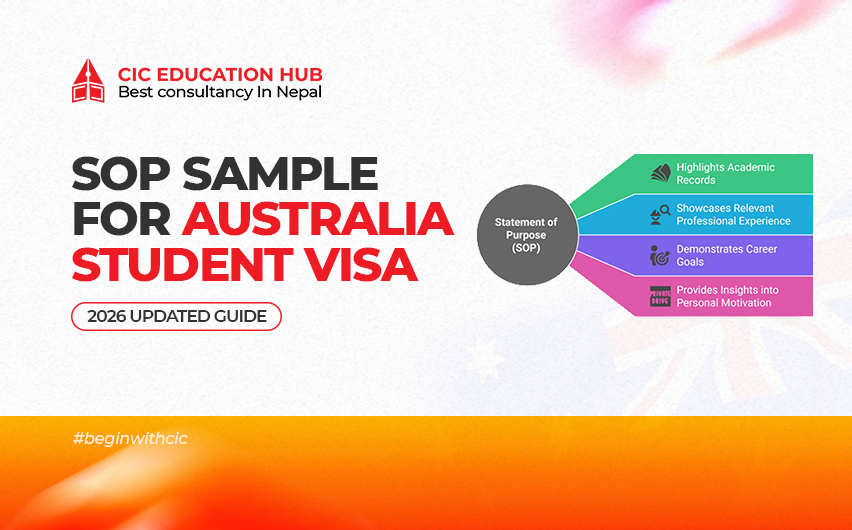
SOP Sample for Australia Student Visa (2026 Updated Guide)

SOP Sample for Australia Student Visa (2026 Updated Guide)

An Australian student visa application can be confusing initially. But one document can make a big impact on your application.That document is the SOP(Statement of Purpose). If you are searching for the best sop sample for australia visa application , this guide will help you understand everything in very simple words.

You will learn:

  • What an SOP is
  • Why Australia asks for it
  • SOP format and structure
  • Common mistakes to avoid
  • A complete SOP sample
  • SOP for dependent visa examples
  •  2026 applicants FAQ

So,this article thoroughly to maximise your chances of a successful visa application.

What is the SOP for Australia Visa Application for students?

SOP means Statement of Purpose.  It is a letter where you explain:

  • Who you are
  • Why you chose Australia
  • Why you selected your course
  • Your future career plans
  • Why you will return to your home country after study

In simple words, the SOP tells the visa officer your real study plan.

Therefore, your SOP should be honest, clear, and easy to understand.

Why is SOP Important for Australia Student Visa Application ?

Australia checks whether a student is a genuine learner or not. Because of this, the SOP becomes very important.

A strong SOP can:

  • Improve visa approval chances
  • Show your career goals
  • Explain study gaps
  • Prove financial and academic plans
  • Build trust with the visa officer

On the other hand, a copied SOP can lead to rejection.

Latest Australia SOP Updates for 2026

In 2026, Australia is focusing more on genuine students. Therefore:

  • Strong career plans are important
  • Financial proof must be clear
  • Course relevance matters more
  • Genuine Student (GS) documents

As a result, students should prepare personalized SOPs instead of copied templates.

Best SOP for Australia Student Visa – What Should It Include?

The best SOP is simple, personal, and well-organized.

Here are the important parts you must include:

Section What to Write
Introduction Your background and study goals
Academic History Previous education details
Work Experience Job or internship details
Why Australia Reason for choosing Australia
Why This Course Benefits of the selected course
Why This College Why you selected the institution
Financial Details How you will pay expenses
Future Plans Career goals after study
Conclusion Final genuine statement

Simple SOP Format for Australia Student Visa

1. Introduction

Start with your name, education, and purpose.

Example:

I am Ramesh Sharma from Nepal. I completed my higher secondary in 2024. I wish to get a Diploma in Information Technology in Australia to upgrade my abilities and develop a great career in the IT area. 

2. Academic Background

Talk about your education honestly.

Mention:

  • School or college name
  • Grades
  • Subjects
  • Achievements

3. Work Experience (If Any)

If you worked before, explain:

  • Company name
  • Position
  • Skills learned

Even part-time jobs or internships can help.

4. Why Australia?

This section is very important.

You can mention:

  • High-quality education
  • International degree recognition
  • Practical learning system
  • Safe and multicultural environment

Example:

I selected Australia because its education system focuses on practical learning and real-world skills. Moreover, Australian qualifications are recognized worldwide.

5. Why This Course?

Explain how the course matches your career goals.

For example:

I selected a Bachelor of Business because I want to improve my management and communication skills. This course will help me build a career in the business sector in Nepal.

6. Why This College?

Mention:

However, avoid copying content from the college website.

7. Financial Support

Clearly explain who will pay your fees and living costs.

You may include:

  • Parents’ income
  • Bank savings
  • Sponsorship
  • Education loan

8. Future Career Plans

This part shows your genuine intention.

9. Conclusion

End politely and confidently.

How Long Should an SOP be Written?

Usually:

  • 800 to 1500 words is enough
  • Keep it clear and organized
  • Avoid unnecessary details

Documents Needed Along With SOP

Here are some common documents:

  • Academic certificates
  • Passport
  • IELTS/PTE result
  • Offer letter
  • Financial documents
  • Work experience letters
  • Gs documents

SOP Sample for Australia Student Visa Application

Disclaimer

Note: This SOP is simply an example. A student’s SOP needs to be tailored for his or her background and study and professional goals. No copy and paste of the same content.

My name is Sita Thapa and I am from Kathmandu, Nepal. Completed +2 with good scores in management studies in 2024. Since school I was interested in business skills and communication abilities and studied in the business field.

I chose Australia because of the quality of the education system, the pragmatic way of learning and because it is a country with internationally accepted qualifications. Australia is a multicultural country and international students can feel comfortable and welcome. I think it will be useful for my knowledge, my talent and future professional chances to study there.

I choose XYZ college for my BBA as the course material of Management, Marketing and Leadership corresponds with my career objective. I can also have hands-on learning experiences at college that will help me progress in my professional sector.

My parents will support me in education and living expenses in Australia. I have enough money to handle all of the expenditures of studying while I am here.

“When I complete my studies, I want to come back to Nepal and work for a reputed business body. I hope to be my own employer and contribute to the development of my country’s economy.

I am a real student with specific educational goals and want you to kindly examine my visa application positively for the same.

Thanks.

Student Visa SOP for Australia – Important Tips

  • Keep Your SOP Simple

Use short sentences and easy words.

  • Write in Your Own Style

Do not copy from websites or friends.

  • Be Honest

Always provide real information.

  • Explain Study Gaps Clearly

If you have a gap year, explain it properly.

  • Focus on Career Goals

Show how the course will help your future.

Common SOP Mistakes Students Should Avoid

  • Copy-Paste Content

Many visa applications get rejected because of copied SOPs.

  • Too Much Personal Story

Keep the focus on education and career goals.

  • Weak Future Plans

You must clearly explain your plans after studying.

  • Grammar Mistakes

Simple English is fine, but avoid major errors.

  • Fake Information

Never provide false details.

SOP for Australia Student Visa Sample for Students With Gap

If you have a study gap, do not panic. Instead, explain the reason clearly.

Example:

After completing higher secondary education, I took a gap year to study for English language examinations and to support my family company. In this time I developed my communication and practical skills. 

Conclusion

Writing a powerful sop sample for australia visa application is easy with three words: Honest, clear and simple. Your SOP should adequately describe your study intentions, professional ambitions and financial assistance. If you are hoping to study in Australia in 2026, make sure you prepare your SOP carefully and avoid copied content. 

You can choose CIC Education Hub for professional help and hassle free Australian visa processing to support your study abroad trip. 

Frequently Asked Questions

1.Can I use SOP samples from the internet?

No, chances of visa refusal are high if you copy SOPs. Always write with your own words.

2.Is SOP compulsory for Australian student visas?

Yes.  SOP is one of the most significant documents in an Australian student visa application.

3.How to Explain the Study Gap in SOP?

Please tell us truthfully what you were doing throughout the gap period e.g. work, training, family duties.

4.What is the worst error that students make while writing SOP?

The largest mistake is duplicate or fraudulent content.

5.Does simple English work in SOP? 

Yeah. In reality plain and clear English is better than complicated terms. 

What is the Process to Apply in Canada from Nepal?

What is the Process to Apply in Canada from Nepal?

You are not the only one in case you are planning to apply in Canada out of Nepal. IRCC has granted study permits to over 27,000 Nepalese nationals between January 2023 and March 2025 and thousands more are applying annually to get work permits and permanent residency.

It is a guide that contains all the routes that will be followed in Canada as a Nepali citizen. You will learn exactly the documents, costs, and procedures needed to go ahead with the required study permits and work permits, to visit visas and PR, etc.

Overview: Ways to Apply in Canada from Nepal

In querying how to apply in Canada as a Nepalese citizen, four major types of visas can be applied in Canada by the citizens of Nepal. Both have different purposes and have their own requirements. Take your goals, qualifications, and the time you will be attaining it and then select a route.

If studying is your goal, start with our full Study in Canada from Nepal guide.

Pathway Purpose Key Document
Study Permit Study at a Canadian institution Letter of Acceptance (LOA)
Work Permit Work for a Canadian employer Job offer or Labour Market Impact Assessment (LMIA)
Visitor Visa Short-term tourism or family visit Proof of ties to Nepal
Permanent Residency (PR) Live and work permanently Express Entry profile or PNP nomination

How to Apply Canada student visa from Nepal

The most common application of the same by the Nepali students is the Nepali student visa to Canada (study permit).  Nepali students who want to apply in Canada for a study permit must follow these steps.

  • Choose an Intake and Institute

Find a Canadian Designated Learning Institution (DLI) that meets your academic objectives and financial means. Compare programs and tuition by researching on our lists of the best colleges and best universities in Canada.

In Canada, there are three seasons of intake, Fall (September), Winter (January), and Spring (May). Fall intake boasts the most program choices, thus check intakes in Canada and file a long time before your favourite deadline.

  • Get Your LOA, PAL and Language Score.

You have just sent your application to your institution, you are now provided with a Letter of Acceptance (LOA). Beginning January 2024 you will also be required to have a Provincial Attestation Letter (PAL) in the province you will be studying. 

Besides, in most of the institutions, you must have IELTS of 6.0 or other PTE to be granted the LOA. 

In order to achieve your target band in a cost effective preparation, our IELTS preparation guide and PTE preparation course will offer you well-organised coaching in case you are still in the preparation phase.

  • Gather Study Permit Documents

When you apply in Canada for a study permit, the IRCC requires:

  • Valid MRP passport (at least 6 months validity beyond your intended stay)
  • Letter of Acceptance from your DLI
  • Provincial Attestation Letter (PAL)
  • Proof of funds: minimum CAD 20,635 per year, plus tuition and travel costs
  • IELTS, PTE, or TOEFL results
  • Statement of Purpose (SOP)
  • Medical examination certificate
  • Police clearance certificate from Nepal
  • Non-English documents must include a certified translation with the translator’s full name, date, and signature.
  • Submit Online and Enroll Biometrics

Make an online application using your IRCC secure account at ircc.canada.ca. Fill out the IMM 5257 form, submit your documents and pay a study permit fee of CAD 150. 

Once the application has been submitted, make a biometrics appointment (CAD 85) at the VFS Global Canada Visa Application Centre in Kathmandu. The average processing time is 4 – 12 weeks, so make sure to process it way before your intake date.

How to apply for work permit in Canada form Nepal

Nepali nationals have the opportunity to apply to Canada either temporary or open work permit according to their case.

Temporary Work Permit (Closed Work Permit)

A closed work permit binds you to one employer. To ensure that there are no Canadian nationals or permanent immigrants who can be hired to work at the post, your employer in Canada has to apply to the positive Labour Market Impact Assessment (LMIA).

The LMIA is then approved after which you use it in Canada to a closed work permit portal at the IRCC. Your passport, job offer letter, positive LMIA, evidence of qualification and biometrics enrolment are important documents.

Post-Graduation Work Permit (PGWP)

Canada The Nepali students have the option of applying to the PGWP, and may work in any employer, on the condition that they graduate in a qualified Canadian institution, which is a public institution. Remarkably, the field of PGWP directly counts the work experience to Express Entry and PR. 

However, new limitations on the usage of the private college graduates on the PGWP will take place starting September 2025. So, the selection of a university is important. Identify the friendliest Universities of Canada to international students.

How to Apply in Canada for Permanent Residency from Nepal

The long-term aspiration of many Nepali applicants is PR. The best known is Express Entry that has three programs, Federal Skilled Worker Program (FSWP), Federal Skilled Trades Program (FSTP), and the Canadian Experience Class (CEC).

In order to be applicable in Canada via Express Entry:

  1. Verify the eligibility using the IRCC Come to Canada tool.
  2. Have an Educational Credential Assessment (ECA) done by WES in case you have not studied in Canada.
  3. Achieve a CLB approved language test score of 7 or higher. IELTS preparation guide will assist you to achieve that standard in less time.
  4. Create your Express Entry profile and get a Comprehensive Ranking System score (CRS).
  5. After a draw you wait to receive an Invitation to Apply (ITA) and within 60 days, submit your complete PR application.

In January 2023 to March 2025, 4,335 Nepalese nationals were accorded a permanent residency in Canada under the economic pathways. The Provincial Nominee Program (PNP) was the most approved with 1,620. Provincial nomination is an addition of 600 CRS points that is virtually a sure ITA.

How to Apply in Canada for a Visitor Visa from Nepal

Canada immigration process between Nepal and Nepal citizens is known as a temporary Resident Visa (TRV) which permits Nepal citizens to visit Canada , do business a bit or visit their family. To apply for a visitor visa in Canada, you can either apply in the IRCC portal or Visa Application Centre (VFS Global Canada Visa Application Centre) in Kathmandu.

The necessary documents are a duly filled IMM 5257 form, valid MRP passport, 6 months bank statement, evidence of property or assets (Lalpurja), a letter of invitation by your host in Canada and clear evidence of close connection with Nepal like employment or owning property.

IRCC needs to be convinced that you have good financial and family ties, to be able to get a visitor visa.

Canada Visa Fees and Processing Times

Visa Type Application Fee Biometrics Fee Processing Time
Study Permit CAD 150 CAD 85 4 – 12 weeks
Work Permit (LMIA-based) CAD 155 CAD 85 5 – 27 weeks
Visitor Visa CAD 100 CAD 85 2 – 5 weeks
PR via Express Entry CAD 1,365 CAD 85 ~6 months

Make payments online via IRCC. When you submit your application to VFS Global Canada Visa Application Centre, Kathmandu, there will be an extra service fee, which must be paid by Manager Cheque.

Frequently Asked Questions

1. Would I be allowed to apply to PR in Canada without employment opportunities? 

Yes. The Federal Skilled Worker Program of Express Entry does not require a work offer. Nevertheless, a good job offer will earn you a lot of CRS points and enhance your opportunities.

2. What IELTS score is needed to apply in Canada?

Most programs require a minimum CLB 7 especially when applying under Canada student visa program and PR programs.

3. Will I be able to work in Canada as a student?

Yes. DLI permit holders of full-time study permit may work a maximum of 24 hours/week off-campus during the academic session without an extra work permit.

4. What are the most suitable courses to Nepali students in Canada? 

Some of the most sought after ones include Data Science, Business Administration, Nursing, Engineering, and IT. Explore the entire list of courses in Canada and identify those which fit your objectives.

5. Do I need IELTS to apply for a Canadian work permit?

Canada has no need for those who are applying to be granted a work permit to write the IELTS or any other English or French language exam.

6. How long does it take to apply in Canada from Nepal?

The time it takes to apply in Canada from Nepal depends on the visa type you are applying for. Typically from 4 weeks to up to 6 months.

Best Courses to Study in UK for Nepali Students (2026 Guide)

Best Courses to Study in UK for Nepali Students (2026 Guide)

Planning to study in UK from Nepal in 2026? You’re making a smart choice. The UK is one of the world’s leading education destinations, attracting over 600,000 international students every year.

However, many Nepali students face one big question: which course is best for a successful career?

In this complete guide, you’ll discover the best courses to study in UK for Nepali students, along with scholarships, career opportunities, and expert tips to help you choose the right path.

Why Study in UK for Nepali Students?

The UK offers globally recognized degrees, shorter course durations, and strong job opportunities after graduation. Additionally, the UK education system focuses on practical learning, which helps students gain real-world skills.

Top Benefits of Studying in the UK

  • Globally recognized degrees
  • Shorter course duration (3 years for Bachelor’s, 1 year for Master’s)
  • Post-study work visa (2-3 years)
  • Access to top universities
  • Scholarships for international students
  • Safe and multicultural environment

As a result, many students from Nepal prefer to study in UK to build a global career.

Overview of Studying in the UK

The UK offers flexible study options, including: fees and courses. Here is the  table overview:

Program Type   Annual Tuition Fee Popular Courses
Undergraduate (Bachelor’s Degree)  £10,000 – £38,000 per year Business, Computer Science, Engineering, Law, Medicine, Social Sciences
Postgraduate (Master’s Degree) £12,000 – £30,000 per year (most are 1-year programs) MBA, Data Science, Finance, Marketing, Artificial Intelligence
Foundation / Pathway Programs £8,500 – £18,000 per year Business Foundation, Computing, Engineering Prep, Arts & Design

Moreover, students gain both theoretical knowledge and practical experience, which increases employability worldwide.

Best Courses to Study in UK for Nepali Students

Choosing the right course is crucial because it directly affects your career opportunities. The following are the top courses to study in UK with strong future prospects.

1. Business Management

Business Management is one of the most popular courses among Nepali students.

Why choose this course?

  • Develop leadership and decision-making skills
  • High global demand
  • Career options in marketing, HR, and entrepreneurship

Many Nepali graduates work in multinational companies after completing this course.

2. Engineering & Technology

Engineering remains a top choice due to strong career prospects.

Key benefits:

  • High-paying jobs
  • Advanced technical skills
  • Specializations such as:
    • Civil Engineering
    • Mechanical Engineering
    • IT & Software Engineering

Furthermore, the UK tech industry is growing rapidly, creating more job opportunities.

3. Medicine and Healthcare

The UK is known for its world-class healthcare education system.

What you gain:

  • Practical hospital training
  • Globally recognized degrees
  • High demand in the healthcare sector

4. Law

Studying law in the UK provides international exposure and a strong academic foundation.

Career opportunities:

  • Lawyer or solicitor
  • Legal advisor
  • Corporate law specialist

In addition, UK law degrees are respected worldwide.

5. Media & Communication

This field is growing rapidly due to digital transformation.

Skills you learn:

  • Journalism and content creation
  • Digital marketing
  • Public relations

As a result, graduates can work in global media industries.

6. Accounting & Finance

This is a highly practical and career-focused field.

Advantages:

  • Pathways to ACCA and CPA
  • Strong global demand
  • Career options in:
    • Banking
    • Auditing
    • Investment firms

7. Social Sciences

This course focuses on understanding society and human behavior.

Career paths:

  • Research and policy-making
  • NGOs and international organizations
  • Social development sectors

Top UK Universities Popular Among Nepali Students

Some universities are especially popular among international students due to affordability and quality education.

  • Coventry University
  • University of Sunderland
  • University of East London
  • University of West London
  • London Metropolitan University
  • University of Roehampton
  • Ravensbourne University London
  • University of Birmingham
  • Birmingham City University
  • University of the West of Scotland (UWS)

These universities offer career-focused programs and strong student support services.

Scholarships in the UK for Nepali Students

Studying in the UK can be expensive. However, scholarships can help reduce financial stress.

Popular Scholarships

Chevening Scholarships: 

  • Chevening Scholarship is funded by the UK Foreign, Commonwealth & Development Office and supports international students for postgraduate study.
  • It is a fully funded scholarship covering tuition, living costs, travel, and more.

GREAT Scholarships: 

  • GREAT Scholarships are funded by the UK government and universities, offering £10,000 towards tuition fees for postgraduate students.

University-specific scholarships:

  • Many UK universities provide merit-based scholarships ranging from £2,000 to £8,000+ per year for international students.
  • These scholarships are often automatically awarded or require a separate application depending on the university.

What They Cover

  • Tuition fees
  • Living expenses
  • Travel costs (in some cases)

Applying early and preparing strong documents can improve your chances of success.

Post Study Work Opportunities in the UK

After completing your studies, you can stay and work in the UK through the Graduate Route Visa.

Key Highlights

Stay Duration:

  • You can stay in the UK for 2 years after completing a Bachelor’s or Master’s degree, and 3 years after a PhD.

Work Flexibility:

  • You are allowed to work in any job or sector, including full-time, part-time, freelance, or self-employment.

No Sponsorship Required:

  • You do not need a job offer or employer sponsorship to apply for this visa.

International Experience:

  • Gain global work exposure, improve your skills, and build an international career profile.

This opportunity helps improve long-term career prospects.

Career Opportunities After Studying in the UK

Graduates can explore opportunities in various fields, including:

  • Business and management
  • Engineering and IT
  • Healthcare
  • Finance and accounting
  • Media and communication

Moreover, international exposure and networking significantly boost employability.

How CIC Education Hub Helps You Study in UK

Choosing the right course and university can be challenging. Therefore, expert guidance is essential.

Services Provided

  • Course and university selection
  • Admission application support
  • Visa processing assistance
  • Scholarship guidance
  • Career counseling

With proper support, your journey to study in the UK becomes easier and more successful.

Conclusion

Choosing the best courses to study in the UK for Nepali students is the first step toward building a successful future.

Courses such as business, engineering, healthcare, and finance offer strong career opportunities. Additionally, the UK provides scholarships, post-study work visas, and global exposure.

If you are planning to study in the UK, start early, choose the right course, and seek expert guidance to achieve your goals.

Ready to begin? Contact the trusted education consultancy CIC Education Hub and take your first step toward studying in the UK.

Frequently Asked Questions (FAQs)

1. Which course is most in demand in the UK?

Courses in business, engineering, IT, medicine, law, and media are highly in demand. These fields offer strong career opportunities and post-study work options.

2. Is the UK good for Nepali students?

Yes! The UK provides high-quality education, globally recognized degrees, a safe multicultural environment, and excellent career prospects, making it ideal for Nepali students.

3. Which course is best to study in the UK?

The best course depends on your career goals, but business, engineering, medicine, IT, law, and media studies are popular among Nepali students for both education quality and job opportunities.

4. How to get a 100% scholarship?

Focus on merit-based scholarships like Chevening, GREAT Scholarships, or university-specific awards. Prepare a strong academic record, personal statement, and recommendation letters, and apply early.

5. Total cost to study in the UK from Nepal?

The cost ranges from £12,000 – £25,000 per year, including tuition, accommodation, and living expenses. Scholarships can help reduce these costs significantly.

6. Requirements to study in the UK from Nepal?

  • Valid passport
  • University admission letter
  • Proof of funds
  • English language test (IELTS, PTE, or TOEFL)
  • UK Student Visa

Study in Canada From Nepal: Best Guide for 2026

Study in Canada From Nepal: Best Guide for 2026

Is Canada good for Nepali students? The answer is a resounding yes. Canada remains a top-tier destination for Nepali students seeking globally recognized degrees, affordable tuition, and clear pathways to long-term career success. Compared to the USA, UK, or Australia, Canada offers highly practical education with paid co-op internships built into many degrees and robust post-graduation work opportunities.

If you are planning to study in Canada from Nepal, navigating the shifting immigration landscape is critical. From calculating the total cost to study in Canada from Nepal to understanding the latest requirements to study in Canada from Nepal, this comprehensive 2026 guide covers everything. We will break down the post-SDS visa process, the new Provincial Attestation Letter (PAL) rules, and exactly what the Canada student visa success rate from Nepal 2026 looks like for incoming students.

Quick Facts: Studying in Canada (2026 Updates)

To give you an immediate overview of the study in Canada from Nepal requirements, here are the critical facts and IRCC policy updates for the 2026 academic year:

  • Average Tuition: CAD 12,000 – CAD 35,000 per year (approx. NPR 11.5 Lakhs – 33.5 Lakhs).
  • Mandatory Living Funds (GIC): CAD $22,895 minimum (Updated 2026 requirement).
  • Off-Campus Work Limits: 24 hours per week during academic sessions.
  • Major Intakes: Fall (September), Winter (January), Summer (May).
  • Minimum IELTS: 6.0 Overall (Diplomas/UG) | 6.5 Overall (Master’s/PG).
  • Visa Processing Stream: Standard Application Stream (the Student Direct Stream / SDS is officially closed).
  • Post-Graduation Work Permit (PGWP): Up to 3 years. (Master’s graduates now automatically qualify for 3 years, regardless of program length).

Visa Success Rate for Canada From Nepal 2026

One of the most frequently asked questions from parents and applicants is regarding the student visa success rate for Canada from Nepal.

Following a period of sweeping policy changes by the IRCC (Immigration, Refugees and Citizenship Canada), the landscape has stabilized. The Canada visa success rate in Nepal 2026 is looking highly positive for well-prepared applicants. As of late 2025 and moving into 2026, the visa success rate of Canada from Nepal sits securely between 57% and 65% for complete, genuine applications.

Why is the Canada visa rate from Nepal 2026 improving?

  1. Clearer Guidelines: The introduction of the study permit cap (~155,000 for 2026) and the PAL system means that if you secure your documents, your seat is virtually guaranteed.
  2. Higher Quality Applications: Students are submitting stronger Statements of Purpose (SOP) and genuine financial documents, which directly boosts the Canada student visa success rate from Nepal.
  3. Graduate Exemptions: As of January 1, 2026, Master’s and PhD students applying to public universities are completely exempt from the study permit cap and the PAL requirement, drastically streamlining their approval process.

If you submit a flawless application, clearly prove your financial capacity, and choose a course relevant to your previous studies, your visa rate to Canada from Nepal 2026 is exceptionally high.

Total Cost to Study in Canada From Nepal

When planning an abroad study in Canada from Nepal, budgeting correctly is the most crucial step. While it is generally more affordable than higher education in the US or Australia, you must prepare for both tuition and mandatory living expenses to meet the strict Canada student visa requirements from Nepal.

1. Estimated Annual Tuition Fees

Program Level

Average Fees (CAD)

Approximate Fees (NPR)

Diploma & Advanced Diploma

$13,000 – $19,000

12.5 Lakhs – 18 Lakhs

Bachelor’s Degree

$18,000 – $28,000

17 Lakhs – 27 Lakhs

Master’s Degree / PG Diploma

$20,000 – $35,000

19 Lakhs – 33.5 Lakhs

2. Living Expenses & The GIC Requirement (Critical 2026 Update)

To secure a student visa for Canada from Nepal, you must prove you can support yourself without relying on part-time work. You are required to show liquid funds, most commonly through a Guaranteed Investment Certificate (GIC) from a participating Canadian bank.

  • The new minimum living expense requirement is CAD $22,895 (approximately NPR 22 Lakhs). This money is locked in a Canadian account and disbursed back to you in monthly installments over your first year to cover rent, food, and transport.
  • Total Funds Needed: For your visa application, you must show the CAD $22,895 plus the receipt proving you have paid your first year of tuition.

Academic & Language Requirements by Program

Canadian institutions maintain high academic standards. Before applying, you must understand exactly how much GPA is required to study in Canada from Nepal.

Study in Canada After 12th for Nepalese Students (Undergraduate)

If you want to pursue a diploma or Bachelor’s degree straight out of high school, here is what you need:

  • Minimum GPA Required for Canada from Nepal: You need a minimum GPA of 2.8 (or 60%) in your +2 (NEB) or A-Levels. Highly competitive universities may require a 3.0 or higher.
  • Language: An IELTS score of 6.0 overall (with no band less than 5.5 or 6.0 depending on the specific college). PTE (usually 58-60) and TOEFL are also widely accepted.
  • Documentation: A Provincial Attestation Letter (PAL) is mandatory for undergraduate visa filing.

Master’s & PG Diploma Programs (Graduate)

  • Minimum GPA: A recognized 3 or 4-year Bachelor’s degree with a minimum CGPA of 2.8 to 3.0. Highly competitive programs (like Data Science, Engineering, or an MBA) prefer a 3.0+.
  • Language: An IELTS score of 6.5 overall (no band less than 6.0).
  • Documentation: A comprehensive Statement of Purpose (SOP), 2-3 Letters of Recommendation (LORs), and an updated CV.

Need Help Preparing for Your Language Test?

Securing a high IELTS or PTE score is the most critical step for your Canadian university admission and visa approval. At CIC Education Hub, we provide expert-led, intensive test preparation tailored to your current English proficiency.

Whether you prefer morning, day, or evening shifts, you can join our highly rated preparation classes at a branch nearest to you:

Our certified trainers provide realistic mock tests, personalized feedback, and the latest study materials to ensure you hit that 6.5+ band requirement on your first attempt.

Intakes and Application Deadlines for 2026

Timing is everything when you decide to study Canada from Nepal. Canada offers three major intakes, allowing flexibility depending on when you complete your academic prerequisites.

1. Fall Intake (September)

  • The Best Option: This is the primary intake for all Canadian universities. It offers the largest selection of courses, the most robust funding options, and ideal weather for new arrivals.
  • Deadline: Apply between November 2025 and March 2026.

2. Winter Intake (January)

  • The Secondary Option: A great alternative if you missed the Fall deadline. Many business, IT, and diploma programs are available.
  • Deadline: Apply between July and September of the previous year.

3. Summer Intake (May)

  • The Limited Option: Only a select few colleges offer a May intake, usually reserved for short-term diplomas or fast-tracked tech and business courses.
  • Deadline: Apply between October and January.

Expert Tip: To maximize your Canada student visa success rate from Nepal 2026, start your IELTS and documentation preparation at least 8 to 10 months before your desired intake.

Scholarship for Nepalese Students in Canada

While Canada does not offer fully tuition-free universities for international students, finding a scholarship for Nepalese students in Canada is entirely possible and can drastically reduce your financial burden.

  • Canada Graduate Scholarships-Master’s Program (CGSM): Awards up to CAD $17,000 for international students engaged in high-level research.
  • Vanier Canada Graduate Scholarship: One of the most prestigious awards, offering up to CAD $50,000 per year for doctoral students.
  • University-Specific Entrance Awards: Many universities automatically assess incoming Nepali students in Canada for entrance scholarships. Depending on your high school or Bachelor’s grades, these can range from CAD $1,000 to $5,000 applied directly to your first-year tuition.

Step-by-Step Canada Student Visa Process From Nepal

Because the IRCC closed the Student Direct Stream (SDS) program, the Canada student visa process from Nepal now requires all students to apply through the standard stream. The digital application process is efficient but requires strict attention to detail.

  1. Secure an Offer Letter: Apply to a Designated Learning Institution (DLI) and receive your Letter of Acceptance (LOA).
  2. Obtain your PAL (If Applicable): Your university will apply to the province on your behalf to secure your Provincial Attestation Letter. (Master’s and PhD students bypass this step).
  3. Pay Tuition & Open a GIC: Transfer your first year’s tuition to the institution, and wire CAD $22,895 to a Canadian bank to secure your GIC certificate.
  4. Prepare Medicals & Police Clearance: Undergo an upfront medical exam (IME) at an IRCC-approved clinic in Nepal (e.g., IOM in Baluwatar) and obtain a police clearance certificate.
  5. Lodge Visa Application: Submit your documents online via the IRCC portal. Include a personalized SOP explaining your study intent and ties to Nepal. Pay the visa fee (CAD $150) and biometrics fee (CAD $85).
  6. Biometrics Appointment: Visit the VFS Global center in Kathmandu to submit your fingerprints and photograph.

Spouse and Dependent Visas (2026 Rules)

For married applicants, the ability to bring a family is a major reason why Canada for Nepali students is so appealing. However, the IRCC has recently tightened the rules regarding the Spousal Open Work Permit (SOWP).

Who can bring their spouse to Canada in 2026?

  • Master’s and PhD Students: If you are enrolled in a Master’s or Doctoral degree program at a university, your spouse is fully eligible to apply for an Open Work Permit.
  • Professional Degrees: Students enrolled in specific high-demand professional degree programs (like Medicine, Dentistry, or Law) can also sponsor their spouses.
  • Undergraduate/Diploma Students: Spouses of students in undergraduate or college diploma programs are no longer eligible for an open work permit, unless they apply for a separate visa (like a visitor visa or their own independent study permit).

Best Cities in Canada for Nepali Students

Where do Nepali students Canada thrive the most? Choosing the right province impacts your cost of living, part-time job opportunities, and future PR prospects.

1. Ontario (Toronto, Ottawa, Kitchener)

  • The Vibe: The economic powerhouse of Canada with massive tech, finance, and healthcare sectors. It boasts the largest Nepali diaspora, meaning easy access to familiar food and community.
  • The Catch: It has the highest cost of living and most competitive housing market in the country.

2. Alberta (Calgary, Edmonton)

  • The Vibe: Rapidly becoming the favorite destination for Nepali students in Canada. Alberta offers lower taxes, highly affordable housing, and booming engineering, trades, and IT sectors.

3. British Columbia (Vancouver, Victoria)

  • The Vibe: Known for its stunning landscapes, mild weather (it rarely snows in Vancouver), and a strong tech industry.
  • The Catch: Similar to Toronto, rent and living expenses are exceptionally high.

4. Atlantic Provinces (Nova Scotia, New Brunswick)

  • The Vibe: The best option for students strictly focused on PR. These provinces feature the Atlantic Immigration Program (AIP), offering streamlined PR pathways combined with the lowest tuition and living costs in Canada.

Frequently Asked Questions (FAQs)

How much gap is accepted to study in Canada?

Canadian institutions generally accept a study gap of up to 2 years for undergraduate programs and up to 5 years for postgraduate programs. However, you must thoroughly justify the gap with valid proof of work experience, internships, or language preparation in your SOP.

What is the minimum IELTS score for Canada from Nepal?

The absolute minimum is an IELTS overall score of 6.0 for diploma and undergraduate programs. For Master’s and Postgraduate diplomas, the minimum is 6.5 overall.

Can I study in Canada from Nepal without IELTS?

While IELTS is the most recognized, you can study in Canada without it if you take an accepted alternative like the PTE Academic (typically 58-60+), TOEFL iBT, or the Duolingo English Test (depending on the specific university’s requirements).

What is the post-graduation work permit (PGWP) duration?

If your program is 2 years or longer, you may be eligible for a PGWP valid for up to 3 years. Note the new 2026 rule: Graduates of Master’s degree programs are now eligible for a full 3-year work permit, even if their program of study was shorter than two years. For college diploma graduates, your field of study must align with IRCC’s eligible occupations list to qualify for the PGWP.

How many hours can an international student work in Canada?

Under the latest 2026 regulations, international students in Canada can legally work up to 24 hours per week off-campus during regular academic sessions. During scheduled academic breaks, such as the summer holidays, students are permitted to work full-time (up to 40 hours per week).

Talk with expert

Index